Avatar

Life is what happens to you while you’re busy making other plans. – John Lennon

Giving back to the community is an important part of Cisco culture, and Cisco encourages volunteerism. They make it pretty easy, too, by planning volunteer opportunities–such as the company-wide event, Day2Give–and allotting us a certain number of days off to work with local charities. Participating in big, company-sponsored activities isn’t the only way to get involved, though, we’re free to choose our own path. The spirit of giving is simply to help make things better than we found them.

So, on May 11, Cisco’s Day2Give, I picked up my friend and fellow technical writer, Anne Robotti, and off we went to the Food Bank of Central & Eastern North Carolina. (As technical writers working with the XS Experience team, we write excellent, customer-facing technical documentation to support the amazing demonstrations hosted on Cisco dCloud.)

A few blocks from the Food Bank, we saw a hungry puppy in the middle of the road.

When you say to your traveling companion, “We’re stopping for this puppy, right?” and the answer is, “Hell yes, we are!” you know you’re in good company. I pulled over and we got out of the car.

Gracie before
Gracie the puppy when we found her and took her to the vet.

Imagine this puppy: A starving, mangy creature too afraid to let us approach, but too weak to do a very good job escaping. This was not the first time I’ve found an abandoned dog on the side of the road, so I keep a leash and other useful dog-rescue items in my car. Anne and I caught the dog and got our first good look at her–which wasn’t good.

Covered in cuts, gouges, scabs, and blood, her skin told the story of weeks of neglect. Head-to-tail mange had left her almost completely bald. She was so malnourished, we could count every bone in her poor body. And yet, all it took was a little food and some soothing attention, and in moments we had a new best friend. Anne picked her up in a blanket and (SPOILER ALERT) fell immediately and hopelessly in love.

With an exhausted, stinky puppy in the back seat, we went to Grace Park Animal Hospital for help. Dr. Traficanti examined the puppy and said that this dog was in the worst shape of any dog she’d ever seen. The staff treated her immediately, pulling thorns out from between her toes, giving her food, medicine, and a much needed bath.

Gracie After
Gracie is all better now, and has a home with Anne.

We named our foundling Gracie to honor the compassion and generosity of the Grace Park staff and shared the story of her rescue and on-going recovery on social media using the hashtag #SaveGracie.

The feedback we’ve received has been heartwarming with everyone from our XS Engineering Director, Jason Angelus, asking “Can I bring her home to Zurich??” to complete strangers thanking us for saving this dog and asking how they can help. If you want to help, please spay and neuter your pets. For every puppy that finds a home, there are nine more that don’t. Gracie is one of the lucky ones.

Gracie now
The two of us with Gracie now!

More than a month has passed since Anne and I found Gracie. Her skin healed, her fur grew back. She looks nothing like her former self. She looks healthy. With excellent medical care, proper nutrition, and lots of love, Gracie got a second chance. She also got a new home at Anne’s house!

So Cisco’s Day2Give didn’t turn out quite the way we thought it would, but that’s OK. Life is what happens to you while you’re busy making other plans.


Do your future plans include working for a company that gives back? See openings at Cisco!

Authors

Laura Marsh

Technical Writer

Cisco dCloud

Avatar

On Friday, billions of people will tune in to watch or listen to the start of the greatest sporting spectacle in the world. As a sports fan, I am excited to see the amazing performances to come, and already prepared with a box of tissues for when I’m brought to tears by the moving stories of the enduring human spirit, courage and acts of patriotism. But as someone who works in technology, and cloud computing specifically, I’m fascinated by what these games represent in terms of the delivery of content. The IT infrastructure required to support the shear volume of content that will be consumed globally and generated by media companies and everyday people – athletes in Rio, fans viewing the games in Brazil and remotely, is overwhelming.

Four years ago, the 2012 games were arguably one of the first of its kind to truly come to life in the era of big data and hyper connectivity. Social media platforms like Twitter, YouTube, Facebook along with streaming content from traditional media outlets dominated. This year user generated live streams will compete and collaborate with traditional media outlets and social platforms.

Mobile will play an even more crucial role in the consumption and delivery of content. According to Cisco’s recent VNI study, mobile video traffic accounted for 55 percent of total mobile data traffic in 2015. I’m sure that the next 23 days will account for a significant chunk of the 2016 traffic. The types of content anticipated from these games will require IT workloads to scale quickly and enable collaboration between geographically dispersed users. This is ideal for a cloud solution. Fast, agile and easily replicable.

There is a strong business case for a hybrid cloud model for these games and future games. But with cloud, there are legitimate concerns about data security and sovereignty. Organizations’ investing in their IT infrastructure at this scale are looking for strong returns on that investment. This is why a cloud strategy that includes a private cloud option makes sound business sense. Private cloud allows organizations to scale workloads in a secure and reliable environment, allowing IT organizations to retain control of company data and technology spending while empowering them to deliver services as quickly and easily as external cloud providers. Cisco Metapod offers the flexibility of public cloud while keeping data and applications on company-controlled infrastructure.

Cloud computing still has the reputation of a disruptor. But according to IDC, only 25% of organizations have implemented a fully optimized cloud strategy. As more companies reach the ideal state of optimization, cloud computing will realize it’s full potential as the IT game changer that it has promised to be.

According to Gartner, by 2020 IT spending on cloud will double to $216 billion. I can only imagine what the connected experiences will be during those games. But one thing I can be certain of is that if cloud optimization is fully achieved by the 2020 games, it will not be described as a disruptor; it will be the status quo.

Until then, for the next 23 days I will be binge viewing, streaming and downloading to my heart’s content. My Twitter and Facebook feeds will likely be inundated with comments about team USA (my adopted country) and team Jamaica (my birth country).

It’s really a good time to be a sports fan but an even better time to be a technologist.

Go Cloud! Go Team!

Authors

Sophia Danvers

Director of Audience Marketing

Cisco Meraki

Avatar

To prevent a security breach and loss of critical business data, security teams must be diligent in defining, identifying, and classifying security gaps in their organization’s network. Many security teams conduct pentesting as a way to assess and mitigate any potential gaps.  As a consulting engineer for Cisco Security Services, I’ve observed a deeper understanding of certain vulnerabilities can lead to improved mitigation techniques.  A good example is Man in The Middle (MiTM) attacks.

MiTM attacks allow attackers to eavesdrop and potentially modify network traffic. Every security expert has heard of these types of attacks and may have even run ARP-spoofing or other kinds of MiTM attack. However, these types of attacks are often not particularly detailed, do not classify attacks well nor do they accurately represent ways an attack could benefit an adversary

Additionally, the kinds of MiTM attacks vary widely, including those against servers, clients, application layer, TCP layer, IP layer, Data Link layer, and physical layer. To provide an effective security solution against MiTM attacks, we must understand how such attacks work.

In my work performing security-testing, I have found that security organizations rarely try to exploit vulnerabilities, resulting only with the conjecture that a MiTM attack is possible without realistic metrics of what a supposed attacker can really do. For example, as a pentester, I have found routers with vulnerable RIP configurations, MPLS networks with iBGP with vulnerable routers and the almost omnipresent issues with internal SSL services

To help bring awareness to this issue, I created a hands-on training course which I will present at the 2016 Black Hat conference. Every student will have the opportunity to practice with techniques that aren’t easily utilized without a dedicated laboratory. The first part of this training is designed to perform a MiTM attack on the following scenarios:

  • TCP/IP and IPv6
  • MiTM with routing protocols
  • Man on the side and 1-way MiTM

Once the pentester has the traffic passing through his/her system, normal security assessments and pentesting activities usually stop here.  However, for advanced services, such as Red Team exercises, the attack simulation goes further than an announced assessment.  Exploitation must pass under the radar of the company’s security team.

The second part of the lab will focus on what can be achieved with a MiTM attack.  This portion includes coverage of approaches I found inside the leaked documents of companies like Hacking Team and Gamma Group, which provide MiTM systems to their clients:

  • Exploiting MiTM
  • Advanced HTTP MiTM
  • Infecting files on-the-fly
  • ‘Rogue’ attacks

In this lab participants will code their own tools to ensure a deep understanding of the attacks. They will also see mitigations that currently exist and their weaknesses.

With this coursework, I hope to educate security teams no only in how to mitigate MiTM attacks, as well as how to improve the overall security of their networks.

The complete syllabus of the training can be found here.  More information on the penetration testing work we do for our client can be found here.

Authors

Leonardo Nve

Senior Penetration Tester

Portcullis, a Part of Cisco Advisory Services

Avatar

We all know that there’s a lot of hype around cloud computing. While many companies won’t move their data to a public cloud anytime soon, the private cloud option is very compelling. IDC estimates that spending on private cloud IT infrastructure will grow by 11.1% year over year to $13.9 billion. Those are pretty impressive numbers. The challenge is to remember that cloud is a technology. It’s a vehicle, a conduit to help you provide value to the business.

The real challenge is determining what should move to the cloud. What benefits provide the best value to the business? Do we move everything? One potential area to look at as a first step is your software development environment. In the past, setting up strong development environments tended to be cost, space, and resource constrained.   social-03

But companies like ING Direct have designed high-performance and highly automated private cloud platforms for their entire operations. Why did ING Direct do this? It’s simple – to dramatically improve software development agility.  This case study outlines how.

ING Direct is a digital-led business that’s challenging the traditional banking model. To remain competitive, the company must bring new services and features to market as quickly as possible. But, provisioning a development and testing environment for a new project used to take four months!  Consequently, the bank was limited by the number of projects it could run concurrently. Moreover, when new products and features were introduced, the bank had to schedule service outages, impacting customers. 

ING Direct launched the Zero Touch project, a private cloud that now hosts the bank’s entire set of applications and systems, alongside a replica testing environment that provides lifecycle management for cloud components and business services. There were immediate and concrete results.   Learn more about the Zero Touch project. 

Cisco helped ING Direct deliver an updated banking platform every week, improve their service standards for customers as well as enable them to innovate with test environments instead of worrying about uptime. Learn more about how Cisco helped ING Direct do that. 


Authors

Lauren Jeter

No Longer with Cisco

Avatar

Intelligence Gathering 101

Traffic analysis is rapidly becoming critical for threat analysis and incident response teams, and a choke point on their capability to be effective. Performing analysis on incoming threats requires security professionals to have monitoring tools that can give them an understanding of the information coming and going into their environment. This understanding needs to consider syntax, grammar and context. For example, to gather intelligence from a phone conversation between an employee and a 3rd party, you need to not only know who they are calling, but also be fluent in the language they are speaking. In technical terms, this means being able to understand the content of traffic at the so-called “application layer.” Without tools that grant security professionals this capability, we have the equivalent of a room full of security personnel trained in speaking Chinese listening to conversations in Arabic.

Unknown Unknowns

To security professionals, popular application layer protocols used by common desktop applications like web browsers are akin to English. HTTP is over twenty years old, and very much a lingua franca for the technologies around us. There is a plethora of devices and utilities (both open and closed source) that provide automated deep introspection into these protocols. They are very well understood and, even when encrypted, their use can be identified on the network. However, there are new protocols in the wild today used by modern web browsers that most security professionals don’t even know exist, and only a few traffic analysis utilities can analyze. Obviously this blind spot is a serious blow to security operation center (SOC) engineers and traffic monitoring technicians. But, what is even more alarming is that some of these protocols are already deployed throughout the latest versions of all popular web browsers. HTTP/2 is supported by more than 70% of all web browsers currently in use and is already bigger than IPv6! [https://w3techs.com/technologies/comparison/ce-http2,ce-ipv6]

QUIC, an Introduction

The Quick UDP Internet Connections protocol (QUIC) [https://www.chromium.org/quic]  was initially implemented by Google in 2012 and was announced as an experimental project in 2013. Although worked on and championed by several other parties, it was included in the release of Chrome 29 on August 20, 2013, and has been supported as a standard communications protocol for certain websites ever since. QUIC is in many ways a natural evolution from prior technologies. It builds upon some of the advancements made by the traditional Transmission Control Protocol (TCP) and Multipath Transmission Control Protocol (MPTCP) standards and is now under discussion at the IETF [https://tools.ietf.org/html/draft-hamilton-early-deployment-quic-00].

Unlike the traditional HTTP over TCP model, the QUIC protocol uses the UDP standard to transmit data without the use of TCP ports, making it much harder for firewalls to block. Additionally, QUIC sessions are stream-based and multiplexed by default, making the task of tracking sessions more complicated for security and monitoring tools by an order of magnitude. Beyond this, the implementation of QUIC published by Google is bonded with HTTP/2. This protocol communicates using frames that are not human readable to transmit HTML and is also capable of multiplexing its sessions.

quic-1

quic-2

QUIC and HTTP/2 don’t open one connection for each request, but multiplex, sharing it between the different requests to a server.

It is already possible to browse google websites on an unmodified chrome browser with TCP disabled! If you thought your transparently redirecting HTTPS proxy was seeing all your web traffic you might be surprised to find it isn’t seeing QUIC traffic at all!

Get the full story

Cisco security consultants Carl Vincent and Kate Pearce will be giving an in-depth presentation detailing the security risks presented by the lack of support within network analysis utilities for these protocols at Black Hat 2016 entitled: HTTP/2 & QUIC – TEACHING GOOD PROTOCOLS TO DO BAD THINGS. Attendees will learn the details of how these new systems are implemented, as well as obtain prototype applications that can help network defenders study the protocols in question so they can begin building detection and protection strategies into their products and network defense strategies. If avoiding blind spots in your security monitoring solutions is your professional responsibility, it’s a presentation you can’t afford to miss.

Learn more about Cisco’s Security Services portfolio here.


Authors

Carl Vincent

Senior Security Consultant

Security Business Group

Avatar

I was recently asked how utilities are being disrupted by Digitization, distributed energy resources, and technologies such as the Tesla power wall, the Nest thermostat, etc.

First is digitization, which is a broad term referring to the growing ability to have processes, devices, and systems implemented as flexible virtualized systems rather than tightly coupled hardware/firmware/software. In and of itself this isn’t necessarily disruptive to utilities because utility operating companies are regulated monopolies.

Distributed Energy Resources (DER) include a variety of technologies inclusive of electric vehicles, energy management, energy storage, demand response, and distributed generation (DG). Energy management is focused on reducing the amount of electricity used and whenever possible, scheduling that use during non-peak times. Although it reduces the amount of electricity an electric utility sells, attainable levels are in the 10-15% range, only significant when adopted by the majority of customers.

solar_image

When people talk about utility disruption, what they generally have in mind is DG – most commonly, rooftop solar.

Why is DG disruptive[i]?

DG provides electricity that is not generated or delivered by the utility. If the solar panels are large enough, they may cumulatively generate enough power to result in a zero bill for the customer. Even when the bill isn’t zero, it’s significantly less.

When there are relatively few customers with solar panels, the impact on the utility is small. However solar installations are growing rapidly with many expecting them to reach penetrations of 25% or more, seriously disrupting the utility business model.

What’s disruptive about the Nest thermostat?

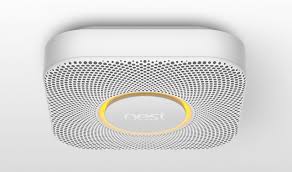
Nest saves energy by reducing heating and cooling when no one is home. Nest also provides the ability to reduce power consumption during utility alerts. That doesn’t sound very disruptive.

nest

Why did Google pay $3.2B for Nest? With compact fluorescents and now LED light bulbs replacing incandescent lighting, the energy used for residential lighting is declining rapidly by as much as 80%. This has all but eliminated the energy saving value of managing lighting.

The largest energy consumption, by appliance, in a home is by far the heating and air-conditioning[ii]. In a home where closely managing energy usage maximizes the impact of solar power – who will own the installed base of heating & air-conditioning control systems?

Investor Owned Utilities, regulated to a fixed return on assets, generally charge customers a tariff that bundles infrastructure cost with the electric power. If the various factors reducing consumption reduce kilowatt hours delivered below the breakeven point, utilities could be left with an unsustainable business model.

solar_image_3 copy

Future regulatory models have not been determined, but recognition that they must change is growing. No matter what direction is taken by future grid operations and business models, a key enabling technology will be secure, scalable, networked communications. Described in various ways as IoT, Digitization or Digitalization, these are opportunities for utilities to maintain or even improve reliability while accommodating growing DER, meeting goals for a lower carbon future, and improving efficiency. Digitization also enriches the customer experience enabling utilities to build customer relationships to help their customers achieve their goals.

Where to go next

For more information, some of the best reports I’ve seen are:

utilities_blog_2

To receive future blogs straight to your inbox:

subscribe

[i] This question is covered in much great detail in a 2013 paper written by the California Independent System Operator (CAISO), “What the duck curve tells us about managing a green grid” 

[ii] Other than a home spa, hot tub or swimming pool


Authors

Rick Geiger

Executive Director

Utilities and Smart Grid

Avatar

Cisco has shared a long-standing and successful relationship with Victoria University (VU). VU is committed to accelerating its transition to a digital campus to enhance student engagement, deliver productivity savings and increase capacity to innovate.

https://www.youtube.com/watch?v=JLib_fArwG4&index=1&list=PLE9603246C9094F72

VU’s digital campus strategy will fully exploit available digital technology to deliver a compelling, effective and efficient learning experience. The benefits envisaged by VU will include more engaged students, better student outcomes, a more digital-savvy workforce and future-proofed digital infrastructure.

To showcase the future partnership and to better understand the impact that digital transformation will have on campus and community at Victoria University, we’ve interviewed Richard Constantine, the Pro Vice-Chancellor of Digital Technologies.

Read on to see what he had to say about the digitization of education and Victoria University’s Cisco partnership.

How have educational institutions become more dependent on technology to meet the needs of students and educators?

Richard Constantine (RC): Students’ expectations have changed due to advances in technology and life pressures have also meant that students want to be able to learn on their own terms and be treated as individuals. Technology is a way that we can satisfy students’ needs easily and effectively.

Where are you currently in the process of digital transformation?  

(RC): As far as the process of digital transformation is concerned, our university is currently hard at work developing the blueprint to help shift our organization in the digital world over the next one to two years with some very innovative new technologies from Cisco.

How important is digital transformation to your university?

(RC): Digital transformation is very important for our university. As we try to accommodate students and their various learning styles, technology will help us understand things better, from the way that students learn to their changing needs. It will also give us quantitative information around student behaviors that we couldn’t have gotten before.

How has Cisco helped in achieving your vision of digital transformation?

(RC): Cisco has been critical in helping us achieve that vision because they’ll provide the important layer of innovation to help make our university increasingly agile and to incorporate new technologies that will meet our students’ rising need for accessibility.

Watch this video to learn more about how universities are leveraging digital technologies to transform higher education around the world, and visit cs.co/digitalcampusanz to see more. 

https://www.youtube.com/watch?v=q8lNisqbuSg

Authors

Reg Johnson

General Manager, Education

Cisco Australia and New Zealand

Avatar

Change is tough. True transformation is even tougher –especially when we are talking about the transformation of your tried and tested networks to a new software-defined model with Cisco’s Digital Network Architecture (DNA). And to take full advantage of these emerging network technologies, you will need new skill-sets and operational policies. The good news is that with Cisco DNA you also get the resources to navigate change and ensure success.

What are customers telling us?

IDC Research has surveyed customers’ current network status on the roadmap and have some preliminary findings:

  1. 4/5ths of organizations have NOT yet aligned their business strategies and IT strategies.
  2. Those that have are seeing twice the revenue growth as those that have not.
  3. The percentage of customers with a fully software-defined, and fully automation-capable network (stages 4 and 5) will more than triple over the next 2 years from 13% to 44%.

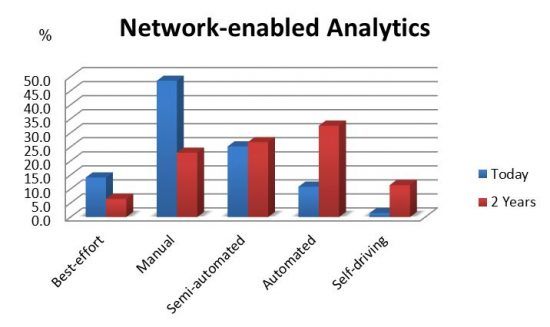
But there is a rush – most customers are planning to rapidly advance the capabilities of their networks across all the key attributes – such as a digital architectural approach, based on automation, security, and analytics. The graph below describes the rapid planned adoption of network-enabled analytics over the next 2 years (in red).

image-4-550x327

Source: IDC Infographic, sponsored by Cisco, How “Digital-Ready” is your organization network today? 2016

So what now?

Your network really does need to evolve. Or, maybe you already started but you wonder- where next?

Your next step depends on your role, but everyone does have a part to play. If you have responsibility for the network architecture, the first thing you should do is make sure you understand and perhaps even drive your organization’s digital plans. What digital initiatives does your organization have on the roadmap – and how well is your network positioned to support them? It’s critical to understand as that will guide how quickly you need to evolve your network to support the business. How do you acquire digital network skills?

B-FB-1200x628

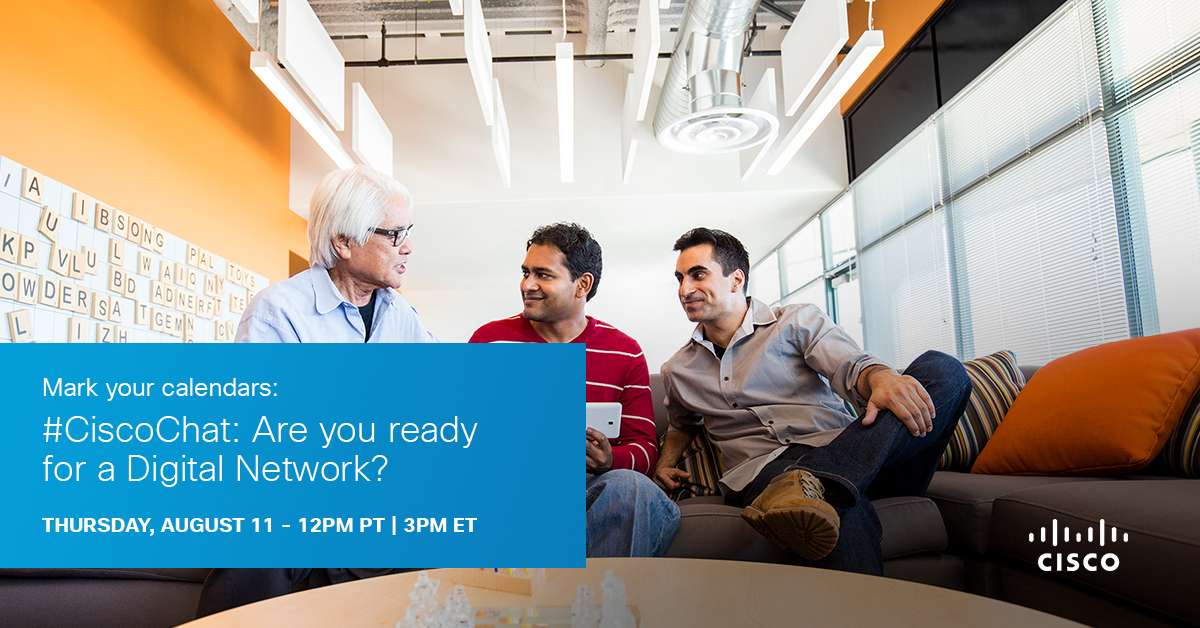
Join @CiscoEnterprise, on August 11th at noon to discuss Network Programing and the application to the Network Engineer and what skills are needed to obtaining a digital ready network. Co-hosting this #CiscoChat is Learning at Cisco’s Technical Engineer,  David Mallory and DevNet’s Chris Oggerino along with Nectar Services Corp. Steven Purcell, Cisco Solution Partner and Sr. Director Cisco Global Program Management and Nectars’ VP of Product, Russell Wiant to answer how #CiscoDNA solutions are used for simplifying QoS across Cisco’s Digital Network Architecture. We’ll also discuss the clear roadmap DNA provides for evolution Cisco of professional skills — expanding from NetOps into DevOps and a clear ability to deliver the future network .

See if your network is ready today: Cisco DNA Readiness Model

Related Links:

Related messages:

Authors

Melanie Kraintz

No Longer with Cisco

Avatar

As schools, colleges, and universities become more connected, it opens up a world of possibilities for students. The IT market suggests today we have around 15 billion devices utilizing an IP address, and that number is expected to grow to approximately 500 billion devices by 2030. Everything from the drinking fountains on the playground to the light bulbs illuminating classrooms will utilize an IP address for administration and monitoring purposes. While this brings numerous benefits to faculty, staff, and students, the increased number of devices utilizing an IP address means there are more entry points a hacker can target – and therefore more areas that need security focus.

In order to protect all of these areas, you have to understand how cyber attacks function from the beginning to the end. Vulnerabilities can be everywhere in your network and managing every possible risk of being exploited is an unfair battle. All it takes is missing an update, an error in configuration, a mistake by a user, or something completely outside your control such as a vulnerable piece of code in a product you purchased to get compromised. Typically, cyber attacks are developed around these vulnerabilities. Attackers exploit them to deliver something unwanted to your system. An example of this is how many exploit kits are used to deliver ransomware.

Ransomware is when a hacker encrypts your information so that you can’t access it without a digital key, which they require payment to provide. They literally hold your information ransom for a cost. And it can be high – once, a hacker demanded $124,000 from four elementary schools after an attack on their online exam system.

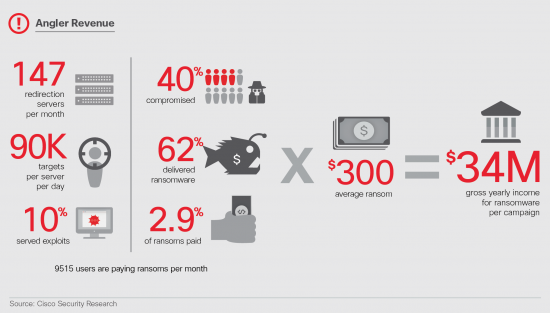
Exploit kits are a way hackers can deliver ransomware to victims. Exploit kit attacks typically involved getting victims to access a website that scans for a vulnerability in their system and exploits that vulnerability to drop ransomware onto the system. The most popular variation of exploit kit is known as Angler, which Cisco’s research group Talos estimated is raking in approximately $34 million dollars a year. And this is just one of the many exploit kits found in the world, so you can see how big ransomware has become.

Angler

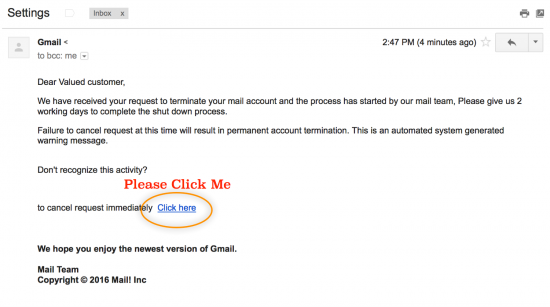
Another popular type of cyber attack is known as phishing. Phishing is when the malicious party poses as a trusted organization and sends you an electronic communication to try and get information – such as bank account information or your social security number. Phishing emails often include claims that you have won a bunch of money or offer free stuff. Phishing has also become a popular method to lure a victim to an exploit kit. Now, you don’t need to enter your information – just by clicking on the link in a phishing email can lead you to a malicious website hosted by an exploit kit. You can see one example of a phishing attempt below, where the attacker claims my account will be terminated until I click the link.

phishing

The good news is there are best practices to reduce the risk of these and other cyber threats. Cisco has numerous resources for education institutions to learn how to properly enforce security based on industry best practices. You can download our cybersecurity for education pocket guide to get started. And for more in-depth information, be sure to register for our upcoming webinar on cybersecurity in K-12 education and higher education.

Authors

Joseph Muniz

Technical Solutions Architect

Americas Security Sales