Avatar

Digital transformation is a multi-trillion dollar global initiative that is placing enormous pressure on IT to move faster and manage the increasing diversity in the types of users, apps, and locations needed just to support their businesses’ bottom line. As a result, developers will create thousands of new enterprises apps that demand the utmost in scale and security without sacrificing performance.

Cisco’s unmatched portfolio of networking solutions as well as integrated, converged, and hyperconverged platforms is a key element of success in the Digital era. The completeness of this portfolio with its foundation built on the Nexus family enables sustained differentiation against point product networking providers and proprietary, single-vendor public clouds.

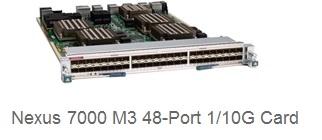
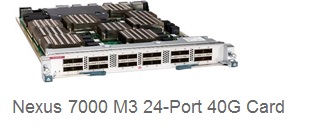
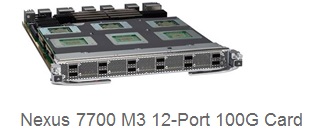
Today Cisco is bolstering this data center networking portfolio by introducing new innovations on Nexus 7000 and Nexus 7700 Series Switches. The new Nexus 7000 M3 Series 1/10G and 40G modules, and the Nexus 7700 M3 Series 100G modules along with the already shipping Nexus 7700 M3 Series 1/10G and 40G modules enhance scale, security and enable Seamless Datacenter Interconnect (DCI) Options while preserving the investment.DCI Webinar

The new modules are also compatible with previous generation Supervisors, Fabric and I/O modules, which allows customers to incrementally and systematically enhance the feature set of their Nexus 7000 and 7700 Series switches. Through these advancements, the Nexus 7000 family addresses the requirements of various designs, cabling, and environmental requirements and is ideal for DCI, DC core and Campus core deployment scenarios.  ( Please check release notes for specific modules that are compatible )

Nexus 7000 M3 48-Port 1/10G CardNexus 7000 M3 24-Port 40G CardNexus 7700 M3 12-Port 100G Card

Continue reading “Nexus 7000 Innovations: Data Center Interconnect, Enhanced Scale, Enhanced Security and Investment Protection”

Authors

Tony Antony

Marketing

Solutions

Avatar

Auston Matthews is a fog node. So are Tom Brady, Steph Curry, Cam Newton, Mike Trout and Jake Arrieta. But what’s a fog node?

auston-matthews-blog-image

Fog nodes are a key element of fog computing, also known as edge computing, which is a relatively new concept in the technology industry. Simply put, fog computing allows companies to collect and act on data received from a sensor (or machine) as close to that sensor (or machine) as possible.

Fog computing is especially useful in manufacturing, where hundreds of machines and sensors on a plant floor are generating data about machine health, production status, and inventory levels. Rather than send all that information to your data center for analysis and instruction, fog nodes – often an industrial switch on your network – analyze and act on the data right there. This decreases the time it takes to act on the information and frees up valuable resources in your data center.

tom-brady

What does this have to do with Auston Matthews and Tom Brady? Well, think about your factory floor as if it were a playing field. Your players are the fog nodes on your network, taking in data as-it-happens. The coaching staff is the data center, responsible for the season strategy.

Now imagine the Patriots are playing the Bills, and Buffalo’s defensive line rushes towards Brady. But instead of reacting to the play, he looks to the sidelines and waits for Belichick to tell him what to do.

While he is waiting, Buffalo sacks him for a loss.

Or on the ice, the Maple Leafs are playing Chicago and Auston Matthews is forechecking near the Blackhawks goal. The puck gets away from the defender and lands on Matthews’ stick. But instead of shooting, he skates to the bench to ask his coach what to do.

He doesn’t score on the play.

The ability for players to take in their surroundings – data – and make split-second decisions based on those surroundings is what makes sports exciting. It’s also what makes them fog nodes. If coaches are the data center, players are the nodes closest to the action (where data is being created) … and they need to act on that data as quickly as possible.

Being a fog node is what makes Tom Brady pass out of the blitz and Auston Matthews take that shot. And it’s what makes Steph Curry shoot the three when a defender steps back. Why? Because certain data needs to be processed immediately for the team to be successful.

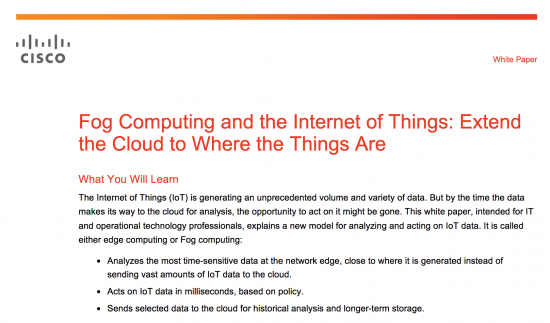
Your plant floor is no different. Stop asking your players to check with the coach before every play, and read this whitepaper to learn more about how fog computing can improve your operations:

iot_whitepaper

Authors

Jennifer Rideout

No Longer at Cisco

Avatar

Organizations aren’t just talking about digital transformation – they’re doing it: More than 75 percent of global business leaders cite digitization as a top strategic priority and nearly seven in ten say their company will meet its digital transformation objectives this year, according to a recent survey from The Economist Intelligence Unit.

To advance these initiatives, organizations are primarily focused on boosting capabilities in Big Data/analytics (as cited by 58 percent of survey respondents), mobile computing (36 percent), Software as a Service (29 percent), Infrastructure as a Service (26 percent) and electronic payments (21 percent). Additionally, according to a recent report from PwC, more than half of organizations have also increased their security spending to support their digitization efforts.

These capabilities are frequently coupled with an intensified interest in social media and the Internet of Things (IoT) and are clearly revolutionizing business practices. But they’re also increasing risk, giving cyber criminals more opportunity to compromise networks and systems and steal valuable data. Such attacks are draining bottom lines, with the average cost of a data breach now totaling $4 million, up 29 percent since 2013, according to research from the Ponemon Institute.

That’s why cyber resilience is so critical for organizations today. At Cisco, we define cyber resilience as the ability to prepare for and adapt to changing threat conditions while withstanding and rapidly recovering from attacks to infrastructure availability. It is largely about managing risk – identifying events that might happen; assessing how likely they are to happen and the impact they could make; and deciding what actions to take.

We recently published a white paper on this topic, titled “Cyber Resilience: Safeguarding the Digital Organization.” In the paper, we outline a multidisciplinary capabilities framework that should serve as the foundation of your cyber resilience program. Key capabilities include:

Identification. First, you need to identify your most valuable assets, so you can make informed decisions about risk and investment. It’s also necessary to perform an asset management and risk assessment. To achieve this, it’s essential to be able to know and authenticate all systems in your network architecture, so one party can confidently identify another party. You must know which devices – with specific cyber resilient capabilities – form the foundation of your cyber resilience and business competencies. You must also know where your business-critical data is and understand its resiliencies. Only then can you develop and maintain a security strategy.

Protection. The next step is to limit or contain the impact of attacks. Policies, processes and mechanisms ensure that systems are built and operate in a state of integrity during an attack, and that they are defended from modification from unauthorized or unauthenticated processes.

Detection. Security teams must constantly measure, collect, verify and analyze system integrity to enable timely discovery of a threat. Detection solutions provide behavior notifications, logging and forwarding events related to unexpected and possibly harmful user behavior or network activity.

Recovery. Recovery restores the normal operation of platforms, apps and services if they are corrupted by a compromise. New platform capabilities, for example, will allow an agent to run and correct or replace compromised components, including firmware, applications, user data, configuration data and software. This greatly reduces costs and downtime when an attack occurs.

Visibility. With visibility mechanisms supporting protection, detection, recovery, analytics and forensics, you assure continuous awareness of system integrity. Visibility tools are typically integrated with other cyber resiliency functions to establish a coordinated security and compliance posture that can reveal the state of system integrity to administrators, users, tools, applications or third parties. With this, IT continuously monitors and tracks the state of integrity of all organizational informational assets.

Analytics. Through analytics, you examine incident data to augment situational awareness, helping security teams distinguish events that pose the greatest risk. In addition, these tools reduce the time from detection to recovery, paving the way for the proactive defense of your network.

Forensics. Teams ingest relevant support data, while preserving, processing, analyzing and presenting system-related evidence in support of recovery.

A complete digital transformation requires a roadmap – not only of the technical investments that will advance business performance, but of the tools, policies and processes that will protect your investments. These capabilities will not entirely eliminate cyber risk; but they create awareness to the risks and will build a formidable defensive posture to significantly reduce the impact of threats.

Authors

Anthony Grieco

SVP & Chief Security & Trust Officer

Security and Trust Organization

Avatar

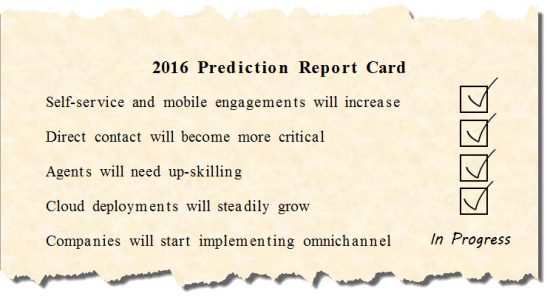
We’re all bombarded with opinions and predictions from so-called experts. But who do you trust? I believe it’s important to have a strong track record if you want people to take you seriously. Last year, I made five predictions about the Customer Care industry for 2016. You can read about them fully in my prior post, but here’s a quick report card:

prediction report card.jpg

I believe these predictions will continue trending through 2017. But there’s more on the horizon. So, my team and I put together our predictions for Customer Care in 2017.

Companies will get serious about delivering a Connected Digital Experience. I introduced this game-changing concept in September. As increasingly more companies adopt our Release 11.5 contact center solutions, their Connected Digital Experience is becoming a reality. With it, they can now deliver contextual, continuous, and capability-rich customer journeys. Have you taken the time to view your business from your customers’ perspective? I encourage you to try. Then consider how a Connected Digital Experience will delight your customers and differentiate you from competitors.

Chief Digital Officers will be more involved in customer-care decisions. Digital transformation has become a driving principal for companies of all sizes, and many businesses now have a Chief Digital Officer. Any holistic digital strategy must include customer care. CDOs recognize that customer care can be an organization’s strongest differentiator, which is a basis for my prediction about connected digital experiences.

There will be a strong uptake in secure cloud applications for customer care. Direct contact between customers and agents continues to be more and more critical. When a customer calls, does your agent have everything needed to help? Including a history of previous interactions and insight from analytics? Cross-channel and multi-application integrations are best done in the cloud but must be secure. One security breach is too many. And cloud applications have to be usable as well as secure. Applications that have to punch holes through firewalls can be too cumbersome. There are better ways. The security key management in Cisco’s Context Service lets you securely track your interactions with customers, across time and channels.

Customer care will extend further beyond the contact center. You don’t have to confine customer service to traditional contact centers. It doesn’t even have to involve agents. Business collaboration suites like Cisco Spark enable informal, automated team care with bots like Cisco Spark Care Assistant. If you’re using Spark, I encourage you to give it a try – especially because it’s free to Spark Message users.

Uncertainty will drive businesses to reassess strategic contact center suppliers. We’re all aware of the recent history of churn among key players in the contact center industry. And that churn is continuing. The typical pattern is that risk-averse companies diversify their platform choices early. Then, if one vendor begins to look risky, they quickly reconsolidate on a trusted vendor in a controlled manner. We might call these companies “early adopters” of risk mitigation.

Other companies wait longer before migrating from at-risk platforms or vendors. Although this can make business sense, it can also greatly increase the difficulty and costs of the eventual migration. We saw this with Nortel in 2009, Aspect in 2016, and now with Avaya.

The kind of questions to ask during these times are:

  • Will support for existing hardware continue?
  • Will maintenance costs rise?
  • What about innovation? Is there a roadmap?
  • How can an unstable vendor transform how businesses care for their own customers?

Whether you consider yourself an early or late adopter, be sure to ask yourself these questions if one of your strategic vendors is looking risky!

Our industry is constantly changing, from customer behavior to the technologies we have to address it to the vendors that offer solutions.

As you look toward 2017 and beyond, what changes do you see? Let me know. Post your own predictions in the comments section.

Cisco Spark

Authors

Chris Botting

No Longer with Cisco

Avatar

The new UCS S-Series storage server leverages the automation and programmability of UCS management to provide greater levels of efficiency and flexibility.

Guest Blogger: Craig Ashapa, Technical Marketing Engineer

Last month Cisco introduced the new Cisco UCS –S-Series S3260 supported by a new release of UCS Manager. The S-Series features a very modular architecture, and it can support up to 600 TB of HDD storage and 90 TB SSD flash. To be honest, there are a couple of storage servers in the market that provide similar scalability, but none of them have the unique advantages of policy-based automation and integration with the broad UCS management partner ecosystem.   Active data and data intensive workloads require the ability to carve up storage resources and manage them more dynamically. That’s why UCS management combined with the S-Series provides significant benefits for your organization

Automating Data Intensive Compute and Storage

When you are trying to provision significant amounts of storage and compute resources and achieve what we call “Data Unstored”, you need the efficiencies of automation and programmability. Active data requires the ability to manage resources rapidly and consistently. We introduced Storage Profiles in earlier releases of UCS Manager, but the S-Series really leverages the power of this functionality.

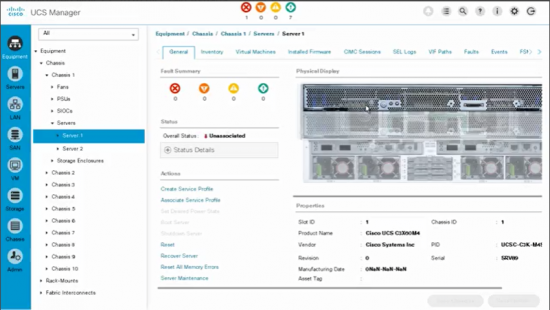
I wanted to help you understand the benefits of Service Profiles and how they differ from traditional disk geometry/volume creation methodologies, so I created this new demo video.

Click on Image to Start the Demo Video

S3260_UCS_Mgmt_Screenshot1

Stepping You Through the Demo

The demo starts with an introduction of the UCS S3260, then it goes through several steps:

  • Bringing the S3260 under UCSM management
  • Chassis template and profile creation and association, including firmware package and disk zoning
  • Server pool creation
  • Storage Profile and Disk Group Policy creation
  • Boot policy creation using a storage profile boot LUN
  • Service Profile Template creation consuming storage profile, boot policy, and server pool
  • Service Profile creation for 20 servers using a Service Profile Template
  • Display 20 Service Profiles/Servers being created in parallel with the local disks being configured

If you are familiar with all the steps required to provision storage and compute without Service Profiles, you will realize the advantages of using UCS management to automate this process and provide you with programmatic control of the resources. Storage Profiles provide a systematic way to automate the steps for provisioning Disk Groups, RAID Levels, LUNs, boot drives, hot spares, and other related resources. They are used in combination with Service Profile Templates to map the associations between logically defined storage resources and servers.


If you’d like to learn more about the UCS S3260, click here.

Authors

Ken Spear

Sr. Marketing Manager, Automation

UCS Solution Marketing

Avatar

In order to react faster in a world of accelerating change, the winners of the digital economy must evolve their enterprise networks. And nowhere is this need to change more apparent than at the network edge.

The edge is where you deliver transformative applications and services to your users. It’s where the Internet of Things (IoT) will add both mind-boggling complexity and unprecedented insights. The network edge is your most vulnerable entry point, as well as your first line of defense against unintended or malicious threats.

Intelligence, agility, and security at the edge are at the heart of digital transformation. But, according to a 2016 study on digital transformation readiness, IT leaders have their concerns:

  • 95% of network changes are still being done manually
  • 70% of policy violations are caused by good old-fashioned human error
  • 75% of total operating expenses are sucked up by monitoring and troubleshooting

Service automation and Quality of Service (QoS) in the branch has never been easy. But I’m here to tell you: simple is possible. And we explore, in detail, exactly how both can be done in this episode of TechWiseTV:

https://youtu.be/x4k_84w8djw

Deploying network infrastructure is complicated, with many time-consuming, routine tasks that are frustratingly dissimilar enough to make nailing down a standard template all but impossible.

As for QoS, core is not the same as access. Who has time to understand the capabilities of all the different devices that access the network, and the different policies they require?  There are a ton of moving parts: ingress vs. egress, multiple service provider policies at the various remote locations…It’s easy to lose control.

In this episode, Cisco’s Prakash Rajamani demonstrates how orchestration tools like Enterprise Service Automation (ESA) can bring repeatable, consistent, and scalable processes to your virtualized branch deployment.  Later, Ramit Kanda shows a dramatically simple way that ESA can be used to control QoS on your network: from wired to wireless, and through the WAN.

As you’ll see, complexity will never be an excuse again.

What is ESA, you ask?

If you’ve never heard of Cisco ESA, here’s a little background before you jump in:

Software Defined Networking has been the broad and ill-defined term offered as the magic pill for all the challenges described above. If you’ve been following our show, you know that Cisco has been making consistent strides toward this reality for several years.

Last year, we introduced you to the Cisco Digital Network Architecture.  We even covered some of the more specific technologies in a two-part series in March. If you haven’t seen these episodes, I encourage you to check them out. In the meantime, here’s a quick introduction to help you see where the demos we cover in this episode fit into the big picture:

Network Functions Virtualization (NFV) is a powerful new tool for simplifying network deployments and operations–especially in the branch. Virtualizing traditional appliance-based functions, such as routing, firewalls, and WAN acceleration, enables you to quickly roll out new services and change existing ones in minutes.  You don’t need to deploy new hardware for every function, and centralized provisioning and management eliminates costly truck rolls.

NFV is a foundational step for Cisco DNA, and is inherent with IOS XE.  For Cisco, that centralized provisioning and management tool (otherwise known as an SDN controller) is the Cisco Application Policy Infrastructure Controller Enterprise Module (APIC-EM). The actual interface or orchestration software you would use to make all of this happen is something we call Enterprise Service Automation… or ESA.

Now that you’re caught up, enjoy the complete episode.

Robb

@robbboyd

http://www.techwisetv.com


P.S. Speaking of QoS, did you hear that Cisco Wireless customers using Meraki can now do granular QoS from an iOS 10 device to the AP, and all the way through the network? To learn more, check out Fast-Tracking the Mobile Enterprise on TechWiseTV.

Authors

Robb Boyd

Producer, Writer, Host

Avatar

So yesterday we had our first snowfall up here in New England, holidays are coming fast, and so are events like the Consumer Electronics Show and Mobile World Congress.

Well while it was snowing yesterday, I realized that I had not updated our industry veterans on our Packet Core Transition. So there has been a lot of industry discussions recently in various industry press and blogs on Virtualized Packet Core (VPC) and Packet Core, but when I did a quick read and found that Cisco Ultra Packet Core information was missing and so I thought that I would take some time and give you an update on our customer transition to our Ultra Services Platform (USP) and in particular the transition to the software based Ultra Packet Core (UPC). Some industry veteran reporters know that our customers have begun the transition to a software based Mobile Packet Core (MPC) for some time, and we too have seen this transition begin in earnest. It is no longer just let’s try to put the VPC in parts of the network like for M2M/IoT, we are seeing customers like AT&T ( Connected Car, Consumer/EPC ), XL Axiata in Indonesia put their entire 60 Million plus customer base onto our UPC, and many more are transitioning. We are seeing not only mobile operators deploy our UPC we are seeing government agencies, military, enterprise, and mining companies deploy our UPC.

So the transition from the traditional Packet Core, our ASR 5000 Series has begun

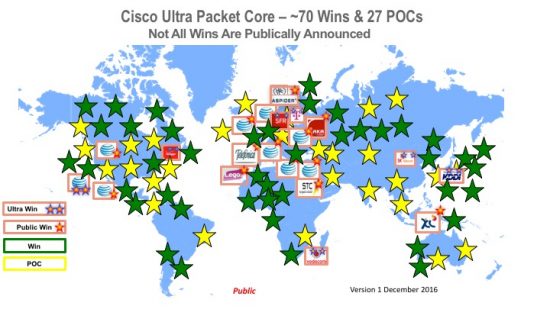
Figure 1

Figure 1 Cisco UPC Wins as of December 2016

You can see by the image in figure 1 we have about 70 UPC customer wins as of December 1st and still have a healthy pipeline of Proof Of Concepts (POCs) with 27. For the past few quarters we have seen some of our 350+ ASR 5000 Series customers transition to UPC, but also they are beginning to migrate to our newer cloud based platforms like our new Ultra M Platform.

Also did I tell you that this same Ultra Services Platform recently won the Telecom Asia Readers Choice Award for “Cloud Innovation of the Year for the Cisco Ultra Platform”! Cisco also won the Readers Choice Awards for “SDN Innovation of the Year for the Cisco Network Services Orchestrator (NSO) and Data Center Innovation of the Year for its ACI and Tetration solutions

So as I said we just wanted to give a quick update on the great progress that we have made with our customers to transition to our software based Ultra Packet Core, which is part of our Ultra Services Platform.

Stay tuned to this space for more updates.

For more information on Cisco Ultra Packet Core, please click here.

For more information on Ultra M or send an e-mail to info-ultram@cisco.com and visit the Ultra M page.

Save

Authors

Jim O'Leary

Sr. Manager Mobile Solutions Marketing

Avatar

Technology is changing everything. It’s solving some of the world’s greatest challenges and transforming our customers’ businesses in new and unprecedented ways. Our job is to help our customers navigate this complexity—so there’s never been a better time to tell the Cisco story clearly and concisely. That’s why I’m so excited to announce that Oliver Roll is joining Cisco as our new SVP and Chief Communications Officer!

In his role, Oliver will lead analyst and public relations, executive and employee communications and Office of the CEO communications.

Oliver joins us from VMWare where he was Chief Communications Officer and led brand and communications work. He’s held senior leadership roles in communications and marketing in Europe, Asia and the United States.

I’m looking forward to working with Oliver as he guides our world-class communications team in sharing the Cisco story and vision!

Authors

Karen Walker

Senior Vice President and Chief Marketing Officer

Avatar

We live in the age of digitization where astonishing opportunities emerge when people and devices connect. Mobile technology empowers remote workers. IoT-based factories achieve new levels of efficiency. Sensors monitor the availability of clean drinking water. We are innovating and reaching people in ways never before possible.

At Cisco, we strive to bring the benefits of digitization to every person in the world by…

  • Empowering individuals and organizations by developing digital skills and catalyzing an innovative and entrepreneurial ecosystem.
  • Advancing positive social and environmental change by investing in global problem solvers who apply innovative, technology-based solutions and multi-stakeholder partnerships.
  • Promoting sustainable outcomes across our business operations, supply chain, and customer base through good business practices and transformative solutions.

…to positively impact 1 billion people by 2025.

This approach is enabling us to change the way we address—and ultimately solve—the world’s most pressing social and environmental challenges.  Our 12th Annual Corporate Social Responsibility Report – Accelerating Global Problem Solving – demonstrates how, through our technology and expertise, Cisco empowers global problem solvers to make a positive difference for people, society, and the planet.

People

Our work to enable people to reach their full potential in a digital economy begins at Cisco, where our focus is to attract and retain the best talent. By focusing on connecting everything, innovating everywhere, and benefiting everyone, we transform the employee experience. Our people are able to flourish as global problem solvers in a way that is both responsible and ethical so they can make a meaningful difference in communities worldwide. In

In fiscal year 2016, 36 percent of employees supported non-profit organizations through their time, donations, and expertise, resulting in $12 million in donations and matched funds and more than 187,000 hours volunteered.  Our goal is to have 80 percent employee engagement by 2020.

Outside of Cisco, we actively nurture the talents of problem solvers around the world by providing foundational digitization and entrepreneurship skills to individuals of diverse backgrounds, preparing them to thrive in the digital economy. In fiscal year 2016, our Cisco Networking Academy Program reached more than one million students in 170 countries.

Beyond education and training, we also provided our students with career resources and connections to employers seeking IT talent. We believe this drives value for Cisco and our customers, ecosystem partners, and society at large. Our goal is to extend the reach of the Networking Academy to two million students a year within the next five years.

Society

Cisco strives to make positive inclusive social and economic impact in countries across the planet by investing in early stage, technology-based solutions that have the potential to be scaled, replicated, and sustained. In fiscal year 2016, we provided cash and in-kind contributions of $309 million to organizations.

Our nonprofit partners report that our cash grant investments positively impacted 78 million people across our key focus areas of critical human needs, economic empowerment, and education. We also sponsored a Cisco Innovation Challenge within the Rice Business Plan Competition (RBPC).  The winner of the challenge,

We also sponsored a Cisco Innovation Challenge within the Rice Business Plan Competition (RBPC). The winner of the challenge, Neopenda, is developing a wearable device that continuously monitors the vital signs of critically ill newborns in hospitals with limited resources. With more than 2.7 million babies dying every year within their first month of life, this technology has the potential to have tremendous impact.

Planet

Our goal to achieve sustainable growth in a connected world extends to the environment as well. We invest in transformative solutions and share energy-efficiency best practices with our customers and partners. Our products improve productivity, reduce the need for traveling, increase utilization of company assets, and enable energy-efficient cloud computing for organizations around the world.

In fiscal year 2016, we implemented more than a hundred energy efficiency and onsite renewable energy projects.  Our use of low-carbon, renewable energy is up to 77 percent of our global electricity demand. And we are on target to reduce our greenhouse gas emissions by 40 percent worldwide by the end of fiscal year 2017 compared to our fiscal year 2007 baseline.


We believe that innovative solutions can arise and their impact multiplied when passionate people and transformative technology connect. By working together, we can move toward eradicating poverty, unemployment, climate change, and hunger everywhere.

Everyone has the potential to become a global problem solver. Won’t you join us?

Read Cisco’s 2016 CSR Report today and learn more about our Corporate Social Responsibility.

Authors

Tae Yoo

No Longer with Cisco