Avatar

Digitization and APIs

Before we get into digitization, let’s discuss disruption. As we all know, Blockbuster was disrupted by… Netflix; and the taxi business is being disrupted by Uber as we speak. If we look deeper, Netflix and Uber essentially streamlined processes through digitization, and hence disrupted their industries. These are two examples of disruption via digitization that I hope we can all relate to.  Digitization is constantly happening all around us, and Cisco and several of our partners are helping customers to digitize their processes.

In the DevNet Zone at Cisco Live, I hosted a lively panel discussion with 4 of our partners to discuss how the various technologies from Cisco are helping them drive digital transformation with their customers.  Let me briefly introduce the panelists who joined me:

  • Craig Sanderson, Senior Director at Infoblox, leading provider of security and network control solutions.
  • Russell Wiant, VP of Product, Nectar Services Corp, enabling seamless communication across the network.
  • Chris Gaun, Director of Strategy, Apprenda, Enterprise PaaS solution provider.
  • Jose Bogarín, Chief Innovation Officer, Altus Consulting, helping customers reduce their IT costs.


Enabling Adaptive Network Control with Cisco pxGrid and Infoblox

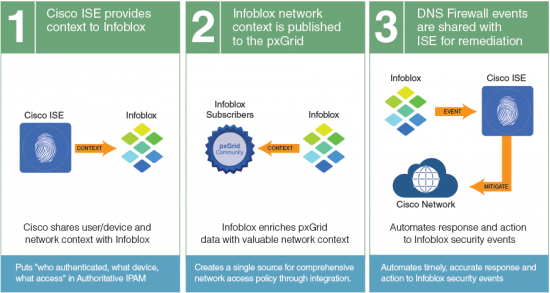
In the discussion with Craig, he shared that Infoblox partnered with Cisco to help customers with an automated response to a variety of security threat-related events. He emphasized that “Threat intelligence sharing helps in rapidly closing the gap between detection and response.”

Cisco’s pxGrid, a data exchange platform, provides a  publish/subscribe model that eliminates the need for point-to-point integration between the various security products a customer might have.  Infoblox and Cisco ISE integration utilizes the Cisco pxGrid to exchange information between Cisco ISE, Infoblox, and other pxGrid participants, for a unified and automated solution.

Craig further explained that pxGrid APIs help Cisco ISE share the user, device and network context.  At the same time, the pxGrid APIs help Infoblox share the DHCP and IPAM (IP address management) context.  Based on the combined context, Cisco ISE is then able to automate a security response, such as quarantining an endpoint.
Infoblox

Optimizing Unified Communication Experiences with Cisco DNA and Nectar

Next, Russell joined me from Nectar, where they help customers to have seamless voice and video communication between any two endpoints, be they wired or wireless. During a video communication, have you ever seen a message saying “the call is experiencing quality issues due to the network,” or something along those lines? The reality is that several factors could be compromising the experience, such as network bandwidth and latency, server performance, and configuration issues .

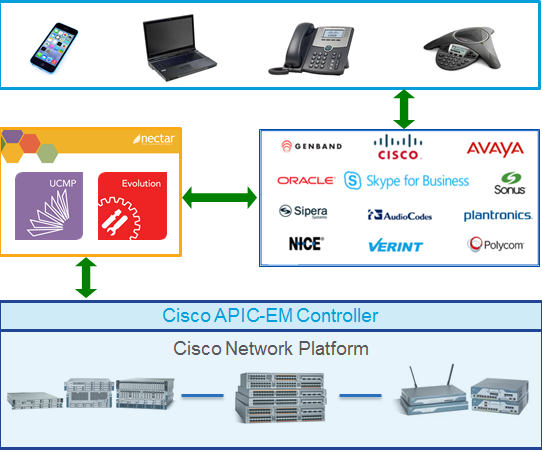
Russell shared that Nectar provides monitoring capabilities with its Unified Communications Management Platform (UCMP) solution, which help identify where communication problems are occurring.  In addition, the recently launched Nectar Evolution provides the means to set the appropriate QoS settings to correct the problem. Nectar Evolution learns about UC events in real time and communicates them to the APIC-EM controller from Cisco using corresponding APIs.  This intelligence, when given to the APIC-EM, enables it to configure the network dynamically with the right prioritization and capacity needed for the two endpoints to communicate effectively.
Nectar

Building a secure PaaS with Cisco ACI and Apprenda

I also had the pleasure of having Chris join us from Apprenda.  He shared with the audience how they are using Cisco’s Application Centric Infrastructure (ACI) to provide a “secure PaaS” offering to their customers.

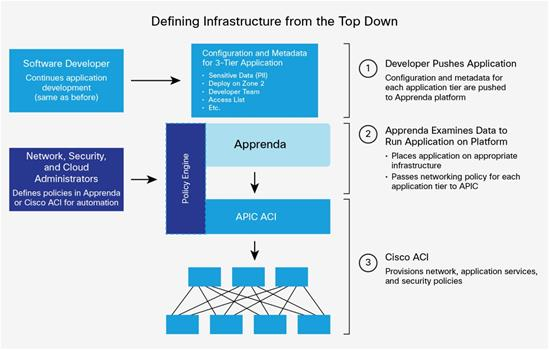
Chris explained that developers are responsible for hosting or making changes to their applications on Apprenda. They need not be aware of the underlying network or infrastructure architecture, which is abstracted by the Apprenda platform, to do their jobs — the platform takes care of those details. When the developer is ready to host the application on the platform, the developer defines information about the application, such as whether it includes personally identifiable information (PII). This definition creates policy information about the application. The Apprenda platform passes that policy information from the application configuration file and metadata to Cisco ACI.

Cisco ACI then stores that policy in the Cisco Application Policy Infrastructure Controller (APIC), creating the rule book that determines which applications (or tiers or arbitrary groups of endpoints) can talk to each other. The Cisco APIC pushes the policy down to the individual Cisco Nexus® 9000 Series Switches in the fabric, which implement the required networking rules for the application architecture.

The result is a secure, policy-based hybrid cloud application platform that helps you achieve the dynamic isolation of application tiers, including data and network, without a dedicated infrastructure. Apprenda also integrates with Cisco Metapod to enhance the provisioning of infrastructure services. Together, Cisco and Apprenda provide the best possible way for enterprises to drive governance, security, rapid development, high service levels and order-of-magnitude savings in operational and capital expenses.
Apprenda

Allowing business users to configure Cisco Contact Center securely with Altus Contact Center Manager

Jose joined me to share how his company’s solution is able to help their customers automate the tasks within Cisco Contact Center Express. Tasks that previously took days can now be done in minutes, freeing up time for the end user and IT administrator to focus on activities with more business value.

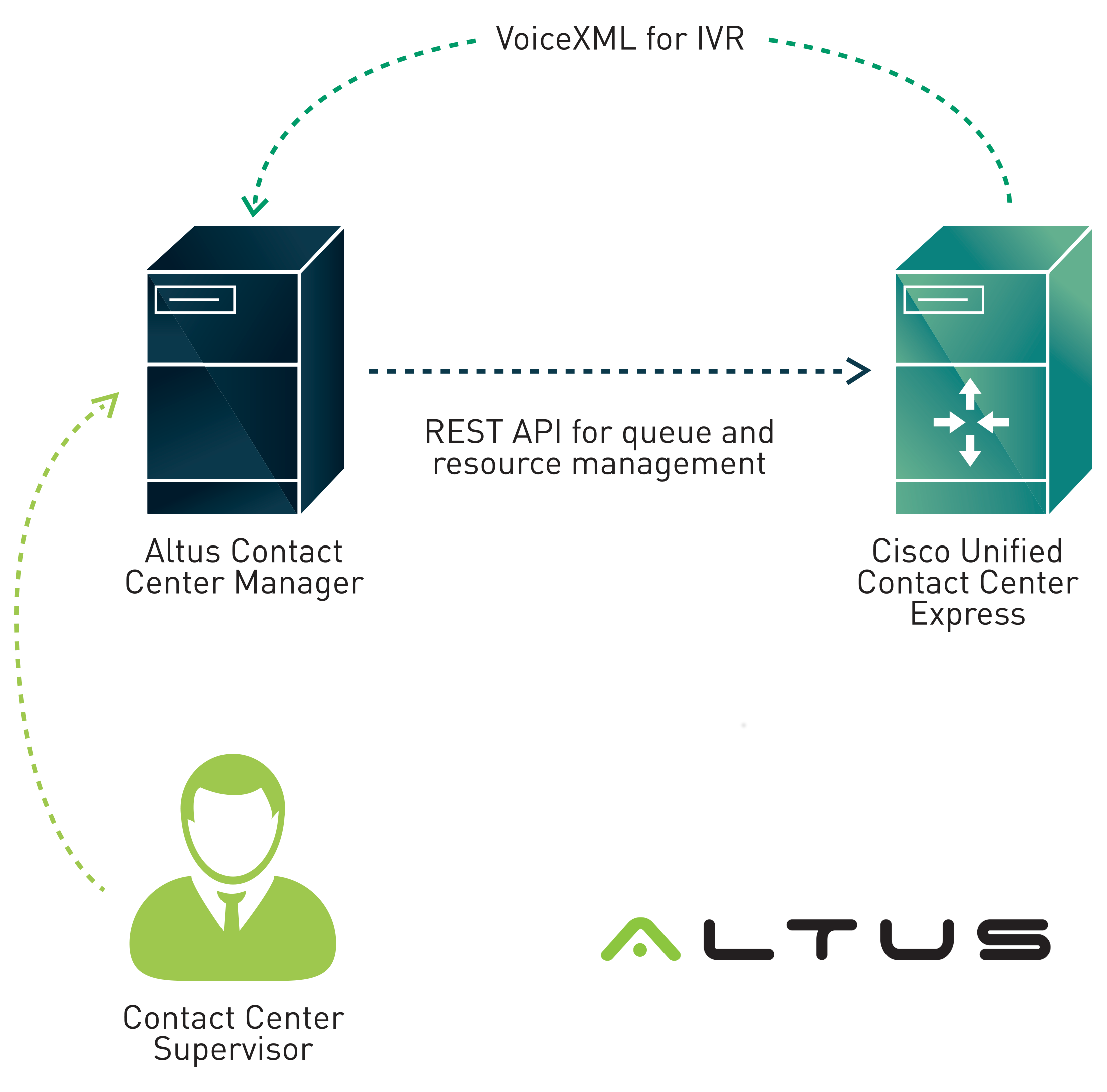
Jose’s organization, Altus, developed Altus Contact Center Manager (ACCM), a software solution that uses APIs to integrate UCCX and provide an easy-to-use interface that allows the end user to configure it.

ACCM enables business users of Cisco Contact Center Express to make configuration changes in the IVR, CSQs (contact service queue) or other agents, without having to go through IT.

In most cases, IT would have to open a support ticket with their Cisco Partner in order to make such changes. Jose mentioned that, “if you take into consideration having to go through two help desks in order to make a simple configuration change, like a greeting audio or an agent skill, our software allows to do in five minutes something that right now may take two or three days to solve.”
Altus Ilustracion2


Begin your journey towards Digital Transformation

It is amazing to see how these partners have leveraged Cisco technologies, and how their innovations work to digitize various processes: threat detection and response, network automation for seamless communication, security policy propagation via an application to the network, and quickly enabling changes to the contact center.  Cisco DevNet played a key role in helping our partners learn how to use the various APIs and test their applications in our sandbox.

As you can tell, there has never been a better time for Digital Transformation with Cisco DevNet!

Authors

Vikram Gulati

Marketing Manager

Cloud Services Marketing

Avatar

Cisco has been working to draw attention to the hidden security risks organizations face by not properly maintaining their aging infrastructure and patching vulnerable systems. Threat actors, including ransomware operators, are using vulnerable Internet infrastructure as a foothold to launch their campaigns. The trends lead us to believe we should expect to see more of this activity in the future — with widespread attacks that target not only traditional servers and endpoints, but also the network itself.  This future activity will bring with it significant consequences affecting not only enterprises, but also entire industries.

Many of the security problems in aging infrastructure are not hard to foresee. Systems that were designed, built and deployed in decades past didn’t anticipate the hostile security environment of today.   Until now, very few have thought about securing infrastructure because they didn’t think adversaries would target these systems and devices, or they had ‘higher priorities’ to fix. This must change.

There is another, even more basic issue: Organizations around the globe are at heightened risk of attack simply because they have not managed this infrastructure, often for several years, entirely missing opportunities to fix known vulnerabilities in their infrastructure.

To understand the scope of this problem, we examined a sample set of Cisco devices deployed around the globe to determine the ages of known vulnerabilities running on fundamental infrastructure. Our findings are discussed in detail in the newly released Cisco 2016 Midyear Cybersecurity Report.

Our analysis was built on the foundation of research about aging infrastructure that we conducted in 2015 and presented in our previous security report [link]. In that first study, we found that 92 percent of the 115,000 Cisco devices sampled on the Internet had known vulnerabilities in the software they were running.

Here are few key highlights from our latest research:

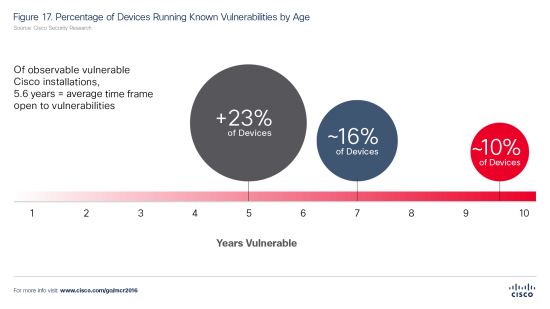
Twenty-three percent of the devices we examined had vulnerabilities dating back to 2011, and nearly 16 percent had vulnerabilities that were first published in 2009. In addition, each device was running 28 known vulnerabilities, on average.

Figure-17.-Percentage-of-Devices-Running-Known-Vulnerabilities-by-Age

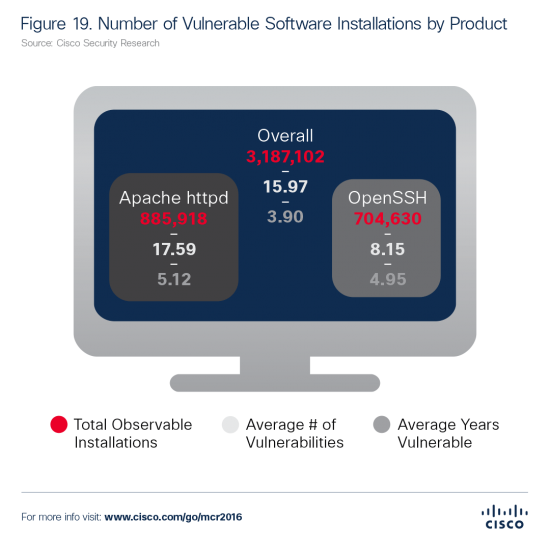
In addition to the infrastructure built with Cisco products, we also looked at common server software packages for further insights.  Organizations using the web-server software, Apache, and secure remote communications software, OpenSSH, showed similarly worrying trends.  They have been running known vulnerabilities for an average of 3.9 years and having an average of nearly 16  known vulnerabilities for these software products.

Figure-19.-Number-of-Vulnerable_software-Installations-by-Product

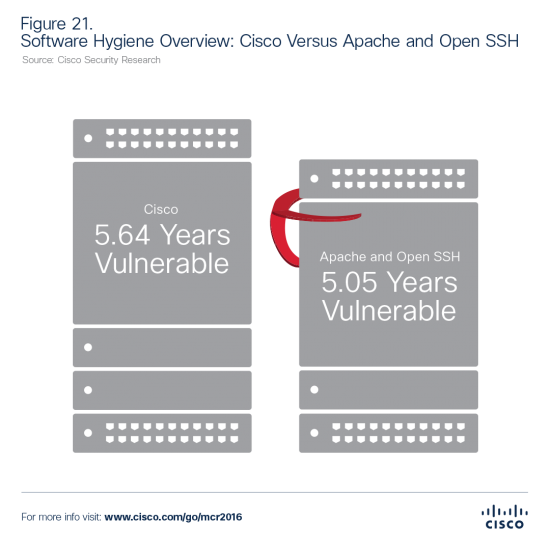
In summary, our analysis of Cisco products, Apache, and OpenSSH found that the internet ecosystem of enterprises and service providers are not diligent about addressing known vulnerabilities in either group of products. With vulnerabilities hanging around for about 5 years, on average, the operational space for adversaries to either directly attack the vulnerable organizations, or us it as a launching pad to attack others extremely broad.

Figure-21.-Software-Hygiene-Overview

The reasons organizations avoid upgrading their network infrastructure are understandable. Updates are inconvenient and time-consuming. They can be very resource-intensive. And every minute that some piece of critical infrastructure is offline is time when a technology-enabled business is not running on full cylinders — and thus, potentially losing money.

However, every moment that an organization chooses to operate with vulnerable infrastructure places it at even greater risk for a crippling breach. Infrastructure vulnerabilities provide adversaries with both time and space to operate, allowing them to move laterally across the network so they can lay the groundwork for campaigns that will deliver maximum impact.

There is another risk of procrastination for organizations to consider, as well: Businesses that have fragile and insecure infrastructure are not likely to succeed in the emerging next-generation digital economy, where security is an essential component for digital transformation.

Businesses must assess the overall strength and cyber-resilience of their deployed infrastructure and systems. This process likely will be eye-opening, but it’s a necessary reality check. Organizations that proactively improve their security posture will be better positioned to meet today’s threats and to prepare for tomorrow’s challenges — and opportunities.

Download the Cisco 2016 Midyear Cybersecurity Report to read more about our findings.

Authors

Anthony Grieco

SVP & Chief Security & Trust Officer

Security and Trust Organization

Avatar

I’m a sailor. As a matter of fact, my family and I sailed around the world a few years ago.

We sailed 16,000 nautical miles from San Francisco to Europe, including through the Panama Canal and across the Atlantic Ocean.  I had a lot of time to think about people in crisis, how to respond and the people who come to help. When you’re out at sea, you have to rely on yourself, and you know that if you ever do get into real trouble, other people will be putting their own lives at risk to save you.

Whenever possible, “Cruisers” as full time sailors are called, help each other out. Once we ran aground in the Aeolian Islands off of Sicily, and two boats (one French and one British) helped us off. We paid it forward later that year to a French boat who ran aground in the Balearic Islands of Spain.

We experienced many heavy weather scenarios including severe gales, thunderstorms, hurricane force winds and other scary or uncomfortable situations – but nothing that was considered a “survival” situation. I can tell you that being at the helm in severe weather conditions with your family down below makes you quickly realize what’s important. And it’s not that deadline at work.

Jennifer in a Fire Truck
I’m ready for the emergency response drill!

That’s originally why I joined Cisco’s Emergency Response Team. I wanted to learn CPR and emergency response skills to augment my safety skills at sea. However, I stayed on the team because they, too, are ready to risk their safety to help their colleagues.

Upon coming back to work at Cisco, I immediately signed up again for the Emergency Response Team, with a renewed sense to help.

I re-trained in CPR and First Aid and my first big opportunity was to participate in an Operational Readiness Drill. An Operational Readiness Drill (ORD) is an annual exercise to test Cisco’s abilities to respond to a large-scale multi-casualty incident.  Scenarios used in previous exercises included explosions, earthquakes, vehicle accidents, and plane crashes.  Cisco even involves the local fire department and county EMS as participants. To make it as realistic as possible, “players” sign up to respond to the incident, while “actors” pretend to be injured, complete with realistic make-up.

Emergency Response Drill
This is me helping an “actor” in distress.

The day of the ORD, the volunteers got a text that there was an earthquake and “more ERT” were needed at the site. Over the next few hours I was tasked with trying to find someone reportedly injured in a building (no luck), performing a triage assessment of multiple injured people, and doing my best to make sense out of a situation that the organizers did their best to make very chaotic – and therefore more realistic.

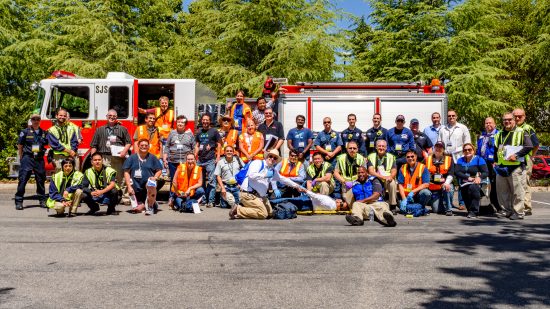
Emergency Response Volunteers
All the volunteers for our emergency response drill!

On my way over to responding to the event, I asked myself, “Would I be running toward danger in a real emergency, not knowing if my family was safe?” In our post-drill discussion, our Emergency Preparedness and Response Coordinator told us, “Safety begins at home.” It was a good reminder. I might be prepared for anything at sea, but I need to also be as well prepared for anything at home. It’s time to dust off the family emergency preparedness plan and get my earthquake kit at home and in the car.

I love that Cisco has a dedicated team thinking about, and preparing for disasters. I love that Cisco involves volunteers who want to help. I love that Cisco realizes what’s most important: its people.


Want to join a company where people are the key? See open opportunities at Cisco.

Read more about Jennifer’s sailing around the world adventure.

Authors

Jennifer Massaro

Senior Communications Manager

Global Corporate Communications

Avatar

Are you comfortable with the whole “Cloud Native” concept yet?

If your (tech-savvy) neighbor wandered over to chat you up in the front yard and asked you about it, could you explain what it is? How it works? Why it matters?

It’s OK if you couldn’t. Most people can’t. Oh they’re not admitting it, but they should. It’s still a very new concept, and the sooner we all get up to speed on it, the sooner we can differentiate between the best cloud-native offerings for our particular environments and those that are less-than-ideal.

Cisco recently hosted a couple of webinars that attempt to do exactly that.

You see, we’re partnering with Pivotal to deliver Cloud Foundry on top of Metapod (our fully-managed OpenStack-based private cloud solution), and Cloud Foundry just happens to be great at delivering all the cloud native goodness you’ve been hearing whispers about.

The first webinar (accessible here on-demand) is dedicated to making the value proposition crystal clear. It explains what Cloud Native really means, why you should care about it, and how other large companies are exploiting it to their advantage.

The second webinar (accessible here) is a more technical deep-dive. It explores what Cloud Foundry consists of, how it works, and why it makes your private cloud much more powerful.

Both sessions are very worthwhile on their own, and combined, they will position you to blow your silly neighbor’s mind when he shows up on your lawn with the nerve to challenge your IT wisdom.

Oh, it might be useful in your day job as well. You know…for enabling a successful DevOps environment, making continuous integration possible, and fundamentally changing the way you build and deploy software…but first things first.

Enjoy!

Authors

Ali Amagasu

Marketing Communications Manager

Avatar

One of the most successful (and maligned) songs ever recorded was 1974’s “Feelings”. Written and recorded by Brazilian Morris Albert, its success was offset by a number of ongoing parodies.

Yet feelings are critical to how consumers evaluate the companies they interact with. Noted industry speaker Mike Wittenstein has developed a very simple and profound definition of customer experience. “What a company does FOR you, what it’s processes do TO you, and how that make you FEEL”.

Companies like Cisco provide solutions that ultimately help generate those feelings for consumers and businesses worldwide. In describing how those feelings come to be, often times companies will describe their solution in a way I refer to as “what it is”, versus “what it does”. Consumers like to see and touch the item they are purchasing. Conversely businesses sell their products the same way. What’s really occurring is consumers are buying the outcome the product delivers. Therefore, businesses should be offering products in the context of the outcome they create.

Because of this “is vs. does” dynamic, industry terms like omnichannel arise in an attempt to describe a complex problem that companies face. Unfortunately, the term falls into the “is” versus “does” trap. And “omnichannel” doesn’t evoke strong positive feelings – the goal of any customer experience.

Rather it appears that consumers are looking more to be “connected” with, to, and through their suppliers. And when they do connect, it is increasingly via a digital asset – such as a web browser, a smart phone, or business messaging. They are looking for an experience that drives a positive emotion for them. And a process that encourages a tighter relationship with their suppliers. One of the best ways for companies to deliver a positive experience is for them to be connected themselves – with the information and context gained throughout the customer journey, inherent in their customer care processes.

Connected Digital Experience – an example of what “does” work. Look for more from Cisco as we deliver on this promise in the weeks and months ahead.

Follow Cisco SVP Chief Digital Officer Kevin Bandy’s blogs and see what Cisco is thinking about in the digitization era.


Authors

Zack Taylor

Director

Cisco Global Collaboration

Avatar

There’s no better example of the recent trend of “Made in America” products than this year’s Ralph Lauren’s Olympics uniforms. But Ralph isn’t the only one leading the “Made in America” charge.

made-in-america-1

Photo Credit: Fortune

Walmart is also capitalizing on the trend. According to them, “Made in the USA” is a strong driver of purchase decisions that is second only to price.

And the research backs it up. Almost 8 in 10 American consumers say they would rather buy an American-made product than an imported one, according to Consumer Reports. Yet manufacturing jobs have been halved since the 1980s when manufacturing accounted for a quarter of all U.S. labor, according to Fortune.

Walmart is taking action. They recently hosted 450 business owners at their headquarters as part of their “Made in the USA” initiative to source an additional $250 billion in products made, assembled, or grown in the US by 2023.

made-in-america-2

They are investing in the American dream by creating one million new US jobs through this initiative – 250,000 direct manufacturing jobs and 750,000 in support and service sectors.

Out with the cost, in with the jobs.

We know that the primary driver to these decisions will be cost. It’s as simple as driving down costs to keep prices low for customers, and ultimately improving the standard of living in the cities that they have stores.

If manufacturers can drive unnecessary costs out of their processes, they can bring back the jobs.

Here’s one story of how employees saved the day by bringing back production of the swivel-headed owl from China to Knoxville.
made-in-america-3

In 2013, Walmart said it would buy more owls if Dalen could make them in the United States. Dalen could get a better deal for raw materials with Walmart’s contract, but the cost of US labor was still holding them back.

One Knoxville employee came up with a new tool to make it easier to mount the head, and others were able to speed up the attachment of eyes and beak (the only parts that still come from outside the U.S.)

As a result, Dalen now makes hundreds of thousands more owls with only a couple of additional employees and many Dalen staff now work year-round.

Companies need to disrupt their historical thinking to keep costs low and bring jobs back.

Here are 8 ways innovative strategies to help:

  1. Deliver quality the first time and every time to improve unnecessary costs
  2. Make Manufacturing Flexible to be able to “change on the fly” and reduce costly changeover times
  3. Use analytics to drive smarter machines and optimize uptime for manufacturing and the supply chain
  4. Predict machine failures with analytics to approach zero unscheduled downtime
  5. Bridge the skills gap with training to deal with an aging workforce
  6. Lower energy costs by implementing sustainability programs
  7. Strengthen security to safeguard against costly breaches
  8. Optimize the supply chain and logistics to speed time to market

The question is really about strategy and execution. Ask yourselves – are you playing offense or defense?

“Digital is the main reason that half of the Fortune 500 companies have disappeared since the year 2000.” – Pierre Nanterme, CEO of Accenture

Digital strategy in manufacturing is not only a good idea but is fundamentally required to future-proof companies.

The time for “wait and see” is over and the time “for let’s get it done” is now. This may be the first of many opportunities to help drive the manufacturing business back to the USA, and we cannot take this for granted.

As we head into 2017, I have never been more excited to see Cisco’s commitment to the Manufacturing Industry.  We are developing technologies and making acquisitions that are all aimed at helping to drive your digital journeys and successes.

We can help you take the next step:

page-cta-2


Authors

Steve Gansen

Senior Business Development Manager

Manufacturing Industry, Americas

Avatar

Cloud computing is one of today’s biggest technology trends. The promise of cloud is to bring the latest solutions to end users, continuously updated and patched at lower cost than those solutions could be delivered in house. For many government agencies, however, it can be a struggle to keep up with the rapid changes in technology and the rise of trends like cloud computing. There are numerous reasons why that is, but one of the biggest ones is that, due to the sensitive nature of information government agencies deal with, data security is of the utmost priority. Before agencies can adopt a new technology, the government must ensure that it meets their strict standards and is correctly deployed to maximize security.

When it comes to cloud, that process is being led by the Federal Risk and Authorization Management Program, otherwise known as FedRAMP. FedRAMP’s goal is to provide a standard approach to security assessment, authorization, and continuous monitoring for government agencies who want to migrate to the cloud. It helps save agencies time and money and is critical to ensuring a successful, secure cloud deployment. Here at Cisco, we see FedRAMP as critical to ensuring the success of government agencies.

Because of that, we’re working to get all of our cloud solutions FedRAMP-certified so that government agencies know that our solutions will work for them. Right now, agencies can start using Cisco WebEx, our cloud-based web conferencing solution, which is already FedRAMP-certified. Not only will WebEx help agencies save time and money and work more productively, but it can also serve as a great jumping off point to other cloud solutions. Additionally, our Hosted Collaboration Solution for Government (HCS for Government) is in the process of FedRAMP certification.

Anwar Mallory, one of our Cloud Collaboration Specialists, shared his thoughts over on Federal News Radio about why WebEx is a great solution for government agencies, how it meets FedRAMP’s standards for cloud security, and more. Check out the interview to learn more, including what next steps your government agency should take as it begins the process of implementing a FedRAMP-compliant solution for cloud.

Authors

Dan Kent

Director

Public Sector Engineering & CTO

Avatar

This post was authored by Edmund Brumaghin and Jonah Samost

Today is Patch Tuesday for August 2016, and Microsoft has released several security bulletins and associated patches to resolve security issues across their products. This month’s patch release includes 9 bulletins addressing 28 vulnerabilities. Five of the bulletins Microsoft has released are rated Critical and address vulnerabilities in Internet Explorer, Edge, Windows Graphics Component, Microsoft Office, and the Windows PDF library. The remaining four bulletins are rated Important and address vulnerabilities in Windows Kernel-Mode Drivers, Secure Boot, Windows Authentication Methods, and ActiveSyncProvider.

Bulletins Rated Critical

Microsoft has listed bulletins MS16-095, MS16-096, MS16-097, MS16-099, MS16-102 as critical in this month’s release.

MS16-095 and MS16-096 are this month’s bulletins addressing security vulnerabilities associated with Microsoft Internet Explorer and Edge. The Internet Explorer bulletin addresses a total of nine vulnerabilities, including five memory corruption bugs and four information disclosure vulnerabilities. The Edge bulletin covers a total of eight vulnerabilities, including a remote code execution vulnerability, four memory corruption bugs and three information disclosure vulnerabilities. The Internet Explorer bulletin is rated Critical for affected Windows clients and Moderate for affected Windows Servers.

Read More >>

Authors

Talos Group

Talos Security Intelligence & Research Group

Avatar

If “talk nerdy to me” were to be elevated to an art form, then at Cisco, we’re Rembrandt! Following a recent article suggesting that our naming convention(s) for our line of Software-Defined Wide Area Networks (SD-WAN) is confusing — I’d go so far as to say “drowning in six-letter acronyms and Dilbert-esque techno-jargon,” — I would like to take the opportunity to simplify things.

I use the Dilbert reference deliberately. I never worked at Pacific Bell, but I know my way around things like ISO-9000 pretty well, and I’ve certainly worked in a few cubicles. Having joined Cisco in 1998, I even know somebody who knows somebody who knows Alice (pretty sure), who, if you didn’t know, is based on a former co-worker of the cartoonist. (Her claim to fame at Pac Bell was “making grown men cry at meetings.”) She left Pac Bell at some point, to work, where? If you guessed Cisco, cheers to you!

Indulge me this humble attempt to untangle the terminology that can indeed be a jumble, what with SD-WANs, I-WANs, ISRs, MPLS, APIC-EMs, NSOs, and E-I-E-I-Os. (Ok, that last one was a throwback to old MacDonald and his farm.) Note: I plan to go at this from a “why” perspective, rather than further confusing the issue with more product jargon.

1452505715146It is correct that we are currently partnered with four service providers to provide SD-WANs, to their business customers.

Those service providers, and likely every entity like them, exist along a continuum of the massive digital and IP transformation happening in networking technologies. What they need, and routinely ask for, are choices. A “mix-and-match” solution roadmap. That way, they can satisfy current businesses, while economically growing their future telecommunications needs — for their customers, as well as for themselves.

If follows that when considering the SD-WAN vendor landscape, service providers generally seek mix-and-match SD-WAN solutions. Again, so they can optimize how they provide bandwidth and telecom services to their enterprise customers, as well as their own operations.

From an operations perspective, for instance, SD-WANs are particularly of interest in branch offices. (The mention of some customers looking for WAN optimization to move traffic from MPLS — Multi-Protocol Label Switchers — to lower cost connections? Spot on.)

That’s because statistics show that some 90% of enterprise revenue happens at branch offices, and that 80% of employees work at those branch offices, according to research from Tech Target and the U.S. Census Bureau. But what happens when work-at-home staffers come in for a week, or when video conferencing and mobile/WiFi traffic picks up (which it is expected to do, at a very rapid rate)? More than half (60%) of WAN budgets are expected to stay flat, according to Nemertes Research.

As a result, a big part of network strategy for service providers is to make those branch services more efficient, with a consistent user experience, no matter the traffic ebbs and flows. (I’m trying to do this without wallowing too much in my comfort zone — tech talk — but that’s where the I-WAN term comes in, where the “I” stands for “Intelligent.”)

As far as controllers go, the mix-and-match of it goes like this: Some enterprise customers prefer more of a “DIY” environment, where they’re in charge of the end-to-end. Those customers generally go for our APIC-EM (which stands for “Application Policy Infrastructure Controller – Enterprise Model.”)

Others prefer more of a managed arrangement by their providers, with tools & portal that simplify the process of service provisioning and brings in automation of connecting or removing devices at different branches. That’s where our Network Services Orchestrator (NSO) comes into play.

Here’s the thing: The two approaches are not mutually exclusive. Roll your own, or take the full suite — it’s a matter of choice.

Another observation in the article suggested that part of the reason for the nomenclature complexity stems from the fact that we’re fashioning our SD-WAN line with existing products — rather than building from scratch, “like many SD-WAN vendors.” Again, here’s the thing: If you’re a service provider, the whole “building from scratch” thing can be intimidating.

Why, because they’re upgrading for SD-WAN and its offshoots with the same solution set we’re building out from — and which we co-developed, over a matter of years, to include the needed suites of interfaces, protocols, and security measures that have held them in good stead. Starting from scratch introduces inevitable potential to “miss something” which becomes customer- or operations-impacting. Usually not in a good way.

I appreciate how much tech-talk can make one’s hair hurt. I used to say that tech talk sounds nerdy because we engineers tend to name things for what they do, but even that is getting less obvious in the all-digital, all-IP, all-software world.

And with that I conclude this network-wade into the tech-talk of software-defined wide area networks. I thank you and the fine folks at SDXcentral.com for shining the light on what’s going on in our world of SD-WANs, however complex. Hopefully this helped clear it up!

Authors

Sanjeev Mervana

Vice President of Product Management

Emerging Technologies & Incubation