Founded in 1935, the Association of Public Safety Communications Officials (APCO) International is the world’s oldest and largest organization of public safety communications professionals and supports the largest U.S. membership base of any public safety association. APCO 2016, APCO International’s Annual Conference & Expo, will be held next week in Orlando and Cisco is proud to be participating.
Those of us at Cisco share in the common belief that there has never been a better time for technology to solve some of the world’s toughest challenges and that Cisco and our partners are at the forefront of developing new approaches to tackle these issues.
Nowhere is this technological evolution more evident than with the accelerating transformation of business and government priorities to leverage digital technologies. Digital transformation is one of the most critical conversations happening with government and public safety leaders today.
For our customers, digital transformation can create new experiences for their employees, enable new (more effective & efficient) work environments, and provide enable enhanced security. At Cisco, we believe that the foundation for digital transformation is the network + security + analytics + automation that we are uniquely positioned to deliver across the data center, cloud, and every endpoint. Cisco is your foundation for digital transformation.
One way we are focused on helping organizations prepare for this digital era is through modernization of their existing networks. A key initiative includes working with our public safety customers to maximize their investment and extend the life of their current equipment by utilizing a next-generation solution from Cisco such as Instant Connect.
Cisco Instant Connect is an IP-based solution which can use any radio, desktop, or mobile device. It delivers highly secure communications with full-featured group collaboration. With Instant Connect, you can enhance productivity by connecting workgroups with robust push-to-talk (PTT) functionality from any device, any network, anywhere. Disconnected radio PPT users can be linked with workgroups for true enterprise collaboration. You no longer need to deploy and manage expensive radio systems that are isolated from enterprise networks and other forms of communications. In addition to the money this saves you, integration also enhances service delivery. Your always-connected communications system delivers information immediately, whether it’s through voice, video, or data.
If you are in Orlando next week at the APCO 2016, please stop by Booth 439 in the Expo Hall and visit with us. We will be demonstrating Cisco Instant Connect and a number of complimentary solutions from our partners. If not attending APCO 2016, follow up with someone at Cisco to find out how you can benefit from the profound changes of the digital era.
Thank you
Cisco Public Safety and Cisco Instant Connect Teams
Infrastructure is aging, networks are expanding, and more devices are connecting. The Cisco 2016 Midyear Cybersecurity Report finds that attackers are remaining active and undetected for weeks, months, or even longer by taking advantage of well-known vulnerabilities that organizations should have addressed long ago. It isn’t unusual to find organizations using software and systems with vulnerabilities that have been known for five years or longer. As more devices connect to the network every day – it’s estimated that up to 300 billion devices will be connected to the Internet by 2030 – the attack surface will continue to expand.
Meanwhile, reducing opportunities for attackers to accomplish their mission is becoming increasingly difficult. Adding one point solution after another to protect a dynamic environment is compounding complexity. And throwing more people at the problem isn’t an option. New global research conducted by the Center for Strategic and International Studies (CSIS) finds that 82 percent of respondents admit to a shortage of cybersecurity skills, with 71 percent citing this shortage as responsible for direct and measurable damage as they are more desirable hacking targets.
Cisco is committed to providing organizations with the visibility and context they need to stop threats from getting in or spreading throughout the network. We believe that for security to be effective you need solutions and services that are automated, open, and simple to use. Frost & Sullivan has lauded our approach to effective security by recognizing Cisco Identity Services Engine (ISE) with the 2016 Global Network Access Control (NAC) Market Leadership Award. Here are a few examples of recent innovations that allow Cisco ISE to excel.
Open – Leveraging the power of Cisco pxGrid, the ISE technology partner ecosystem continues to expand, reducing the complexity and fragmentation of security products that don’t normally work together and allowing you to get more value from the tools you most need to keep your company safe.
Simple – Easy Connect simplifies network access authorization from any endpoint – wired or wireless. A streamlined visibility wizard provides the visibility and context you need about every device and user connected to your network without even deploying 801.1x.
Automated – Cisco ISE integrates with other Cisco solutions like Stealthwatch, Web Security Appliance, Firepower Management Center, AMP, as well as 40+ Cisco networking platforms with embedded Cisco TrustSec technology. By seeing and sharing data about users, devices, and your environment it allows you to automatically stop threats from getting in and spreading, dynamically enforce and update access policies based on the security posture of endpoints, and maintain consistent segmentation.
Frost & Sullivan cites Cisco ISE as the leading next-generation NAC solution with four points of competitive differentiation: Best Security Features in a NAC, Best Access Controls, Best Innovation Initiated in 2015, and Rapid Threat Containment. While Cisco ISE stands out on its own, it is vastly more powerful than other NAC offerings because it is integrated into our security architecture and standards-based to work with complementary, third-party security technologies. As part of an integrated approach to threat defense it removes the burden from your security team and enables faster times to detect and respond to threats and vulnerabilities. Download the Frost & Sullivan report to learn the details.
Summer time is half over and some people are starting to come back from vacation, while others are taking off on vacation this week, all-in-all it has been a great summer as long as you like the heat.
Gartner Research hasn’t been on vacation as they have been busy working through their analysis of the LTE Vendors in their Gartner 2016 LTE Magic Quadrant. Here are some of their results on Cisco:
Cisco is “a dominant player in the Evolved Packet Core (EPC) segment of LTE, including policy control, and a supplier of centralized self-organizing networks (SONs).
Cisco is a leader in the EPC segment, and its Virtualized Packet Core (VPC) also receives major Communication Service Providers’ (CSP) interest.
Cisco is a leader in Internet Protocol (IP) technology, which is an advantage as EPC is an all-IP network technology.
Of the vendors in this year’s Magic Quadrant, Cisco has one of the highest scores for overall financial viability.
In 2016, Cisco announced the intention to buy Jasper Technologies, which provides an Internet of Things (IoT) platform. This IoT service has a broad geographic reach, and its integration with existing IoT products can push forward Cisco’s Internet of Everything (IoE)/IoT vision of collaborating with other ecosystem partners.
LTE small cells, Cisco is leveraging its enterprise channels to market for reselling SpiderCloud Wireless radio products (with, for example, agreements with Vodafone).”
So why is this important to you? Recently I did a series of blogs on mobile video and the mobile video providers, where I highlighted how fast growing mobile video traffic is going to be. To help get the best performance and features for your customers mobile video experience read this blog.
So to sum things up, according to Gartner Research Cisco is dominant player and partner for you in the Mobile Packet Core. We are the leader in the EPC and VPC, and have the deep financial resources for you to trust with your mobile core and your entire mobile infrastructure for the best customer experience you can offer.
Watch this space for more and for more information go to cisco.com/go/lte.
With life and death situations occurring nearly every hour, working in a hospital can be an extremely difficult business. How about working in a hospital with out-of-date WiFi infrastructure that routinely broke down once or twice a month? That’s almost impossible.
This was the situation that was facing the United Kingdom’s Milton Keynes University Hospital (MKUH) before it turned to Cisco for help in updating their network. Not only was the constant network outages a big-time productivity hindrance, but also the lack of an adequate network was costing the hospital money and shots at the best doctors. Who wants to work in a high-stress environment where something most folks take for granted—a strong wireless network—breaks down at least twice a month?
Using Cisco Catalyst 2960-X and 6500 Series switches along with Cisco Aironet 700 and 1600 Series access points, MKUH was able to redesign and deploy an entirely new network. And with Cisco Identity Service Engine making sure that devices are safe and able to securely connect to the network, the hospital had the security that that they needed. For instance, physicians have their own rights for accessing data. This is in stark contrast to patients and visitors who are allowed to roam the web but not peruse any sensitive material.
And the best part, those days when the wireless network went down? They’re a thing of the past. Doctors and hospital staff are utilizing the new network and are connecting better than ever through voice, video, conferencing and instant messaging.
“Now we don’t get any outages and at 10Gbps, people can instantly get the data and apps they need to work efficiently,” Craig York, Associate Director of IT said. “[With a] good, stable network connection you can plug in a new Cisco access point anywhere and everything works straight away.”
For MKUH, the new network is medicine that everyone can enjoy.
Critical to workforce development, economic growth and the foundation of our future generation is the digitization of education.
Schools and universities around the country are using technology to transform their classrooms and campuses. Through technology, institutions are seeking learning delivery effectiveness on and off campus, and are finding efficiencies and cost reduction through the use of smart lighting and facilities management.
Transforming the physical infrastructure that powers K-12 and higher education connected learning is the first step in the digital journey to enable the new education vision. Key trends for the digital campus include: increasing broadband and network capacity, migrating to cloud/hybrid infrastructure, mobility, student data privacy and moving the role of Chief Information Officer from administration to innovation, furthering the importance of transformation.
On the learning side of the spectrum in K-12 and higher education, personalized learning, online productivity tools and non-traditional assessments are key. Content creation, virtual learning and research development are driven by Open Education Resources, Microcredentials, and the ability to research and collaborate across boundaries.
Underway in higher education specifically is an evolution of business models. By 2025 there will be more than 50 different business models in higher education, furthering the need to define core tenants and the technology that powers US institutions.
While institutions and schools in the United States have made great strides in digitizing education, there are still many opportunities to innovate in the classroom, on the campus – everywhere. Innovation is only truly limited by the educator’s imagination.
As an organization, we have the passion to solve complicated world issues through the thoughtful placement of technology. With Cisco’s reliable and easy-to-access solutions, we can not only drive the technology that powers key education trends, but we can continuously inspire the imaginations of educators across the country to spark innovation in their classrooms and communities.
Cisconians like to give back. It’s part of what makes working here so awesome. We just want to ROAR about how Cisco enables us to change the world with our new Time2Give benefit. Cisco gives us the encouragement and means to change our communities with time off in addition to our regular paid time off.
Recently a group of 43 Early in Career Network members in Raleigh (ECN-RTP) used their Time2Give to contribute 341 Cisco-matched hours and numerous donations for the Carolina Tiger Rescue, a nonprofit wildlife sanctuary located in Pittsboro, NC. (ECN is a Cisco organization that connects those early in their career across the business to develop relationships through social, professional, and philanthropic events).
More than 13,000 people visit Carolina Tiger Rescue each year, learning about the issues affecting wildcats through guided tours and field trips. Research projects at Carolina Tiger Rescue are assisting conservation efforts in the wild and providing valuable information to colleges around the country about the rainforest habitat and about species represented at the facility.
We began our volunteer event with an hour tour, where our guide took us on a half-mile walk outdoors to introduce us to their tigers, lions, bobcats, servals, ocelots, and more, all while explaining their rescue stories.
They were excited that we were there, because Carolina Tiger relies heavily on volunteers to help them maintain the facility and care for their resident animals.
Our volunteers spent the day clearing vines and brush in animal enclosures and completing other grounds-keeping activities throughout the compound.
Our Bigger Impact:
Cisco didn’t just give us time off to volunteer, they also matched our volunteer time. For each hour we volunteered, Cisco matched $10—so from our one day of Time2Give the Carolina Tiger Rescue will receive a $3,410 matching contribution.
This benefit is valued not only by those early in career, but by our entire #WeAreCisco family. Giving back is an integral part of our culture, and Time2Give makes it even easier for all employees to contribute their time and talent to make a difference in the community and around the world.
Discovered by Marcin ‘Icewall’ Noga of Cisco Talos
Talos is releasing an advisory for a vulnerability in BlueStacks App Player. (TALOS-2016-0124/CVE-2016-4288). The BlueStacks App Player is designed to enable Android applications to run on Windows PCs and Macintosh computers. It’s commonly used to run popular Android games on these platforms.
Details
A weak registry key permission vulnerability exists in the BlueStacks application. By default the BlueStack installer sets a weak permission to the registry key, which contains InstallDir reg value, this can be used later by the BlueStacks service component. This default configuration gives a malicious user the ability to modify this value, which can lead to privilege escalation.
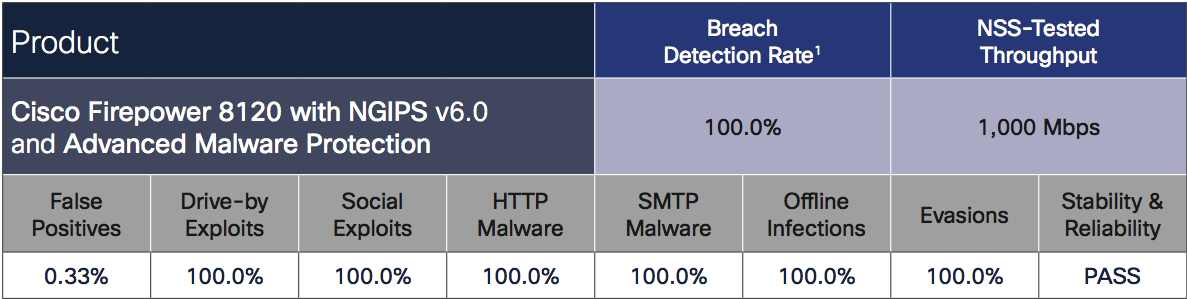
It is with great pride that we received the latest Breach Detection Report from NSS Labs, in which Cisco achieved a 100% detection rate – we simply couldn’t be more pleased to have our products so well-represented and validated in the market, and we truly believe we have the best, most effective security products available today. You can get your complementary copy of the NSS Labs report here.
The Results
“The Cisco FirePOWER 8120 with NGIPS and Advanced Malware Protection received a breach detection rating of 100.0%. The FirePOWER 8120 proved effective against all evasion techniques tested. The solution also passed all stability and reliability tests.”
If you are not familiar with the NSS Labs Breach Detection Report, its simple premise is based on detecting a breach, especially those that bypass traditional detection and protection methods like antivirus and firewalls, and that this detection happens through any means possible. A full description from the 2016 BDS Comparative report for Security from NSS Labs:
“The ability of the product to detect and report successful infections in a timely manner is critical to maintaining the security and functionality of the monitored network. Infection and transmission of malware should be reported quickly and accurately, giving administrators the opportunity to contain the infection and minimize impact on the network. As response time is critical in halting the damage caused by malware infections, the SUT should be able to detect known samples, or analyze unknown samples, and report on them within 24 hours of initial infection and command and control (C&C) callback. Any SUT that does not alert on an attack, infection, or C&C callback within the detection window will not receive credit for the detection.”
This means that the Cisco products detected 100% of the tested breaches within 24 hours, an impressive testament to our commitment to delivering truly effective security to our customers.
The Challenge – Reducing Operational Space
While a tremendous accolade to our engineers, the result is indeed bittersweet. Cisco prides itself in having products that can perform so effectively, but we also work diligently to guide our customers, and a “100% detection” claim without context would confuse security practitioners who look at long periods of arbitrary time, versus reducing the operational space of the adversary.
Therefore, it is questionable whether Cisco or any other vendor should even claim 100% detection as a proof point. Is this a useful measure to push vendors to build better products and provide improved value for our customers? Of course. But in the end, 100% detection of a breach within 24 hours is not what we should be striving for. Asking a simple question illustrates the point well:
If two products scored 100% with product A detecting 100% of breaches within 5 minutes and product B detecting 100% of breaches within 1380 minutes which would you prefer?
Which product do you think the attacker would like to face if given the choice?
Which product would you think the defender would like to have given the choice?
We believe that the time it takes to detect the breach is the better measure and the goal for this measure should be zero minutes. That’s because it would reduce the operational space of the adversary, which is the space and time an adversary has in which to operate after breaching a system. This is far more representative of the effectiveness than the ultimate detection of a breach at some arbitrary future time. Reducing the operational space available to the adversary is what limits the amount of damage done once a system has been breached and it is this time that is the key factor to successfully identifying and mitigating the breach.
Proper Measurement: A ‘For Instance’
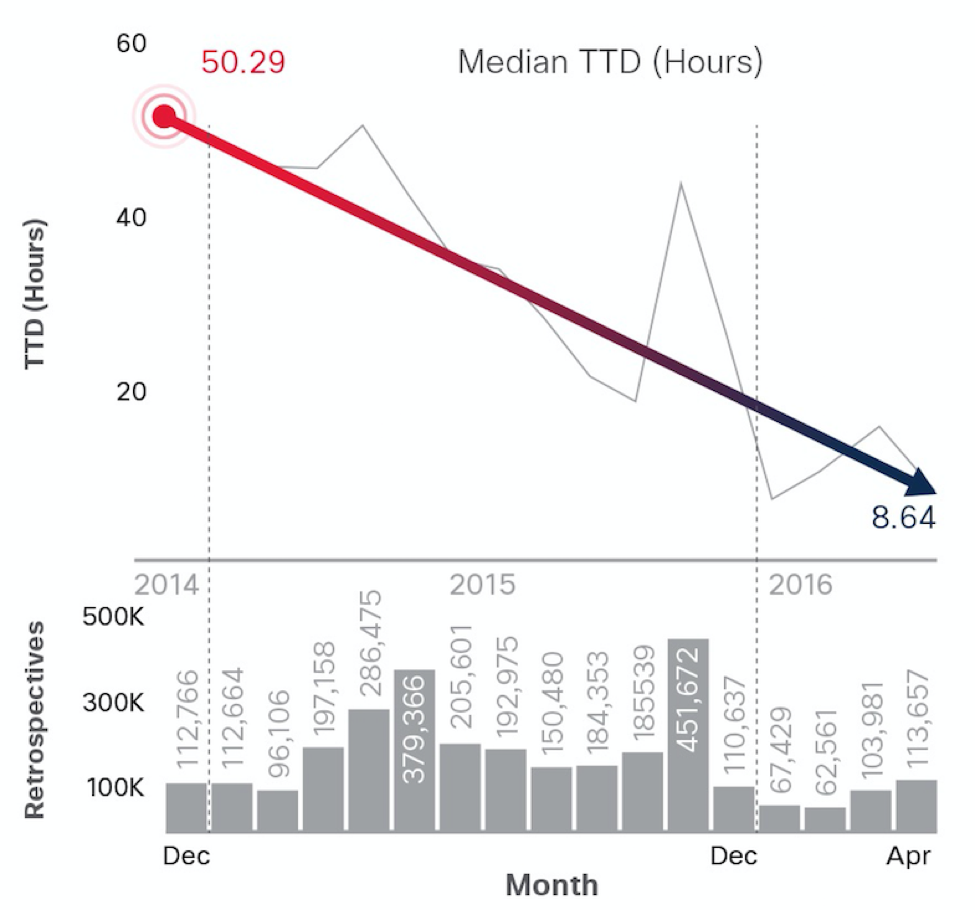
How you should measure the effectiveness of a system is to measure the total amount of time it takes the product to detect the totality of tested breaches. For example – If we assign a greater value to faster detection than we do to slower detection then we can assess overall product effectiveness that is weighted by time. In doing this we do not need to impose arbitrary limits on the length a solution can take to detect a breach and we can better represent the value of that detection. We have referred to and reported on our insights to this metric as our Time to Detection (TTD) since December 2014 and have consistently reduced it from a median of 50.2 hours to a median of 13 hours for this reporting period. Data is available in our 2016 Midyear Cybersecurity Report.
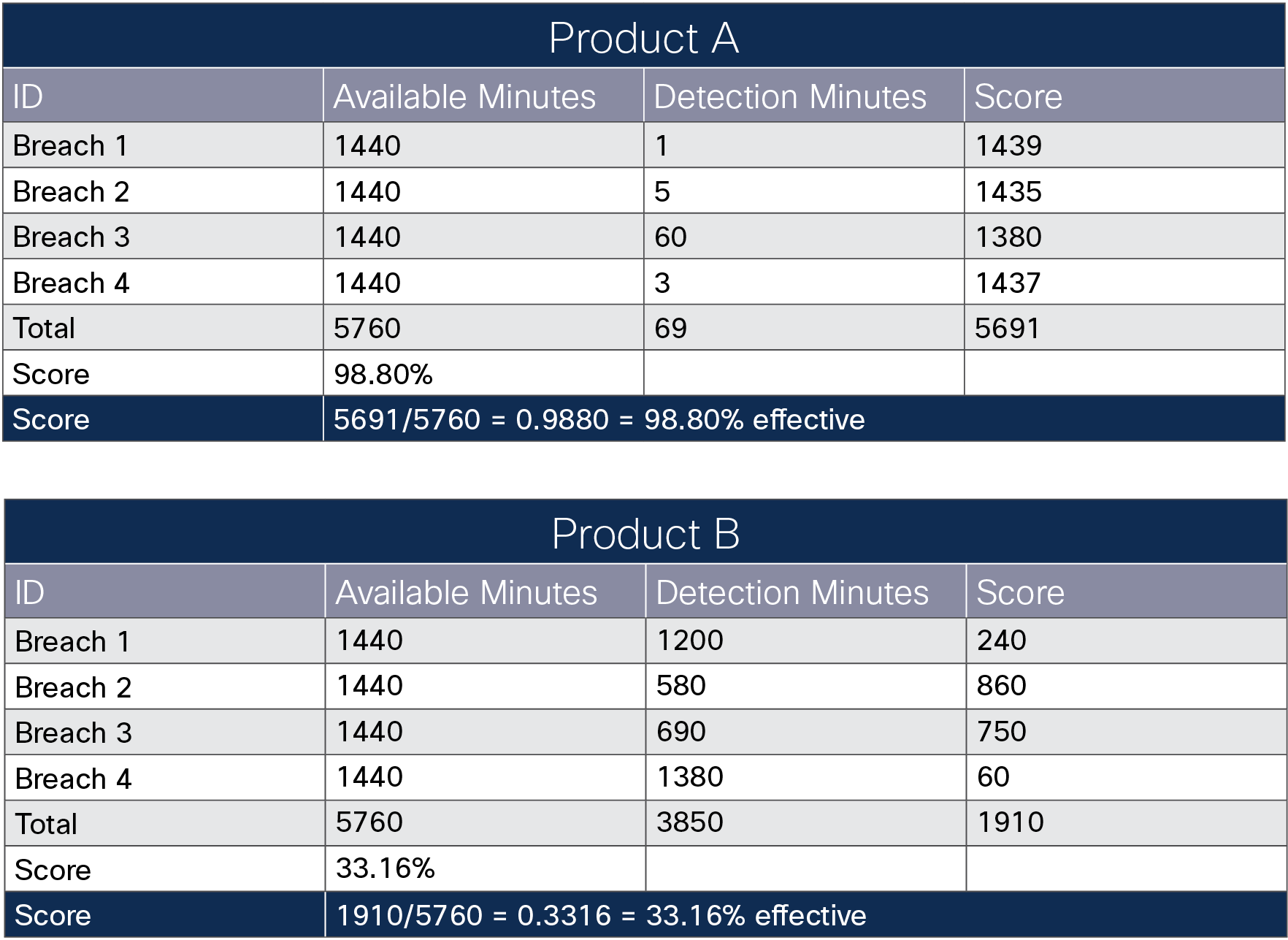
I’ve taken the liberty to model how one such assessment for this breach test might work. While there are many models we could apply, I’ve just inverted the time values and used that as a scoring metric to keep it simple. Simply put, if you have 1440 total minutes to detect a breach and you detect it within one minute you will be given 1439 points for the detection.
EG:
Note that both products detected 100% of the breaches within 24 hours though one product performed significantly better in the TTD and thus reduced the unconstrained operational space of the adversary – and the resulting risk and exposure to your business.
While full data is necessary to perform an exact assessment, we can apply a similar approach with the data that is available from this test. I’ve one such summary below and have eliminated product names as to not mislead defenders or violate usage terms.
What do you think?
There are, of course, other considerations that should be taken into account, such as the actual operational cost of the technology, the real impact of false positives, the value of blocking, and the operational burden any given technology will place on your people and processes. Right now, I would like your feedback on this proposed approach and how it relates to your experiences. Do you think there is a better way to score the effectiveness of security products in detecting a breach? What else do you think is needed or can be improved? Please help us understand what key performance indicators you would like to see, and how you currently measure them or think they can be measured so we can help you deliver more accurate and timely representations in our products.
In the meantime, we do maintain our pride over our current test results, because as stated before, it’s currently our industry’s only measurement. Take a look and consider if we had these measures, as well as the ones I mention above, how that could ultimately help us all better advance our defenses against the adversary.
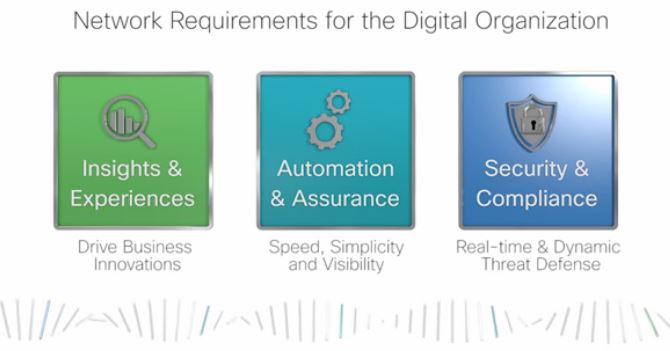
Enterprises are looking to design and deploy network infrastructure that responds faster to change. Cisco Digital Network Architecture (DNA) can help organizations get in front of this market movement by providing a flexible, programmable and open architecture, delivering the foundation for transitioning your business, operations, and technology strategies to achieve digitization.
The business extracts actionable intelligence from the network such as the location of users and enables the Internet of Things (or something to that effect)
The IT team harnesses automation and is freed to work on higher-level and more innovative tasks
The network can identify advanced security threats that bypass other means of detection and quickly remediate those vulnerabilities


 communications professionals and supports the largest U.S. membership base of any public safety association. APCO 2016, APCO International’s Annual Conference & Expo, will be held next week in Orlando and Cisco is proud to be participating.

 Summer time is half over and some people are starting to come back from vacation, while others are taking off on vacation this week, all-in-all it has been a great summer as long as you like the heat.






 Cisconians like to give back. It’s part of what makes working here so awesome. We just want to ROAR about how Cisco enables us to change the world with our new Time2Give benefit. Cisco gives us the encouragement and means to change our communities with time off in addition to our regular paid time off.