There’s never been a better time to attend EDUCAUSE! Who wouldn’t want to hear education revolutionaries and TED Talk alumnae, Sugata Mitra and Susan Cain speak, along with the best thinkers in Higher Education IT? EDUCAUSE is higher education’s premiere technology event, and this year thousands of university leaders, industry experts, and more are gathering in Anaheim, California, to discuss best practices and innovations.
On Wednesday, October 26th, I’ll be joining Georgia State University and Mercer University to discuss changes in virtual learning environments, and how technology is advancing student outcomes. I hope you can join us to learn more about how integrated programs get students, teachers, parents and college staff more involved in outcomes!
I’m also thrilled that Peter Romness, a cybersecurity expert here at Cisco, along with University of Wisconsin – Madison will be speaking on Thursday, October 27th, about cybersecurity in higher education. This is a critical issue for colleges and universities, since networks are growing exponentially with troves of faculty research and student data that need protection. Peter will discuss effective threat detection and how to limit attacks by being digital-ready.
Another revealing session will be led by Cisco high performance computing (HPC) expert Tae Hwang on Wednesday, October 26th. Tae will address how campus IT infrastructure and HPC clusters can integrate to become a better resource for students, faculty, and staff. If you work for a research university, you’ll want to attend this session!
Beyond these provocative discussions, we will also have the best and brightest from Cisco’s higher education team on-hand to demonstrate different secure solutions for students, faculty, and staff:
End-to-end, full spectrum technologies that support cloud computing
Integrations that make teaching and learning accessible anywhere
Licensing that brings digital-ready technology to staff easily and affordably
There’s never been a better time to reimagine education. Be sure to look out for updates from EDUCAUSE on social media – we’re on Twitter at @CiscoHigherEdu and @CiscoEdu, and on Facebook at Cisco. U.S. Education. Also keep an eye on the blog this week for my takeaways from the show floor. Finally, if you’ll be at EDUCAUSE, make sure to visit us at booth 1101 to see our higher education solutions in action!
When Callie was ten years old, she was diagnosed with leukemia. Then, after two years of chemotherapy and three years of remission, Callie relapsed when she was fifteen.
To help Callie beat cancer, a bone marrow transplant was needed. However, due to the risk of exposure to germs post-transplant, Callie needed to be kept in isolation for 100 days.
This isolation would cause Callie to miss her sophomore year of high school. Of course, she was devastated.
As Callie began to beat her illness, her parents started looking into technologies that would enable her to continue her education from home. Cisco helped Callie do just that.
When our team first heard about Callie, our initial response was that we absolutely needed to help.
https://www.youtube.com/watch?v=H1uXVLFbbTE
With the support of Callie, her family, and her school, our team was able to install TelePresence endpoints in Callie’s classrooms to enable remote learning without disrupting peers in the classroom.
To ensure that Callie wasn’t just connected, but was actually able to benefit from the virtual learning experience, we worked closely with her teachers to educate them about the technology and best practices for digital learning.
The impact was incredible.
A turning point for me was when I came into a classroom and saw that Callie’s peers had decorated the endpoint for her birthday. Seeing their willingness to not only accept the technology but also to drive it to new heights was extremely emotional and powerful for me.
Allowing Callie to continue attending classes while battling this terrible illness has been by far the most rewarding thing I’ve done in my professional career. Knowing that Callie has made the Honor Roll in her last two semesters, and that this technology has enabled her to continue living and learning is truly amazing.
Callie’s story is just the beginning. Our technologies have the ability to change lives, and I know that as a company, Cisco will continue to work to get these technologies into the hands of students in need, just like Callie. Imagine the possibilities…
This month advocates worldwide continue to shine the light on cybersecurity. In the U.S. this week’s National Cyber Security Awareness Month theme is “From the Break Room to the Boardroom: Creating a Culture of Cybersecurity in the Workplace.” We at Cisco firmly believe that people are a core component of an organization’s protection efforts, and organizations should place employees at the center of their security efforts.
Why? Because “mistakes” by employees account for one-quarter of data breaches, according to research from the Ponemon Institute.
To avoid such losses, it’s critical that organizations create a culture of cybersecurity awareness. Protecting proprietary and/or sensitive internal and customer data isn’t the sole responsibility of the IT department – nor should it be. While deploying the latest network defense tools is important, a successful cyber strategy should include developing a culture of cybersecurity within the workplace. The developers can focus on writing secure, quality code, while the human resources department and concentrate on maintaining employee privacy. It’s about instilling best practices into the day-to-day routines of the entire workforce, to the point where it is a healthy lifestyle choice in support of your organization’s ‘cyber-health’. A workforce that follows regular practices that keep data assets safe can help minimize risk.
At Cisco, we take the following people-centric steps to drive company-wide security awareness:
Educate them. According to the Ponemon Institute research, employee training reduces the cost of every compromised record by $9. Through training, websites, articles, digital signage, videos, all-hands meetings and blogs, we’re constantly educating our workforce about cybersecurity. Take phishing, for example, which is the number one source of endpoint compromises and something that any employee can fall victim to. We show employees what a phishing scam looks like, with an adversary “disguising” a malware-containing link to appear like a legitimate business inquiry, like this example:
We illustrate the proper way to obtain, classify, mark and store customer data so it is safeguarded. We make it clear that external, non-Cisco approved, cloud file sharing tools put data in danger – and emphasize the use of Cisco-approved tools.
Passwords are a simple, but big, part of our educational efforts. We teach employees how to use more effective passwords – a mix of letters and numbers and special characters – and enforce policies that require the changing of passwords on a regular basis.
Test them. Every effort to educate should involve a test, shouldn’t it? At least we try to make it fun. Remember how we show employees what a phishing scam looks like? To determine whether they’ve paid attention, we periodically send phishing emails to all employees. For those who “take the bait,” they are immediately directed to what we call the “Phish Pond,” an internal landing page. Here, our information security team explains what they did wrong, and how to avoid it in the future. Soon after that, we email to them another mock phishing attempt and, if they click on the suspect link again, we send them back to the Pond for more education.
We also make abundant use of online polls and quizzes – a quick way to reinforce best practices and behaviors to avoid. In addition, we’re collecting and analyzing responses to get a better sense of the level of knowledge of our workforce on the topic.
Make them accountable. Ultimately, we need our employees to understand that we are not requesting they apply cybersecurity hygiene to their usage of the network, computers, mobile devices, apps and data – we’re mandating it. Every year, all employees must review and sign a code of business conduct that covers a broad range of topics, including cybersecurity and data protection. With this, they are committing to a standard of accountability that defines their responsibilities to Cisco and its customers.
Our Phish Pond exercise enters the equation here too: If employees “bite” for a third time, we work with them and their managers to come up with a formal, corrective course of action – one that inevitably involves more intensified training.
Cisco’s dedication to a culture of cybersecurity awareness goes beyond being just a “workplace thing” – we’re cultivating a digital lifestyle. Our employees should completely understand that they play a critical role in the protection of our systems, data and, ultimately, the company. Like avoiding a medical virus in life, you seek to identify where and how problems happen, and change behaviors accordingly.
We stress to all our employees that this really is about business, and that we do not want our data protection policies to restrict them from achieving ROI-generating strategic goals. Guardrails, after all, do not block traffic – they keep cars from going off a cliff. From their first day to their last, our employees learn where the cybersecurity “cliffs” are – and more importantly, how to steer in the right direction.
Steve Martino is Vice President and Chief Information Security Officer at Cisco. For more information on data protection, visit trust.cisco.com.
I wrote in my last post about the industry move to software subscription buying models. While the benefits to software companies and customers are clear, there are also many misconceptions about how this transition will happen.
It won’t take place with the flip of a switch. As customers do with any new technology or new way of doing business, they will need a smooth path to transform how they buy and consume software.
As we’ve seen with nearly every technology driven consumption transition, there remains a long tail of legacy buying. Indeed, while the pace of change has increased, it remains a multi-year journey before we see greater than 50 percent penetration. Even the DVD, which the chart below shows had one of the fastest technology adoption curves in history, took around five years to pass 50% penetration.
Source: Consumer Electronics Association eBrain Market Research
We’re seeing the same long-tail effect in the adoption of –aaS and subscription buying models as they overtake traditional perpetual and premise-based models.
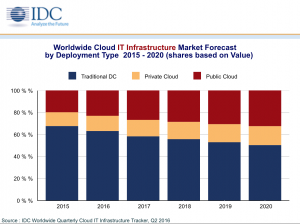
You can see from this forecast by IDC, that IT infrastructure-as-a-Service (delivered by the cloud) is expected to surpass traditional models by 2019—yet when you adjust for private cloud impact (most of which will continue to be priced and licensed in a traditional model), we won’t see greater than 50% penetration until beyond 2021.
Another misconception is that subscription buying takes place subscription by subscription, user by user, without a cross-enterprise strategy or governance. While it is true that users of these new services will find subscriptions easier to adopt because they can simply buy directly through the line of business without going through procurement—the reality is that enterprises are increasingly managing these subscriptions on a more concerted and organized basis.
In fact, most companies will need to use multiple buying models to meet the requirements of different applications and parts of the business. The overall environment might be slightly more complex during the transition, and over time, adoption of these new services will be more tightly coordinated and managed.
Leading software companies need to maintain a range of software buying and delivery models to meet customer requirements and smoothly facilitate the transition. We see this happening not through a single subscription or licensing agreement, but by way of a comprehensive licensing platform that goes across all the various consumption and delivery models customers are looking for.
Vendors must begin thinking of their application portfolios as flexible platforms that allow customers to choose among software components and pricing models.
At Cisco, we’re looking at new ways of offering a cross-architectural Enterprise Licensing Agreement that provides customers subscription on-premise, perpetual-on-premise, and in many situations, the easy movement of technologies between buying and consumption models.
I’m looking forward to telling you more about it here soon.
Guest Blog: Cisco Technical Marketing Engineer Karthik Karupasamy highlights his experiences from Splunk’s recent .conf2016 event in Orlando, FL.
What an amazing week I had at Splunk’s annual user conference,. conf2016! This is the second year I attended and it just keeps getting better. This year the focus was on delivering operational intelligence by leveraging machine data with a particular focus on machine learning.
I really enjoyed meeting so many folks face-to-face who I had previously only interacted with via telephone or WebEx. I was very happy to share how Splunk and Cisco are paving the way to digital transformation with our programmable UCS infrastructure and the Cisco + Splunk integrations around operational intelligence & security analytics. Together Cisco and Splunk help organizations derive hidden insights from their machine data, whether it’s from a little VM, a container, a data center switch, an application server, or a sensor hidden deep in an underground tunnel.
At .conf2016, I co-presented with Splunk’s Brian Wooden. In our talk, we highlighted the benefits and long term value of deploying Splunk Enterprise on the Cisco UCS Integrated Infrastructure for Big Data, our strong partnership with Splunk and about how you can effectively splunk the UCS infrastructure using the Cisco UCS App. During my presentation I announced the release of a new version of UCS Director Express for Big Data with support for Splunk. Check out this video that shows how easily UCS Director Express provisions the entire Splunk cluster (8 indexers, search head cluster with 3 search heads, and an admin node with cluster master, DMC, deployer and license manager functions) – access the video here (1:31). Continue reading “.conf2016 – Beyond Machine Data. Cisco and Splunk Pave the Way for Digital Transformation”
Your challenge today with your mobile network is that you have your current network running at peak capacity, your CxO’s orders you to move to virtualization within your current budget, and you don’t have the resources.
The dynamic network demand requirements of trying to connect the billions of Smartphones and IOT devices onto your mobile network is like trying to connect all of the stars in the sky. Without the ability to hire and retain suitable talent to run the network is making it almost impossible…. Have I gotten that right?
Global Mobile Data Traffic Drivers
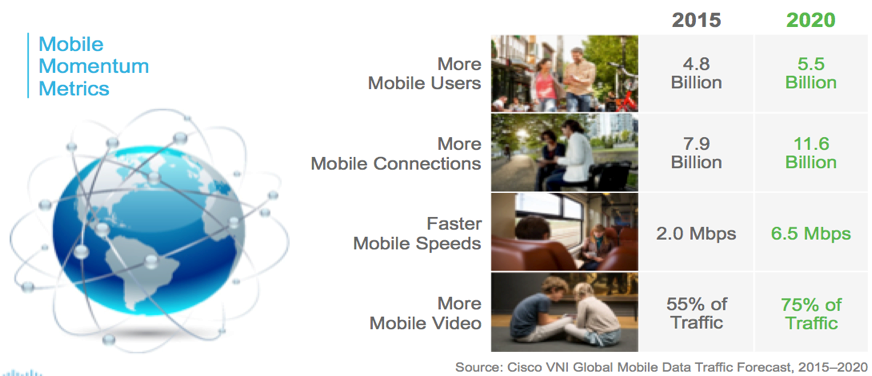
According to the 2016 Cisco Mobile Visual Networking Index, mobile is the #1 consumer device and Video is driving the next wave of Mobility and you will need virtualization in your network to handle all of this. But because of stiff competition you have been mandated to work within your budget.
Fully virtualized solution available today
Cisco is pleased to announce the availability of Ultra M, a turnkey virtualization platform that will simplify the deployment of mobile core virtual network functions (VNFs).
The solution combines Cisco Ultra Gateway Applications with a Cisco validated OpenStack infrastructure that provides customers with the confidence to start rolling out services quickly. This virtualization solution can then be upgraded to the Ultra Services Platform, Cisco’s next generation for cloud mobile services.
Path to Virtualization
Ultra M is part of Cisco’s path to virtualization for the mobile services core.
Ultra M components include:
Cisco Ultra Gateway Platform (UGP) for VNF
Cisco Elastic Services Controller (ESC)
Virtual Network Functions Manager (VNFM)
Cisco Ultra Automation Services provides a simple turnkey installation and turn up
VNF Element Manager (EM) for a closer integration of the VNF and infrastructure
Web-based interface to simplify deployment of the VNF
Qualified on pre-packaged OpenStack Platform from Red Hat and Cisco UCS C-Series
Simple, integrated support structure
Ultra M is available now for customers to deploy a virtualized EPC function and will grow in capabilities as the Cisco Mobile Business Group team further enhances the solution.
Software based load balancers are making a big splash in recent times driven by developer-centric and application-led initiatives. Adding to this growing space of excitement is the up and coming Avi Networks (a Gartner Cool Vendor in Enterprise Networking 2016) which makes load balancers cool again!
Cisco ACI has partnered with L4-L7 application networking specialist, Avi Networks, to deliver automation and application agility across the complete application lifecycle. Avi Networks integrates with Cisco ACI and APIC to deliver flexible, high performance load balancing, application analytics, and predictive auto scaling services.
A few months ago we shared an example of how Cisco ACI and the Avi Vantage platform delivered automated services at a leading financial services firm. Continuing with this success, we are happy to bring another new customer success story in this blog.
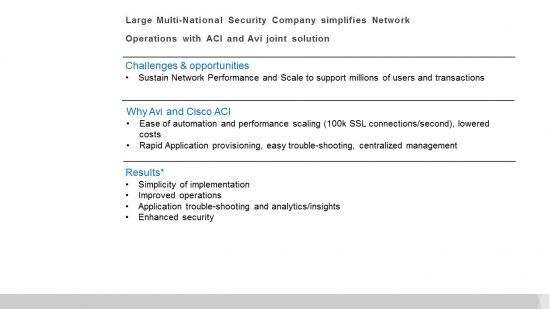
Challenges: This customer success story features a large multinational security company providing critical, always-on security services for hundreds of millions of active users, and running billions of transactions every day across more than 150 countries. For the customer, a network that can scale, perform and support application agility stood among the major requirements to support their massive network operations.
Why Cisco ACI – Avi Networks solution as the choice for this customer? The ease of automation, performance scaling possible with Avi and ACI solution, and the resulting huge operating cost savings were the major reasons for the customer’s decision. The ACI-Avi networks infrastructure handled more than 100,000 SSL connections per second. Alternatives could not handle such magnitudes of scale in their VM-centric environment. Besides, the environment is managed from a central location, with no additional manpower needed as their network and applications expand rapidly. Applications can be provisioned in minutes versus days (as was the case with legacy infrastructure), and issues resolved easily. One network architect even shared that the solution has dramatically reduced the network team’s “Mean Time To Innocence”, allowing them to triage performance issues on the fly.
Business benefits delivered by ACI-Avi solution:
Simplicity of Implementation: The elegant architecture, seamless integration and REST API based automation of Cisco ACI/APIC and Avi Networks means ACI can be implemented on the networking elements in a day. Avi’s L4-L7 application services can be integrated within 30 minutes. Running on standard x86, the Avi Vantage software-defined application services platform is simple to implement and scale-out, and even scale-in if capacity is not needed, automatically reducing costs.
Improved Operations: Complementing implementation and integration, subsequent operations have been automated so applications can get serviced within minutes, versus days in legacy environments. Therefore the lines-of-business get what they need fast, while operations can concentrate on advanced projects and troubleshooting, even as their environments scale.
Application Troubleshooting and Insights: The Avi admin console presents intuitive tree-views of the network topology with granular details of virtual services, all the way to the server pool and pool member details along with health scores that highlights potential application performance issues. This allows the network team to get pinpoint analytics and visibility into application performance. Gone are the days when internal customers and application owners had to wait for several hours or even days to get answers about what was ailing their applications. On many occasions, issues were solved even during the phone call to log the trouble ticket. The team is also able to empower lines of business with role-based access to different application owners to monitor their respective applications.
Enhanced Security: The Avi Vantage platform is integrated into the fabric of the architecture, so a universal security policies can be implemented on Avi’s intuitive and centrally managed Controller.
Cisco continues to leverage its partnerships to deliver unprecedented operational simplicity, with common policy, management, and operation models across application, network, and security resources. Check out more about our partner Avi Networks at https://avinetworks.com and their integration with Cisco ACI.
Are you attending or thinking about joining the largest gathering of women technologists at the Grace Hopper Celebration in Houston later this month? Cisco is proud to be 1 of 10, diamond sponsors of this 3-day conference, where they will be expecting 15,000 attendees. The buzz is ever growing and once again we are planning to descend into Houston and make a bigger splash at GHC. Last year, our Cisco booth was not only featured in the Houston Chronicle with the caption that read, “A call to be confident”, but attendees could not get enough of the infectious energy and excitement at our booth. On the behalf of our executive sponsors, SVP/GM CSPG, Liz Centoni & VP of Eng HR, Christine Bastian, we are once again challenging attendees to truly Embrace their Power and #BeLegendary. In our upcoming #CiscoChat, we’ll be sharing tips and details of the conference so you can plan to get the most out of your GHC experience. Not attending the conference? Join us anyway! We’ll be offering up our insights into
Where there is tremendous change in the digital era, there is tremendous opportunity.
As research reflects, digital disruption will replace almost four of the top 10 industry leaders in the next five years. There’s never been a better time to control your own digital transformation by leading your own innovation and disruption and Cisco wants to show you how.
I hope you will join CEO and Founder of Crowd Companies, Jeremiah Owyang and me for an immersive conversation via Facebook Live on Friday, October 14 at 12 p.m. PT. We’ll host this conversation from Cisco’s headquarters in Silicon Valley, and discuss some of the trends we are seeing around digital transformation, as well as the keys to digital transformation success, including security, big data, IoT, cloud and mobile alignment.
Have digital questions of your own? Ask us live during the discussion. To participate:
Log into your Facebook account today and follow Jeremiah Owyang’s Facebook page (Jeremiah Owyang Verified) to receive updates on the Facebook Live chat
Join our #CiscoChat via Jeremiah’s page on October 14 at Noon PT / 3 p.m. ET, when Jeremiah and I will begin welcoming guests
Ask questions directly in the live stream comments section during the event
I can’t wait for you to join us on this immersive experience. Learn why there’s never been a better time for technology to solve the world’s greatest challenges. #NeverBetter http://www.cisco.com/c/m/en_us/never-better/index.html