Six months ago, Cisco announced the Digital Network Architecture (DNA), providing companies with infrastructure capabilities necessary to digitize their businesses. At the core of DNA are four guiding principles:
Virtualize networking services into software, with the freedom to run on a variety of platforms
Automate the deployment & configuration of networking services through controllers
Surface Analytical capabilities directly from the network which has broad traffic visibility
Cloud-enable the network and applications through “software as a service” and hybrid-cloud
DNA represents a new architectural approach and is directly aligned to Cisco’s investment priorities. Many of the latest Cisco innovations showcase these principles, such as:
Automation: APIC and APIC-EM provide centralized policy-based automation, for both data center and campus/branch environments
Analytics: Tetration Analytics delivers real-time insights into data center telemetry
Cloud: CMX Cloud allows customers to better connect and engage their customers
Although the architectural approach is changing, we wanted to keep the way that customers access Cisco’s latest technology consistent: Cisco ONE Software. Cisco ONE Software gives our customers a simple and more valuable way to consume Cisco’s software capabilities for their infrastructure.
Now 20 months after launch, over 14,000 customers have purchased Cisco ONE Software. 91% of the Fortune 100 have Cisco ONE Software today. 39% of customers have already adopted new capabilities included in the suites, with another 50% planning to use new capabilities over time. While the suites may cost more than purchasing a few individual features, customers who have purchased Cisco ONE Software have found the additional value justifies the price.
If you’re still wondering whether Cisco ONE Software is right for your infrastructure needs, please connect with your Cisco account team or partner, to see if you could benefit from this new model. I’d appreciate any questions or feedback below.
We’ve all heard it by now: Digital disruptors will replace 4 in 10 incumbent companies over the next five years. That’s a statistic certain to make even the Fortune 50 feel squeamish. Companies are rushing to keep pace and transform in the new digital economy. And recognizing both the digital opportunity and the potential demise.
At Cisco, we are on a mission to help you embrace digital transformation. We’re deploying new capabilities that put the network at the foundation for digital transformation. In this new digital world, employees and customers expect effortless communication and interactive experiences. And they expect it anytime, anywhere, on any device.
Apple and Cisco together enable optimized network connections for faster, more seamless mobile experiences. We help you transform business with mobility by helping you put your workers’ business phones in their pockets. Using an iPhone or iPad on campus, people can communicate over the corporate network.
All that digital agility equals more productivity. A recent survey found that companies with digitally agile workforces were three times more likely to perform “better than average” over the past five years. That’s value for your bottom line—and money in your pocket. Along with that mobile phone of course.
Our lives demand digital engagement. In a world where almost any experience can be delivered in an instant, real-time information and access is now an expectation, especially in the healthcare industry.
I’ve been studying the challenges and opportunities of virtual care over the last seven years, and I know what it takes to schedule physicians, engage with patients, provide positive experiences for those receiving care, and most importantly improve the patient outcomes.
Healthcare providers worldwide are partnering with companies like Cisco to deliver this real-time service to their communities, and are using our technologies to prepare the future generation for wellness through promotion of nutrition, general health, and value-based care over episodic-based care.
Watch this video to learn why virtual care is the future of our industry.
Cisco Intern David Black shared this post with us before he returned back to school. We wish all of our interns a very successful year ahead of them!
***
No, my name isn’t Waldo. But when I started my internship at Cisco, I felt a lot like the character Waldo who blends into a massive crowd in the Where’s Waldo? Series, and amongst the sea of interns I knew I’d have to find a way to stand out.
When I arrived at orientation, I hit the ground running as I was quickly immersed in the Cisco culture and even made a few fast friends who I’d explore the Bay area with throughout the summer.
Post-orientation, the nerves hit. I was grouped with engineers, and although I was part of the engineering group – I did not have a technical background. I’ll be honest, a lot of what they were talking about went right over my head. But instead of letting these nerves scare me, I let them excite me instead! This meant that I was going to have a chance to learn a lot more about engineering, but I was also on the lookout for opportunities to make my mark further.
When my team and I realized the Software Platform Group site we were working on lacked fresh content, I knew this was my chance! I began writing a weekly blog series highlighting different employees within SPG to learn about different employee’s jobs here at Cisco and their journeys of how they got to where they are now.
Throughout the course of the summer there were many key takeaways from these interviews and the people I got a chance to meet. Here are some of my favorite tips:
Say Yes to New Opportunities:
I knew my internship at Cisco was going to be different than any other experience I’ve had to date, and that’s what excited me most about it. As I began to face new challenges, this is also when I started to say ‘yes’ to those opportunities.
You never know what may happen by simply trying something new. Ask if you could become more involved or help with other projects. This may lead to learning a new skill, discovering an untapped passion, or at the very least, strengthening your relationship with your colleagues as they begin to see you as someone who is dedicated to being a team player.
Ask For Help:
I didn’t have much of a technical background before the summer started, and after a couple days here in SPG, I could see that put me at a disadvantage, even though I was in a non-technical role. I needed to up my knowledge, especially with the specific technical aspects of our business. I went to my team and asked for help. With their assistance and recommended materials they provided, I closed the gap.
I also knew that I needed to refine my writing skills. I realized unless I worked on it, I wouldn’t improve. Talking to SPG Today’s chief editor, we made a plan to guide and coach my writing process. Working together, I improved my technical skills and learned how to write to engage readers. Through asking for help, I was able to write my series on my co-workers and gain so many valuable lessons!
Don’t be afraid of asking for help. Sure, it may feel scary. But if you don’t, it’ll get in the way of your growth, and you may miss an amazing opportunity.
Never Stop Learning and Adapting:
Throughout my internship I learned to adapt, and do it often, and it’s now become an invaluable skill. When you can easily adapt, you’ll be more valuable as an employee and the regular changes we experience at work (and life!) will be a little easier to manage.
Coming along with adapting to new situations, is how much you will learn. Learning is a lifelong mission. The moment we choose to stop learning is the moment we fall behind and become stagnant. Luckily for us, Cisco has a lot of opportunities to learn, from online, in stretch projects, volunteer events, on Jive communities, and so many more.
Network! Network! Network!
Someone once told me to always network and build new relationships, and it was one of the most valuable pieces of advice I have ever received. Cisco has provided me with so many opportunities to meet new people and to be exposed to a vast amount of knowledge in such a short amount of time. There’s no telling where these relationships will go in the future!
With a company as big as Cisco, there is never a shortage of people to meet, and an opportunity to expand your network.
I leave with you one last, recommendation, or maybe it’s a challenge. Go out and start a conversation with a random Cisco colleague today. Learn about them. Listen more than you talk. And build a real relationship that will last.
Are you ready to join a team that believe in building relationships? Join us!
Since I started this blog series about corporate innovation and intrapreneurship, readers often ask which of my nine building blocks is most essential to mobilize an innovation disruption across an entire company.
Which is the cornerstone? Which carries the most weight? Which is most disruptive? Which impacts cultural transformation? Which turns employees into entrepreneurs?
My answer is always, “All nine of them.”
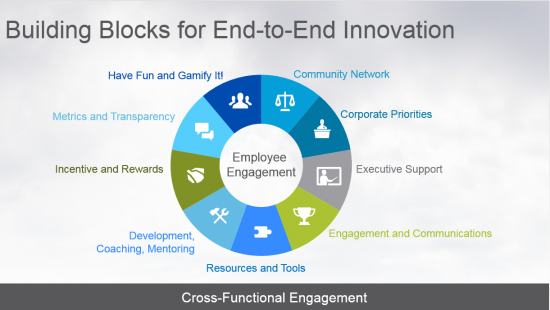
Like Lego blocks, each strategically fits into the bigger construct and reinforces its overall strength. Put another way, the sum of the parts is greater than the whole.
My nine building blocks are interdependent. Think of them holistically rather than independently. Take one out, and it weakens the foundation.
Together, they form a strong foundation to build a culture of innovation across all functions and organizations—no matter their size or market sector.
In that spirit, I’m reassembling all nine building blocks of launching successful internal innovation programs here in one place. Below are condensed versions of each building block that I laid out more extensively in Part 1, Part 2, and Part 3 of this series:
First Building Block: Form aCommunity Network. No person is an island — don’t develop your plan on one. Build bridges with key allies to help shape and advocate your plans, including business unit leaders in all functions, disruptive rebels and steady mentors inside and outside the company. I prefer to call them your “co-conspirators.” This community will help to fuel a grassroots movement, overcome pockets of resistance or break down functional siloes once the games begin. We collaborated with 16 internal organizations, many with own innovation programs. And let the outside in. External experts bring fresh perspectives. Look for people who have challenged the norm and risked everything to start something new.
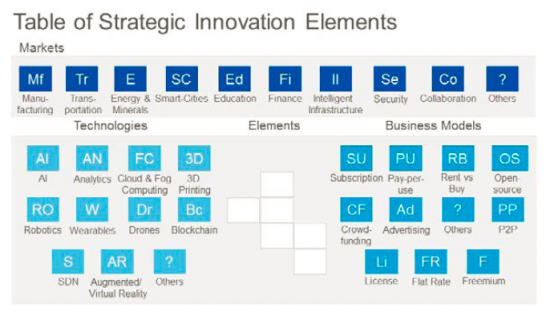
Second Building Block: Drive Alignment to Company Priorities. Don’t be a loose cannon aiming at every dream that streaks across the sky. Make sure your company-wide innovation program aligns with corporate priorities. In our case, we developed a Table of Strategic Innovation Elements, inspired by Adobe Kickbox, which focused innovators on specific markets, technologies, and business models.
Third Building Block: SecureExecutive Commitment. Any grassroots movement needs strong and bold leadership. Without executive champions, especially the CEO and head of HR, such an ambitious cultural transformation will not survive the naysayers. Do your homework, win over the C-suite with the value proposition, game plan, and their roles as champions. And make sure they engage throughout the journey.
Fourth Building Block: Don’t UnderestimateEngagement and Communication. Maintain and ramp up the buzz at each milestone of the challenge to stimulate participation, engagement, and enthusiasm around the teams, many of which will have their own feverish fan base. Blast out ongoing news, especially spotlights on teams, solutions, participants and coaches across all of your employee communications channels. Make sure leaders reinforce key messages such as the importance of forming cross-functional teams, following your passions and taking risks.
Fifth Building Block: Give Your Employees the Right Resources and Tools. Nearly everyone I know has at least one brilliant idea for an app. Very few, however, know how to develop it. You must equip innovation newcomers with everything they need. Resources should encompass a broad scope of specially packaged startup processes, technology tools, and examples of successful startups. At Cisco, we set up online resources through videos, a web site, links, workshops and downloadable guides.
Sixth Building Block: Invest inDevelopment, Coaching and Mentorship. Hands-on and in-person skills training, coaching and mentorship can make the difference in whether your disruption gains momentum and scale. We set up three-day “boot camps” with semifinalists. Lean Startup experts taught teams how to fine tune their solutions, hone their messages, and sharpen their pitches. Make sure your mentors can be reached easily and quickly to overcome technical, business or political challenges. Mentors who guide teams are more valuable than traditional managers, who can be roadblocks to innovation.
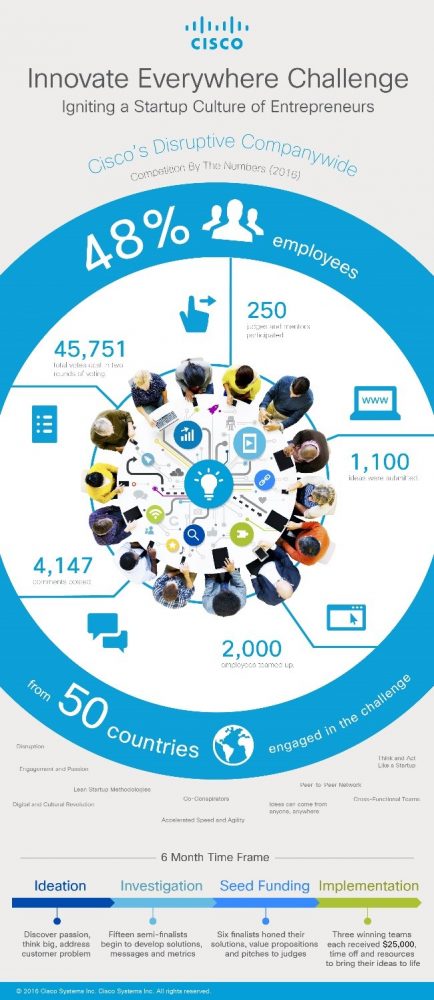
Seventh Building Block: Give Your EmployeesIncentives and Rewards. Gift cards just don’t cut it here. To move the needle, you will need a combination of notable monetary rewards, public recognition, and job flexibility. Our three winning teams received $50,000 each in recognition and development funds, companywide acknowledgement at our All Hands meeting, access to our nine Innovation Centers worldwide, and, most importantly, the option of three months off to develop their ventures. Be sure your organization continues to support teams after they have won.
Eighth Building Block: Don’t Forget AboutTransparency and Metrics. Transparent communications enhance credibility and engagement throughout the journey. Invite employees to cast votes, make comments and form their own communities on an open platform, and communicate why certain teams advanced and others didn’t. Traditional metrics don’t apply to innovation, where failure can lead to success and uncertainty prevails. We used success factors such as employee participation and engagement by function, rank and geography; formation of community networks; discovery of game-changing ideas; and, attraction and retention of top talent.
Ninth Building Block: Have Fun andGamify It!Make this serious business a fun and exciting experience that inspires employees, where the stakes and passions are high, and the winners celebrate victory with their colleagues. We haven’t incorporated Pokemon GO-type features yet, but the lesson is to create dynamic interactions through collaboration technology and exciting live events.
As mentioned in Part 3, these building blocks led to the wild success of our recent Innovate Everywhere Challenge, which captured three Gold Awards from Brandon Hall Group’s 2016 Excellence Awards program. Nearly 50 percent of our global workforce participated, generating 1,100 entries from more than 2,000 teams across 50 countries.
Here are key lessons learned:
Focus on the innovator – NOT the innovation
Builda grassroots, innovation community
Remain flexible: Listen and learn from employees, adjust course if necessary
Passionate innovation is contagious
Passion is an untapped force in many organizations, but when unleashed, can transform your culture into a game-changing disruptor. Passion can bring new levels of value to your company, customers and employees.
To me, today’s successful companies must engage the full spectrum of their talent around innovation. Brilliant ideas for the next big thing can come from anyone, anywhere. Especially when all employees feel engaged and empowered to unleash their passions around innovation.
On a personal note, I am most passionate about innovation in companies of all sizes and types. You can always contact me:
For every young woman who wants to pursue a career in science, math, engineering, or technology (STEM), look no further than Ada Lovelace. Born in 1815 at the heart of the Industrial Revolution, she gravitated toward the fascinating world of science and mathematics, eventually becoming the world’s first computer programmer.
Her lengthy studies connected her with Charles Babbage, a professor of mathematics who’d spent years designing the world’s first computers – clockwork calculating machines. But it wasn’t until Ada arrived that his work ascended into the history books.
Babbage called Ada the “Enchantress of Numbers” and claimed she grasped the sciences “with a force few masculine intellects” could have matched. She took her passion for mathematics and helped bring Babbage’s Analytical Engine to life.
She did so by translating an article from an Italian mathematician, one that described the engine’s core functions. Ada didn’t just translate the article, though; she expanded it, writing a piece three times the length and adding her own “computer programs” to the equation. Her programs detailed the potential uses of the machine, including the manipulation of symbols and the creation of music that would define today’s computers.
Because Ada’s programs are the most thorough – and the first to be published – she’s widely considered the world’s “first computer programmer.” Her findings influenced Alan Turing, who designed the machine that broke Germany’s “Enigma” code during World War II.
And today, Lovelace’s legacy inspires thousands of young women around the world to pursue their passion for STEM. As we celebrate Ada Lovelace Day, we recognize the many ways Cisco is encouraging girls to learn about the achievements of women in STEM, inspiring others and creating new role models for tomorrow’s global problem solvers.
Each year, Cisco recognizes Girls in ICT Day through Girls Power Tech, a mentoring initiative designed to encourage young women to pursue STEM careers. In 2016, 104 Cisco offices around the world participated, and more than 5,000 girls attended events that included hands-on activities and mentoring from industry professionals.
Cisco is also empowering young women to thrive in today’s digital economy. Through the Cisco Networking Academy, more than 6 million people have built the skills to become global problem solvers. They’re turning their networking expertise into fulfilling careers and using the curriculum to solve the problems that matter to them.
In South Africa, Soso Luningo studied technology at a local community center and discovered her passion for technology. She’s now an IT expert who gives back to her community by sharing that passion with other students. In Saudi Arabia, Dr. Akila Sarirete helped bring NetAcad to Effat University, where she’s inspiring the next generation of woman leaders.
The legacy of Ada Lovelace lives on through every woman in STEM. There’s a tremendous opportunity to make a difference in the world, and for many, that starts with technology. Ada’s inventions influenced an entire field of computer science, indirectly creating millions of jobs for today’s generation of young entrepreneurs, technologists, and social change agents.
Learn how you can follow in Ada’s footsteps and break new ground in IT by visiting NetAcad.com
Companies today are facing an increasingly competitive environment and continue to look for substantial differentiation in their market. The Storage and Storage Networking continues to play a vital role in enabling businesses to adopt new technologies and applications to help them scale and grow. Trends like the Internet of Things, Cloud, Big data and Flash Storage are imposing new requirements on storage infrastructure and how storage is managed and scaled. Storage vendors are working on new solutions to alleviate the data proliferation and management issues imposed by new requirements.
Dell EMC today announced the Dell EMC VMAX 250F, expanding Dell EMC ‘s All Flash Portfolio delivering VMAX mission-critical availability while extending VMAX to a new set of customers.
The new VMAX 250F delivers extreme levels of performance and availability in a compact footprint to gain data center efficiency and increase service velocity.
Along with the new Dell EMC VMAX, the latest update to HYPERMAX OS allows customers to deploy Flash storage and manage data efficiently. The all-inclusive software enables new business models by providing features like:
Inline Compression- enables greater levels of efficiency and economics through one of the industry’s most intelligent inline compression offering.
Non-Disruptive Migration – provides unmatched simplicity for migrating previous generation VMAX to newer VMAX 3 or VMAX All Flash
SRDF/Metro Enhancements – delivers increased resiliency and flexibility through Dell EMC virtual witness technology and 3rd-site asynchronous remote replication.
Dell EMC is also introducing a new all-inclusive VPLEX solution exclusively for Dell EMC All-Flash arrays along with a new VPLEX VS6 platform. The VS6 platform and VPLEX For All-Flash solutions have been designed to enable customers to modernize their datacenters with continuous availability and non-disruptive data mobility. VPLEX brings seven-nines availability to mission-critical workloads for performance intensive all-flash systems.
Cisco works closely with Dell EMC to integrate Cisco MDS 9000 platform with Dell EMC storage offerings that provide customers a choice of industry-leading architectures that simplify, automate, and transform your IT while helping you accelerate the journey to the cloud.
Cisco MDS is an open, flexible and standards-based platform, integrates well with a wide variety of storage systems including the new VMAX. To keep pace with the speed of all flash storage systems, Dell EMC customers can rely on the Cisco MDS 9000 Storage Networking platform to deliver Industry-leading performance and scale. The MDS 9000 platform which is sold and serviced by Dell EMC under the Connectrix brand will help customers realize the full value of their IT investments faster.
Cisco MDS 9000 Series Switches have met and often exceeded the demanding requirements for storage area networks for more than a decade. Cisco MDS offers a combination of performance, non-stop operations, and multiprotocol flexibility which is the perfect compliment to the Dell EMC storage solution.
Dell EMC, the Storage leader and Cisco, the leader in Datacenter Networking, provide state of the art joint solutions to enable policy-based infrastructure that is flexible and affordable to satisfy all types of customer requirements.
Live #CiscoChat October 18th – Disruption and Opportunity ahead for the Wealth Management Industry and the 3 things you need to know
Keyword: #CiscoChat
What are the disruptive forces reshaping the wealth and asset management industry? Our recent research with Roubini ThoughtLab predicts that technological, economic, and demographic shifts in the coming years will transform the industry by 2021 — in about 4 years’ time from now. These shifts will unleash an unprecedented wave of global wealth, and along with it, adjusted and expanded consumer expectations for investment providers’ digital and advisory offerings. With 48% of investors surveyed declaring they’ll switch providers if these soon-to-be needs aren’t met, wealth and asset managers can’t afford to miss out on this insightful #CiscoChat. Mark your calendars for Tuesday, October 18 from 9–10am PT.
In the chat, you’ll hear from Dr. Nouriel Roubini (@Nouriel), NYU Stern economist and chairman of Roubini Macro Associates, Louis Celi (@Rthoughtlab), chief executive and founder of Roubini ThoughtLab, Danny Vicente (@Danny_Vicente77), Cisco market manager, and Joseph Pagano (@joseph_pagano), Cisco financial services practice advisor.
To participate in the chat:
Make sure you’re logged into your Twitter account.
Search for the #CiscoChat hashtag and click on the Live tab.
The chat will be moderated Alexis Doherty and D’Auria Henry on the Cisco FSI channel (@CiscoFSI) on Twitter. Be sure to follow the account to participate. They will begin welcoming guests at 9am PT (12pm ET) and posting questions for discussion.
For @ replies to specific participants in the discussion, please use a “.” at the beginning of the tweet, so that your question or comment will appear in your public twitter feed.
If you need multiple tweets to answer a question, please preface each tweet with “1A, 2A,” etc. in order to make it easier for others to follow along with the conversation.
Be sure to use the #CiscoChat hashtag at the end of each tweet, so that others can find your contributions to the discussion.
We can’t wait to chat with you, share our findings, and answer your questions. We’ll see you there.



 Get the Podcast






 r construct and reinforces its overall strength. Put another way, the sum of the parts is greater than the whole.
 Second Building Block: Drive Alignment to Company Priorities. Don’t be a loose cannon aiming at every dream that streaks across the sky. Make sure your company-wide innovation program aligns with corporate priorities. In our case, we developed a Table of Strategic Innovation Elements, inspired by
 Seventh Building Block: Give Your Employees Incentives and Rewards. Gift cards just don’t cut it here. To move the needle, you will need a combination of notable monetary rewards, public recognition, and job flexibility. Our three winning teams received $50,000 each in recognition and development funds, companywide acknowledgement at our All Hands meeting, access to our nine Innovation Centers worldwide, and, most importantly, the option of three months off to develop their ventures. Be sure your organization continues to support teams after they have won.