Ansell, a leading manufacturer of safety solutions, helps protect workers across the globe and is now protecting itself from outside threats like hacking, phishing, and ransomware. They recently implemented a cybersecurity strategy across their operations – not an easy task for a global company that employs more than 15,000 workers.
The result: greater productivity, secure networks at 1/3 of the cost, and increased agility to support innovation and improve the customer experience.
The nature of their business added to the complexity. Ansell’s manufacturing processes could not be interrupted for long periods of times and had to maintain consistent delivery across multiple markets. The company’s board felt a sense of urgency due to the increasing concern of cyber breaches that could potentially impact patents and trade secrets.
“Cyber threats are a growing concern for companies, and as a manufacturer, we have patents and trade secrets that we need to protect from competitors.”
– George Michalitsianos, IT Infrastructure Director at Ansell
A proper transition needed to occur within its aging infrastructure that connected its workers and operations. The company looked at this transition as a way to future-proof its network, create effective security, and boost efficiency. They also wanted to take advantage of new services such as collaboration and improving the customer experience within its call centers.
This meant looking at the network architecture holistically instead of piecing together a patchwork of solutions.
“Standardizing on Cisco solutions gives us an agile and secure platform to support our growth and innovation”
– George Michalitsianos, IT Infrastructure Director
https://youtu.be/_dnI5pWkjbE
Cisco brought that vision together and partnered with Ansell to deliver:
Streamlined network security: A complete network refresh with security design as a focal point of the architecture through Cisco Integrated Services Routers (ISR), Cisco Adaptive Security Appliance (ASA) Software with FirePOWERTM Services next-generation firewalls (NGFWs).
Reduced process time: Superior network proficiency and reduced latency to support more traffic and improve worker productivity.
Reduced executive travel for meetings, saving significant time and money: New collaboration services like the deployment of the Cisco TelePresence® IX5000 Series and Unified Computing System (UCS ) servers in the data center to support video.
Centralized call centers enhanced the customer experience: Unified Contact Center helped agents support customer inquiries as well as metrics and tools to analyze call center performance.
Quicker onboarding of new sites from acquisitions & ensuring global security standards are being met: simplified management of security and licenses through the Cisco Enterprise Licensing Agreement (ELA) to scale the business.
Find out more about how Ansell is changing its business here. And learn how we can help you with security in our interactive infographic:
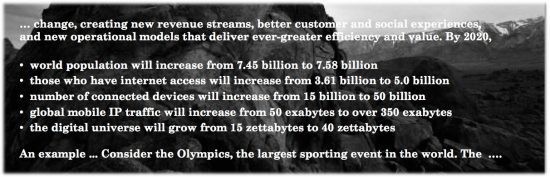
It begins with connecting the unconnected. That the world is undergoing digital transformation is without question. Billions of devices are connected to the internet, and billions
more will be connected by 2020.
Over three and a half billion people have internet access today with another billion and a half coming online by 2020. Let’s not forget that when you bring something online it’s not just connected to the Internet – it is connected to everything else.
This is connecting the unconnected and it is an implacable, unstoppable force that shows no mercy and takes no prisoners. With these connections comes an unprecedented volume of data that successful companies are leveraging in innovative ways.
Clearly, you can’t analyze data you haven’t stored. But there’s more. Increasingly, companies are faced with the realization that they can’t analyze data they have stored but have archived. They have to ‘unstore’ it first. Actually, first they have to find it, then restore it, then analyze it. All the while the clock’s ticking.
And so as we move ahead connecting the unconnected, we find we also need to store the unstored. This includes new data arriving in volumes never before seen, and data we already have and must have immediate access to. It’s no longer about simply accumulating data but constantly analyzing it, transforming it and creating value with it in new ways.
When we store the unstored, we can:
Make the world a safer place: schools, the workplace and public spaces can all benefit from video surveillance and analytics
Create smarter cities with optimized traffic flow and more efficient parking
Help the environment by using energy more efficiently: in business, in our homes, in our schools, everywhere
Make better, more informed decisions regarding health care, education and safety
Serve customers better by knowing them better. More data means deeper insights into customer behavior and better inputs to recommendation engines.
Manage partners more efficiently through supply chain optimization and improved asset management
Improve information technology operational costs and efficiency by storing more for less
Even create entire new lines of business
Why the S-Series?
Digital transformation demands higher capacity storage at lower cost. Internet of Things (IoT) devices such as smart sensors, connected machines and connected automobiles, mobile phones and social media, e-commerce and video surveillance systems, etc. are all generating data at an unprecedented scale. Data storage requirements are increasing in line with Moore’s law (in some cases faster) but the data center footprint, IT staff and funding are not – a lot of optimization is required. So higher storage capacity at lower cost is a must have.
Traditional storage arrays are expensive and have limited scalability. The vision of Cisco’s S-series is to address the every growing demand for dense, high performance and highly scaleable storage systems. The first server in this series, the S3260, is specifically addressing these requirements:
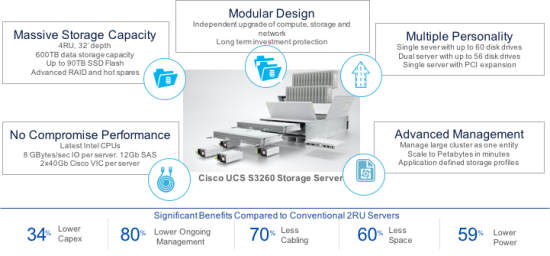
Modular design enables independent upgrades of key server components enabling long term investment protection
High storage density to accommodate data growth without data center expansion
Lowest dollar per terabyte enabling data ‘unstore’ economical
Flexibility in the number of servers and disk drives, and third party adapter options to meet a variety of workload demands
Advanced manageability as a single entity in a scale-out cluster environments even at 10’s of petabytes
High performance network connectivity, currently 4 x 40 GbE, and it’s 100 GbE-ready, massive scalability with Cisco ACI
High I/O Bandwidth per server. Perfect for data intensive workloads.
Data protection through advanced RAID options and global hot spares, and support for leading software defined storage software stacks
Cisco UCS S3260 Storage Server
The Cisco UCS S3260 Storage Server is a modular platform designed for applications that need to store and process large amounts of data and scale effortlessly as the applications demand. The system adds several innovations to the Cisco Unified Computing System improving
on the server, fabric and advanced management.
Protect your Investment: The Cisco UCS S3260 Storage Server helps you significantly reduce total cost of ownership and long term investment protection. The design allows you to upgrade individual components as technology advances. Network, storage and computing components can all be independently upgraded. Never scrap a server again.
Unparalleled Flexibility: The Cisco UCS S3260 Storage Server is flexible enough to handle any workload. It can be configured with one server node for capacity-intensive workloads, or two server nodes when high performance is needed. Designed for high performance and capacity, each server supports 8 GBytes/sec of I/O bandwidth, two Intel Xeon E5-2600 series processors per server node, two server nodes per chassis, and up to 600 terabytes of storage, all in a 4RU form factor and a 32-inch depth innovative design.
More Cost-Effective than Cloud Storage: A recent analysis of the S3260 by Bill Shields shows it is less than half the cost of equivalent public cloud storage. Not discussed in that analysis but equally important, is the cloud is only storage, no processing. If you want to analyze your data you have to pay even more. With the S3260 you get the same storage as the cloud for half the price and the processing capability to analyze the data.
A Lot Denser than Traditional Rack Servers: A single 4RU chassis is equivalent to four 2RU servers in storage capacity, and each server is equipped with dual port 40 Gbps ethernet, employing a balanced, one-to-one core-to-spindle ratio delivering superior computing performance and less server based software licenses, and management points. Also compare 80 Gbps/28 disks (2.8) to 20 Gbps/24 disks (0.83) of a traditional 2RU systems which is critical for data inject, data replication and recovery in scale-out solutions.
On November 17th we’ll be holding a joint webinar with Intel where we’ll discuss the challenges of data intensive applications and the applications and hardware to address them. Click here to register
Workloads for S3260
The Cisco UCS S3260 Storage Server employs a modular design making it flexible enough to handle a wide variety of workloads.
1. Big Data and Analytics
Big data is a big market. IDC estimates the big data technology and services market will exceed $48 billion in 2019. Business intelligence used to mean collecting data, warehousing it and reporting on it periodically. Now data in huge volume is moving from source to consumer at lightning speed, streamed in real-time and analyzed for immediate use. Let me give you few examples.
Big data technology allows financial institutions to consolidate their data from different systems across different lines of business in a more efficient and cost effective way, providing a consolidated 360-degree view of their customer information and transactions. The storage and use of this data varies widely from real-time, low-latency fraud detection to long-term archive storage for compliance purposes.
The Cisco UCS S3260 Storage Server is uniquely positioned to aid financial institutions with its combination of high-density storage and high-performance architecture. The modular design gives IT departments the flexibility to match the configuration to the need.
Manufacturing: Many manufacturing industries employ very complex processes to create their products. For example, pharmaceutical companies and semiconductor manufacturers both monitor hundreds of dependent and independent variables as the material moves through the production line. Even small variations in the raw material and equipment processing can create very large changes in the final yield and the quality of the product.
Increasingly, companies are turning to big data to address these issues, both preventing manufacturing excursions using real-time processing, and in the identification of important relationships between variables to improve quality and yield. The S3260’s ability to effortlessly store huge volumes of unstructured data, process it live while the data is in-motion, and analyze it after the fact when it’s at-rest, makes it the perfect choice to improve quality, increase yield and lower cost in complex manufacturing environments.
Health Care: Big data technology is quietly revolutionizing health care. Using applications built on big data, people are able to live healthier lives and get the right care by the right provider at the right time.
One provider implemented a system that stores and shares data across all facilities and promotes the use of up-to-date electronic health records. The integrated system has improved outcomes in cardiovascular disease and achieved an estimated $1 billion in savings from reduced office visits and lab tests. Another provider developed an integrated system that delivers evidence-based care by coordinating doctors, hospitals and health plans using personalized data.
Others are conducting real world studies of chronic illnesses and common diseases, then combining the results with clinical trial data for analysis to determine the most effective treatments. The same data is also used to guide R&D investment decisions.
Hospitals are using real-time data processing in concert with predictive analytics tools to enable highly advanced, forward-looking and customized treatment plans for patients. Patient records aren’t just being digitized and stored. Diagnostic imaging data is being analyzed in real time for faster and better outcomes
All of these initiatives are driven by the large scale storage and processing of structured and unstructured data. The volume of data requires dense storage to be cost-effective and high-performance to be timely. These are two features where the S3260 shines.
Cisco has published validated designs with major ISVs including Cloudera, Hortonworks, IBM, MapR, SAP, Splunk and others consisting of systems and solutions that have been designed, tested, and documented to facilitate faster, more reliable, and more predictable customer deployments and significantly lower the cost of ownership.
2. Collaboration and Data Protection
Data volumes are growing dramatically. Even mundane systems like email and file sharing are growing at an alarming rate. Traditionally, high-end proprietary (and expensive) systems are used for data protection. The new trend is scale out at a significantly lower cost per terabyte.
The need for data protection solutions is obvious. They are insurance for the business, reducing risk by storing and safeguarding the business data, making it readily available when needed. This includes recovery from failure, both spot failures and disaster recovery, but also the increasingly important need to meet regulatory and compliance requirements by retaining data for a specified retention period.
Cisco provides tested data protection solutions partnered with leading software vendors. These solutions are offered across the entire data center infrastructure: bare-metal, converged and hyper converged solutions. The flexibility, high density storage with exceptional I/O, along with the state-of-the-art network bandwidth (4×40 Gbps) make the S3260 ideal platform for data protection solutions.
3. Content Distribution and Video Analytics
Digital video used to be solely a capacity problem but is changing to a compute processing challenge. Video surveillance now routinely collects and stores terabytes of footage. These systems also share the video across the network providing the ability to actively access events like crimes or accidents. They enable safer schools, cities and workplaces. Other uses include traffic control and crowd control, with an emerging set of systems processing facial recognition and motion event triggers in real-time.
Digital video analytics needs high density storage and high performance computing and networking. The S3260 is uniquely positioned to handle this workload with high density storage per RU, the latest Intel processors, 8 GBytes/sec I/O and 4 x 40 Gbps network bandwidth. A single S3260 chassis with 600 TB of storage can hold a full year’s worth of high quality HD video for 23 cameras (1280 x 1024 x 30 fps, H.264).
Cisco Video Surveillance Manager with Cisco UCS S3260 Storage Server provide a comprehensive video surveillance solution, making it easy for your security staff to remotely monitor, investigate and respond to incidents. This solution combines high-performance computing systems, high-density storage and video surveillance and remote management software.
4. Software Defined and Object Store
Traditional storage systems are limited in their ability to easily and cost-effectively scale to support massive amounts of unstructured data. Object storage is an approach that can handle both the lack of structure in the data and the volume of data. With about 80% of today’s data being unstructured the need for a scalable solution is paramount. The Cisco UCS S3260 Storage Server is an excellent choice for the variety of different workloads required by object storage solutions, including: web-scale applications, media storage, file-based storage and backup.
Managing data that’s constantly flowing into your company requires combining capacity, performance and economics. Even more, creating insight from that data quickly and reliably requires a server optimized for both high-density storage and high-performance. The Cisco UCS S3260 Storage Server meets these requirements at the lowest cost while integrating seamlessly with Cisco UCS and its unparalleled ease of management.
The Internet of Things (IoT) is a critical next step for 21st century companies. But it’s also a complex, multidimensional transformation, demanding new skill sets, technologies, and business models. How to get started? Over years of working with companies at various stages in the IoT journey, I’ve developed a “recipe” for IoT success, with eight essential ingredients. Here is the first ingredient: Build an ecosystem of partners; learn and co-develop with them.
You can’t do IoT alone. No one can. A single vendor can’t provide a complete solution, and similarly, it doesn’t make sense for any organization to try to develop a custom IoT solution for itself.
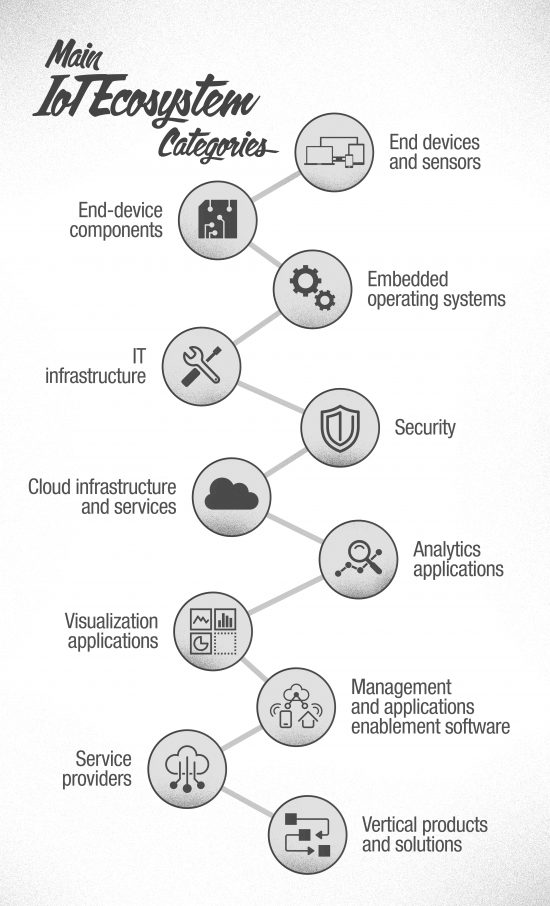
The emerging IoT ecosystem includes customers, other vendors, and startups, each of which brings its own skills, expertise, and relationships to the table.
There are many reasons IoT is driving this shift from a single-vendor end-to-end approach to a partner ecosystem model. For starters, consider the speed of innovation in this space, the complexity of IoT solutions, the cost of custom solutions, and the need for scalability.
The industry is rapidly evolving into a world of partnership ecosystems and customer co-creation. Many companies are working together with customers to develop optimal solutions with horizontal reusable modules that are both open and interoperable. The result will be an open ecosystem of standards-based contributors of IoT solutions. I call this trend the co-economy.
But at the same time, if we are not careful, the partner ecosystem approach can also backfire and slow us down—it is complicated to work across multiple organizations with different cultures. And even when the solution is based on industry standards (which is essential), we still need to take care to ensure interoperability and integration.
So here are some practical steps you can take to approach IoT collaboration for success:
Set the right expectations: Be clear about what you are trying to accomplish, as well as where, when, and how.
Do your homework, but don’t overanalyze: Look for use cases you can apply to many customers with little customization, then, dive right in to experimenting and rapid prototyping.
Assemble the right team and set a clear framework: You need the right mix of viewpoints and perspectives, so put together a diverse team with complementary skillsets. Balance creativity with discipline, and establish guidelines for team communication and dynamics.
Pace the team: Start small, looking first at the four fast paths to payback I discussed a few weeks ago. After an early success, the team will be ready to tackle a bigger challenge.
Measure progress: Stay on track by establishing clear metrics and measuring KPIs.
Include users from the very beginning: Never assume you know what the user wants. Bring customers into the innovation process to give feedback on every prototype and iteration.
Embrace failure: Dare to try something bold and difficult. If you don’t risk failure, you will get mediocre, “me-too” ideas rather than transformative concepts
Okay, so how does this work in the real world?
One example is Cisco’s long-standing partnership with industrial automation and information provider Rockwell Automation. Cisco provides technology know-how in IT infrastructure, security, and collaboration, and market knowledge of the IT industry. Rockwell brings technology know-how in manufacturing automation, and market knowledge in manufacturing, transportation, mining, and oil and gas segments. By adding the industrial robot capabilities of Japan’s FANUC, we complete a solution that extracts data from robots and securely connects them with people, processes and things to provide insight into robot performance—all based on industry standards, of course. If a major element is still missing, then perhaps an eager startup can fill the gap.
Whatever the nature and duration of the partnership, it should focus on customers’ business challenges rather than each partner’s technical offerings. When the customer is at the center, the whole ecosystem benefits.
In upcoming blogs, I’ll share additional ingredients for my recipe for IoT success. Coming up next: how to attract and train new and existing talent.
Strategic innovation in the digital age is powered by people connected to the Internet of Things (IoT). Maciej Kranz has written a definitive guide on how to implement and capture the unprecedented value of IoT. The first of its kind, Building the Internet of Things,” gets past the hype to guide organizations across industries through the IoT journey. His book is available online at major retailers.
It might not seem that hope would come from such a thing, but at the age of 13, my parents and two of my siblings were mercilessly killed during the genocide in Rwanda.
Perhaps hope comes because I miraculously survived, along with my three younger siblings who were all under the age of ten at that time. As the oldest – I assumed the role of a parent to my siblings. Today, we all completed our higher education as we navigated life on our own and rose above the storms.
Rising Above the Storm. This is the name of a non-profit I began just a few years ago to offer hope to orphans in underdeveloped areas of the world. Both the name, and the vision are derived from my personal life story.
Through my journey I’ve learned that I can be an advocate for those who cannot speak for themselves. Rising Above the Storms looks to advocate for orphans, bring hope to rebuild a brighter and more positive future, and empower through education.
Education shaped who I am today. I have an incredible career as a network engineer at Cisco. I got here with full scholarships to college in Rwanda and graduate school in the United States. And this has given me the capability to support my younger siblings. Ultimately, I believe this will help to inspire and encourage those who need it most.
Sometimes, it’s hard to be both an engineer and a non-profit founder. A lot of time and energy goes into both. The technology industry changes every day, and I am always continuing to learn. The same goes for achieving my personal goals with the non-profit, because keeping volunteers constantly engaged also takes learning. Plus, English is my third language. I invest more time to be sure I properly showcase my ideas, but it’s worth it. Add in that I still try to understand a culture that I didn’t grow up in daily, and it’s a full plate.
My parents always believed in me and taught me to work hard. Being a black female engineer has never been a show-stopper for me. It is my hope that I show others that is shouldn’t be for them, either.
What keeps me going?
I am not afraid of challenges. With my history, perhaps you think I should be afraid. Fear doesn’t keep me from trying something new and pushing myself.
I don’t give up. I don’t get discouraged easily and I am very determined. Even when I am disappointed, as long as I am driven by great intentions, I keep marching no matter the obstacles.
I am a grateful person. I make it a goal to ensure people around me feel appreciated and respected.
I don’t take life for granted. To me, every day is a gift and I feel like I was given another chance at life.
I believe in equality of all human kind. Everyone, no matter how great or mighty, we all have insecurities, desire to be loved and respected, and bleed red blood. Everyone deserves a chance and to be treated with respect.
I am aware of my strengths and weaknesses. This helps me team up with the right people to help me grow in life and also to be considerate of those who are different.
I am able to forgive, and move on!
I am not perfect but my goal is hope. To inspire and positively impact one person at a time, whenever I get chance. Join me!
“Every single person has a chance to make a positive impact in someone’s life; not everyone has to do a “big” thing to make a difference. Create and seize opportunities around you, you might be the only hope someone will ever get.”
According to Chuck Robbins, “At Cisco you, our customers, are our number one priority. We can only be successful if we’ve helped you be successful.”
The customer experience has always been a top priority for Cisco. But over the last several quarters, Cisco Security has been hyper-focused on ensuring that our customers achieve consistent and exceptional outcomes throughout their entire journey with us. We are moving past “speeds and feeds” to deliver customer-driven business outcomes, including security efficacy, faster time to detection, and faster time to resolution. In fact, Cisco is blocking 3x as many threats for our customers as Google has searches, while delivering 99.9% efficacy, in its ability to identify and detect both known and unknown threats.
We recently had an opportunity to showcase these efforts to the more than 1,600 attendees at the Technology Services World (TSW) conference in Las Vegas. At TSW 2016, I had the pleasure of delivering a keynote, “Customer Outcomes – a Matter of Survival in Cyber Security!” that details how Cisco has made security our number one priority, as it is our customers’ number one priority to innovate and digitize securely.
The Cisco Security Approach to Customer Success
Now more than ever, increasingly complex network environments and an ever-evolving threat landscape necessitate a strong relationship between security vendors, channel partners and their customers. The amount of data available online today is exploding. Cyber criminals and new attack types such as ransomware are capitalizing on this unprecedented access to valuable information. Organizations have a strategic imperative to properly deploy and utilize their security solutions, otherwise the consequences could be dire.
Cisco Security already provides our customers with superior technology. We can detect new threats within 13 hours when the industry average is up to 200 days. We go to market with a security architecture comprised of best of breed products that are open, automated, and simple to use to deliver effective security.
Now, we are prioritizing the customer experience to ensure customers are not only getting superior technology, but also becoming more secure. We are delivering the right mix of products, services, training, and support needed to help customers achieve their business outcomes and enhance their threat defense strategies every step of the way. It is these types of collaborative efforts that will ultimately enable the security industry to succeed against our highly organized and skilled adversaries.
It Goes Beyond Security
Cisco’s dedication to customers goes beyond just the security team. In addition to my keynote, Cisco also presented a whopping seven other sessions at TSW 2016. The sessions were focused on everything from optimizing service operations, to embracing digitization for service delivery, to best practices gleaned from the Cisco WebEx team’s customer success approach.
Additionally, Cisco was recognized as a finalist for the coveted 2016 TSIA STAR Award in seven of the 12 award categories. Now in its 26th year, the TSIA STAR Award is one of the highest honors in the technology services industry. A recipient of the TSIA Hall of Fame Lifetime Achievement Award, Cisco is the only organization to have achieved more than 30 individual STAR Awards since the inception of the Awards in 1990. Congratulations to each of these teams on being named a finalist in your respective categories. The bottom line is, Cisco customers, we have your back! And we continue to innovate to find the right balance of support that will allow you to protect your network, increase efficacy, and accelerate your time to value for Cisco solutions.
The release of the sixth annual Cisco Global Cloud Index (GCI) reveals some interesting new findings on global data center and cloud trends. For those of us who are not data center operators, these infrastructures are largely invisible or nebulous (pardon the pun). Maybe you’ve walked by the server room or data center area at your company. Perhaps you’ve peeked in to see racks of equipment and blinking lights or you just hear the fans keeping the equipment cool as you stroll by the closed doors (that generally require special access to open). For many, data centers are a secret, clandestine space. But they support billions of network users and machine-to-machine connections around the world. Whether they are delivering services, transporting and storing information, or providing access and authorization to approved content and applications, data centers have become dynamic hubs to an information-rich digital world. Below are three of the seven key trends highlighted in our updated GCI Report that may help remove some of the mystery that surrounds the largely proprietary world of data centers and cloud computing.
1. How many data centers are there globally?
Within the GCI forecast, there are several data center types defined by their size and function. From small server closets to large hyperscale deployments. For the first time in our analysis (through collaboration with Synergy Research), we’ve been able to quantify and forecast the number of hyperscale data centers worldwide. Today, there are 24 hyperscale cloud operators that meet at least one of the one the following infrastructure-as-a-service (IaaS), platform-as-a-service (PaaS), software-as-a-service (SaaS), or other cloud service revenue requirements:
>$1B in IaaS/PaaS (e.g., Amazon/AWS, Rackspace, NTT, IBM)
>$2B in SaaS (e.g., Salesforce, Google, Microsoft, Oracle)
>$4B in Internet/search/social networking (e.g., Facebook, Apple, Tencent, Yahoo)
>$8B in e-commerce/payment processing (e.g., Amazon, eBay, Alibaba)
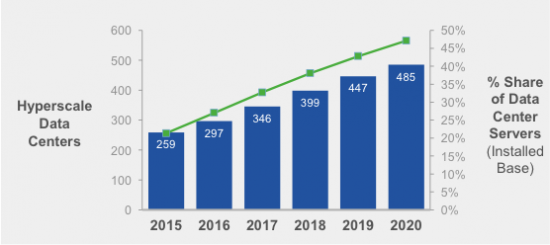
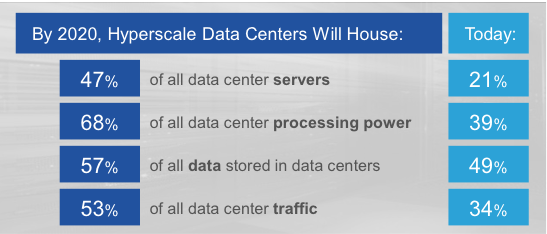
Hyperscale data centers will grow from 259 at the end of 2015 to 485 by 2020. They will also house 47 percent of all installed data center servers by 2020.
Hyperscale data centers will have a significant impact on global data center landscape, representing a significant consolidation of processing power, storage capacity, and data center traffic support.
2. What’s growing faster – public or private clouds?
As part of our standard forecast, analysts compared public and private cloud growth based on workloads. A server workload is defined as a virtual or physical set of computer resources, including storage, assigned to run a specific application or provide computing services for one or many users. Public cloud, as indicated by the workloads growth, is growing faster than private cloud. As the business sensitivity to costs associated with dedicated IT resources grows along with demand for agility, we expect to see a greater adoption of public cloud services by businesses (especially with strengthened cloud security measures). Although many mission-critical workloads might remain in traditional data centers or private cloud, public cloud trust and adoption is increasing. Some enterprises might adopt a hybrid approach to cloud, whereby some of the cloud computing resources are managed in-house by an enterprise and some are provided by an external provider
3. How many consumers are using cloud computing?
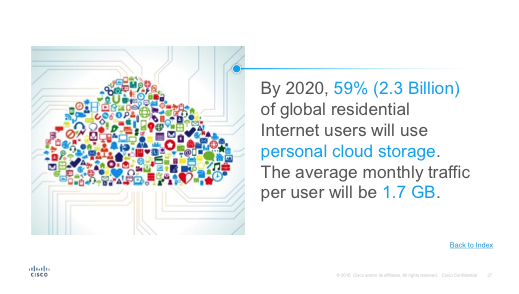
We’ve previously reported on the growth of the global consumer Internet population and multi-device ownership. Complementing those trends in the updated GCI report, we are forecasting significant growth in the use of consumer cloud storage (also called personal content lockers). In personal content lockers, users can store and share music, photos, and videos through an easy-to-use interface at relatively low or no cost. Furthermore, the proliferation of tablets, smartphones, and other mobile devices allows users to access their personal content lockers from a variety of end points. We estimate that by 2020, 59 percent (2.3 billion) of the consumer Internet population will use personal cloud storage, up from 47 percent (1.3 billion users) in 2015. From a traffic perspective, this growth translates to per-user traffic of 1.7 gigabytes per month by 2020, up from 513 megabytes per month in 2015.
In the 2016 U.S. Presidential Election, we witnessed the stunning and unexpected defeat of a methodology in addition to a candidate: poll-based election predictions. November 8, 2016 was a spectacular failure of poll-based predictions, fast on the heels of the spectacular failure of the poll-based predictions in the 2015 U.K. General Election.
Since we have published a new big data forecast as part of the Cisco Global Cloud Index, I had to ask myself… did the big data election forecasts do any better? I was surprised to find that there weren’t any publicly released big data election forecasts. Polls are not big data. Poll-based forecasts are also not data science (often used interchangeably with big data), since a true data science approach would not assume beforehand that only one type of data has predictive power. There may be big data forecasts in existence, possibly done by BlueLabs and Cambridge Analytica, the two firms responsible for microtargeting for each of the campaigns. But these models, if they do exist, are proprietary. All public state-by-state election forecasts were based almost exclusively on polling data, with few exceptions.
In an era when people are plastering social media with their inner thoughts on a daily basis, the idea that you can only know how people will vote by calling them up and asking them does seem a little old-fashioned. If a retailer can figure out you’re pregnant before you’ve told anyone (so they can recommend products you’ll need for the baby in advance), guessing someone’s voting intentions does not seem out of reach. We are in the middle of a big data boom, but there seems to be little sign of it in the world of political predictions. The methodology for how to incorporate the vast amounts of data now available is poorly understood, it’s true, but clearly there is space for experimentation given how poorly most of the forecasts fared in this election.
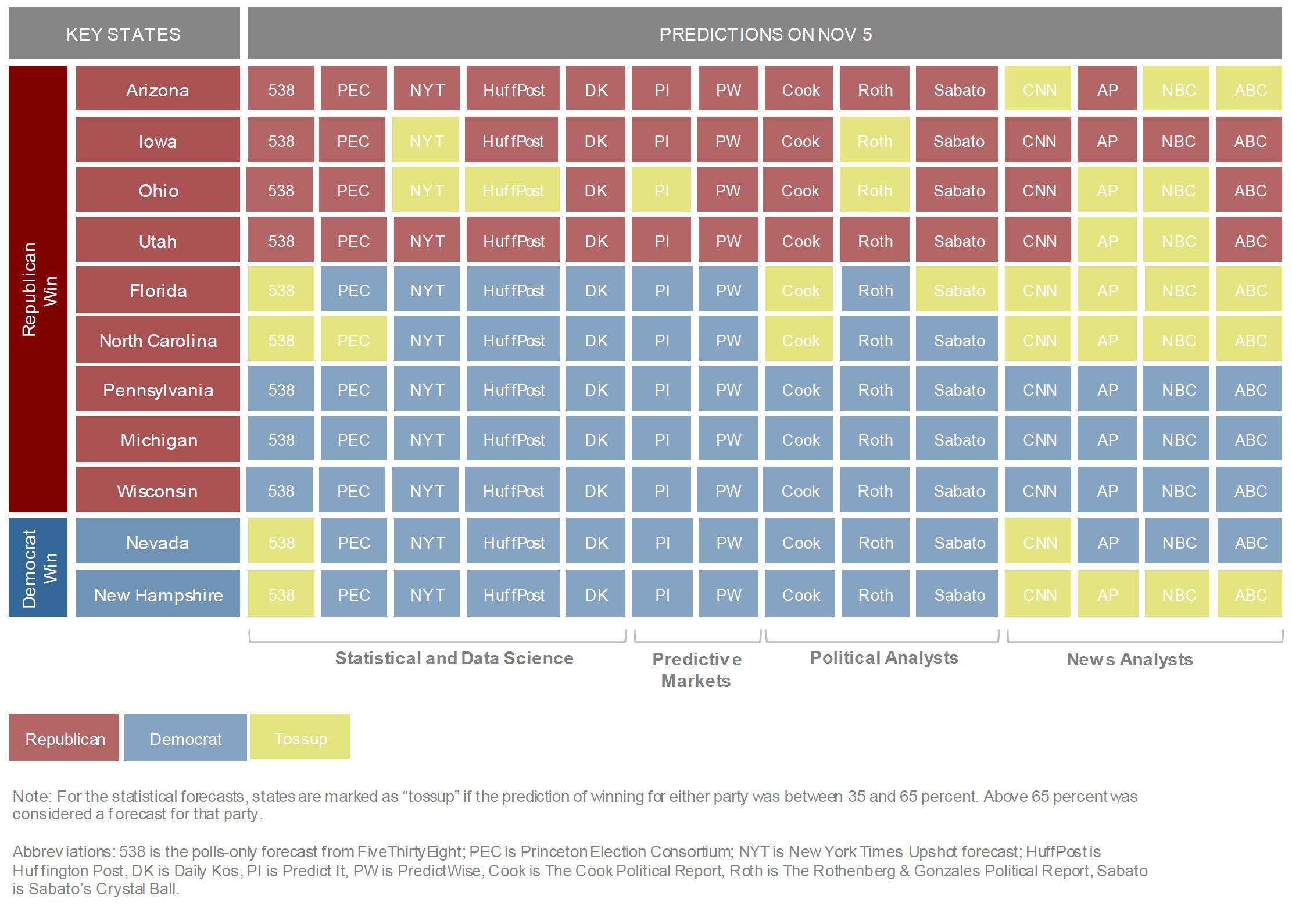
The matrix below shows most of the major predictions for states where the final outcome was not anticipated.
The big blocks of blue for states that ultimately went red is striking. None of the 14 forecasts covered here expected the results we saw in Pennsylvania, Michigan, and Wisconsin. None even tagged those states as tossups. Florida and North Carolina were seen as tossups by several forecasters, but there’s still a lot of blue from others and a conspicuous absence of red.
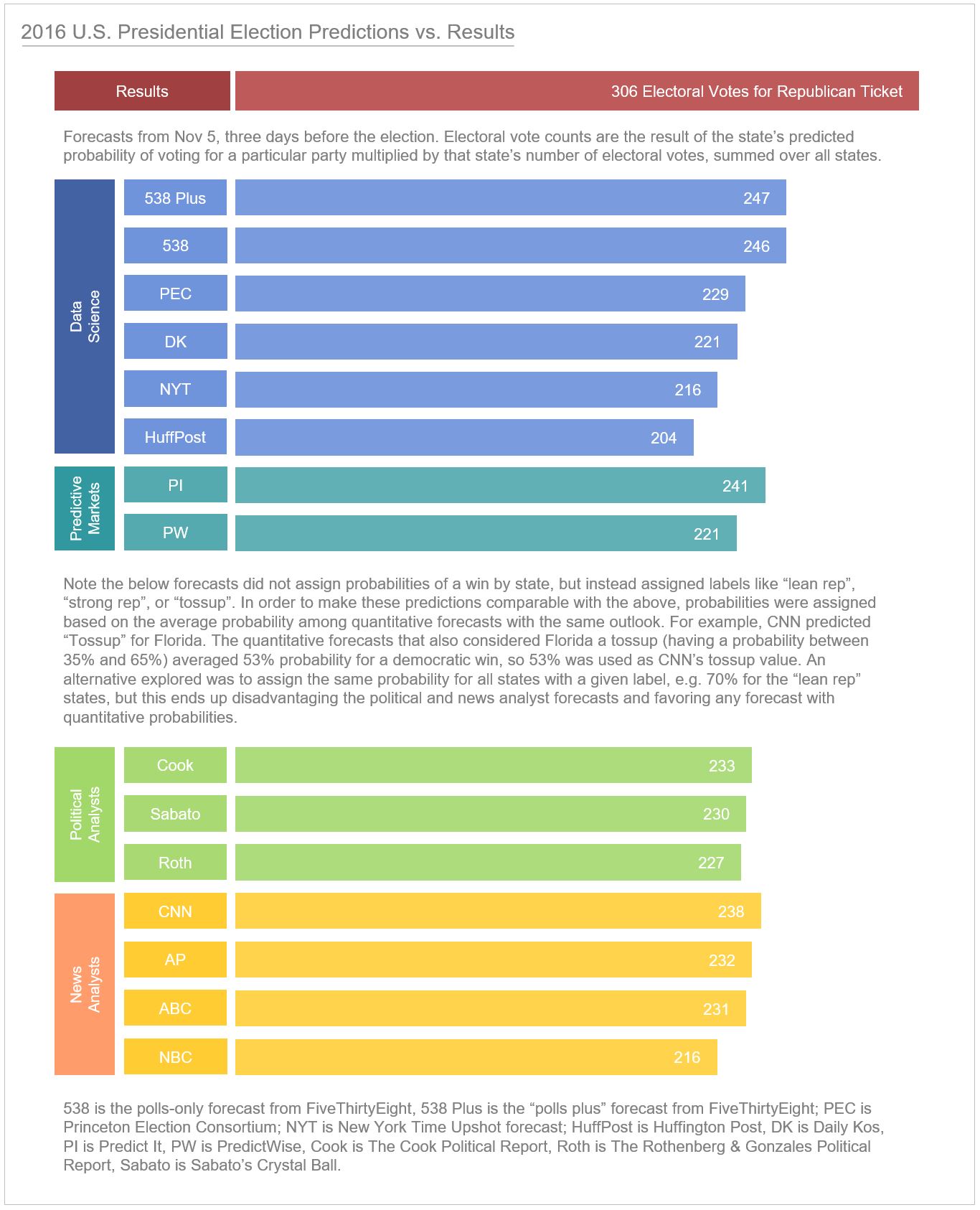
How did the overall electoral vote projections from these organizations compare to the actual results? See the graphic below, which makes projections comparable by eliminating “tossup” wild cards. (See the notes in the graphic for details on how this was done.)
The closest projection came from Nate Silver’s FiveThirtyEight “Polls Plus” model, followed closely by the FiveThirtyEight “Polls Only” model, followed by the results from PredictIt, which tended to follow the FiveThirtyEight data. The FiveThirtyEight “Polls Plus” model is one of the few to incorporate non-polling data in the form of an economic index, and the economic data indicated this would be a tight race. The “Polls Only” model incorporates the historical accuracy of polling data, and also takes into account the connections between state results so that the probabilities of a win in one state are not independent of those in another.
While the FiveThirtyEight model was vindicated as the most accurate poll-centric forecast for this election, the bottom line is that all the forecasts missed, by a significant margin. And all forecasts were lower than the actual result. This is a red flag that something is wrong – ideally we would have some over and some under the final result. To me, it indicates that the data underlying the forecasts was bad, not that the forecast methodologies were faulty. The main problem with the forecast methodologies are that they relied almost exclusively on polling data.
What is the problem with polling? Polls seem increasingly unable to accurately capture the demographic that ends up voting. There are a few reasons for this:
The difficulty of random sampling by phone. Due to the decline in landline phones and the inability (by law) of pollsters to autodial cell phones, it is difficult to reach mobile users, and landline users may no longer be a good base for random sampling. Response rates for phone polling have declined over time, which has contributed to the inability to get a good sample with this method.
The difficulty of representative sampling via the internet. As explained in a 2015 NYT article by Cliff Zukin, the methodology for getting a representative sample with online polling is still poorly understood.
Mischaracterization of “likely voters”. In this election, there may have been a higher than expected turnout of demographic sub-groups that haven’t been frequent voters in the past, as suggested by Cambridge Analytica in a Wired article. It’s easy for polls to miss subgroups of new or infrequent voters. Weighting to capture subgroups is likely what led the USC/L.A. Times Daybreak poll to have results that most accurately reflected what happened on election day.
With the discussion above, it appears we can make further progress in improving the polling data that is used by the forecasters.
What about predictive markets? In theory, predictive markets are supposed to be good at capturing multiple variables through a “wisdom of the crowds” effect where well-informed participants wager on certain outcomes in a market-like setting. In this case, however, the PredictIt and PredictWise predictions appeared just to mimic the statistical forecasts. I asked Paul Held, one of the top predictors to come out of the Good Judgement Project (one of the best-known predictive market projects), why this might be. He explained that the number of participants in each forecast is legally capped so there is not enough of a “crowd” to capture many of the nuances that would bring to a question. What’s more, the value of bets is legally capped, so the markets are not very liquid. According to Held, “any market that doesn’t have high liquidity is going to be less efficient at processing information. Since regulatory rules on predictive markets limit the number of traders and the amount they can venture, the closer you get to an election the less liquidity you see in those markets.”
The conclusion I’ve come to about poll-based forecasts is that while statistical methods such as those used by the FiveThirtyEight group and others have done an impressive job in interpreting the data from polls, the data itself is flawed, as is the reliance only on poll data. Big data is not the answer to every problem, but in this case it can be used to identify other relevant variables that can be used in predictive models, so that forecasters have multiple lenses on the voting population rather than just one.
Maybe in four years we’ll have an election in which there are viable big data forecast contenders. I hope that firms with proprietary data science or big data election predictions will start to make those public. I hope that the new generation of data scientists will start experimenting with new machine learning models to anticipate election results.
For now, without a big data forecast, we will have to settle for a forecast of big data, which is a new feature of our Global Cloud Index. We are expecting big data volumes (bytes) to multiply 10-fold by 2020. See the Global Cloud Index page for more details on this forecast, along with our forecasts for datacenter and cloud traffic, datacenter and cloud workloads, SaaS/PaaS/IaaS, hyperscale data centers and hyperscale traffic, storage capacity and total data stored, and the cloud readiness of countries across the globe.
Join our conversation on Twitter through #CiscoGCI.
Cisco has long been known for its vast partner ecosystem, encompassing resellers, integrators, consultants, and many more from around the globe. But one year ago today, we announced a completely new and, for many in the industry, an unexpected type of partnership.
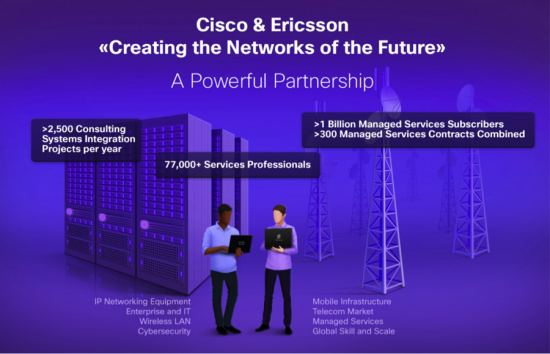
On November 9th, 2015, Ericsson and Cisco – two industry leaders in networking, mobility, and cloud technologies – formed a next-generation strategic partnership to create the networks of the future.
https://www.youtube.com/watch?v=u0Vj472_Lb8
That dark autumn morning in Sweden, I was sitting in a conference room at Ericsson’s Kista headquarters with new colleagues (including Ulf Ewaldsson, Ericsson’s Chief Strategy and Technical Officer, who is as humorous and friendly as he is smart), as we spoke in call after call about our companies’ unique comprehensive end-to-end portfolio, global market presence, and a strong cultural fit. How, together, we would be focused on speed, innovation, and growth, and how such a partnership could benefit our customers.
Over the past 365 days, our companies have worked hard to deliver on this vision. We have jointly engaged with more than 250 customers in every region of the globe and have doubled the number of wins each of the last two quarters, most of which we couldn’t have won on our own. We’ve extended the partnership from its original service provider focus to now also include the enterprise and public sector segments with particular demand in transportation, Smart City, and utility areas, as well as into the web segment.
Our global coverage is now complete after recently receiving regulatory approval to now operate in Brazil, and we have increased the scope of technologies being included in the partnership with the addition of security, WiFi and datacenter switching portfolios. Ericsson has also worked aggressively to extend their leading services capability by achieving more than 2,500 Cisco networking certifications or qualifications to better address the IP Transformation needs of customers worldwide.
There is much more that has been accomplished this past year, and while we certainly have still much more to do and have much more still planned, , I didn’t want this milestone to pass without thanking our Ericsson colleagues for their partnership, collaboration, and shared desire to help our customers thrive.
Winning more than 60 deals across all regions, doubling the number of wins each of the last two quarters– with majority of those deals not possible to win without the partnership
Expanding number of active customer engagements to more than 250 to showcase activity across all regions
Extending the partnership into the enterprise and public sector segments with particular demand in transportation, Smart City, and utility areas, as well as into the web segment
Completing global coverage after receiving regulatory approval to now operate in Brazil
Increasing the scope of technologies being included in the partnership with the addition of security, WiFi and datacenter switching portfolios
Delivering Ericsson-certified solutions in different areas, as Mobile Backhaul, IP Core, and SP WiFi where certification is ongoing, with additional solutions on the way, where Cisco is contributing with products, expertise and use cases.
Developing a joint services portfolio based on Ericsson’s scale and skill in systems integration and managed services and Cisco’s IP competence. The portfolio is developed in the areas of Networks, Enterprise, SP WiFi and small cells, Data Center and Cloud and Security.
Achieving around 2,500 Cisco networking certifications or qualifications by Ericsson sales and service engineers
Amid more than 50,000 global innovators at this week’s Web Summit in Lisbon, three emerged victorious just moments ago in our third annual Innovation Grand Challenge.
The electrified atmosphere of Europe’s largest innovation marketplace heated up when our own challenge finalists took the stage and pitched their disruptive digital ventures to a panel of industry luminaries. With onlookers in their seats, and finalists anxiously awaiting the culmination of a six-month-long competition, judges rendered their decision on the spot.
I am thrilled and honored to announce the three ultimate winners of this year’s Innovation Grand Challenge:
Streamroot, France (first place winner, $150,000 prize): Centralized video optimization network improves speed, quality of service, and global reach. Streamroot offers a secure and coordinated mesh network of viewers watching the same content, providing video segments from the source that can provide them more quickly and thereby diminishing stress on saturated servers.
Gestoos, Spain (second place winner, $75,000 prize): Cameras leveraging Artificial Intelligence, Gestural Interaction, IoT and Multimodal locations to see and understand people’s movements, gestures and behavior in any environment and context. Gestoos is the “brains behind the eyes,” alerting, for example, distracted drivers to be more attentive or autonomous cars to take over.
Dedrone, United States (third place winner, $25,000): Automated, 3D aerial security platform identifies unauthorized drones, protects critical installations and ensures safe drone usage. Dedrone’s goal is to become the leading drone detection company, delivering the world’s first lower airspace surveillance system.
A panel of judges selected the three winners after all finalists made well-rehearsed investor pitches earlier in the day. All the finalists had already survived successive rounds of competition that began last May, setting themselves apart from more than 5,700 entries in 160-plus countries.
Beyond their compelling presentations, judges also scored the ventures on criteria such as customer value, potential for market growth, disruptive nature and uniqueness from the competition, compatibility with Cisco’s and our partner’s strategic focus, leadership and talent, and likelihood for success.
“What an amazing experience. What an exciting time! All finalists earned tremendous admiration and inspired everyone who gathered for the live event,” said Helder Antunes, Cisco’s senior director of corporate development technology who served as host and master of ceremonies. “Co-innovation ideas are overflowing throughout the conference, but our three winners rose to the top because of their unique potential to change the game in key industry markets.”
Cisco’s Christiaan Kuun and Rowan Trollope discuss the future of the Internet of Things on Periscope at Cisco’s Web Summit booth. Watch here.
These startup stars now embark on an incredible co-innovation journey to jumpstart their ventures. In addition to the $250,000 prize money they will share, each startup will gain access to Cisco’s Innovation Centers, premier resources, mentorships and vast opportunities with partners and investors to accelerate go-to-market engagements.
In addition to congratulating this year’s winners, I want to thank our valued partners at TTTech, who helped us run the challenge from beginning to end, and co-hosted the finals. We could not have done it without you!
I also want to single out the many eminent judges who spent untold hours analyzing the merits of our entries. More than 100 experts both inside and outside Cisco had the excruciatingly difficult task of poring over thousands of entries and narrowing the field based on detailed criteria.
Our esteemed judges in Lisbon also deserve special recognition for their own time and talented commitment to help discover the world’s best innovation talent:
Marek Rubasinski, Director, Sky Startup Investments and Partnerships
Thanks to this growing community, the r-evolution of disruptive innovation has become the new normal. The Innovation Grand Challenge both ignites and reflects this unrelenting momentum. This year’s challenge in particular reinforced my belief that startups and new ideas for digital transformation continue to mature, diversify and grow exponentially year over year.
We’re experiencing an historic period of hyper innovation, enabled by Internet of Things (IoT) technologies to digitize industry, government and society. As just one data point, participation in our annual challenge has nearly doubled each of the past three years.
And according to Accenture, the digital economy will account for 25 percent of the global economy by 2020—up from 15 percent in 2005 and 22 percent in 2015. With mass digitization pervading all industries, I am convinced the next wave of this revolution will come from inter-connected ecosystems linked to the leading digital platforms. Platform-based partnerships built around co-innovation will accelerate the development, value, and scalability of the most brilliant ideas.
That’s why I get so excited about the Innovation Grand Challenge every year. In addition to the challenge itself, we always discover new talent, forge new relationships and renew lasting ones. At our Web Summit booth, Helder and his team of strategic innovators are blazing new trails of opportunity with innovators all week long.
This year’s challenge reinforced another one of my strong beliefs: Innovation can truly come from anywhere, and co-innovation can take it everywhere.




 data center footprint, IT staff and funding are not – a lot of optimization is required. So higher storage capacity at lower cost is a must have.
 upgraded. Never scrap a server again.

 hundreds of dependent and independent variables as the material moves through the production line. Even small variations in the raw material and equipment processing can create very large changes in the final yield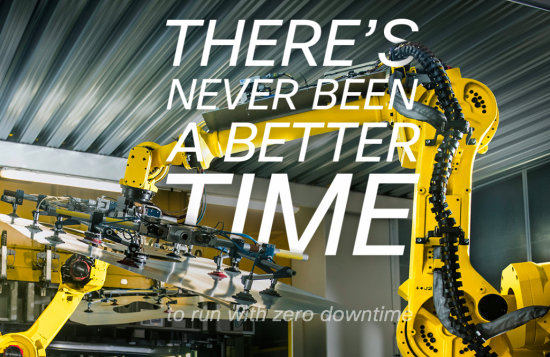
 One provider implemented a system that stores and shares data across all facilities and promotes the use of up-to-date electronic health records. The integrated system has improved outcomes in cardiovascular disease and achieved an estimated $1 billion in savings from reduced office visits and lab tests. Another provider developed an integrated system that delivers evidence-based care by coordinating doctors, hospitals and health plans using personalized data.







 What keeps me going?