I am incredibly excited about IoT in general. But IoT applied to cities—so called “Smart Cities”— is particularly exciting because it hits so very close to home. This is not about sensors in some faraway manufacturing facility. It is stuff that can profoundly affect the quality of the air you breathe and the safety of the streets you walk.
As a geek and innovator, I am always looking for the multiplier: What needs to happen to get to the next level of awesome? How do we take what we have learned so far and make a bigger impact for a broader swath of humanity?
For Smart Cities, we need to do a few things. We need to make it super-simple for cities to securely connect new “things” so that new information can be collected, analyzed and shared. And at the same time, we need to make it super-simple for new cities—cities that are not yet on the digital track—to get started.
The Cisco Smart+Connected Digital Platform we announced today helps on both fronts. Cities can confidently connect new “things” as we certify a set of companies that provide infrastructural solutions both “south” of the platform and application solutions “north” of the platform. This simplicity—a cornerstone of our overall strategy for IoT—will give more cities the green light to boldly pursue a digital future.
We are excited to be working already with cities in the US, India, Denmark, and Australia. Results won’t come overnight, but change will happen faster than you might expect. I am so excited about IoT’s ability to create cleaner, safer cities—cities I want to live in. What do you think about smart cities? Let me know @rowantrollope
To learn more about the Smart+Connected Digital Platform, please visit cs.co/digitalplatform
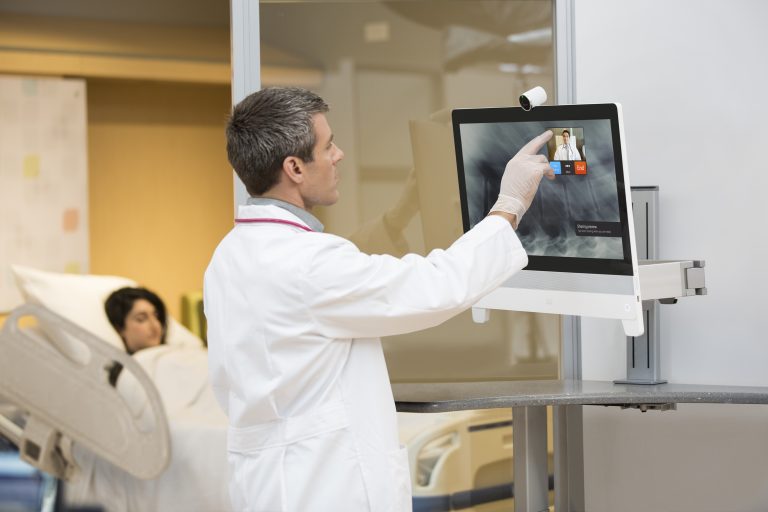
One in eight women will be diagnosed with breast cancer in their lifetime. See how digitizing the network connects multiple experts to the patient securely for efficient diagnoses.
For most women, it all starts with a call from their doctor that something was abnormal in their routine mammogram. The first few weeks of this harrowing journey can be especially stressful as the patient waits for answers. They wait to hear back from their doctor about test results, wait for an appointment with a specialist, and then wait some more to hear back again.
vRad is transforming and accelerating this conventional process with the implementation of Cisco collaboration, networking, and security technology. As the leading American teleradiology services and telemedicine company, vRad enables nearly 500 physicians to interpret and process patient imaging studies virtually. The physicians work remotely and are able to optimize workflows in a way that dramatically reduces the turnaround time. This allows for significant improvements in the patient experience – most patients are able to get their imaging results in the same appointment as the scan procedure!
Still can’t turn on video because it jitters too much? Want to connect to more endpoints without spending a lot of money? Try using a Cisco Catalyst 3850 and 3650 Series switches to provide AVB.
Whether you’re in hospitality, government, enterprise or another industry, Cisco AVB is an ideal solution for crisper video and clear audio. Deploy it into your current audio-video setup: in conference rooms, auditoriums, and more.
Best of it — It’s the built-in feature in Catalyst 3650/3850, you don’t need to spend extra to have it!
Audio video (AV) equipment deployments have traditionally been single-purpose, analog, point-to-point connections with one-way links. As AV deployments migrate to digital, they have continued to retain this inflexible point to-point architecture. This dedicated connection model also results in a mass of cabling that is difficult and costly to manage. In contrast, an open-standards based Ethernet infrastructure enables flexibility and transparent interoperability of multi-vendor AV equipment and integration of new services.
Benefits of Catalyst AVB:
Improves quality of experience by delivering low jitter and low latency
Helps scale applications across networked deployments, for many-to-many connections.
Reduce cable complexity: You’ve seen the results of too much cable: it’s messy, disordered, and nearly impossible to trace to the source. In this case, less is more.
It’s been an exciting week for education at Cisco Live Latin America! Not only did attendees get to see our technologies in action at the World of Solutions, but some also got the opportunity to attend our Higher Education Summit on Monday as well.
The Higher Education Summit addressed how to securely enable digital transformation in education.
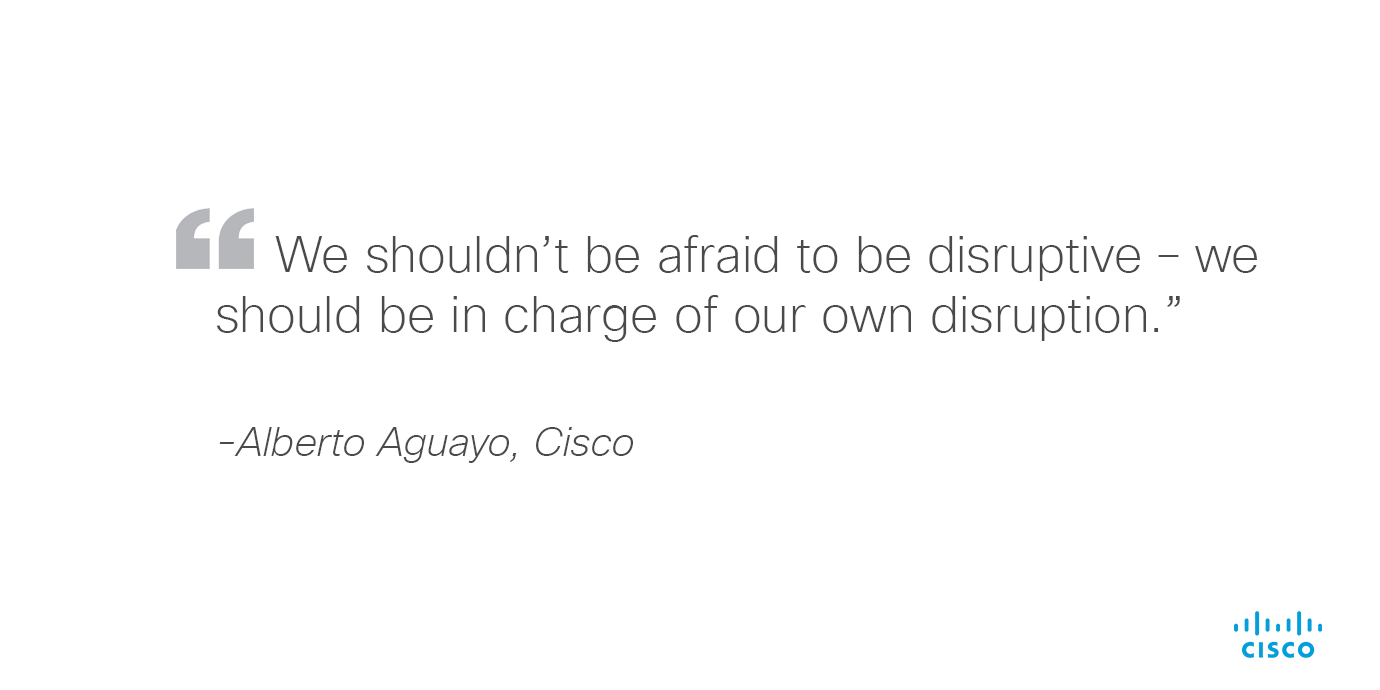
The day started off with a discussion with Alberto Aguayo, a director at Cisco. He spoke on the necessary evolution of the role of the CIO to the Chief Digital Officer, urging the participants to rethink and redefine what it means to innovate.
Next up was a customer panel with three of the leading higher education institutions in Latin America.
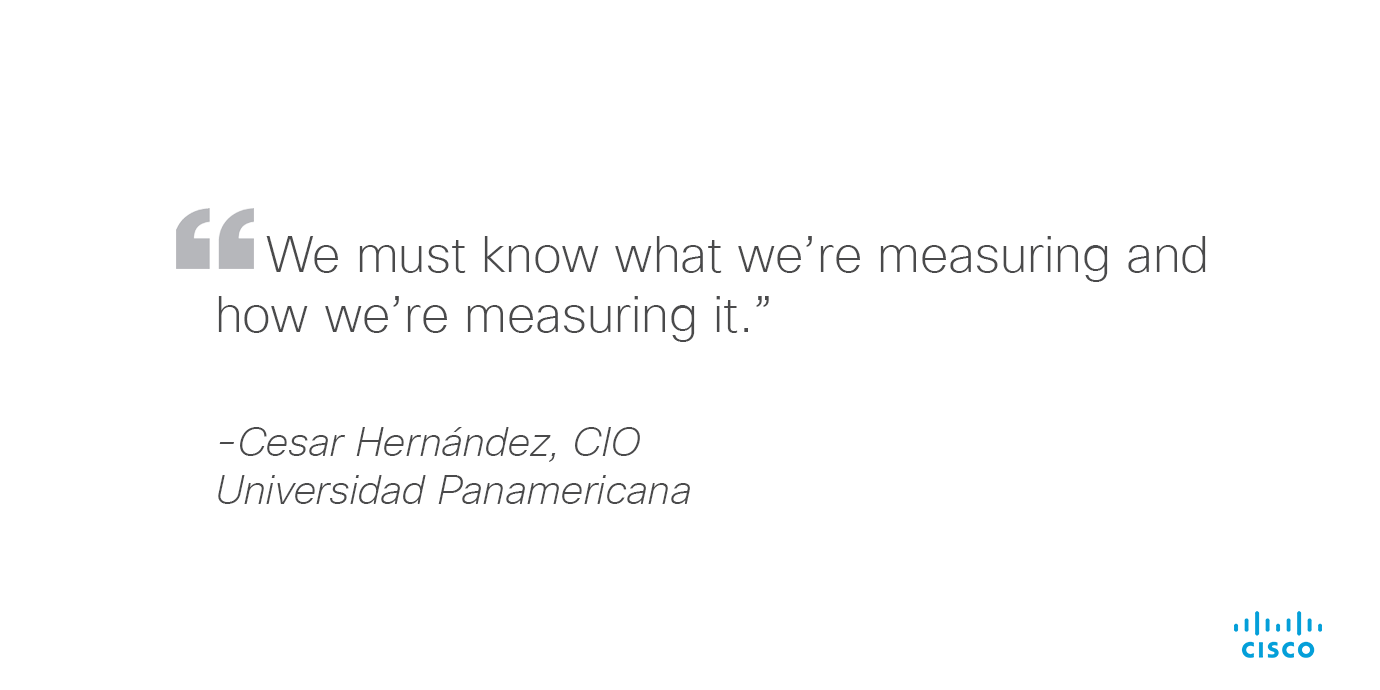
Cesar Hernández, CIO of the Universidad Panamericana, stressed the importance of communication and metrics when transforming a higher education campus.
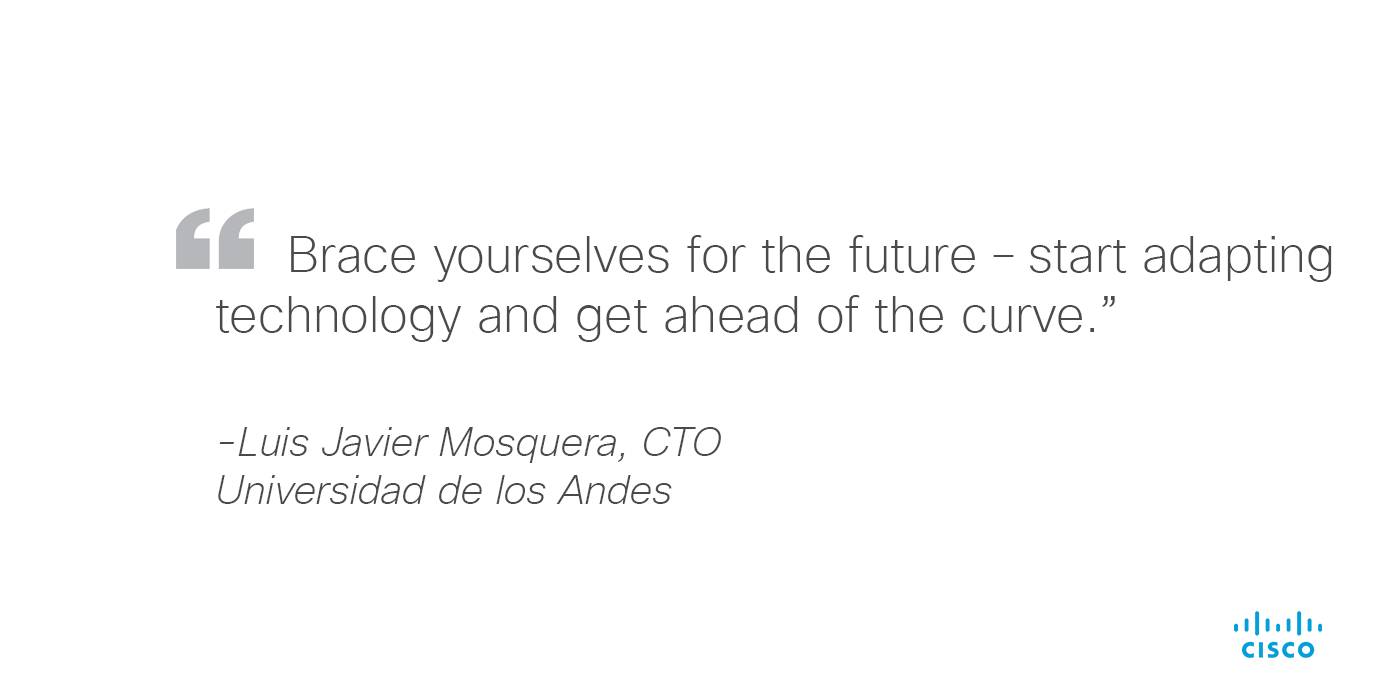
Cesar Díaz, the CIO of Benémerita Universidad Autónoma de Puebla spoke to his campus’ need for virtual classrooms, and the transition they made to transform learning at their institution. Finally, Luis Javier Mosquera, the CTO of Universidad de los Andes spoke to attendees about getting to know the business, and using that information to inform innovation.
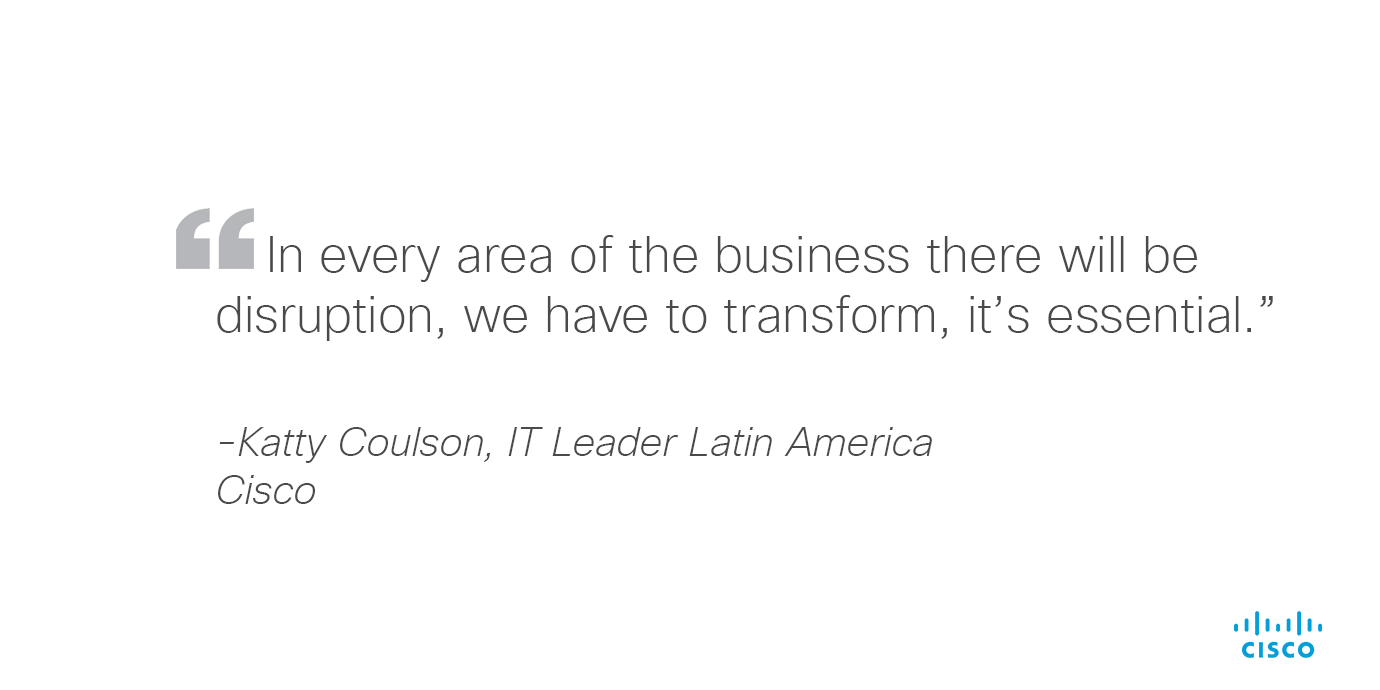
After a presentation on our Digital Education Platform, we ended the day with Katty Coulson, the IT Leader for Latin America. Her presentation centered on the critical investment in security to allow universities to embark on the road to digital transformation.
Following the summit, participants left with renewed inspiration to continuously evolve and transform their campuses. If you were at the Higher Education Summit, tell us what you thought in the comments below!
There was a time when launching a virtual network meant creating an mobile virtual network operator (MVNO). From enabling access to the network, to launching the brand, to developing a customer base – everything took its time.
But the growth of the Internet of Things (IoT) is now changing all that. The number of potential virtual networks is virtually limitless. Auto brands want to use networks to support a connected car service. Home owners want to control their appliances, lighting, and thermostats from their phones. Cities and local authorities want to create smart cities – bringing together their streetlamps, parking meters, traffic management systems and more.
This world is arriving fast – and it’s a world of opportunity for service providers. But to take advantage, they’ll need to be able to do a lot of different things: to get new products to market fast, to extend and update, to offer different levels of service, and to make it possible for other developers to build the applications that will make all this happen.
Sounds like a big ask? At Cisco, we’re leading the way in building the foundations to make this vision possible, with our programmable networking and virtualisation technology.
Introducing the agile virtual network
Let’s dig deeper into the idea of a smart city. A smart traffic management system has the potential to bring a host of benefits like reducing congestion, accidents and pollution – even as the number of cars on our roads increases. But it needs to be underpinned by a network that draws together information from sources like vehicle and road sensors to manage and direct traffic.
A network with such an important role must be able to guarantee capacity. Cisco’s technology helps here, by using software to build agile virtual networks not constrained by the limits of their physical infrastructure. A programmable network is more efficient because it’s flexible in the way it provisions its capacity, knowing where data is most needed and sending it there. What’s more, most of this functioning can be automated, bringing real savings on operational costs.
The agility of programmable networks can help smart cities in other ways, too – like empowering them to connect their traffic platforms to the wider network. We use open API standards and YANG data models to build our software, because this helps different parts of the network to ‘talk to each other’ easily. So it’s straightforward for a traffic management system using our programmable network technology to take on board future developments like new roads, roadworks or driverless cars – and to be joined together with other parts of the smart city.
Once the foundations of a programmable network are in place, a provider has the opportunity to sell other services, like enhanced security. And it can add further services to the mix as they’re developed, offering different options tailored to suit each customer. A network defined by software rather than physical equipment offers flexibility now, and plenty of room for future growth.
How virtual is becoming actual in Hamburg
One location where Cisco technology is being used to create flexible, agile virtual networks is Hamburg. The Hamburg Port Authority (HPA) was previously relying on four different networks, which couldn’t communicate with each other, for traffic management and communication.
Cisco virtual network technology is now being used to integrate these networks and manage lots of different aspects of city life – including traffic management, smart parking, and connected port logistics. The Port of Hamburg is now increasing trade flows, protecting resources, and improving the daily lives of its citizens. It’s projecting a 70% reduction in operational costs over the next seven years.
As impressive as a project like this may be, we think that so far we’ve only scratched the surface of what our technology can do – and we’re enthusiastic about the vast range of possibilities for creating intelligent, responsive virtual networks.
Have we whet your appetite for a new project? Get in touch to find out how we can help.
KEY TAKEAWAYS
There was a time when launching a virtual network meant creating an MVNO. But the growth of IoT is now changing all that. The number of potential virtual networks is virtually limitless.
This is a world of opportunity for service providers. But to take advantage, they’ll need to be able to get new products to market fast, to extend and update them, to offer different levels of service, and to make it possible for other developers to build applications.
Cisco’s technology helps here, by using software to build agile virtual networks not constrained by the limits of their physical infrastructure. A programmable network is more efficient because it is flexible in the way it provisions its capacity.
Most of this functioning can be automated, bringing real savings on operational costs.
Cisco uses open API standards and YANG data models to build its software, because this enables different parts of the network to ‘talk to each other’ easily. So it’s straightforward to take on board future developments and connect to other networks.
Learn more about innovation in Programmable Networks here or watch our expert interview about Programmable Network.
Arodi Grullon Fernandez spent 12 years in the U.S. military, traveling around the world as a member of the Marine Corps. He’s deployed twice to Afghanistan, once to Iraq, and served countless hours on military bases around the United States.
Still, his time as a maintenance chief and platoon sergeant didn’t fully prepare Arodi for his true passion — cybersecurity. When he finished active duty with the Marines in 2014 and stayed at Camp Lejeune in North Carolina, Arodi immediately enrolled in networking classes at Craven Community College.
“I knew from the beginning I wanted to do something with computers,” he said. “Cybersecurity was becoming more popular, and I thought I’d be good at it.”
Arodi had the passion, but like many military veterans lacked the experience to pursue a career in the IT field. The skills he gained in the military, from teamwork to leadership and communication, were valuable in any civilian job. But to work in networking and security, he’d need more than the right mix of soft skills.
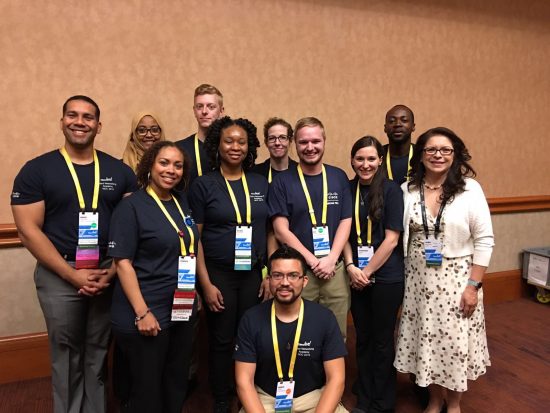
After earning two associate degrees in cybersecurity and network management, Arodi was nominated to the Cisco Networking Academy Dream Team – a group of students that provides networking support at Cisco’s largest customer event. In July 2016, he spent two weeks in Las Vegas as a member of this exclusive networking team.
There, he worked side-by-side with IT professionals, setting up and maintaining the massive network that brought Cisco Live US to life. For Arodi, it was a once-in-a-lifetime experience, one that brought him closer to a career in the cybersecurity field.
“I met a lot of great people there,” he said. “Our team lead had us speak with vice presidents and other experts in the field who shared valuable advice.”
One piece of advice echoed something Arodi had learned in the Marines — stay focused on the ultimate goal, no matter the obstacles. “I’m able to see a situation, and even if can’t do anything about it, I have to be able to change my mentality and take on new challenges.”
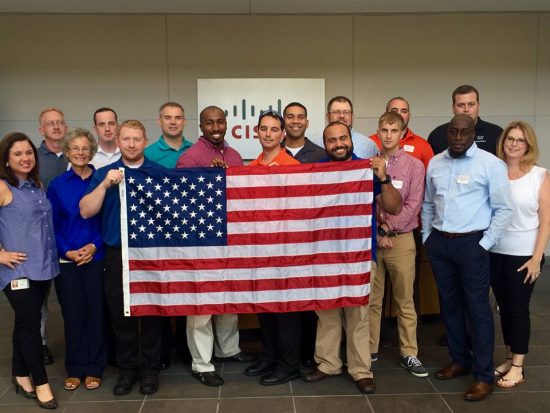
Following his time with the Dream Team, Arodi took on a new, worthwhile challenge in the form of Cisco’s Veteran Talent Incubation Program (VTIP). The nine-month pilot program is designed to prepare veterans for jobs as Customer Support Engineers (CSEs) in the Cisco Global Technical Assistance Center (TAC). Participants also earn Cisco CCNA certification.
Arodi was one of 12 veterans selected to participate following an intensive interview process. “Getting into VTIP took more effort and preparation than interviewing for my part-time IT job in college,” he said.
After six months of rigorous training, mentoring, corporate culture training, and job shadowing, VTIP participants who meet qualifications will be accepted into the three-month Cisco Services Academy, preparing them for jobs at a Cisco TAC.
“Much of the training was done individually, but we never worked alone,” Arodi said. “We had the tools to work collaboratively together, and because we all had the same interests, the morale was high from the get-go. We were even able to speak with engineers, take advantage of the online resources, and work on actual customer support tickets.”
With his military experience, networking expertise, and general passion for the field, Arodi is confident he has what it takes to thrive as an IT professional.
https://youtu.be/OXaTfbYtO1g
“I think I’m ready to get out there and do the job,” he said. “I’ve been training for two-plus years and my certifications validate the knowledge I’ve gained. Jonathan Nichols (VTIP instructor) has been thorough in preparing us with the right skills.”
The VTIP is part of Cisco’s commitment to the Veterans Jobs Mission, an effort of more than 300 companies to hire 1 million veterans by 2020. To learn more about Cisco’s Veterans Program and veterans like Arodi, please visit csr.cisco.com.
Veterans like Stan Roberts have served our country in a myriad of ways. As a United States Marine, Stan served three tours in Iraq. He received many combat-related awards before he lost his leg and was medically retired.
After 11 years with the military, Stan had to reset his plans of entering law enforcement, where he had hoped to continue to serve others. At 30, he decided to go back to school to study cyber security and information systems.
Military veterans bring valuable skills, experience, and qualifications to the civilian workforce. Matching talent to open positions, however, has proved daunting for both veterans and hiring companies. This is why Cisco invests in Veterans Programs that use technology and human networks to better connect returning service members to civilian opportunities. For example, this year Cisco piloted the Veterans Talent Incubation Program (VTIP) to prepare military personnel for entry-level jobs in the Cisco Technical Assistance Center (TAC) in North Carolina.
Stan is one of the many to benefit from Cisco’s efforts to recruit and hire military veterans. Today, he works at Cisco as a customer support engineer. Unfortunately, not every veteran finds the support Stan had when they leave the service. “Veterans have excellent training,” Stan says. “But if the door is closed because of stereotypes or stigmas, this training is useless.”
Stan admits the commercial world is very different from the military. However, it is this difference that enables veterans to bring a unique perspective to the workplace. “We have seen things most people won’t see in their lifetime. And when you have that kind of experience behind you, it really does help you function in any type of stressful environment.”
Veterans have a lot to offer employers. “The best thing we bring is that veterans are part of a team. We’ve been training for this since day one.”
Stan’s experience has also helped him become a skilled problem solver in the workplace. “That’s what we do in the military; we’re always tasked with helping others. And in doing so, we’ve learned to deal with different cultures. Often we have to be able to work with people who can’t speak the same language. We have advanced training on how to do this. We’re used to working with people who don’t necessarily work the same way we do.”
As part of his job at Cisco, Stan works with numerous organizations related to veteran activities, including the North Carolina for Military Employment (NC4ME) coalition. The NC4ME was started by the state of North Carolina to help veterans find employment by showing employers the value veterans can bring to their operations. In March 2016, Cisco launched the IT component of NC4ME, hosting two IT Awareness Days at Camp Lejeune and Fort Bragg in North Carolina. More than 120 transitioning or recently transitioned service members attended the events, where they learned about North Carolina’s growing IT industry. Stan regularly represents Cisco at NC4ME summits to share his story and that unique perspective men and women who have served in the military can offer.
To further its support of veterans, Cisco has recently joined with Amazon Web Services, ISC2, and the Institute for Veterans and Military Families’ Onward to Opportunity (O2O) to sponsor a free cyber training pilot program for Virginia veterans who want to work in cyber security.
Veterans have given much to our country through their military service. At Cisco, we’re proud to have Stan on our team to help usher in the digital revolution and accelerate global problem solving. Stan exemplifies many of the attributes of a global problem solver – digital skills, teamwork, leadership, and creativity, as well as his desire to give back and support other veterans through their journey.
Each of us has the potential to become a global problem solver – to innovate as a technologist, think as an entrepreneur, and act as a social change agent. Our hope is that everyone understands they have a role to play and that their unique perspective is needed.
As many of you may already know, we do a ‘live workshop’ as a companion to every TechWiseTV episode we release. These workshops are NOT using video at all..but they do feature a solid hour of demos, explanations and two-way Q&A with some of the best engineers in Cisco.
Many of us relied on Lancope’s Stealthwatch product, and their Network Based Anomaly Detection capabilities, well before Cisco finally acquired them. But this acquisition also allowed for a deeper level of integration with an internally developed Cisco project. The general ideas was to use machine learning to detect anomalies in a branch network router as opposed to stretching it across a large enterprise network. These teams have since combined their expertise and are now working towards integrating these macro and micro level views together in the Cisco Stealthwatch anomaly detection product family.
That storyline and the power it brings to the monitoring and analysis many of us struggle with, was front and center for yesterday’s live workshop.
The workshop plus this Q&A below should give you a great understanding of what is possible here.
Get an inside look at how Stealthwatch Learning Network License can transform your branch network router into a powerful security sensor and enforcer: one capable of quickly detecting threat activity and mitigating attacks, with little to no hands-on management needed.
Q&A
Are there any additional enhancements required for the router such as memory or a specific module?
Hi Tom, yes it does require more memory and optionally a hard drive, Brian will share more details towards the end of the call.
Is this compatible with Cisco iWAN?
Technically it is compatible with iWAN, we are currently undergoing details performance characterization with iWAN to quantify the points of compatibility.
SLN is a lightweight solution in terms of memory and HD is optional?
Yes we are lightweight . We need the ISR 4K to only have the 8G Mem option installed. We then use all of IOS Infrastructure you already own to run our Agent . In addition the ISR 4K CiscoOne Bundles now all ship with the 8G Mem as the default
Is this supported in an iWAN design that’s also running ISR-WAAS already running in a container on the ISR 4K router?
If you were to run WAAS and SLN on same ISR 4K we recommend you run WAASv on the UCS blade as it is much higher resources utilization for HD and Memory and SLN in Container
Are the policies managed from centralized system?
The Learning Agent does this. It observes and learns about the network in the ISR. After a short training period it generates reports about anomalies. You compare that data against policies at the SLN Manager.
Do the agents automatically download updated policies?
The Agents are constantly learning and save a backup copy of their state at the Learning Manager. We have a script run at the Manager to update agent code on ISRs.
SLN requires extra hardware, software and license. Right?
Sort of. SLN is a smart licensed product. It requires the IOS-XE AppX license. It does require a minimum of 8Gb of RAM in the ISR.
Could you send Cisco link for this ISR 4K CiscoOne?
Do we have the ability to plug into OpenDNS investigate for anomalous IP’s ?
We are developing the capability to pivot from the SLN Manager to OpenDNS Umbrella to investigate. The pivot is currently implemented in Stealthwatch SMC. The feed-back from OpenDNS could be used by the Machine Learning algorithm to increase degree of anomaly (if OpenDNS reports an IP address as suspicious for example).
Is this compatible with iWAN (dmvpn/waas/PfR/AppNav) and zone based firewall?
So we are working through testing SLN with different IWAN configurations. We have reached out to customers for config samples. We expect to publish early next year. So far no show stoppers.
Does this ISR container require any router modules? (storage? E-Series blade, NIM of any sort?)
No. None required. We can use the NIM-SSD if installed for extra storage (think pcaps).
Will this run on a 4331?
the 4331 will be supported Dec 1st a few weeks out
Is this technology usable with the ASA5520 and existing 6800 routers?
According to IDC, the big data market, including services such as analytics, is expected to reach nearly $50 billion by 2019. Luckily for Quantium, data is in its DNA. Australia’s largest analytics business is happily riding the wave on the booming global big data industry.
Quantium’s customers—including the likes of Google, P&G, Kellogg’s, Facebook, eBay, Qantas, and Unilever—generate enormous amounts of data. But data without insights is of little value. That’s why they turn to Quantium to help them transform their data into business knowledge to help drive informed decision-making.
But as the abundance of data increases, so too does the pressure on the platforms that churn out thousands of simultaneous predictive models and machine learning algorithms. Quantium’s data scientists are constantly inventing new analytics applications to power a new world of possibilities for customers. Data sets have increased a million-fold in just a few years, straining the company’s infrastructure to support this massive scaling.
That’s why Quantium’s technology team turned to Cisco and MapR to support its huge workload. The team opted for a data center infrastructure that would provide more control over data security. Employees, partners, and customers now enjoy flexible, secure access to data from any device. Cisco collaboration tools also help them stay connected on a global scale, driving up productivity and quality while reducing travel costs.
Cost savings in ongoing management are another big benefit. A single view and point of control across the network for proactive monitoring, reporting, and management helps Quantium scale quickly and efficiently. That means new insights for customers, like Woolworth Supermarkets. Woolworths partnered with Quantium to create an analytics engine that processes trillions of rows of data to match supplier offers to each member—the equivalent of asking each loyalty program customer 70 million questions every week.
The result? More relevant and personalized offers, leading to increased sales.
https://www.youtube.com/watch?v=czEP62G9GwY
Quantium is also working with L’Oreal Australia to bridge the gap between the online and offline worlds. Using Quantium’s Facebook partnership, L’Oreal Australia was able to determine the effectiveness of its Facebook advertising, helping advertisers understand the impact that their digital investments were having on customers who purchase products in a physical store.
But it’s not all about increasing revenues. Quantium developed an analytics application for the My Choices Foundation, a nonprofit based in India that combats human trafficking. By using data to help predict where and when traffickers are likely to strike next, the organization is working towards its goal to end large-scale human trafficking in India by 2025.
Big data is projected to remain a big business, with more opportunities for Quantium on the horizon. “There’s never been a better time to apply intelligence to your business,” says Greg Schneider, Executive Director, Quantium. “Standardizing on Cisco is helping us push the boundaries of data science.”