Avatar

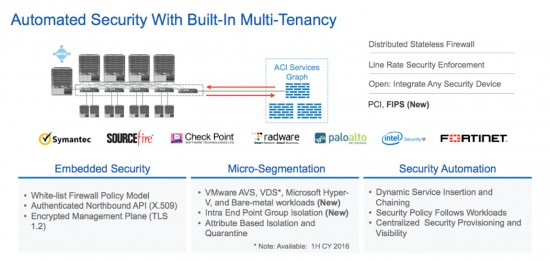
Cisco Systems Application Centric Infrastructure (ACI) is the industry leading SDN platform according to Gartner, outpacing NSX by a factor of 2:1. ACI continues to accelerate past NSX by enabling Micro Segmentation and End-Point Granularity.  In real world data centers, there are many simultaneous application delivery end points including VM’s from multiple hypervisors, bare-metal hosts, Linux containers, and layer 4 – 7 appliances that are both physical and virtual.

VMware recently published articles regarding this announcement and appear confused through inaccurately stating ACI capability.  Juan Lage, a Principal Engineer at Cisco Systems provides an accurate and detailed description of our capabilities and addresses VMware’s obvious misunderstanding in his article below my introduction.

After reading Juan’s article below, the only thing left to say to VMware NSX is welcome to the “real world”

When we announced last month the 1.2 release of ACI (http://newsroom.cisco.com/press-release-content?articleId=1732204) we knew that we were bringing a lot of value to our customers, but we also knew that as a consequence, we are making it more complicated for competing offerings, and that there would be reactions to our announcement.

best pic 1 300 screen shot preview

This is why VMware’s blog “VMware NSX and Split and Smear Micro-Segmentation”
(https://blogs.vmware.com/networkvirtualization/2016/01/vmware-nsx-and-split-and-smear-micro-segmentation.html ) did not come as a surprise.

The author of the blog attempts to prove that only VMware NSX can provide micro segmentation. Also, it appears the author suggests that you are not protected from “the bad” guys if you don’t have VMware’s Micro Segmentation.

It is an interesting post, but it has several statements that are inaccurate and a few ideas and exaggerations that are recurring in NSX’s marketing and that we certainly disagree with. Continue reading “ACI Surpasses VMware NSX Again with Micro Segmentation & End-Point Granularity”

Authors

Frank D'Agostino

No Longer with Cisco

Avatar

It’s a good time to be a cloud service provider (CSP). According to the newly released Cisco® Global Cloud Index, global cloud traffic will more than quadruple over the next four years. And for many, if not most enterprise cloud customers, conversations are no longer about whether to adopt the cloud. They’re about how well-tuned cloud services are to their specific business needs—and how fast CSPs can deliver them.

This is all good news, but it reflects some major underlying changes in the cloud services marketplace. In fact, it’s such a big shift, that analysts at 451 Research are calling it Cloud 2.0. And if you’re a CSP trying to tap into the growing market for cloud services, you’d better be ready for it.

What Is Cloud 2.0?
The first wave of cloud services focused primarily on increasing revenue and reducing enterprise IT costs. Those are still important goals, but today, enterprises view them as table stakes for any cloud solution. Increasingly, customers are focused on using cloud to fuel continuous innovation. They know that maintaining the status quo is the fastest way to become irrelevant. At the same time, they face constant pressure to reduce risk. If those sound like contradictory goals, then you understand why enterprises are asking CSPs for help.

Katie Broderick, research director of 451 Research, describes it this way: Continue reading “Get Ready for Cloud 2.0”

Authors

John Malzahn

Senior Marketing Manager

Service Provider Cloud Solutions

Avatar

One of these days the ground will drop out from beneath your feet
One of these days your heart will stop and play its final beat
One of these days the clocks will stop and time won’t mean a thing

“These Days”, Dave Grohl, Foo Fighters

 As we kick-off 2016, the time is now for industry decision-makers to make a profound difference in the way Insurance business is transacted. Not just for competitive position, but for future generations, shareholders and most importantly, for the customer. Peer group competitors are formulating action plans now to address the most pressing tactical and strategic business imperatives across the enterprise for 2016 and beyond. Are you? Here are five top focus areas for 2016 that I am hearing from insurance executives across both Life and P&C:

  1. Digital Strategy
  2. Security
  3. Collaboration
  4. Talent Acquisition and Retention
  5. Business Outcome Approach

Continue reading “Five Strategic Insurance Business Imperatives for 2016”

Authors

Tom Filep

Cisco Financial Services Lead for Americas Industry

Avatar

This Post was Authored by Nick Biasini, with contributions by Joel Esler

Exploit Kits are one of the biggest threats that affects users, both inside and outside the enterprise, as it indiscriminately compromises simply by visiting a web site, delivering a malicious payload. One of the challenges with exploit kits is at any given time there are numerous kits active on the Internet. RIG is one of these exploit kits that is always around delivering malicious payloads to unsuspecting users. RIG first appeared in our telemetry back in November of 2013, back then we referred to it as Goon, today it’s known as RIG.

We started focusing on RIG and found some interesting data similar to what we found while analyzing Angler. This post will discuss RIG, findings in the data, and what actions were taken as a result.

The Exploit Kit Overview

RIG compromises users like any exploit kit. It starts with a user being redirected to a landing page. This is done via malicious iframes or malvertising and looks similar the following:

It begins with an initial link to a javascript:

Redirection

Read More >>>

Authors

Talos Group

Talos Security Intelligence & Research Group

Avatar

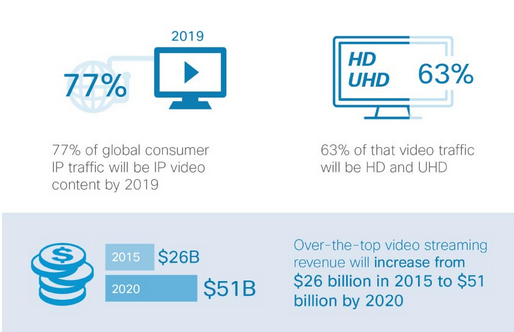
George Tupy’s recent blog described how the growth of cloud and over the top (OTT) video presents a massive market opportunity for service providers to deliver video content anytime, anywhere, and on any screen. He also discussed how open IP networks and cloud-based delivery methods introduce new security vulnerabilities. To add fuel to the fire, content and customer data is often stored together inside the video headend and data centers making it more easily accessed by attackers. They can disrupt operations by launching denial of services (DoS) attacks, target your authorized users to gain access to your corporate network to steal, modify video content directly on your video headend, or even siphon out valuable customer and billing data. Theft of credit card numbers or customer identity information hurts your customers and damages your reputation in the industry.

Now the good news: Cisco has the security solutions to protect your video content and broadcast infrastructure so you can focus on developing premium content and services for your subscribers.

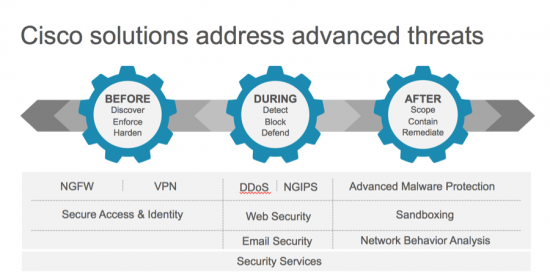
Imagine your video infrastructure protected by the leader in data center security. Envision multilayered solutions working together to ensure your content, services, and business are protected from advanced cyber threats – across the attack continuum – before, during and after an attack.

Cisco solutions address advanced threats


Before

Our Next-Generation Firewalls use granular access control and identity checks. This strengthens your network perimeter and locks your video headend and data centers to defend before an attack happens.

During

When an attacker tries to compromise your business – through the network, web, or email – our integrated Next-Generation Intrusion Prevention System (NGIPS), Distributed Denial of Service (DDoS), and Web and Email Security Solutions engage threats as they happen.

After

If malware does manage to get in, Advanced Malware Protection (AMP), Network Behavioral Analysis, and sandboxing solutions have you covered.  These solutions continuously scan traffic and files to find threats before they become active. If malware does become active, we can isolate the threat and remediate the infection to bring you back online quickly.

Cisco brings a wealth of robust security solutions to provide comprehensive protection across your headend infrastructure and corporate IT systems. Security Services are also available to help you design, implement, and manage your security each step of the way and ensure you have the best protection across your business.

For more detailed product information, see Cisco’s Secure Data Center Solution. For a compelling deployment story, read how Cisco’s security solution was deployed to help fortress BT against growing cyber threats. You can also learn more on how Sky has chosen to implement Cisco’s comprehensive VideoGuard Everywhere software security solution for its next generation home entertainment system.

Authors

Sam Rastogi

Senior Product & Solutions Marketing Manager

Avatar

Remember 1995? That was the year we put ‘e’ in front of everything to signify that it was being done ‘electronically.’ eBusiness, eCRM, and eProcurement were all the rage.

Fast forward to 2016 and we’ve dropped the ‘e’ because doing things electronically has become the norm.  The same will happen with the term ‘Digital’ Marketing. Cisco’s CMO Karen Walker has said, “Marketing was the last function to be industrialised and the first function to be digitised.” Marching into the future, that means we’re no longer doing ‘Digital’ Marketing, we’re simply Marketing in a digital world.

As the term Digital Marketing dies and Marketing regains its place, what other trends will accelerate in 2016? Here are my thoughts

1. AIDA will become AIDAA

Our marketing text books teach us to drive customer engagement according to the AIDA model: attention, interest, desire, action.  In 2016 I’m adding an ‘a’ – for Advocacy!

Once a customer has purchased a product or a service from a company, the ultimate goal is to have that customer share the positive experience with peers. Why?  According to Edelman’s 2014 Trust Barometer, customers trust their peers more than any sales and marketing collateral – and even more than industry analysts.

Cisco has taken this message to heart and has officially made it part of our marketing team’s role and purpose – ”To inspire people to prefer, choose, and advocate Cisco.”  I’m sure we’ll hear a lot more about customer advocacy in 2016.

2. Customer data will improve the customer experience

Market leaders have always had rich customer data on their installed base and could predict future behaviour based on past bookings and external insight. We’ve now gained the ability to layer additional data based on what customers are doing online.  This is good news for marketers, obviously, because we can use customer intelligence to inform the customer journey.  But what’s more important is that it’s good news for the customer – because companies are able to use the information they collect to fine tune the customer experience.

This critical link between customer data and customer experience is echoed by Jeremy Bevan, Vice President of EMEAR Marketing at Cisco. In his blog post, “Is Customer Experience Your North Star?” Bevan implores marketers: “consumers have more purchasing muscle today than yesterday – they are firmly in the driving seat – so why are you not working harder to create the optimal customer experience?” Look for marketers to take Bevan’s challenge to heart in 2016.

3. The use of predictive analytics will explode

Not only do today’s customers want companies to react to the “digital footprint” they leave behind – they are put off when we don’t. As a recent Harvard Business Review report explains, “When marketers send customers a promotion for a product they already own or would never be interested in, they send a clear signal: We don’t know much about you, and we don’t much care.”

Predictive analytics provide the critical information marketers need to know their customers well and demonstrate that they care. A study conducted by Forrester Consulting revealed that most B2B marketing organisations (89 percent) see value in using predictive analytics to identify new opportunities and to better qualify leads. The more advanced users also realise upstream and downstream benefits: 97 percent analyse their best customers and understand how/why they buy; 92 percent optimise the marketing mix to reach the right types of buyers. The takeaway? In 2016, marketers who aren’t yet using predictive analytics will get on board – fast.

4.  The face of content marketing will change

Buyers are still using content to inform their digitally driven purchasing decisions, but it’s not the content of yesterday. To help buyers through the journey – and to spark conversations along the way – marketers are developing new forms of content marketing that are dynamic and personalised.  They’re highly visual.  They’re fun and humorous. What’s more, many of them are not even created solely by the marketing organisation. In 2016, we’ll see less content created by corporate marketing teams and agencies and more created by the folks that are closer to customers:  local marketing teams, company employees, and even users themselves. For more on this trend, see my blog post, “Content Marketing: It’s Getting Personal.”

5. Marketers will act more like publishers

Marketers are good at creating content, but we have traditionally worked in linear sprints that deliver programs like a website refresh or a marketing campaign. In 2016, as content marketing continues its reign, we’ll have to work as if we’re publishing a never-ending daily newspaper.  The hallmarks of this new approach?  Telling great stories to engage readers, using analytics to ensure that content is audience driven, and balancing breaking news with feature-length pieces.

This will not be an easy transition for marketers. We’ll have to get comfortable with paradoxes:  maintaining corporate oversight while enabling local personalisation; operating according to strict schedules while allowing for responsiveness; and balancing the quality of content against an incessant need for quantity.

6. Marketers will move from listening to responding in real-time

We’ve known for a while that it’s not good marketing to simply broadcast your viewpoint to prospective customers. Recently, we’ve been focused on listening to what our customers are telling us.  In 2016, we’ll need to respond to customers’ needs in real-time.

What will real-time marketing look like? According to a recent report from Wayin, a social intelligence company, 49% of respondents say real-time marketing is the ability to respond within minutes to an event – and 26% say it is the ability to respond within seconds. But here’s the really important bit:  98% of those surveyed (200 manager and executive-level marketers at companies with more than $100 million in revenue) say they see a positive revenue impact from their real-time marketing efforts. Speed pays – and in 2016, marketers will pull out all the stops to respond at lightening speeds.

With so much change predicted for 2016, how can marketers master it all? We can’t.  We’ll have to experiment, run the analytics, tinker with the formula, fail sometimes, and try again.  As Richard Tyler says so nicely, “The greatest risk is NOT doing something different, the greatest risk is staying doing the same thing.” If we wait for perfection, we’ll get left behind. Let’s dare to begin before we’re ready! Happy New Year!

Authors

Dr. Christine Bailey

Marketing Director

EMEAR

Avatar

Retailers are in the business to sell, not to be stolen from. And they don’t set up shop to buy security products from companies like Cisco. However, attackers who target retailers have discovered that it’s much more lucrative to shoplift virtually rather than physically. So even if you focus on security rather than selling, you face a daunting task.

ChristianImage

The challenge of retail security is that it gets more complex by the minute. The combination of mobile devices, distributed services, increased customer expectations, virtual systems, and changing business goals creates a huge attack surface for fraudsters. Add in a pantheon of security vendors offering specialized products that don’t always work well together as well as a dwindling supply of qualified security personnel, and feelings of frustration and futility are understandable.

Our industry desperately needs a resource that addresses the problem from end to end and makes security easier to understand. Enter Cisco SAFE, a comprehensive and credible solution portfolio. SAFE uses a model to organize retail networks into areas that can be more easily understood from a security perspective. It looks at the threats that exist and the best practices available to defend against them. It helps manage the design, build, and maintenance of today’s retail networks.

SAFE provides “how to” guides tested in Cisco’s laboratories for complex security challenges. It maps your threats to the security capabilities you need at this time, which can help you avoid overspending and overcomplicating the defenses you need to protect your business.

Come see me at the National Retail Federation show in New York. At a Big Idea session, I’ll be speaking about how Cisco SAFE helps simplify retail security. We’ll be in Room 4, Level 3 of the Expo Hall, on Monday, January 18, at 12:45 p.m.–1:30 p.m. Learn more.

I look forward to meeting you there!

Authors

Christian Janoff

Enterprise Architect, Compliance

Security Technology Group

Avatar

Ever heard that when you’ve told someone what device you just bought?  Or perhaps ”You’ve already upgraded, does everything still work?”  As more devices hit the market, they bring with them new platforms and operating systems. Add video delivery into the mix, and the terrain becomes even harder to navigate.  But it also brings a huge opportunity; the opportunity to be first with your video and entertainment service.

What does being first really mean?  It means that you are the first to offer apps that are compatible with new channels to market. It means continuing to give your customers the content they love when, and how they want it, no matter which platform they use.  It means ensuring that when they unbox that new device, yours is one of the first apps or services they use.  Being first helps you strengthen customer loyalty and engagement from day one, whilst, of course, ensuring that you continue to provide a quality service on established and legacy platforms.

You've Got What

To  learn more about the infographic above click here.

At CES 2016, we’ll be showing how you can support a huge range of devices and platforms using our Infinite Video service. Putting DevOps for Video into action, we’ll show you how you can rapidly deliver a broad range of high quality services from the cloud with a consistent user experience.

Thanks to our scale, our partner relationships, and our experience, we can develop solutions that will work on new platforms even before they are released to the market. That way, our customers can continue to monetize their content and services irrespective of the device their consumers are using.  By providing this capability to our customers as a service, we free them up to focus on managing their business, not their technology.

So if you’re a content provider, a rights owner, or service provider, visit us at CES 2016. We’ll demonstrate how our customers are monetizing on great content and services, no matter what device or network their consumers use. And you’ll see how Cisco is putting its customers first… in more ways than one!

To find out more, follow us on Twitter @CiscoSP360.


Authors

Adam Davies

Technical Leader, Engineering

Service Provider, Video Solutions

Avatar

Having grown up in Denver, I’m a big fan of the Denver Broncos. Although I currently live in San Diego, I really enjoy the opportunity to see at game at Mile High Stadium any chance I get.  Sure, I could always upgrade my TV services to include a NFL package or subscribe to the Bronco’s fan club for updates, but nothing can replace the experience of attending a game in person.  Delivering a truly unique, unforgettable fan experience is a goal that is transforming the way stadiums and venues interact with fans today.

AR65543 (002) Stadium

Enhance the Fan Experience

In fact, most sports fans report that they want a more connected, personal experience. According to Gartner, in 2016, 89% of companies will compete on the basis of customer experience as compared to just 36% four years ago.  Companies will differentiate themselves, attract new customers and identify new sources of revenue using customer experiences as a driver.  To create truly personalized customer experiences, companies are turning to technology—a trend that is typically referred to as digital transformation.  In my last blog, I wrote about how new mobile engagements are improving the guest experiences in Hospitality. Sports and entertainment provide another example of how mobile experiences are enhancing the fan experience.

Build Loyalty with the Connected Stadium

Continue reading “Transform the Digital Experience from Free Wi-Fi to Interactive Mobile Experiences”

Authors

Peter Mason

Senior Director, Automation and Experiences Platforms

Product Management and Product Marketing