Avatar

Arista’s filing of bogus antitrust claims today is not accidental or a coincidence.

The claims, most of which were included in earlier Arista filings, are a smokescreen to divert attention from the important ruling expected from the International Trade Commission (ITC) on February 2*. This is when Judge Shaw will rule on the validity of five Cisco patents and whether Arista infringed any of those patents. We chose the ITC as a forum because of its defined and accelerated timetable. If infringement is found, Arista, despite their efforts to delay the ITC process, may be just a few months from an exclusion order banning a majority (or all) of their products entering the United States.

The antitrust claims may also be a pretext to muddy a District Court trial scheduled for November, just as Arista used procedural tactics in a failed effort to delay the ITC actions. Arista missed the deadline for amending their claims in the CLI case to which they are seeking to add these new claims, after they got only a portion of the long delay they earlier sought from Judge Freeman.

Let me be clear. We welcome the opportunity to show that Cisco’s business practices are consistent with a highly competitive and vibrant industry. We seek only fair competition, but will take action against those who misappropriate our technology and use it to compete against us.

By contrast, the extent of Arista’s copying of our CLI sets them apart from others in the industry. They have directly lifted more than 500 multi-word command line expressions. By comparison, networking products from HP, Brocade, Alcatel-Lucent, Juniper Networks and Extreme each have only a small fraction of overlapping commands. It is no surprise then, that when Arista’s Chief Technology Officer and Senior Vice President of Software Engineering was asked about the CLI, he references his company’s “slavish” copying.

Our goal has always been to protect Cisco’s innovation, and stop Arista from using our patented and copyrighted technology. Arista’s behavior has negative consequences for the industry, and for their customers and partners who were sold products using stolen technology. They can no longer delay the inevitable.

* Updated 27 January 2016: The due date for Initial Determination in ITC Case 944 has been extended to 2 February 2016. This change is in response to the Federal Government closures that took place this week due to inclement weather in Washington DC.

Authors

Mark Chandler

Retired | Executive Vice President

Chief Legal and Compliance Officer

Avatar

Software testing. For a long time, software testing was one of those dark alleys of the software development process. Often ignored, considered as an afterthought, and staffed by “someone else” who did an important job but was outside of the core development process.

Well, that has all changed.

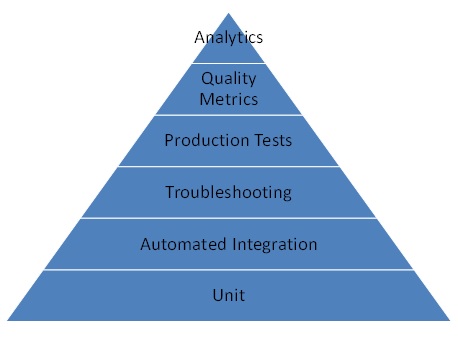
In the SaaS world – especially one governed by continuous delivery – testing is not just an afterthought. It’s a core part of the development process. And like many other engineering processes, there are differing levels of maturity that SaaS development shops can evolve through. In a lot of ways, these different stages of maturity are like Maslow’s hierarchy of human needs. You really, really have to execute on the stuff at the bottom. As you succeed with that you move up to higher levels and achieve greater levels of happiness – in this case through greater quality of software. In the case of testing, each layer is like a filter – each of them catching bugs. The layers at the bottom catch the most basic, easy-to-find bugs. As you go up the stack, the technology helps you catch problems that are rarer and more troubling to identify, reproduce, and fix.

Here is my view on the layers of the hierarchy of SaaS testing needs:

heirarchy of SaaS testing needs Continue reading “The Hierarchy of SaaS Testing Needs”

Authors

Jonathan Rosenberg

Cisco Fellow and Vice President

CTO for Cisco's Collaboration Business

Avatar

Are you preparing your organization for the end of support on Microsoft SQL Server 2005? Continuing to run legacy SQL Server can present significant challenges for your organization.

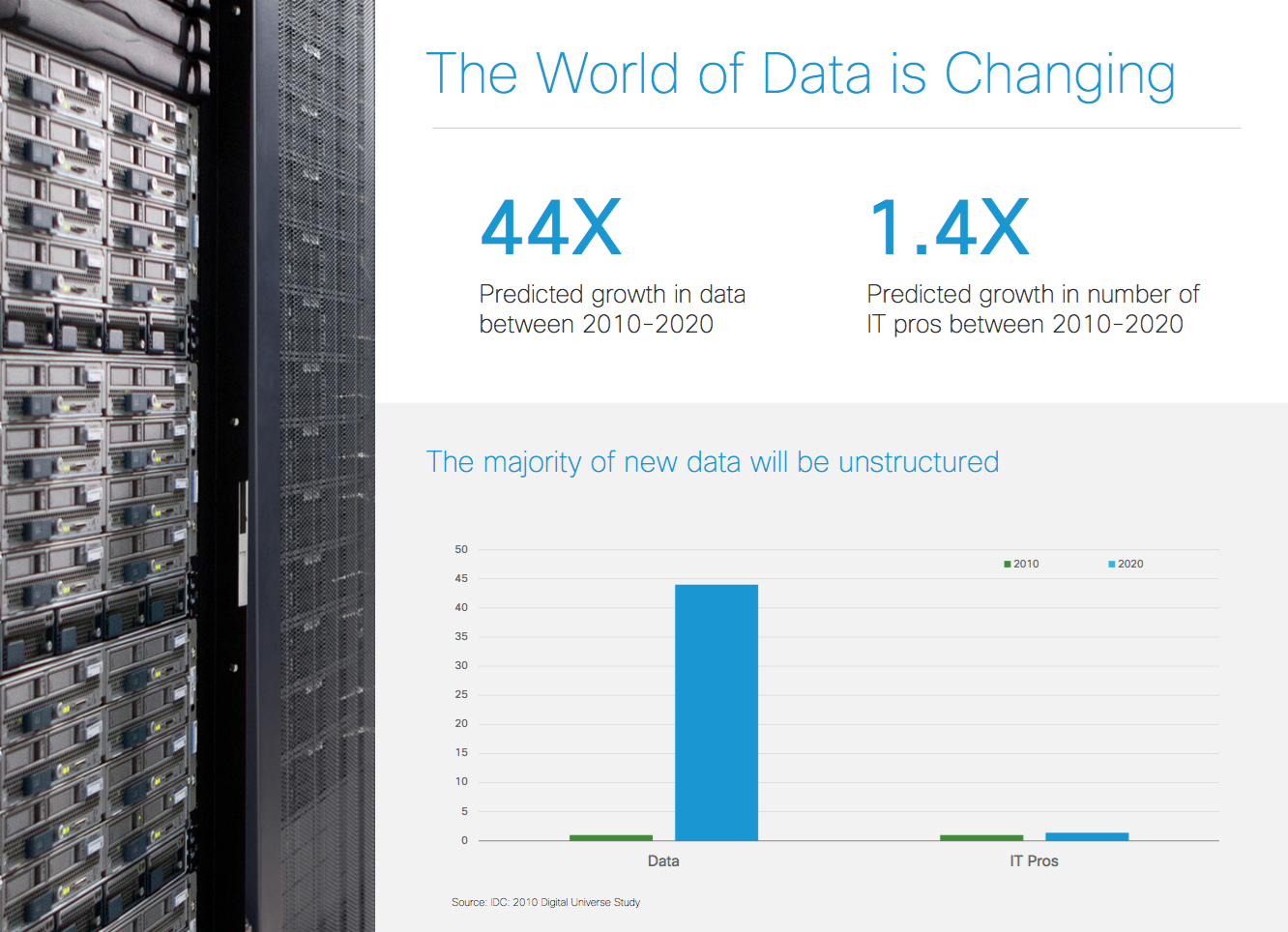
Information volume continues to grow worldwide at a minimum rate of 59% annually. And while data is expected to grow 44x larger over the next decade, the number of IT pros is only expected to grow 1.4x larger. This puts IT pros under pressure to perform at higher levels than they ever have, and legacy infrastructure is ill-equipped to take on this burden.

Screen Shot 2016-01-22 at 2.16.37 PM

Continue reading “Is your database at risk? Let Cisco help”

Authors

Reesha Dedhia

No Longer with Cisco

Avatar

As I look back on 2015 and the great effort of the Mantl.io and CiscoShipped.io teams, I am reminded of the efforts I had in the initial cloud computing efforts 8 years ago. The buzz and market interest in cloud computing then was not accepted by traditional hosting and telecommunications companies. A retail company understood that their business needed agility and rapid delivery of software to accomplish the goals that the business vision had before them. This was one of the first examples of software disruption as this retail company 8 years later is larger than all the hosting, telecommunication, and cloud service providers combined. How did this happen? It’s quite simple, they paid attention to one simple rule: application architecture and programmability are critical to agility and enable the business applications and services to differentiate from the competition. The requirements to accomplish what the business applications need are defined in terms of agile software development, infrastructure as code (IaaS) and automated interfaces through Application Programmable Interfaces (APIs).

Continue reading “2016 Prediction #1 – Production Application Development and Deployment Rapidly Transforming to Microservices Architect …”

Authors

Kenneth Owens

Chief Technical Officer, Cloud Infrastructure Services

Avatar

I’ve been using online banking for a while now. Just the other day, I had a quick question and saw “Chat Live with a representative” so I decided try it out. As I got comfortable asking a few questions, I started to want to do more. I wanted to talk with the banker. And I’d like the banker to look at my account page with me so I knew we were looking at the same information. It would have helped if I could see the banker and have her give me on-screen guidance.

In a recent report, Alyson Clarke from Forrester interviewed a number of financial institutions that have been using various channels to communicate with their customers from online chat to video. The report revealed that while online chat can be a great way to offer live help, the experience is probably better suited to simple situations.

Apple’s FaceTime has made video communications convenient and simple to use. Video technology has dramatically improved; so it’s time for financial institutions to move beyond chat and offer video banking, true video banking. Continue reading “When Online Chat is just not enough”

Authors

Leni Selvaggio

Global Senior Manager

Financial Services Industry

Avatar

Introduction

TLS (Transport Layer Security) is a cryptographic protocol that provides privacy for applications. TLS is usually implemented on top of common protocols such as HTTP for web browsing or SMTP for email. HTTPS is the usage of TLS over HTTP, which is the most popular way of securing communication between a web server and client and is supported by the bulk of major web servers.

As TLS has become more popular and easier to use, we have seen the adoption of this technology by malware to secure its own communication. It is fairly straightforward for malware to plug into existing TLS libraries, and in some cases include an entire implementation in its own source code. This ease of use is troubling because it allows malware to easily evade detection and blend into benign traffic patterns typically observed on a network. In short, malware authors know how to use encryption, and they use it in TLS and in custom applications across many different ports and protocols.

In this blog post, we highlight some of the trends we are seeing with respect to the volume of malware traffic taking advantage of TLS, and on which ports this traffic appears. We compare and contrast malware’s usage of TLS with that of benign network traffic. Finally, we conclude by giving next steps to detect malware even in the face of encryption.

Continue reading “Hiding in Plain Sight: Malware’s Use of TLS and Encryption”

Authors

Blake Anderson

Software Engineer

Advanced Security Research Group

Avatar

Cisco Partners Weekly Rewind Banner-650

Each week, we’ll highlight the most important Cisco Partner Ecosystem news and stories, as well as point you to important, Cisco-related partner content you may have missed along the way. Here’s what you might have missed this week:

Off the Top

Greetings everyone. Hope you all had a great week – let’s jump right into it!

Customer Success Teams Can Be Revenue Engines

I’m always excited to have new bloggers contribute to the partner blog. Scott Schell, from the Global Customer Success team, made his debut this week.

It’s no secret that we’re keen on helping you build customer success here at Cisco.  Scott offered up some great advice on how you can deliver just that and drive revenue.

Check out his post to learn more and be sure to attend the accompanied webinar. Great to have you Scott!

The 2016 ASR Report is Out!

I’m not completely sure, but I think security is a pretty big topic these days, which is all the more reason to check out our Annual Security Report.

The report analyzes advances by security industry and criminals and can give you key insights into where to strengthen your customer’s defenses. You’ll also find new threat intelligence, trend analysis and much more.

Here’s our CEO and SVP of Security talking about this year’s report:

In the Channel News

Continue reading “Cisco Partner Weekly Rewind – January 22, 2016”

Authors

Darek Rensing

No Longer with Cisco

Avatar

Connected_Factory_Chat

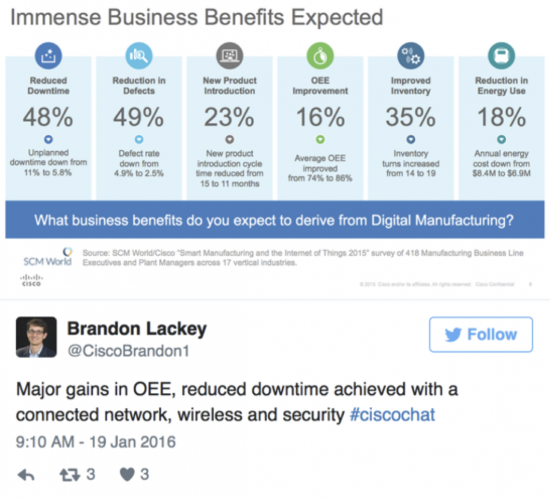
Manufacturers are challenged with how to start digitizing their factories. Many have told me it is not inertia or budget holding them back, but being overwhelmed or unsure of where to start. Yet the value that awaits them is great – connected factories can boost profits by up to 19 percent (according to our latest Manufacturing Thought Leadership Study).

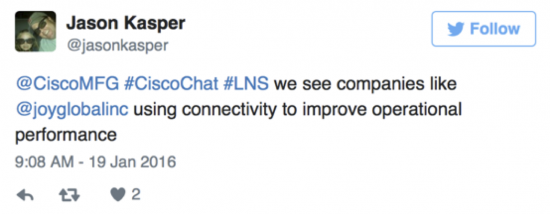
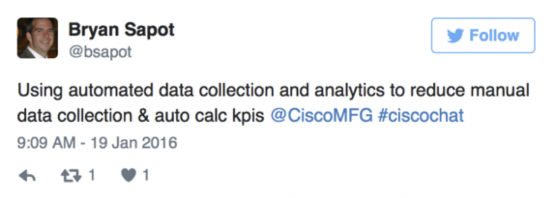
To help manufacturers navigate the complexity, I hosted a #CiscoChat with Brandon Lackey, Manufacturing Vertical Business Development Manager at Cisco, and Lorenzo Veronesi, Analyst at IDC. We discussed the benefits of a connected factory, the roadblocks manufacturers face, and how to take the first step. Many industry thought leaders and luminaries joined us and it made for an animated discussion.

If you missed the chat, the full recap is here, and I will share with you a few of the highlights:

We kicked off the chat by asking: How are manufacturers making factories more connected and intelligent?

Chat1

Chat2

Chat3

Chat4 Continue reading “Jump Start Your Connected Factory: Recap of the Recent #CiscoChat”

Authors

Douglas Bellin

Global Lead, Industries

Manufacturing and Energy

Avatar

AR55106

AGCO is a company that’s made its name by providing high-tech solutions to farmers around the world. After years of acquisitions and growth, the company needed to update its IT infrastructure. AGCO looked to Cisco to facilitate this communication simplification by making sure that its workers were all on the same page.

Cisco deployed a suite of business communication software to ensure that AGCO’s frontend portals were consistent through out the company. But the real changes occurred in the backend infrastructure. AGCO realized that it wouldn’t do much good to have cutting-edge communication software without having cutting-edge hardware for it to run on.

Therefore, the company began consolidating data centers and standardizing on Cisco networking and communication infrastructure. Products that were included on this complete overhaul included: Continue reading “AGCO Reaps Rewards with Cisco Infrastructure”

Authors

Byron Magrane

Product Manager, Marketing