The Domain Name Service (DNS) provides the IP addresses of intended domain names in response to queries from requesting end hosts. Because many threat actors today are leveraging DNS to compromise end hosts monitoring DNS is often a critical step in identifying and containing malware infections and investigating attacks. Yet our research found that few organizations actually monitor DNS for security purposes—or at all—which makes DNS a security “blind spot.”
Before coming to Cisco, I worked as CTO for an irrigation system manufacturer. We were building a cloud-based commercial irrigation system and we needed an improved ERP system for the back-office transactions. My goal was to move us from the on-premise system that was architected when Ronald Reagan was president to a new cloud-based system. However, the stability of our Internet connection at the plant was a significant barrier to this type of change.
One of my first days on the new job, our internet access at the factory was down and we blamed it squarely on our ISP. They denied any issues with the service. One evening after everyone had left the building, I took a walk through the factory and into the engineering lab. There I discovered a closet with a cobweb of Ethernet cables connected to three unmanaged 6-port switches and a wifi router – all most certainly purchased at the nearby Best Buy. We later discovered that one of our employees had plugged a VoIP (Voice over IP) phone into one of those switches near her desk and created a network loop that took the entire plant network offline. Continue reading “A Simple Way to Get Your Factory IoT-Ready”
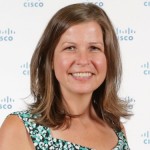
That’s me, on the far left, with my Talent Acquisition colleagues.
I’m a Cisco recruiter. But I do more than that. We recruiters make dreams come true. As a military veteran, I can say that this, too, is more than just a job.
Do we read a lot of resumes? Yes. We also help change the world. And we hire people who help change the world. There’s a lot of world-changing going on at Cisco.
For example, I help hire engineers who work on our Telepresence video collaboration technology. Not only do they help companies get work done, but they also used the technology to enable remote education and healthcare. People who would not historically have access to learning or top health specialists do now. That’s giving someone a new life, a new opportunity, a new hope.
Are you a sports fan? I hire engineers who develop the content networking architecture so you can have the dream-team experience that’s now available in many sports stadiums across the U.S.
I also recently worked with our Corporate Social Responsibility team on a program to support the underserved to get education and potentially internships to help them apply next gen skills in the Internet of Everything economy.
If you’re wondering to yourself, “But I’m not an engineer, or someone with the skills to build life-changing technology, so how can I make a difference at Cisco?” Every new employee at Cisco gets to change the world. The culture of giving back allows employees the flexibility to participate in charitable events that are meaningful to them. Cisco matches those volunteer hours as well as donations, so you can work in marketing, in operations, in any discipline here and still understand your impact. Plus, Cisco just announced that employees can have 5 paid days per year to volunteer for the cause that they’re passionate about.
Yes, I’m a recruiter. But I’m a Cisco employee too. These are the reasons #IChoseCisco myself. I love the culture of giving, but I also like the fast pace in which we innovate and change the world.
My favorite way to give back (aside from hiring those world-changers) is to spend time with my team giving back in our local community.
According to the latest predictions from analyst firm IDC, “more than 80% of enterprise IT organizations will commit to hybrid cloud by 2017.” That means that your organization is likely to evaluate an Infrastructure-as-a-Service (IaaS) solutions this year, if you haven’t chosen one already. As you consider options, it can be difficult to evaluate the different management platforms and sort through the vendor claims. A team of technical experts developed a list of evaluation criteria to make it easier. They have recently published a white paper that provides a clear comparison between Cisco UCS Director and HPE OneView. The paper looks at three critical areas of IaaS functionality:
Orchestration and automation
Self-service provisioning
Heterogeneous provisioning and management
A concise side-by-side comparison is provided in a table on page 5 of the document with details provided in the other sections of the paper.
Defending a network against threats of growing complexity requires a mix of technology and policies that are as sophisticated as the campaigns created by attackers. A necessary component to an efffective defense includes tackling the low-hanging fruit—that is, basic tasks such as patching vulnerabilities and updating old software.
Networking Field Day 11 is tomorrow and will be live streaming this Thursday, January 21st, from 2:00-4:00pm.
For the uninitiated, Tech Field Day is an event hosted by Cisco where delegates come and listen to a technical deep dive by a Cisco expert in a presentation and discussion format. These delegates range from bloggers, speakers, freelance writers, and podcasters that have a public presence that has an immense influence on ways that products and companies are perceived by IT practitioners. There are a few different branches of Tech Field Day: Networking Field Day, Wireless Field Day, Virtualization Field Day, and Storage Field Day.
When building a customer success team and making your case for more investment in the initiative, the most striking misunderstanding you may have come across is that a customer success team is a cost center and just provides really good customer support. Let’s set the record straight – a customer success team does provide excellent customer support, but it’s also a powerful revenue engine.
According to Gainsight, companies with a dedicated customer success team – focused on identifying at-risk customers and getting them back on track – see a 24% lower churn rate than companies without one. Reducing churn is key to growing the bottom line.
In addition to reducing churn, a customer success team increases the lifetime value of an account. Over time, account revenue can grow to be many times larger than the customer’s year 1 value. As a customer success team increases customer lifetime value, they can actually produce as much or more revenue than the sales team over the lifetime of the customer.
So, you had them at revenue engine. Management wants you to build a customer success team.
So, why is video conferencing a hot item? It delivers connections that matter.
When integrated into an overall collaboration strategy, the benefits of video conferencing are a “win-win” for all involved. Simplified video conferencing:
Reduces geographical and organizational obstacles
Provides greater clarity on discussion topics
Enables more efficient meetings
These are just a few pieces of a collaboration puzzle that, when put together, result in amazing experiences and outcomes.
Defining “true” outcomes is a first step in understanding the full potential of video conferencing. And as the saying goes, “the proof is in the pudding.” To explore the impact, take a look at three businesses that have overcome pressing challenges using video conferencing.
I am going to show you how to discover one of the best kept secrets within Cisco’s portfolio. A service that when our customers become aware of it, it becomes a must-have for their environments!
There is no man behind the curtain, pulling strings, making various noises and effects like the famous movie inferred by the title of this blog. This blog is about CMCS– Compliance Management and Configuration Service. What’s that you ask? CMCS is a service that utilizes the head end management system to the collector Cisco uses in its Network Optimization Service (NOS). CMCS is a powerful compliance, management and configuration service.
For example, what would it feel like if you could say with certainty, on any given day, that your network was in compliance with the chosen security standard for your company or industry?










 Networking Field Day 11 is tomorrow and will be live streaming this Thursday, January 21st, from 2:00-4:00pm.