It is by now reasonably well understood that we are finding ourselves in the fourth wave of the industrial revolution, one that is characterized by the digitization of things and processes, and the subsequent transformation of business outcomes. Key technology developments that enable businesses, government, and countries to re-imagine themselves in an rapidly changing world, include mobility (90% of internet traffic will be consumed via mobile devices by 2017), pervasive video (one million minutes of video traverses the internet every second), hyper connectivity with the Internet of Things (20 billion smart objects will be connected to digital infrastructure by the year 2020), big data and advanced analytics (data doubles every two years and last year alone we generated more data than all of mankind before), apps (more than 47,000 applications are being downloaded each and every minute), and cloud (changing consumption models).
These technological trends allow us to take advantage of the digital age and rethink how we enable, differentiate and define business, experiences, and outcomes.
To many, this still sounds esoteric. We talk about the technology enablers on the one hand, and the desired outcomes and business transformation on the other hand. We hold up Uber, AirBnB, and Shopify and tell how these are just a few examples of how we see traditional industries being cannibalized–warning every other executive in every other industry that it is only a matter of time before their business will experience the same competitive pressures and challenges. Subsequently, leaders need a digital strategy that augments and complements their business strategy for a sustainable future. All this is true, and the innovation and transformation is happening today. Continue reading “Digitization: Making it Real with Digital Solutions”
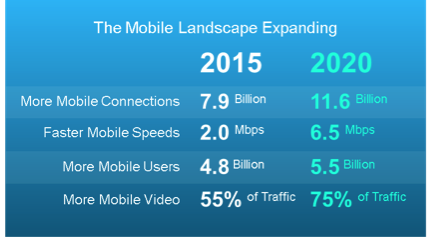
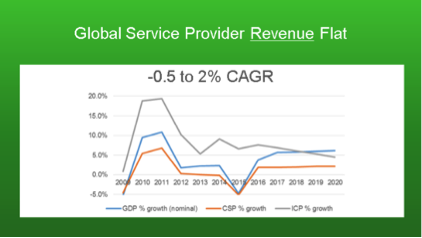
Mobile network operators face interesting challenges today. Their customers have fully embraced the digital world, and that digital world keeps expanding. Most individuals have multiple devices, and more “things” are getting connected each day. However, for the most part, revenues for the Mobile operator remain flat. Many of the applications and services used are provided by over the top (OTT) cloud services providers. Many of these OTT services are content heavy which require the mobile operator to continue building out the network – without increasing (you guessed it) revenue. Not the best business model. However, Mobile operators are run by smart people. They know that to increase revenue and profit margins they need to expand into new markets and compete with the cloud services providers.
But here is another conundrum; Mobile operators must provide Telco-grade (that’s 99.999% up time) networks with connectivity everywhere. The big cloud service companies have a different model. They build data centers – or lease rack space – close to their major customers. These data centers only need to provide 99.9% up time. You do the math. In addition, the cloud providers are very agile and flexible. There customers can make changes to their services every few weeks – no problem. Not so easy in the Mobile operator environment.
So how can a Mobile network operator strike a balance between Telco-grade networks with Cloud-like efficiencies? I am so glad you asked.
The challenge of trying to make a good visual for technology resides somewhere in the ability to tell a story and/or leverage a metaphor. As I dug into the logic around why we needed interim speeds to preserve the accelerating capabilities arriving for mobility…I recalled my favorite pastime as a bored kid growing up in Austin, TX looking for ramps to jump on my bike.
The challenge surrounds the bottleneck of expectations we are seeing in mobile data traffic. Deployed wireless speeds have already started eclipsing that of their wired counterparts. The idea of finding a cabled Ethernet port to get the good stuff…well that is quickly becoming something my kids don’t relate to, (the past).
Each week, we’ll highlight the most important Cisco Partner Ecosystem news and stories, as well as point you to important, Cisco-related partner content you may have missed along the way. Here’s what you might have missed this week:
I wasn’t in Berlin for Cisco Live Europe this week, but I was able to follow along via social media and the event hashtag: #CLEUR. I encourage you to take a moment to visit the hashtag and view the top tweets from the week. It’s amazing how much you can learn from an event by doing that. As far as I can tell, the partner presence there continues to grow by leaps and bounds each year.
This was one of my favorite tweets from the event:
Were you there? Tell me your Cisco Live Berlin Story in the comments below!
We also had a couple launches at Cisco Live Europe that are important for partners:
Cisco Launches NGFW
On Tuesday, we launched the industry’s first fully integrated, threat-focused Next Generation Firewall. NGFW is fully integrated to cut cost and complexity while enabling greater focus and insight with robust management.
Partners, you can visit the launch page for more information and everything you need to know to start delivering to your customers.
Cisco Rolls out New Digital Solutions for Partners
On Wednesday, Cisco introduced new offers and validated, purpose-built solutions that bring together hardware, software, services, and Cisco partner technologies, all designed to:
Improve the customer and workforce experience
Gain efficiencies by converging multiple building networks
Partner activities on the show floor did not just stop at our partners’ booths. For the first time at Cisco Live EMEAR, we hosted a group of our partners to do a demo in the Cisco Powered booth, which was within the Cisco Campus of the World of Solutions.
Various Cisco partners all joined us to show us their cloud demos at the demo pods in the CP booth. Not only did this allow our partners to leverage the audience of the Cisco campus, it showed how important our partner ecosystem is at Cisco and how tightly aligned we are.
The Drive to Digitization and the Impact on Your Business and Customers
Karin Surber is always tying together sales and the biggest topics of our industry. This month, she talks about digitization and the impact, or potential impact, it can have on partners.
She also shares four valuable insights to help ensure your customers succeed with you in the digitization era. Go on, check it out!
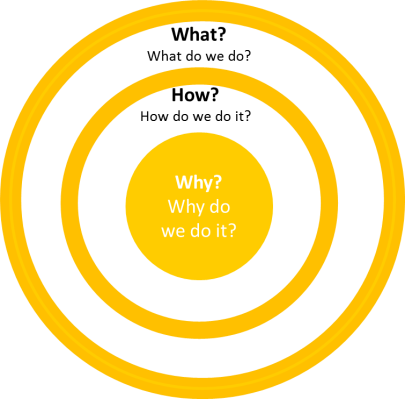
In Simon Sinek’s now famous TED Talk, How Great Leaders Inspire Action more than 25 million views served as the catalyst for his book, Start with Why.
Sinek explains that for a person or an organization to be successful, they must be intentional about creating a compelling message that others are inspired by and are inclined to act upon. This message must demonstrate three things – knowing the why, how, and what of what you do. It’s referred to as The Golden Circle and I thought it would be interesting to tie this concept to Cisco ServiceGrid.
The ServiceGrid Golden Circle
Why?
Our why is quite simple. We know every year our customers’ IT ecosystems become more complex and they are looking for ways to simplify vendor management, accelerate speed to resolution, and reduce exposure to risk. Cisco ServiceGrid exists to help our customers conquer complexity and evolve their support by enabling them to manage all their services in one place.
How?
ServiceGrid specifically helps Service Providers conquer complexity by securely connecting people, processes, and data. But, before you read our real-world examples of how ServiceGrid helped a couple of our customers, I encourage you to take 95 seconds to watch this overview video first.
You’ve read the announcement of last week’s Cisco launch that introduced the new Cisco Aironet 2800 and Aironet 3800 Access Points. Now you’re able to listen to the Cisco access point product managers talk about their products on the recently recorded “No Strings Attached Show – Networking Without Strings” podcast.
Aironet 2800 Access Point Product Manager Brian Levin and Aironet 3800 Access Point (AP) Product Manager Mark Denny sit down with No String Attached Show hosts Blake Krone and Samuel Clements to discuss their products in the first of a two-part series dedicated to the APs. Denny and Levin devote the majority of the broadcast talking about the features of their products and provide a look into both the hardware and software through the eyes of the experts. Continue reading “Talking Cisco Aironet 2800 and 3800 Access Points”
On January 10, David Bowie passed away. He was an icon in the music world, with a career spanning 5 decades, and selling 140 million albums, with many going to number 1 on the charts. And yes, you are reading a Data Center blog that will, eventually, wind its way back to the more familiar topics of containers, microservices, clouds, as well as routing tables, MAC addresses and buffering algorithms. They are all connected, as we shall see over the next couple weeks and posts.
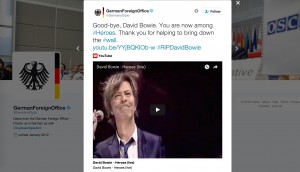
Back to Mr. Bowie. When he passed away last month, the German government sent out this tweet:
Why? We’ll get to that, but first let’s consider his hit song “Changes”. That song, in many ways, was symbolic of Bowie’s life. He was a very creative guy, in terms of the music he made and also his ventures into other areas – fashion, film…he even started his own Internet Service Provider. He went through significant changes in terms of his overall look, style and sound.
He reflected cultural shifts – over time and space (he was popular on multiple continents, over many years) – and, to some extent, impacted these shifts. He was relevant in different eras and different places. One of those places was in Berlin, which is where Cisco Live is happening this week. He actually lived there for 3 years from 1976-1979, during which he recorded 3 albums. One of them had a song on it called “Heroes”, about a couple that met at the Berlin wall. It was a story of desperation and hopelessness.
In any case, “Changes” could be the anthem for what we are seeing in the industry right now. Tech in general and networking in particular are always changing. Over the past few decades we’ve seen many new protocols, media, speeds, operating models, etc. However, never before has there been such a major set of far reaching changes hitting us all at once. This convergence of change is creating a seemingly infinite loop between technology and business, one that is accelerating and cycling at a dizzying pace. Digitization is having a hugely disruptive influence on business, which then demands more from the technology, which then delivers new innovation having a disruptive influence on the business…and round and round we go. Note this disruption to the business can be either positive or negative, depending on how capable/innovative the business is to integrate and exploit the new technology. ‘Tis much better to be a disruptor than to be disrupted.
A few of the key trends causing this disruption include containers/microservices, cloud and hyperconvergence.
Containers are picking up a lot of momentum. Fast. We will see lots of containers, ‘across time and space’, i.e. over the coming months/years, irrespective of geographies, vertical markets, or organizational size. Docker hub pulls grew from 11.3 million in January 2015 to 1.3 billion in October 2015. Why? They offer a lighter weight, faster, more scalable way (vs VMs) to operate and isolate multiple apps on the same operating system.
As traditional apps are deconstructed into multiple microservices running on containers, each of those containers represents new addressable endpoints on the network. How many more endpoints? Lots. As a result, any given RU will see dramatic increases in the number of endpoints. I’ve seen many different projections, but it appears that the rough numbers indicate we’re looking at a move from like dozens of VM’s per RU to 100’s of containers per RU. As this concept is multiplied across the rack, aisle and overall data center, all those new endpoints mean a corresponding increase in addresses, routes, etc.
As customers struggle to deal with these increasing requirements, they will seek out new ways deal with them. These new ways will be the subject of the next 2 posts, along with consideration of how both hyperconvergence and cloud play into this mix, beyond them simply reflecting the output of a random buzzword generator.
As for Mr. Bowie, I learned that about a decade after he left Berlin, he returned – in 1987 – to do a concert at the Berlin Wall. It was actually a dual concert because he played in West Berlin, but thousands of fan’s gathered on the East Berlin side as well, and could hear as he played “Heroes”, and spoke in German. Riots erupted on the East Berlin side. The following week, Ronald Reagan delivered his famous speech telling Gorbachev “Tear down this wall”. It’s said that these riots served as the catalyst for a parade of revolt over the next 2 years that ultimately led to the Wall coming down. So, that is the somewhat embellished story behind the tweet that opened this post, and the way David Bowie, Containers and Cisco Live Europe are (at least in my perhaps twisted view of the world) connected.
In summary, one could say that the Wall stood between an ineffective political/economic system that did not meet the needs of a changing world, and the promise of change, openness, freedom and security. Actually, Reagan used those very words (bolded) in his speech at the wall. These same words can be used to describe many of the innovations at Cisco Live Berlin this week. Innovations that are enabling customers to adapt to a changing world, with open API’s and standards, freedom of choice and embedded security. Note, I am not being so ludicrous as to say there is any comparison between the impact of the 2 events – I’m just saying one is a metaphor for the other. Check back next week as we cover more about these innovations and how they address major trends of change in the industry.
A mentor of mine once told me, “if you have trouble solving a problem, try innovating from the opposite direction.”
Jimi Hendrix clearly understood this concept well. Being left handed, he was initially confounded by the lack of available left-handed Fender Stratocaster guitars. His solution was ingenious. Hendrix bought a right-handed version, turned it upside down, and restrung it as a left-handed guitar. Voila! Problem solved. This unique approach only added to his mystique.
Today’s customer experience challenge can be a daunting and complex challenging proposition.
One sure way to sub-optimize customer experience outcomes is to start with a technology solution in mind. Both companies and vendors often take this approach. It’s tempting because there are some really neat things happening in the customer care technology ranks these days.
A more effective solution is to “flip the process over” and solve the customer experience backwards – from the customer viewpoint. Many organizations are adopting an emerging model that actually begins with the emotion it wants to elicit from its products and customer facing processes. Continue reading “Play It Backwards: Jimi Hendrix and Customer Experience Part III”
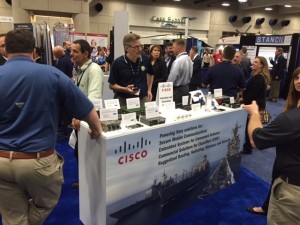
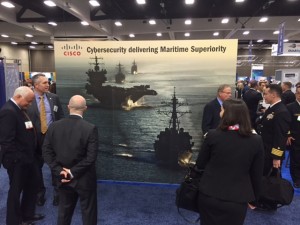
I’m writing to you from AFCEA WEST 2016, one of the biggest naval conferences on the West Coast. Here in San Diego, I’m surrounded by both industry experts and military leaders who are discussing how to use technology to advance the Navy’s mission to maintain, train and equip combat-ready Naval forces capable of winning wars, deterring aggression and maintaining freedom of the seas. Cisco is here sharing our solutions for the Navy that focus on both collaboration and security.
Our Connected Navy initiative helps digitize naval operations, connecting the unconnected to assist the Navy in increasing operational efficiencies and performing their duties more effectively. For example, Cisco solutions can help the Navy improve the intelligence, surveillance, and reconnaissance abilities on unmanned vehicles to increase situational awareness on the open seas. We also have tools that can help the Navy keep track of key assets on an enormous aircraft carrier, or improve shipboard security and the Navy’s Anti-Terrorism Force Protection capabilities. Digitization can provide the Navy with an opportunity to better deliver net-centric warfare across the operational spectrum, which in turn helps keep our seas safer.
Additionally, for us security is given. At Cisco security is embedded into everything we do. For example, Cisco Advanced Malware Protection (AMP) provides protection across the attack continuum, detecting known threats both as they enter the network and turning back the clock to identify previously unknown threats. Also, as part of Cisco’s security portfolio, Lancope’s StealthWatch system provides visibility into suspicious traffic patterns and helps accelerate incident response. The increased network visibility and advanced threat detection Cisco provides is crucial to protecting naval networks so that warfighters can use them securely during their missions. And Cisco Industrial and Embedded products can be used for everything from mobile communications to unmanned vehicles. For example, Cisco embedded solutions are used in Marine Corp vehicles and aircraft.
If you’re at West 2016, make sure you stop by Booth #1631 to learn more about Cisco’s security solutions and our Connected Navy initiative. If you’re not in San Diego this week, make sure you follow along on social media using #WEST2016 and @CiscoFederal for key insights from what I’m hearing on the show floor.



 It is by now reasonably well understood that we are finding ourselves in the fourth wave of the industrial revolution, one that is characterized by the digitization of things and processes, and the subsequent transformation of business outcomes. Key technology developments that enable businesses, government, and countries to re-imagine themselves in an rapidly changing world, include mobility (90% of internet traffic will be consumed via mobile devices by 2017), pervasive video (one million minutes of video traverses the internet every second), hyper connectivity with the Internet of Things (20 billion smart objects will be connected to digital infrastructure by the year 2020), big data and advanced analytics (data doubles every two years and last year alone we generated more data than all of mankind before), apps (more than 47,000 applications are being downloaded each and every minute), and cloud (changing consumption models).




 In Simon Sinek’s now famous TED Talk,





![west-2016[1]](https://blogs.cisco.com/gcs/ciscoblogs/1/west-20161-300x107.png)