Avatar

Greetings from the Mile High City!

When the Bronco’s won Super Bowl 50 last month, a million happy fans gathered downtown for a victory parade and rally in Civic Center Park. Transporting a million people around a city the size of Denver, in a matter of hours, is no easy task. That day saw the largest one-day total ridership in the 40 plus years of service by Denver’s Regional Transportation District (RTD). Light rail use was up 82% over a typical weekday. Though many people used mass transit, I-25, the main artery leading into downtown and other roads were still heavily congested.

This week, U.S. Secretary of Transportation, Anthony Foxx gave Denver another reason to celebrate as he named Denver one of seven finalists in the US Department of Transportation (USDOT) Smart City Challenge.  Ok, we may not get a million people downtown to cheer on our city leaders as they vie for this coveted award. But, winning the $50 million grand prize would go a long way towards improving transportation and mobility for the 3 million Denver Metro area residents. Not to mention the 15 million people who visit each year.

Denver’s proposal is all about “connecting more with less”. The plan focuses on creating a more connected multi-modal system to connect residents, systems and infrastructure with technology and information to provide more flexible, affordable, and accessible transportation options and a higher quality of life.

So, what is a smart city? The Smart Cities Council says a smart city “uses information and communications technology (ICT) to enhance its livability, workability, and sustainability. And, also that a smart city “has digital technology embedded across all city functions.” Smart cities may digitize city services, public safety, healthcare, education, lighting, and so forth but transportation is at the heart of every smart city. It is hard to imagine a modern smart city without an intelligent transportation system of connected roadways, vehicles, mass transit, airports, stations and ports. Many cities exist today because of transportation and Denver is the city it is today, thanks to the arrival of the railroad in 1870, which literally saved it from demise.

According to the USDOT, the U.S. population is expected to grow by 70 million people over the next 30 years, making it imperative for cities to adapt and update their transportation systems – and soon! Americans already spend an average of 40 hours stuck in traffic each year, which makes digital network connectivity of roadway infrastructures even more critical for cities of the future.

Ninety-eight cities met the criteria for the USDOT Smart City Challenge, and 78 cities submitted proposals, far exceeding expectations. Secretary Foxx stated, “after an overwhelming response, we chose to select seven finalists instead of five because of their outstanding potential to transform the future of urban transportation.”
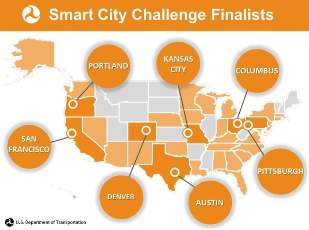
Smart City Challenge 7 finalists image - CopyThe other six finalists are: Austin, TX; Columbus, OH; Kansas City, MO; Pittsburgh, PA; Portland, OR; and San Francisco, CA. All finalists will receive $100,000 to help fine tune their proposals before the winner is announced in June. You can be sure that some of the greatest minds in transportation will be  busy in each city with $50 million at stake.

Cisco has a presence in all seven of the finalist cities, with current deployments in place or through formal letters of support for the implementation of each city’s proposed plans for network connectivity.

Cisco’s robust portfolio of products forms the foundation for a secure end-to-end digital IP network for transportation. The Cisco IoT System, includes ruggedized switches, routers, wireless access points and high-definition video cameras designed to withstand harsh environments. Of course, it takes an integrated and sometimes diverse ecosystem to build a truly connected transportation infrastructure so Cisco also works closely with trusted industry-leading partners to complete the picture.

union-station-bus
RTD bus in front of Denver’s historic Union Station. (This photo and title photo provided courtesy of Denver RTD)

Good luck to all – yes, even you Columbus. I don’t believe this lifelong Michigan Wolverine fan has ever said good luck to the Buckeyes.  But, the fact is, everyone wins when more smart cities and intelligent transportation systems are built.  On that note, I’ll end with Go Denver!

Learn more about the USDOT Smart City Challenge

Learn more about the Cisco Connected Roadways and Cisco Connected Mass Transit solutions

Watch the Cisco Connected Transportation and Smart Cities video

 

Authors

Barb Rigel

Marketing Manager

Internet of Things, Connected Transportation

Avatar

Cisco Partners Weekly Rewind Banner-650

Each week, we’ll highlight the most important Cisco Partner Ecosystem news and stories, as well as point you to important, Cisco-related partner content you may have missed along the way. Here’s what you might have missed this week:

Off the Top

If you weren’t able to go or follow live, be sure to stop by Cisco SalesConnect for on-demand recordings of sessions from Partner Summit 2016.

Digital Transformation Is in Our DNA

It’s been quite a while since we’ve had someone from our fantastic distribution team stop by to share what’s top of mind. So, needless to say I was thrilled to have Oren Singer on this week.

In his first partner blog, Oren continues the conversation that was started at Partner Summit 2016 a couple of weeks ago. See how his personal experiences and work life collide to highlight the partner and distributor benefits of CiscoDNA.

Look for more regular posts from the distribution team and welcome to the partner blog, Oren!

It’s Time to Use the Engage Marketing Suite – and Win!

Marketing Velocity 2016 finished a couple of weeks back. And host of the event, Michelle Chiantera, is continuing the energized conversation and riding the momentum by taking a deeper dive in Engage, our latest marketing suite for partners.

Be sure to read her blog from this morning to get the full picture of the Marketing Velocity program and how you can start leveraging all it has to offer.

It surely is a digital world, and partners can now Engage with their customers in new ways.

CRN Channel Madness 2016

Last year, our cisco execs failed to make it out of the first round in this annual, light-hearted tournament. This year, we hope to change that and take our only entrant straight to the final four!

Be sure to stop by CRN and vote for our own Channel Chief, Wendy Bahr!

In the News

Good Reads

Continue reading “Cisco Partner Weekly Rewind – March 18, 2016”

Authors

Darek Rensing

No Longer with Cisco

Avatar

Screen Shot 2016-03-18 at 8.55.52 AMAccording to IDC, The Big Data technology and services market will grow from $16.55 billion in 2014 to $41.52 billion in 2018. 
Big data will continue to transform businesses everywhere.
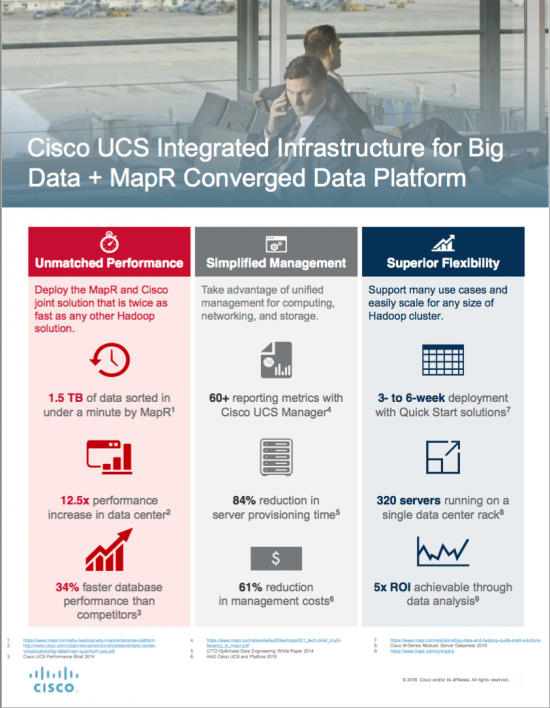
Together, Cisco and MapR enable customers to take full advantage of structured and unstructured data throughout your business.

  • Sort petabytes of information with record-breaking speeds and unmatched performance.
  • Achieve faster parallel processing and application performance using Cisco UCS servers.
  • Reduce management efforts with workload automation and use industry-standard tools to maintain the data lake.
  • Demonstrate compliance with reduced effort, and protect data.
  • Easily scale storage and compute investments to meet your business needs.

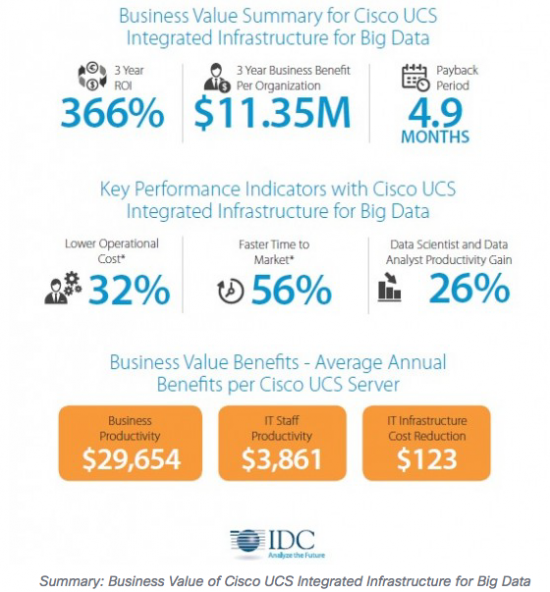
MapR and Cisco deliver unmatched performance, simplified management, and superior flexibility for big data. Gartner has named MapR a Visionary in the Gartner 2016 Magic Quadrant for Data Warehouse and Data Management Solutions for Analytics. IDC also validated that Cisco UCS Integrated Infrastructure for Big Data provides the competitive edge that the customers are looking for (see below).

Screen Shot 2016-03-18 at 10.06.38 AM


Want to learn more? Come to MapR Big Data Everywhere!

This is is a half-day conference focused on Hadoop, Spark and other big data technologies that brings together users and developers to share their experience via technical sessions and user success stories. Industry and technical experts will share their knowledge, share best practices, and discuss use cases and business applications. Continue reading “MapR Big Data Everywhere 2016”

Authors

Renee Yao

No longer at Cisco

Avatar

Here we are, two weeks past the Marketing Velocity event and I wanted to share my thoughts about the power the Engage Marketing Suite could bring to your companies. As many of you know, I am wholeheartedly focused on the well-being of our Partners. I truly believe this is an incredible contribution Cisco is making to the value exchange in our joint relationships. But it only works when both parties can work together successfully. While I hope that what is shared here answers your questions and dispels any challenges, I welcome your questions!

Now that we have the housekeeping put aside, let’s talk about why we’ve taken this approach. We greatly value the partnerships we have with you and believe that in addition to creating great products, services, and solutions, we must follow the old adage, “You have to spend money, to make money!”  There is also the growing opportunity of how digital is impacting marketing. I’ll talk about this shortly.

Some of you are aware that we have created marketing campaigns that include marketing dollars that we’re investing in your companies to help you succeed. Alas, over time we’ve experienced that many of these funds go untouched. Why? Well there have been many reasons, including complications with Partner Marketing Central, not knowing how much wallet is available, and not knowing how to initiate marketing programs.

Well, we hope we have something to help with this. As SVP Wendy Bahr shared on main stage during the opening of Partner Summit — we give you, the Engage Marketing Suite. What does this mean, sans all the marketing speak? Simply put it’s a formula to help you succeed – but it will still require your focus and participation! Let’s break Engage down to its parts, then the sum of everything shows how it works for you.infographic_Engage

The first part of the Engage suite includes a reinvigorated Marketing Velocity program. Previously, we would encapsulate best practices and bring them to our annual event or roadshow. We have expanded those capabilities to give you the latest in marketing best practices, training and advice from experts, along with the practical approaches offered at the annual event and ongoing global roadshows.

With the Marketing Velocity Hub, you will have always-on access to consistent best practices NOT just from Cisco, but from across the globe! Training will also be available so you can hone your marketing skills – with each course you take you will receive a certification of completion. No longer do we require you to take multiple courses, electives and classes. Imagine — you can be the envy of your colleagues with your newly acquired marketing knowledge.

Hub

In case that’s not enough, we know how much you enjoy guest speakers during the Marketing Velocity event, so we have initiated the On-the-Air Webcast series so you can learn from the experts. Because we really like you, we’ll continue to bring the Marketing Velocity events to life with great speakers and content, similar to the incredible talks from Guy Kawasaki and Cmdr. Chris Hadfield. Do I have you enchanted yet?

Ok… so that’s just a piece of it. While it’s our goal that you’ll use the learning benefits to help you think differently, to market effectively — all to reach existing or new audiences in ways you may not have thought possible. But now you ask, “What would we share and how could we pay for it?” This is where the new Partner Marketing Central (PMC) becomes that much more important.

We listened! And we changed it!

PMC

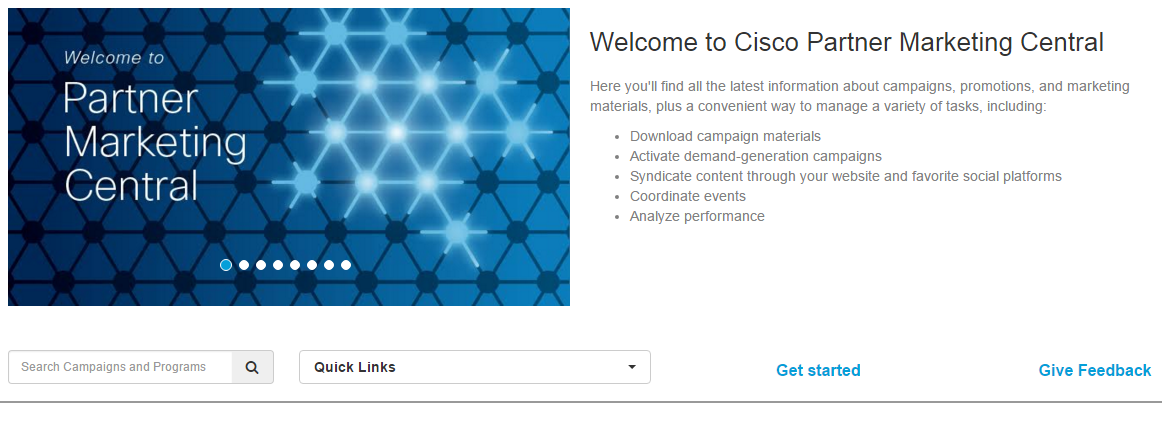
Simply put, Partner Marketing Central is a personalized digital experience that gives you access to campaigns tailored for you, combined with a simple way to manage your marketing funds. This means you can customize digital demand generation services to engage your customers and drive revenue. No longer will you have to hunt for campaigns and content since the interface is personalized for you. And, depending on your region you’ll have access to your marketing funds easily, safely and securely. If you’re having challenges, questions or concerns we have digital marketing experts available for you to help you identify and activate the right marketing mix for your company. Still not sure how to use those funds? Rely on your new marketing knowledge provided by Marketing Velocity, or use your funds to manage one of the many vendors we have on standby to help you…ENGAGE.

Continue reading “It’s Time to Use the Engage Marketing Suite – And Win!”

Avatar

Last week’s Enterprise Connect event was an eye-opening experience from many perspectives. A tour of the exhibit area seemed like a real-time stroll through the history of contact center technology.

Several traditional contact-center providers were present, but some former industry powerhouses were notably absent. Also missing were many recent additions to the industry ecosystem. The consistent question for me was identifying what was new vs. iterations of existing concepts.

There’s no question that customer care is going through at least three major transitions: cloud, context, and hybrid.

  • The move to cloud is well underway. Estimates have the cloud contact-center market growing at least 20% year-over-year for the foreseeable future.
  • The market shift from transactions to interactions requires a much deeper set of insights than traditionally applied. Context is an extraordinary opportunity to improve the service you’ve delivered (or not) – regardless of the customer’s starting point.
  • Delivering value in hybrid (cloud + on-premises) environments is critical to ensuring that vendors respect existing customer investments while infusing new value through cloud.

Good news: Cisco is heavily invested in these three areas, not only in our contact center, but across the entire Collaboration portfolio.

Market transitions are rarely simple. As a vendor, making it through them requires:

  • Focusing on the long-term success of each customer
  • Having the financial strength to execute on that focus

Investing for long-term customer success is critical.  Market transitions tend to start in the minds of developers, evolve to the vendor pavilion, and then reach customers. Corporate patience in transitions is a virtue. Long-term success requires extensible platforms that enable customers to easily evolve over time.

Financial strength is critical. You need the investment horizon to move an entire ecosystem through these transitions. That means products, platforms, teams, partners, and customers.

Cisco looks forward to continuing to lead the transition as the trusted provider for our industry.

Learn more about the products in our Customer Care product portfolio.

Authors

Chris Botting

No Longer with Cisco

Avatar

This post was written by guest blogger Linas Dauksa, Marketing Manager, Enterprise Segment, and DIRT volunteer Picture1

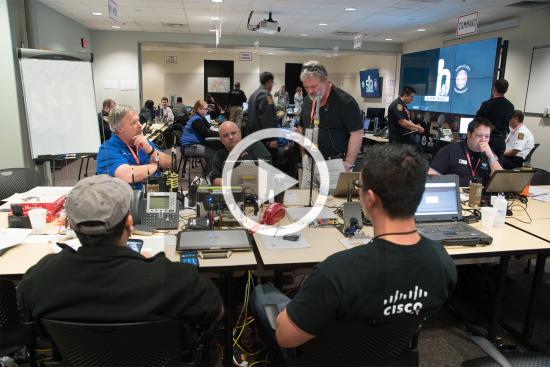
Super Bowl 50 was uneventful. Dare I say boring? I’m not talking about the game, but events in the Super Bowl Operations Center. There were 60+ people in the room and none of us were actually watching the game, though it was playing on several televisions. No one cheered at the end when the Broncos won (even though there were Broncos fans – including myself). Instead, we used our unique specialties to ensure that those attending or watching the game in the Bay Area had a safe, fun, and uneventful experience.

The Operations Center provided an environment for Federal, State and Local agencies to coordinate their resources and personnel among 40+ different agencies. There were the local and state police forces, fire departments, Air Force, Army, NOAA (weather), PG&E (our local Gas & Electric agency), various cyber intelligence agencies, and some people in dark suits. I was there – though I’m in Marketing at Cisco – as volunteer with Cisco’s Disaster Incident Response Team, managed by the TacOps (Tactical Operations) Team. Typically TacOps provides communications support during natural or man-made disasters. In this case we were invited to support the Super Bowl.

A behind the scenes view of the Super Bowl Operations center

Continue reading “The DIRT on Why Cisco’s Network Emergency Response Vehicle Sat Idle at Super Bowl 50”

Authors

Austin Belisle

No Longer with Cisco

Avatar

Apache Mesos, it’s fair to say, is a battle-hardened system for treating your whole data center as one pool of resources. Through the use of frameworks and their APIs, it’s possible to manage and schedule resources across both data centers and different cloud environments. It is for these reasons that Mantl, our microservices framework, was built on top of Mesos initially.

One of the goals of Mantl is to be developer friendly. We want developers to spend most of their time developing applications and not managing platforms and infrastructure. This meant we had to  make it easier to get onto the cloud, where Mantl succeeds(for example, with numerous Terraform scripts). We also wanted to move the cloud closer to the developers. It was this last goal that gave birth to minimesos.

minimesos

minimesos is an experimentation and testing tool that allows developers to run Apache Mesos locally. The cluster boots up in seconds, which allows, for example, developers to run automated tests both locally and through the CI server. This dramatically reduces the time it takes to develop applications that run on Apache Mesos.

minimesos Online

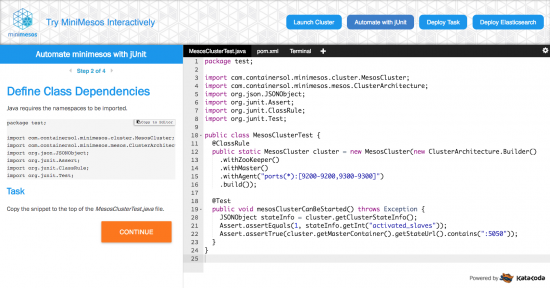
As part of Cisco’s mission to connect to more developers and to make cloud-native easier, we decided to team up with KataCoda and create minimesos Online. minimesos Online is a rich, online interactive environment that lets people experiment with minimesos. Through guided scenarios, users can learn basic minimesos commands as well as how to control the Mesos cluster programmatically (writing a JUnit test, for example). Give it a try here.

As well as playing around with basic minimesos commands, users can also experiment with the Marathon, inspect the minimesos file and even install and experiment with the Elastic framework. This interactive learning environment allows users to play whilst understanding the features of minimesos. If your writing test automation of the cluster, you will have this configuration.

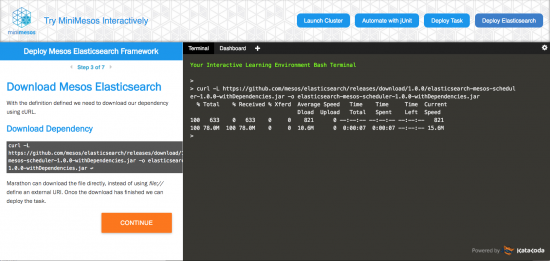
minimesis1

The terminal will allow you to download and install the Elastic framwork for Mesos via terminal.

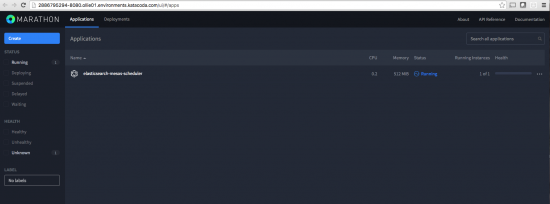
minimesis2

Your able to access the Marathon scheduler through the browser.

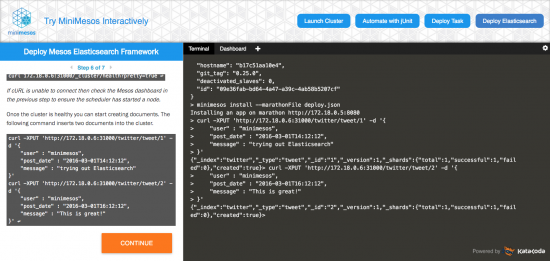
minimesis3

This next image shows being able to add documents to the Elastic database from the terminal.

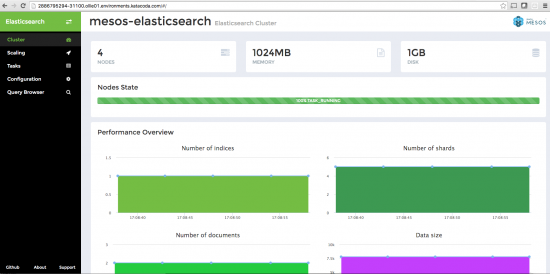
minimesis4

And if your would rather use the Elastic GUI, we enable that as well.

minimesis45

Other Features

  • Configuration file for creating rich Mesos clusters locally.
  • A rich CLI.
  • Java API.
  • Rest API.
  • Integrated service discovery.
  • Support for a large range of frameworks.
  • Encapsulated network; no unintended interaction with other clusters.
  • Resource allocation; sandboxed CPU, RAM, disk and port resources.

If you want to see more, check out the videos here.

Conclusion

Cisco is a founding member of the CNCF (Cloud Native Computing Foundation). The CNCF’s mission is “to create and drive the adoption of a new computing paradigm that is optimized for modern distributed systems environments”. It is through our work with Mantl that we are trying to drive the new paradigm forward. However, it is through tools like minimesos that we are driving the adoption of this paradigm. One of the current problems with cloud-native application is the cost of experimentation (COE). We must continually look to reduce the COE and two ways we are contributing to that is with minimesos and minimesos Online.

We hope you enjoy these tools and look forward to any feedback, which can be sent to the GitHub repo or via Twitter at @minimesos.

Acknowledgment

minimesos is a collaboration between Cisco Cloud Services and Container Solutions. minimesos Online was built in collaboration with KataCoda.

Authors

Kenneth Owens

Chief Technical Officer, Cloud Infrastructure Services

Avatar

Just as we are beginning to think that the latest cloud news may have become quite predictable, you run into an article that causes you to pause: “Dropbox moves 90% of its data off Amazon AWS in favor of its own private cloud

What I found interesting about the article, as it relates to what I am about to discuss, is the fact that even if Dropbox spent two and a half years building its own private cloud ‘they have always had a hybrid cloud architecture’ in mind.

Cloud does involve technology, intimately. And with all the talk about public, private, and hybrid clouds; open-source versus commercial cloud management software; internally deployed versus hosted; it’s easy to get lost in the weeds. The question though is … ‘what’s your cloud strategy’? Unfortunately, today not many organizations have advanced cloud strategies in place and the reason is not necessarily poor planning.

Embracing cloud is all about retaining choice. This is true in general, simply because without choice you have no cloud strategy to begin with. The choices we make today will limit our decisions tomorrow. Choices set the context and define the strategy. And it all starts with the business strategy, which in turn shapes the context of your IT strategy. In this case, Dropbox retained business and IT flexibility by adopting a hybrid cloud architecture. This choice allowed them to make the decision to eventually take back 500 PB of data. This was a business decision as much as it was an IT decision.

Cloud strategy Blog Pic 1

N=2,378. Source: IDC InfoBrief, sponsored by Cisco, Don’t Get Left Behind:
The Business Benefits of Achieving Greater Cloud Adoption, Aug 2015.

Not surprisingly market research findings indicate that 64% of cloud adopters are using some form of hybrid cloud. I emphasize ‘some form’ of hybrid cloud, simply because the very same nature of what hybrid cloud is (or perceived to be) varies greatly among organizations.

Organizations that think strategically perceive cloud as an opportunity to shift the role of IT in the enterprise from focusing on more mundane, maintenance-oriented tasks to being catalysts for overall business innovation, digital disruption and ultimately revenue growth. Your cloud strategy needs to review the reasons why you’re considering cloud in the first place. Many cloud projects ‘fail’ simply because the goals, metrics and objectives were not clear to begin with.

Locking yourself into one vendor can mean ceding control over your ability to experiment and innovate. The best cloud strategy is the one that gives you the highest possible number of options— right up until the time you consume cloud services (and possibly beyond.) To that end, it is important to preserve choice in consumption models. Not all workloads are created equal. Are you targeting DevOps environments or traditional business-critical applications? Do you want to own the IT assets, or do you prefer usage-based pricing models? Do you want to outsource the management of your IT assets? Do you want to keep your data on premises? These and other choices have profound implications on your financial metrics, your internal organizational structure, your risk profile and the way you partner with your LoBs.

cloud choices Blog - Fig 2

Cisco cloud deployment choices

The good news is that there are a variety of resources that can help you define your cloud strategy (e.g., identify choices) and successfully implement it (e.g., make decisions). Cisco continues to provide you with a number of choices to support your cloud projects. Additionally, Cisco and IDC have worked together to package the findings of multiple research studies into a set of tools that enable you to achieve greater impact as you execute your cloud strategy.

For example, with the Cisco Business Cloud Advisor framework (enabled by IDC) you can:

  • Assess your organizational readiness for cloud adoption.
  • Understand and quantify how improving your cloud strategy can benefit your business.
  • Compare your cloud adoption levels with your peers by industry, company size or geography
  • Identify gaps and opportunities (based on market data … versus anecdotal data points)
  • Define a cloud adoption strategy and execution plan for better business outcomes.

So what’s your cloud strategy? Take a brief survey to begin the journey or contact us, you may be eligible to participate in a complimentary BCA Workshop.

Additional Resources:

Authors

Enrico Fuiano

Senior Solutions Marketing Manager

Cisco Cloud Marketing Team

Avatar

Controlling quality in a complex manufacturing environment moving at light speed is not easy, but it needs to be done. Any time there’s a recall, it affects your brand and the trust your customers have with your products. True quality control is fixing problems inside of your 4 walls.

Imagine you have been alerted that a key component you are sourcing from another company has a recall issue.

You have several suppliers for this component to your plant and now you have to figure out which of your products are affected. If you are able to identify where the components are, then you can deliver a controlled recall specifically to your customers.

If not, your customers could be disappointed watching a national recall on the evening news and your brand takes a hit. Worse yet, you may have a customer that was buying your product and you just chased them to the competitor….and they might never come back.

If you cannot isolate where the quality problem exists in your plant, the cost of controlling that becomes exponentially higher. You need to prevent the problem before it leaves the plant and affects customers.

That’s where Cisco comes in.

Cisco provides traceability across the network to collect and track production data. The data can be analyzed in real-time and alert operations that there’s a problem.

Here’s where we’ve done it:

We’ve helped Barilla track pasta across the entire supply chain. Customers can know the farms where the wheat was grown, the co-ops and factories where it was processed, and how much water and carbon dioxide were involved in production.

quality-control-2

We’ve partnered with Bosch to help workers on the assembly line use their wireless torque wrenches for consistent quality. For example, the wrenches can catch a problem and alert the worker that a bolt wasn’t tight enough. Our systems monitor thousands of torque recordings and help ensure the components are put on correctly every time.

quality-control-4

What it took to get you here will not be enough to keep you here. Only by digitizing processes can you have first time, every time quality.

Are you meeting your own quality expectations? Share your thoughts in the comments below. If you are interested in receiving our weekly blog posts, click the “Subscribe” button at the top right corner of this page.

Authors

Steve Gansen

Senior Business Development Manager

Manufacturing Industry, Americas