Avatar

Author:  Dan O’Malley , Senior Product Manager, Cisco Internet of Things Group

Intelligence relies on the ability to create connections – to connect the unconnected – and to deliver the right information to the right person, machine or device that facilitates autonomous decision-making and action.  Broadband network infrastructure technologies, such as LTE, and the Internet of Things (IoT) products and technologies are accelerating our ability to realize the benefits of the digital platform by connecting people, processes, data and things.

Continue reading “Cisco Partners with Parallel Wireless on Deploy-It-Yourself (DIY) Kit to Help Mission Critical Public Safety agencies to …”

Authors

Kacey Carpenter

Senior Manager

Global Government and Public Sector Marketing

Avatar

The role of IT is to maximize business capacity, and refreshing your servers is an opportunity to increase capacity, reduce hardware and most importantly, lower costs for the business. It is reasonable to assume that packing more physical servers into less rack space helps you accomplish these goals.

Here is the problem: If you increase server density by repackaging it into a smaller physical chassis, it does not mean you get more servers into fewer racks. Even with moderately dense blade and rack solutions today, you run out of available power (and more critically) available cooling, long before you run out dangerof physical space. You might say ‘we are building a new data center that is sure to offer higher density’ or ‘we are moving to a new co-location facility and this won’t be an issue.’ However, it takes expensive and complex technology to achieve higher average rack cooling density on the facility side, and critical trade-offs on the server side….this the fine print. Unfortunately, purchasing decisions are being made on the number of servers vendors can stuff into a rack unit without truly looking at the fine print.

Let’s look at real power and cooling limitations of modern data centers;  not aging facilities that are long in the tooth, but facilities being built today to last another 10-15 years. What are the power and cooling design guidelines? To discuss these factors, we invited Vali Sorell, the Chief Critical Facilities HVAC Engineer at Syska Hennessy, one of the largest data center design firms in the world, to provide input:

ValiSorell

Typical power per rack in enterprise-type data centers today rarely exceeds 8 kW. There are always some high power racks or cabinets in the typical data center, but overall averages are usually considerably LOWER than the IT load planners had anticipated. The fact that there are pockets of higher density should not affect the way in which racks and equipment are purchased. In those isolated cases, cooling provisions can be made to account for it. This brings up a few points that need to be considered when planning a data center:

With the exception of high performance computing applications, specifically ones in which cabling distances affect the speed to a solution, there is not a need to densify. Densifying when it is actually not called for creates situations in which high power servers are all grouped into a small number of slots. Without proper air flow management, providing a cooling solution for that layout can be complicated, and is often overlooked. Often, data center owners spend too much time “minding the gap” between adjacent cabinets, and miss the issue that blatant gaps inside cabinets are just as harmful to effective operation. Even if blanking panels are used to stop the resulting gaps, some degree of internal recirculation and bypass is promoted through the operation of the high density servers and their use of the higher power server fans. As a result, the use of higher density servers can result in lost efficiency, poor internal air flow, and higher entering IT equipment temperatures.

Densifying is not cost effective. To deliver cooling and power to a cabinet populated to 20 kW will cost more than 2X than doing the same for twice as many cabinets populated to 10 kW. The typical argument FOR densification is that it will use less floor area. That approach misses the bigger picture that the back-of-house spaces, which deliver cooling and power to the cabinets, are not affected by densification. The only determinant of back-of-house floor areas is the TOTAL power delivered to the data hall. For high density installations, that back-of-house floor area to data hall ratio could be upwards of 5 to 1; for lower densities it could be 2 or 3 to 1. Adding more complexity to that high density solution is that the overhead or underfloor spaces required for delivering the cooling air increases quickly as the loads per rack increase.

Additionally, with higher density, more modes of failure exist; and when a failure occurs, the response time to prevent a shutdown of a facility is significantly reduced. The net result: increase in density leads to a decrease in reliability.Vali Sorell


The bottom line is that new data centers rarely average over 8kW per rack, and increasing average density above 12kW requires expensive supplemental cooling technology that adds complexity and affects overall data center reliability. Consider that a typical blade enclosure on average consumes between 270W-470W per rack unit (RU) depending on workload. This means a 42U rack today could easily consume over 20kW of power and cooling capacity! Vendors are creating servers today that put several nodes into a 2U package, but they aren’t all sharing the Fine Print that affects customer decisions. It would sound something like this:

https://youtu.be/0xr4JszOdck

Density isn’t they key to refreshing your data center servers – Efficiency is the Key. Cisco UCS brings the most power efficient platform to your data center by unifying the fabric and unifying management to maximize each and every rack. No other platform provides the rack efficiency both in power and in operation. Let’s look at your racks and the business efficiency you will gain with Cisco UCS!

Thanks to our Cisco Power & Cooling experts, Roy Zeighami & Jeffrey Metcalf

For More Information:

Authors

Kevin Egan

Director, Compute Systems Group

Cisco’s Data Center Business Group

Avatar

This post was authored by Anu Jadhav, Product Manager

Cisco Connected Mobile Experiences (CMX) is an innovative WiFi-based solution that enables public-facing organizations across many industries to better understand customer behaviors and trends. CMX provides your visitors with guest wi-fi access and connects with them by offering location-based promotions, which increases revenue opportunities and higher customer satisfaction.

As public enterprises continue to upgrade and modify their venue and services layouts, their WiFi deployments must be validated for location accuracy and latency to ensure Cisco CMX can provide optimal service.

We are excited to introduce the Cisco CMX mobile app to aid CMX customers with this ongoing effort, The first version of the app is now available in the Apple App Store and enables CMX deployment configuration, monitoring, and troubleshooting.

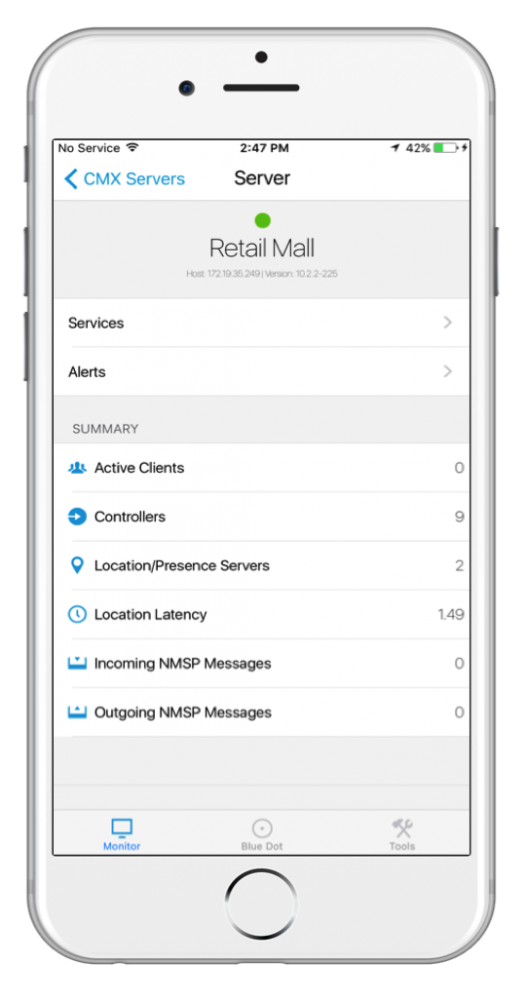
CMX Admin mobile app screenshot with iPhone bezel

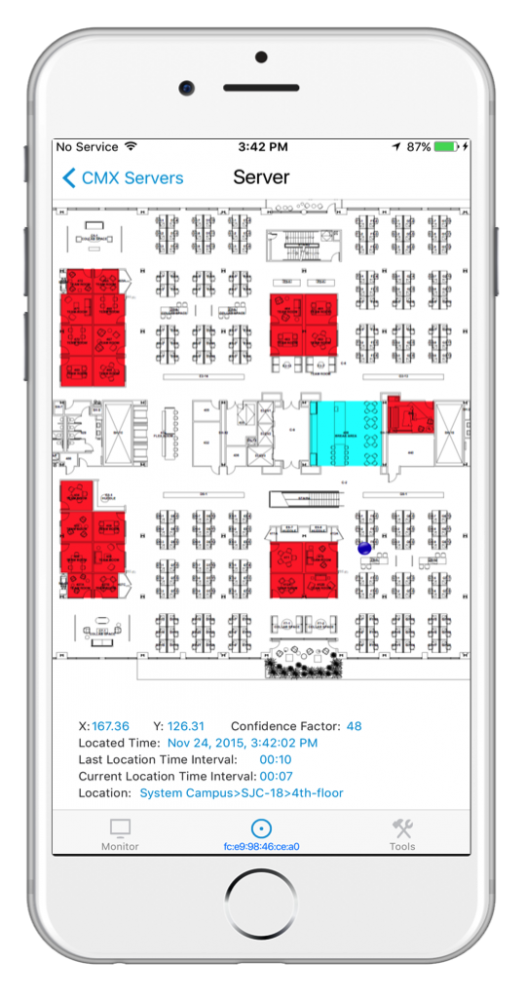
The intuitive dashboard on the CMX Server page allows the deployment administrator to monitor critical statistics such as Active Clients, Latency, and more. The Blue Dot feature allows existing deployments to monitor WiFi locationing functionality and accuracy with real-time field tests.

CMX Admin mobile app screenshot 2 with iPhone bezel

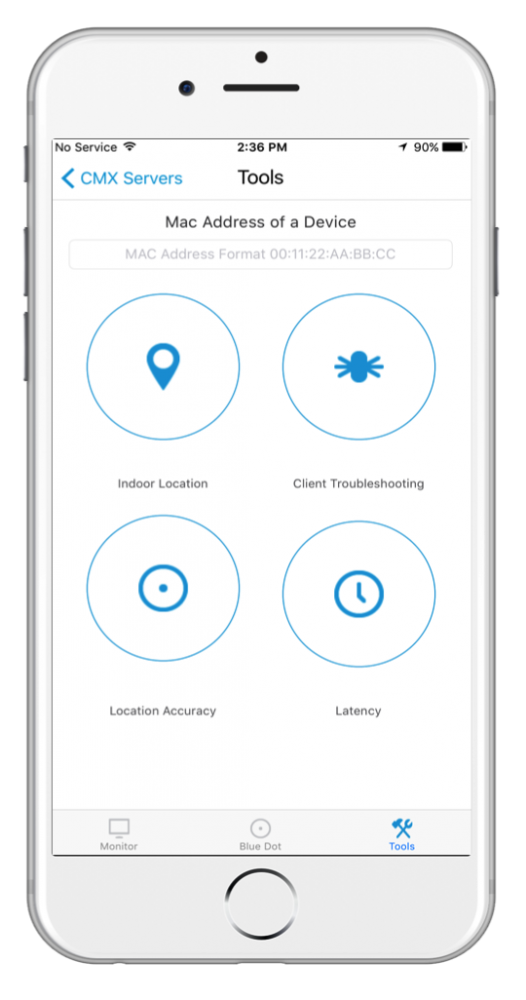
Advanced test tools make your CMX deployments successful. Location Accuracy allows deployment admin to conduct point by point location accuracy tests at 10m accuracy and return Avg Error Distance. Location Latency helps to confirm location computations are occurring in a timely manner onsite or alert of an computation latency problems that may have risen due to network configuration or deployment changes.

CMX Admin mobile app screenshot 3 with iPhone bezel


These tools provide the first few steps of insight into debugging WiFi location-related symptoms at CMX deployments, which is critical for getting the most out of your CMX deployment!

Coming soon…the CMX mobile app for the Android platform as well as features enhancement for monitoring WIPS, Access Points, and Analytics data.

Give it a try and let us know what you think! For more about Cisco CMX, visit http://cisco.com/go/cmx.


Guest Blogger: Anu Jadhav, Product Manager

Anu Jadhav Guest BloggerAnu Jadhav is part of the Enterprise Networking Group with focus on mobility. In his present role, Anu is responsible for Product Management of Cisco CMX mobile application for iOS platform and Cisco CMX SaaS technical marketing. He is passionate about bringing innovative WiFi solutions to market. Anu joined Cisco with 7+ years experience in the Wi-Fi technology industry. He has a Masters degree in Engineering Management & Computer Networks from Santa Clara University. He enjoys photography, painting, and playing basketball.


Authors

Jolene Tam

Product Marketing Manager

Security

Avatar

If you read the avalanche of marketing material from venture-funded loss-making startups in the cloud space you’d think that on-premise infrastructure will become akin to old typewriters lying around in store rooms and that IT departments will go the way of the dinosaurs after the asteroid hit. Any vendor advocating anything else is toast. Geddit?

We all know that controversy brings eyeballs and that a wild claim can be somewhat off the mark but still indicative of a major disruptive change in the market.  In 2007 Mark Benioff said that “Software was dead!” which he later admitted was an exaggeration on his real point that the model for software was ripe for change. The reality was that we were going through a transition in the market where the opportunity was around new models and services; a transition that witnessed the way that we consume, manage, build, and deploy software radically change from the days of packaged licensed software, multi-year upgrades and slow innovation cycles.  He was right and software is thriving.

We’re going through a similar transition in cloud and, as we shift into the next wave, the driver for cloud adoption is shifting from economics-led to innovation-led as leading-edge companies invest in cloud services as the foundation for digitizing their companies and, in so doing, creating new forms of customer value. While the model in enterprise IT is changing, this will in turn lead to a second bigger wave of cloud adoption that spans both the data center and the public cloud.

When we launched Intercloud in March of 2014 we said it would be architected to enable hybrid cloud, security, data sovereignty, management control, and services choice. It would also leverage the huge assets of our partner ecosystem in a way that enabled them to profitably participate in the model. All of the external market developments we have witnessed in the last two years have re-affirmed that these design criteria were not only correct but have now become the key criteria for the next wave of cloud enabled industry disruption – Digitization.

To see this consider the four areas in particular that will determine success in this next phase:

Cloud Battleground 1: Security from the Data Center to the Edge

As the Internet of Things (IoT) grows we will see a convergence of customers’ existing information technology (IT) and operational technology (OT) networks. This convergence significantly expands the security challenges, due to its increased breadth and depth over existing network connectivity. The IT and OT networks are managed with different priorities in mind, and each has distinct security needs. Today, the priority of the IT network is to protect data confidentiality and the focus of the OT network is on physical security and secure access to ensure operational and employee safety. With the convergence of these two environments and the hyper distribution of applications across hybrid cloud architectures, IoT security requires a new approach that combines physical and cyber security components driven by cloud-based software analytics that detects anomalies and takes pre-emptive action.

Cloud Battleground 2: Orchestration and Multi-Cloud Management  

The explosion of cloud services will drive a significant need for scalable, automated and policy-driven orchestration with multi-cloud management from the data center to the edge, for networks, operations, applications and all IT policies.  This orchestration needs to enable low-touch on-demand provisioning for both network and operations with compliance that spans regulatory and security requirements for stringent service-level agreements (SLAs). As a subset of orchestration, multi-cloud management will become one of the most strategic control points for cloud as customers will require single pane of glass management capabilities that provide visibility, automation, control and freedom of choice over all cloud services accessed across the Enterprise. The need for this is already apparent as our Cloud Consumption as a Service data shows where the average company is now accessing over 1,200 cloud services but the IT department has approved less than 100.

Cloud Battleground 3: Developers and the Next Generation PaaS

Recently we have seen managed OpenStack solutions, such as Cisco Metapod and associated platform as a service (PaaS) tools, enable a new more agile DevOps approach to software development of cloud native applications. Christened the ‘Modern IT Stack’, this is enabling the new DevOps movement in enterprises where new application development and deployment are integrated into the same process without the traditional handoff between developers and deployers. Containers have become the preferred deployment model for cloud native applications. By containerizing the application platform and its dependencies, differences in OS distributions and underlying infrastructure are abstracted away and the application becomes more portable. This makes them ideal for the hyper distributed IT models we see emerging where applications take the form of microservices accessing data at the edge. This means that the future hybrid cloud platforms need to embrace all three models – bare metal, OpenStack and containers – and successful vendors must win the software developers mindset to develop on our their cloud platform regardless of which tools they choose. After all, Stephen O’Grady said it well “developers are the new kingmakers.”

Cloud Battleground 4: IoT and Analytics: Data Is the New Oil

As 50 billion things connect to the network and harnessing the relevance of this data becomes vital to business process digitization, companies must begin treating data as an enterprise-wide corporate asset while also managing the data locally within business units. The challenge is that data at the edge is not only many times bigger making ‘extract, transform and load’ techniques slow and expensive but the data itself is ephemeral. It needs to be captured, only the relevant portions moved, and then given context by analyzing it with other relevant data elements—where they are, what they are, what state they are in, and real time conclusions drawn on what all this data means for business decision making. This will give rise to ‘data developers’ who will use machine-to-machine (M2M) capabilities to define and access data analytics services on an ‘IoT Fabric.’ Every company will require a cloud-based IoT Fabric that will be a conduit through which IoT data services will be securely defined, accessed and managed. The end result and its capability to refine data into greater business insights, more profitable decision-making, and new product offerings is clearly one way to make a substantial impact on the business.

These developments show that the second phase of cloud will be bigger than the first. At Cisco, our estimate is the TAM for solutions that meet these four criteria is around $200 billion over the next few years of which only around $30 billion will be addressed by what we call public cloud today.

That’s a lot of typewriters…enjoy your toast.

Authors

Nick Earle

Senior Vice President, Worldwide Services Sales

Avatar

In March 2015, Cisco created the AMP Threat Grid for Law Enforcement Program, empowering state and local law enforcement agencies with its dynamic malware analysis and threat intelligence platform. Cisco has renewed the program and made it a permanent part of Cisco Gives. Law Enforcement investigators can register for the program on the new Cisco Threat Grid Law Enforcement Program page.

The no-cost AMP Threat Grid for Law Enforcement program is for state and local agencies with less than 1,000 sworn officers. Once empowered with AMP Threat Grid, within seconds of a threat intelligence query or within a few minutes of a submitting a suspicious file or URL for analysis, an investigator has the ability to view and download an easy-to-read and comprehensive report detailing the actual behavior of the submitted file, including changes to the file system, registry, command-and-control communication, downloads, code injection and other malicious activity. In addition, AMP Threat Grid will correlate the file with the millions of samples and billions of artifacts in the threat intelligence database, providing instant global and historical context. The program also includes seamless integration with EnCase Forensic, to reduce investigators’ time and effort to identify and analyze suspected malware.

Threat Grid continues to be used to support law enforcement investigations around the globe. “As a local detective assigned to a USSS Financial Crimes Task Force, I respond to many low to mid-sized point of sale (POS) breaches. We have limited resources and budget, and Threat Grid is invaluable in analyzing suspicious processes to determine the behavior and threat. We appreciate Cisco’s AMP Threat Grid Law Enforcement Program, providing us this leading edge malware analysis and threat intelligence platform to aid in my investigations,” commented Det. Michael Chaves, Monroe CT Police Department, USSS CT Financial Crimes Task Force.

We have limited resources and budget, and Threat Grid is invaluable in analyzing suspicious processes to determine the behavior and threat.

The AMP Threat Grid for Law Enforcement program includes:

  • Two portal user accounts per agency
  • Up to five samples (a suspicious file or computer program) or URLs submitted per day, per user, for analysis, through the portal or via the API integration with EnCase Forensic
  • Unlimited sample queries through the portal or via the API integration with EnCase Forensic, including file hash values, IP addresses, domains, registry keys and file paths
  • The AMP Threat Grid Malware Analysis and Intelligence for EnCase EnScript and installation guide, training manual and video, and EnCase case template
  • Discount program for Federal and large State and Local law enforcement agencies; and for those agencies who need more Threat Grid user accounts, or a higher volume of daily samples submitted for analysis, than those provided in the no-cost program

Cisco will host a hands-on lab for threat intelligence and dynamic malware analysis at the Enfuse Conference, to be held at Caesars Palace in Las Vegas, May 23-26, 2016. The Enfuse session is entitled “Threat Intelligence for Law Enforcement”.

Again, Law Enforcement investigators can register for the program on the Threat Grid Law Enforcement Program page. The AMP Threat Grid Malware Analysis and Intelligence for EnCase EnScript is available for download at no cost to Guidance Software’s customers from the EnCase App Central store; which includes a 30-day pilot of the full solution for non-law enforcement incident responders, with malware sample submissions and contextual searches of the Threat Grid threat intelligence repository.

Authors

Jessica (Bair) Oppenheimer

Director, Security Operations

Threat Detection & Response

Avatar

Irish Sayings

Today, the 17th of March, is a day where many around the world will become just a bit more Irish as they celebrate St. Patrick’s Day. A tad more green will be worn throughout the offices and four leaf clovers will be heavily sought after, but what is St. Patrick’s Day like for those of us here in Ireland? We’d love to share with you why this day is so important to us, and why it even helps us to love where we work here at Cisco!

The weeks leading up to St. Patrick’s Day are always an exciting time for us as this holiday also falls around our Cisco Sports Day. This is a day where we raise money for our charity of the quarter – Multiple Sclerosis Galway – and participate in a variety of team building games and sports. Many of these games will have our Galway office take on our Dublin office, or even our staff challenging the managers. It’s a great day of bonding together as our Cisco folk are a generous bunch and will do anything for the “Craic” (Irish slang for fun) – that also leads us into our St. Patricks’ Day festivities.

While on site here in Ireland, we have nearly 30 different nationalities from around the globe! They have all embraced St. Patrick’s Day in their own way, and really love learning about the Irish culture as well. Some of the most endearing qualities in being Irish is our sense of humor and our ability to make people feel welcome – or as we say, “Cead Mile Failte” (1,000 welcomes) – and we really love that our entire Cisco family is part of these celebrations.

I asked a few staff around the site here in Ireland their thoughts on St Patrick’s Day. As you can see, their answers highlight our true Irish nature from humor and tradition to hospitality and sports.

🍀🍀🍀

Martin Burke

MartinBurke

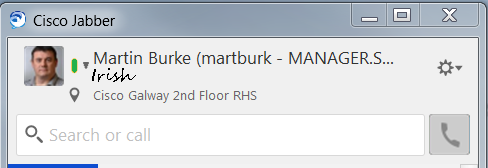
It’s the day when the whole world changes their Jabber status to Irish!


Adam Grennan

Adam Grennan

Our National holiday reminds me that we have a long, complex and rich heritage here in Ireland – something we should all celebrate. At Cisco, it’s quite similar, and while the heritage may not be quite as long as Ireland’s – there’s no doubt it is equally complex, rich, and worthy of celebration.


Shane Tuohy

AdamGrennan

St. Patrick’s Day gives Cisco employees in Ireland a chance to highlight our Irish culture and draw attention to the contributions that Cisco Ireland makes to the larger community and our very global company. Also, with the diversity that exists just here in the Cisco offices in Ireland, it gives us a chance to share Irish culture with our co-workers who are from elsewhere in the world.


Katie NicGabhann

Katie NicGabhann

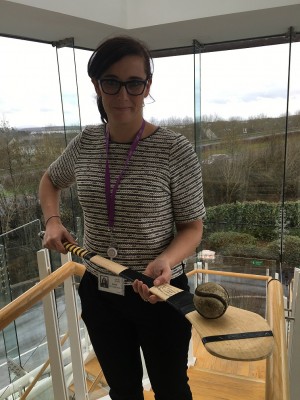
St. Patrick’s Day for me means travelling up to Dublin where Croke Park Stadium and the home of GAA for the All Ireland Club finals are held! This is where teams represent their local clubs at the highest level of their sports – Hurling and Gaelic Football.

If I’m lucky enough my club or a club from my county will be there. Having so many Cisco colleagues from all over Ireland and the world means there is always some rivalry and competition at the coffee dock on the build-up to the matches as flags are put up at desks, while everyone tries to outdo each other – It’s friendly competition, of course, and always makes for fun around the office.


Peter Doran

Peter Doran

For me St. Patrick’s is all about celebrating and having fun. As an Irish Cisco Employee I am proud the event is global and open to all, and looks to bring people together to celebrate.

🍀🍀🍀

Throughout the years, St. Patrick’s Day has come to mean many things to me personally and as I have grown the holiday has taken on a different meaning. I’ve had the opportunity now to travel around the world, and I have seen how recognized the Irish people are. This makes me so proud of my heritage, and it is impossible not to be overwhelmed by that pride when you see the Eiffel Tower in Paris or the Colosseum in Rome turning green for St Patrick’s Day. That this small country, and our people – with a population of only 5.5 million – is being celebrated all over the world is something truly beautiful. How can you not be proud of that?

How are you celebrating St. Patrick’s Day? We’d love to see you celebrating on social media! Don’t forget to tag #WeAreCisco!


Authors

Sheila Greaney

Office Manager

Unified Communications Galway Dev Center

Avatar

These days, it seems every new data center solution lays claim to the latest industry buzz words: automation and simplicity. Unfortunately, most solutions don’t really live up to their claims and over time they’ve lost their clout. Most people just gloss over them.

So, knowing that, why would I use them to describe Cisco Nexus Fabric Manager? I should avoid them at all cost, right? Well, automation and simplicity is exactly what Nexus Fabric Manager was designed for and it’s exactly what it delivers. You be the judge at the end of this blog.

What is the Cisco Nexus Fabric Manager?

If you’ve ever setup a data center fabric with VXLAN overlays from scratch (let alone with a BGP-EVPN control plane), you have a pretty good idea of the configuration complexities, troubleshooting and how long it takes to get it to production. No matter how small your fabric, the complexities are similar just on a different scale. So, if you have a fabric build looming, you’re really going to appreciate the simplicity Cisco Nexus Fabric Manager delivers. It’s literally setting a new bar for the definition of simplicity.

This short video provides a good overview of what Nexus Fabric Manager is and what it delivers.

NFM video image


Watch Video


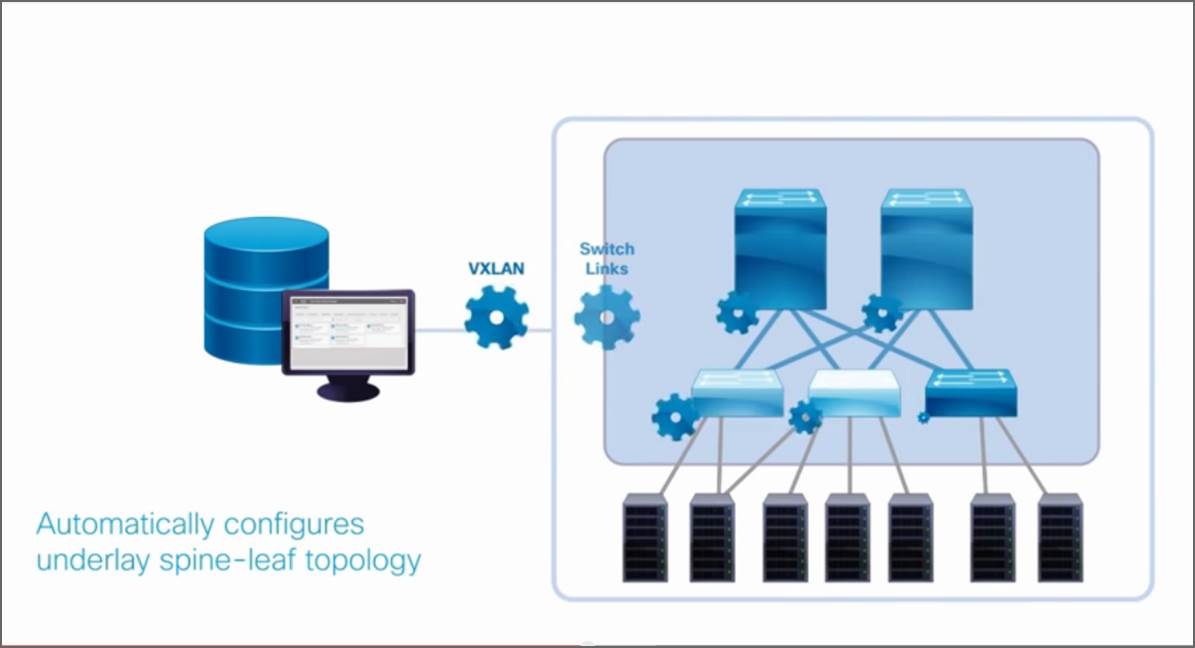
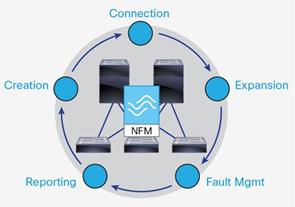
Figure 1. Nexus Fabric Manager Lifecycle


At a basic level, Nexus Fabric Manager provides a simple point-and-click approach to build and manage both the underlay spine-leaf topology and the VXLAN overlay. Since it is fully fabric aware, it understands how the fabric should operate and can autonomously configure and maintain fabric health throughout its lifecycle, as shown in Figure 1.

The first release of Nexus Fabric Manager will be supported across the Nexus 9000 Series Switches running in standalone NX-OS mode.


What makes it simple?

By “point-n-click”, I literally mean point-n-click! With Nexus Fabric Manager, you don’t need any knowledge of CLI, scripting, or networking protocols. Nexus Fabric Manager provides an intuitive point-and-click web-based interface with simple workflows to self-discover, self-build and self-manage both underlay and overlay configurations. The entire configuration and management is mouse-click driven, so you can put away your CLI configuration guides.

What’s automated?

The complete underlay and overlay configuration and management are automated. Using simple requests, like “add switch” or “set up a broadcast domain”, and in just a few mouse clicks, the Nexus Fabric Manager self-builds a complete data center spine-leaf underlay and VXLAN overlay, creates broadcast domains, and maps hosts to the domains. With traditional configuration approaches, what would normally take hundreds of CLI configuration commands, Nexus Fabric Manager creates with just a few mouse clicks.

Setting up a data center fabric requires a lot of configuration time from the initial switch setup to IP addressing, routing protocols, switch links, anycast gateways, host vPCs, BGP-EVPN, VXLANs, VLAN mappings, map hosts to broadcast domains and the list goes on. Even a small fabric with a few switches can take multiple days before it’s ready for production. With Nexus Fabric Manager, you can setup the same fabric in less than an hour without ever having to type a single CLI command.

And, if you’re not typing CLI commands, you’re not making CLI config errors. We’ve all spent hours looking through CLI command lists trying to pinpoint a misconfiguration that’s keeping the network from going production. With Nexus Fabric Manager, you eliminate that problem. The intuitive workflows automatically build and manage the entire fabric down to the addressing,  eliminating operator generated errors.

I hope you took the time to watch the short overview video to see the full capabilities and benefits of the Cisco Nexus Fabric Manager. Now, you be the judge! Are my use of the words “automation” and “simplicity” justified?

For more information on Cisco Nexus Fabric Manager, visit www.cisco.com/go/nexusfabricmanager

Authors

Dave Dhillon

Product Marketing Manager

Data Center Solutions Team

Avatar

Third in a series of blogs written by Cisco Switch Product Managers discussing their recently released products.

KQ65064

Does your office or workspace have reduced depth cabinets or not have a traditional wiring closet? Do you have a smaller satellite office but would like to provide the same services as your headquarters? Do you like the existing Catalyst 3K Series switches but find them too cumbersome to fit in a rack?

Today’s your lucky day.

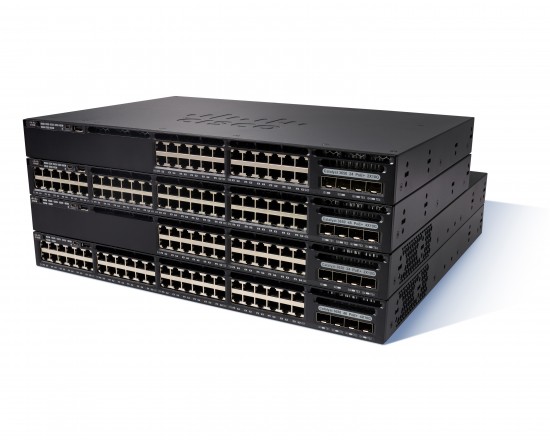
Last month, Cisco introduced the Cisco Catalyst 3650 Series Mini Switches. The Cisco Catalyst 3650 Series Mini Switches are less than 12 inches deep and have the same functionality as the larger switches. The small size makes it perfect to deploy in tight wiring cabinets, racks, or places where switch depth is a concern and real estate is at a premium. With these smaller switches, you can avoid spending cash to replace the cabinets or mounting the switch at an angle. As a result, this reduces downtime to the network. The Cisco Catalyst 3650 Series Mini Switches enable the same uniform wired-wireless policy enforcement, application visibility, flexibility, application optimization and superior resiliency as the existing 3650 full-sized switches.

https://youtu.be/klyhugd06XQ

The Cisco Catalyst 3650 Series Mini Switch come in 24- and 48-port Gigabit Ethernet SKUs and support all the same features as the existing 3650 switches. The only differences between the full-sized switches and the new switches is that Cisco Catlayst 3650 Series Mini Switch comes with fixed fans, fixed power supplies and support for external RPS2300 for redundancy. These Power Over Ethernet (PoE) switches support both PoE (IEEE 802.3af) and PoE+ (IEEE 802.3at standard), providing up to 30W of power. The switches have up to 4×10 Gigabit Ethernet SFP+ uplinks allowing the support of any high-bandwidth application. These switches also support stacking and can stack with either each other or the existing 3650 switches using the same Cisco StackWise-160 technology. In addition the Cisco Catalyst 3650 Series Mini Switch supports all the advanced security features such as: Flexible Netflow, Cisco Trustec, MACSec encryption and Network as a Sensor/Enforcer.

The Cisco Catalyst 3650 Series Mini Switch is also fully integrated with Cisco APIC-EM and Cisco Prime Infrastructure for IT simplicity. The Plug and Play (PnP) app on APIC-EM can be used to simplify deployment across multiple remote sites, saving enterprise IT teams time and money. The path trace app on APIC-EM also enables detailed flow-based visibility and troubleshooting by tracing a path between two hosts. It further provides in-depth information about the nature of each hop, including information such as whether the path segment is Layer 2 or Layer 3 and which protocols are running on it.

Finally, the Cisco Catalyst 3650 Series Mini Switch and the full-sized Cisco Catalyst 3650 switch both use the same IOS XE software and can be deployed and managed using the same policies, and configuration for maximum operational simplicity and flexibility.

Find more information about these switches here.

Authors

Jay Kothari

Senior Director

Product Management

Avatar

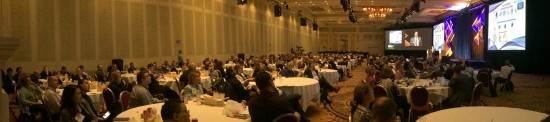
We hope you were able to join Cisco and your peers for the 9th Annual Connected Health Summit at HIMSS16.  It was Cisco’s annual half-day meeting featuring sessions by healthcare thought leaders who discussed innovations in care delivery including:

  • Empowering patients, family members, and care teams with personalized information
  • Secure and easy virtual visits to provide broad coverage with limited resources
  • Population health and chronic disease management using patient-generated data

You’ll find links to the presentations below for you to review and to share with your colleagues.

New Parkland Hospital and Their Digital Transformation
Joe Longo
Vice President, Parkland Health & Hospital System

Joe highlighted the digital technology at the $1.3B New Parkland Hospital, part of Dallas’ Parkland Health & Hospital System, and their use of Cisco Patient Connect to empower patients, family members, and care teams with personalized information to stay connected, informed, engaged, and entertained throughout the patient journey.

Changing How Care is Delivered at Spectrum Health
Joseph Brennan
Senior Director for MedNow, Spectrum Health
Dr. Kristopher Brenner
Division Chief for MedNow, Spectrum Health

Joseph and Dr. Brenner described the Spectrum Health and Priority Health MedNow telehealth program that provides patients with easy access to care at a lower cost.

Tele-stroke and Telehealth Programs at Lee Memorial Health
William Carracino, M.D.
VP & CMIO, Lee Memorial Health

Dr. Carracino shared his perspectives on building a telehealth program from scratch with a specific focus on lessons learned around technology selection, EHR integration, workflow transformation and future plans to expand into other clinical areas.

Building a Digital Health Innovation Ecosystem
Dr. Michael Blum
Cardiologist, CMIO, Vice Chancellor of Informatics, UCSF
Dr. Aaron Neinstein
Endocrinologist and Director of Clinical Informatics, UCSF
Ed Martin
Technical Director, UCSF

Dr. Blum, Dr. Neinstein, and Ed described the collaborative efforts between UCSF Center for Digital Health Innovation and Cisco to build a Connected Health Interoperability Platform (CHIP) to revolutionize healthcare by connecting and passing data between EHRs, mobile health apps and devices, and wearables.

We look forward to seeing you next year at the 10th Annual Connected Health Summit at HIMSS17!

Connected Health Summit

Authors

Mike Haymaker

Healthcare Industry Marketing

No Longer with Cisco