Avatar

If you’ve spent any time on Cisco Cloud blogs at all, you’ve heard about Metapod. It’s our production-ready, OpenStack-based, on-premises private cloud solution. We engineer it, deploy it, and remotely operate it 24×7 on your behalf. It’s the perfect solution for companies that enjoy the public cloud experience, but need the security and performance advantages of a private cloud environment.

So what could make Metapod better?

Mantl.

Mantl is Cisco’s end-to-end solution for microservices infrastructure.

I’ve never created microservices infrastructure myself (I’m not that kind of girl), but my understanding is not really all that fun.

Apparently it requires pulling together a container orchestrator, a network stack, something to monitor health, some automation and a service discovery solution. You’ve got to figure out how to describe a deployment, where should you run which service, how to connect them together, where to store secrets, and where the logs should go.

I can see how all that would get in the way of the whole “deploy fast, pivot quickly, improve often,” DevOps thing.

And that’s why Cisco has developed Mantl. With Mantl, we’ve taken all the industry standard components you need to deploy a microservices platform, and made them work well together—so you can just focus on building your application. It’s a “batteries included” end-to-end solution for your microservices infrastructure.

Intrigued?

You’re in luck. Cisco is hosting a webinar on 4/5 at 8:30 AM (Pacific) to explain how it works and how it’s making application development faster and easier than ever before.

If you’d like to attend, register here: http://event.on24.com/wcc/r/1155018/1622C39AD52660C4429FC40A9DE9ABFF

Authors

Ali Amagasu

Marketing Communications Manager

Avatar

There is a battle for mobile video viewers going on now. In North America alone, one operator offers their subscribers free streaming video without charging against their data plan. At another service provider, they enable companies to sponsor the data plans for subscribers to encourage a strong advertising model. And yet another service provider is bundling mobile video with wired video when using their own mobile video application. There are many ways to attract video subscribers, and the battle strategies are evolving as fast as new content is developed to watch.

cropped version

Continue reading “Winning the Battle for Mobile Video Viewers”

Authors

Maywun Wong

Manager, Market Management

Avatar

Manufacturing is alive and well in the United States, even in the most unlikely places – such as the beautiful Pacific North West. The manufacturing renaissance in North America and the resurgence of the freight and transportation industries has powered the recent growth of the trucking industry. Our customer Daimler Trucks North America (DTNA) is riding this growth with their successful enterprise network upgrade.

DTNA is one of the biggest employers in Portland and is known for the power, reliability, and innovation of its vehicles. With brand names such as Western Star, Freightliner, Detroit, and Thomas, their leading-edge trucks may remind you of Optimus Prime in the Transformers movies. On the way to film the story, we were excited to see this poster greet us at the airport:

daimler-poster  Continue reading “On the Road to a Manufacturing Transformation: Daimler Trucks Goes Digital”

Authors

Douglas Bellin

Global Lead, Industries

Manufacturing and Energy

Avatar

This week we are very pleased to release version 0.8.0 of minimesos. This new release contains many improvements, bug fixes and new features. The two most important features are that minimesos now ships with Weave Scope and HashiCorp’s Consul. In this blog, I am going to focus on how important we think the integration with Scope is.

What is minimesos?

Minimesos is our testing and experimentation tool that allows developers to run Apache Mesos locally. Minimesos contains a number of great features, for example the minimesos file, which lets you version control and configure the cluster. Minimesos also ships with Apache Zookeeper, Mesosphere’s Marathon, for scheduling, and, as of today, HashiCorp’s Consul, which takes care of service discovery.

This set of tools and integrations means that developers can download minimesos and immediately start working on a tool stack that is otherwise notoriously difficult to get started with. The upside of this is that experimenting with cloud-native applications becomes very simple – no virtual machines, no cloud accounts.

As well as integrating a very useful stack, minimesos includes the minimesosFile and JUnit class rules. This means that minimesos can be used for local unit and system testing. Once application code is checked in, it can be picked up by the build server, which also has minimesos installed. The code can then be tested and integrated before finally being deployed to the cloud. Minismesos thus enables cloud-native development by enabling cloud-native continuous integration.

Why minimesos?

There are a two main of reasons for minimesos.

  • Firstly, there are a number of amazing tools out there, including Cisco’s Mantl, a batteries included end to end solution for your microservices infrastructure. Most of them are notoriously hard to get started with. This means that the cost of experimentation is much too high for most developers. This slows down the adoption and the take up of all these tools.
  • Secondly, developers must have tools that increase the speed of the software development life cycle, not slow it down. Currently, these tools hardly exist or if they do they are kludges or hacks of existing tools. Minimesos is designed from the ground up to enable the cloud-native software development cycle (CN-SDC).

Minimesos and Weave Scope

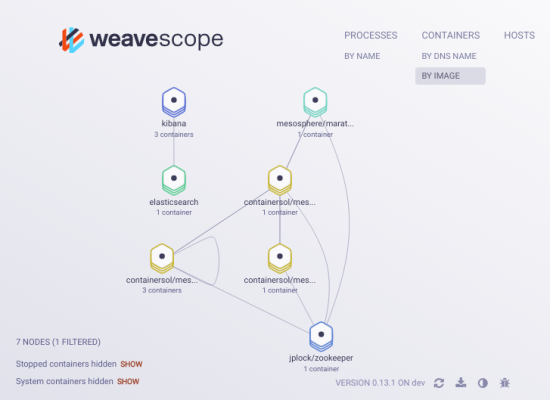
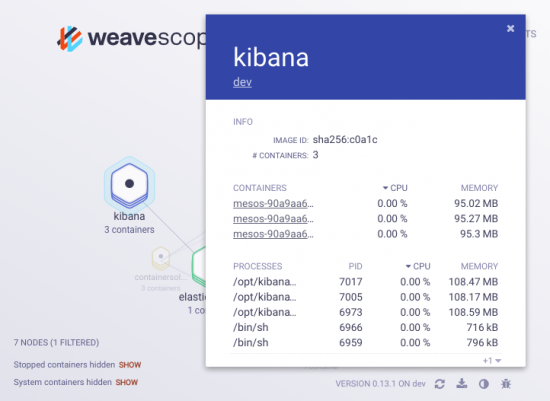
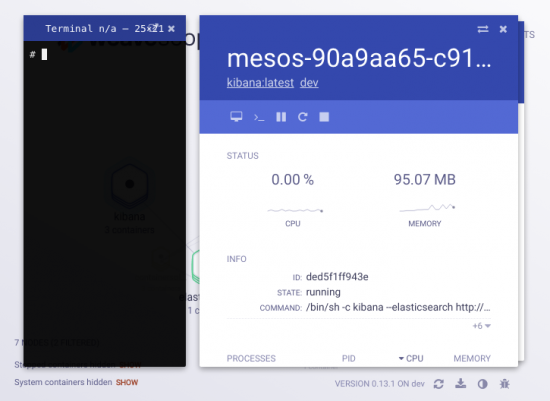
Weave Scope is an extremely useful tool that not only visualises the cluster but allows you to monitor it in a much more intuitive way than you can through the command line. Weave Scope also lets you drill down, from the web interface, into each container where you see vital metrics, such as CPU, memory and details of specific containers. Through the Scope controls, we can pause, stop or even restart containers. Finally, we can actually enter the container’s shell and interact with it directly. All this is done through from the browser.

The power off connecting Weave Scope to minimesos cannot be overstated. Here are just a few of the use cases we have discovered:

  • Debugging. Cloud-native applications are already easy to debug with minimesos, because of its support for unit and system testing. However, Scope allows you to visually check what you had to previously defined in a config file. This can save minutes or maybe hours of tedious debugging.
  • Exploratory Testing. We know that automated tests and checks are vital for smooth software development. We also know, however, that automated tests don’t catch all types of bugs. Exploratory testing, whereby developers and testers use their intuition to prod and probe a system, is a hugely effective testing technique. Minimesos, when used with Scope, gives both developers and testers the chance to check their assumptions by literally pulling things apart to see what might happen. This can be used for testing high availability as well as for testing the links between the containers, for example between application containers and the load balancer.
  • Dev and Ops. They say a picture tells a thousand words. When moving between Dev and Ops a visualization, the type created by Scope, is very handy for communicating and reasoning about the state of a cluster at different stages of the software development lifecycle.


Some Examples:


image1

Image 1 – The minimesos cluster and an ElasticSearch and Kibana installation.

image2

Image 2 – Drilling down into the Kibana node to inspect its key metrics.

image3

Image 3 – Accessing a container’s terminal via Scope’s interface.

There is a great video from the team that shows the capabilities here.

Conclusion

We hope you enjoy minimesos and that it is useful for you. If not, please reach out on Twitter to @minimesos and let us know what you need. In the meantime, we are delighted with this current release, which with the addition of the truly excellent Weave Scope means that minimesos is maturing into a world class tool for developing cloud native applications. As we head towards Cisco Live! in July, we are additionally excited about the upcoming features, which will include integration with Weave DNS for automatic service discovery and integration with Docker Swarm.

Minimesos and these new features are just some examples of how Cisco are helping to drive cloud-native development. Check out other upcoming features here.

Authors

Kenneth Owens

Chief Technical Officer, Cloud Infrastructure Services

Avatar

February is always a month to celebrate love, so Cisco asked employees to tell us why they love working here using the hashtags #LoveWhereYouWork and #WeAreCisco.

Love Where You Work

It looks like there’s no shortage of reasons. We had so many great entries that the judges had to add categories to fit them all in!

These are the tops of the tops. The best of the best. Just like our employees.

If you love working at Cisco, keep telling the world why with your photos on Instagram and Twitter (remember to tag them with both #LoveWhereYouWork AND #WeAreCisco.) We’ll keep highlighting them each month, and there MIGHT be some surprises for the ones that stand out.

If you’d like to #LoveWhereYouWork, you can always apply to be a Cisconian!

[storify url = “https://storify.com/WeAreCisco/878a0c96a5587d69bfba84e8f966b53f”]

Authors

Carmen Shirkey Collins

Social Media Manager

Talent Brand and Enablement Team, HR

Avatar

Last week I wrote about how digital fans are expecting new experiences at NCAA games as part of March Madness. (Wow – how about some of those games this weekend – and my Fighting Irish survive and advance to the Sweet 16! But I digress…)

This week I want to look at another topic—a much more important one.

Healthcare. We all need it. It’s right up there with death and taxes on life’s list of inevitabilities. And while the rising cost of healthcare has been slowing from the torrid rates of a few years ago, according to an article in CBS MoneyWatch, overall U.S. health costs are still expected to climb 6.5 percent in 2016—more than three times the rate of inflation. The United States isn’t alone. Healthcare systems around the world are wrestling with the challenge of managing costs while delivering quality care.

The good news is that a broad range of digital solutions is making healthcare less expensive and more accessible. In fact, last year private sector hospitals and pharmaceutical companies globally realized $67 billion in digital value, according to a recent Cisco analysis. The bad news? This represents only 16 percent of what they could have generated in 2015. The industry walked away from 84 percent—or $350 billion—in potential value. Clearly, our healthcare systems can do better.

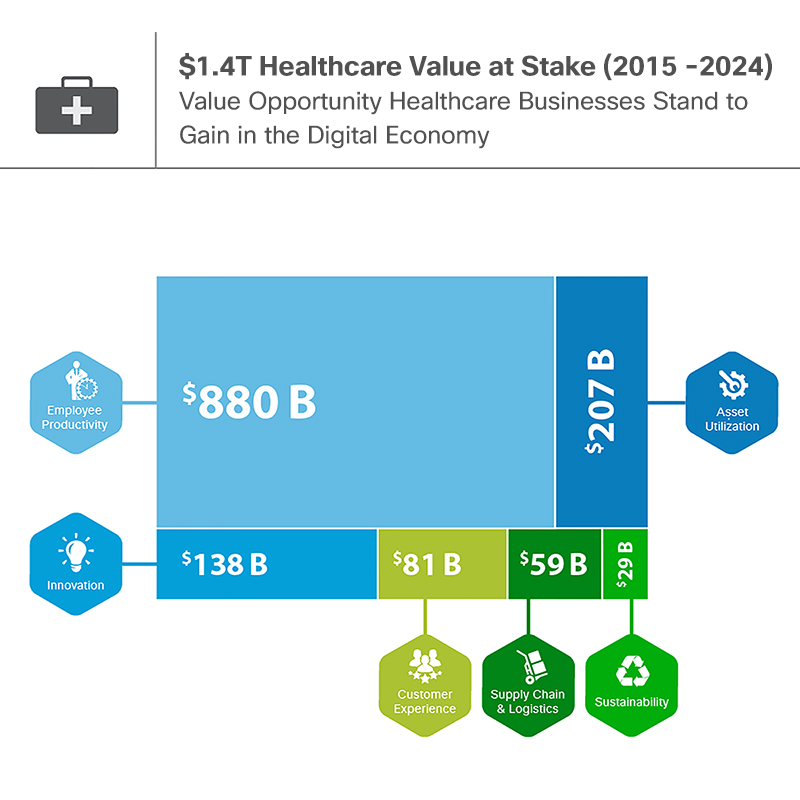
There is a tremendous opportunity to create digital value over the next decade. Cisco’s analysis identified 31 digital use cases with the potential to drive $1.4 trillion in private sector healthcare value from 2015 to 2024 (see Figure 1). This “value” translates directly into the industry’s ability to serve more patients, improve the quality of care, and reduce healthcare costs.

Healthcare
Figure 1. Six value drivers have the potential to generate a total of $1.4 trillion for hospitals and pharmaceutical companies worldwide (2015-2024).

Healthcare providers must balance a long list of urgent priorities: reduce operational costs, improve the quality and efficiency of care, decrease inpatient volume, shift from volume- to value-based reimbursement, and improve relationships between clinicians and administrators. Electronic health records, mobile apps, telehealth, and social media are some of the patient-friendly technologies that address these concerns.

Telehealth is an important case in point. It can save money and extend services—but also save lives. The telehealth program at Lucile Packard Children’s Hospital in Palo Alto, California, helps fill the gap in rural areas that have a shortage of pediatric specialists. With high-quality video conferencing, instant access to patient records, and network-connected medical devices, the hospital’s virtual visits provide care for 300 pediatric patients. The hospital is also a part of the Virtual Pediatric Network, which uses advanced collaboration technologies to help physicians across the country work together on difficult cases.

Pharmaceutical companies face a different array of issues. Like other manufacturers, they must fend off low-cost competitors, improve supply chain management, and increase production efficiency. To bring new drugs to market faster and more cheaply, they also need to manage all kinds of data more effectively. Data analytics, social media, cloud, and mobility play an essential role in improving customer engagement, developing personalized medicines, collaborating seamlessly with new partners, and reaching new markets.

Some of the biggest sources of digital value are not unique to healthcare. Areas like cybersecurity, payments, and connected marketing drive 86 percent of Digital Value at Stake. The largest of these categories, next-generation workers, uses many of the same technologies that make telehealth possible. They can make all healthcare workers—not just physicians—more productive, to the tune of $838 billion over the next decade.

You may be wondering what’s new about all this. After all, people throughout the healthcare industry have been working on digital transformation for years. That’s true, but now we’re at a tipping point. The array of digital technologies available can fundamentally change healthcare processes, systems, and business models—for the better. This comes not a moment too soon.

Death and taxes may be inevitable worries, but if we get this right, healthcare won’t be.

To find out more about Digital Value at Stake in healthcare and five other private sector industries, read our full report, “Where To Begin Your Journey to Digital Value in the Private Sector.”

Authors

Michael Riegel

Vice President

Industries, Platforms, and Services Marketing

Avatar

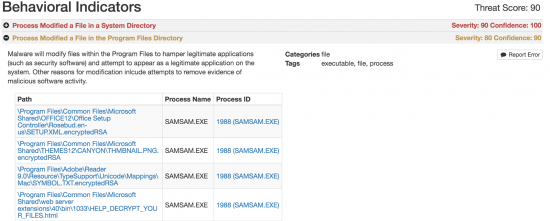
Cisco Talos is currently observing a widespread campaign leveraging the Samas/Samsam/MSIL.B/C ransomware variant. Unlike most ransomware, SamSam is not launched via user focused attack vectors, such as phishing campaigns and exploit kits. This particular family seems to be distributed via compromising servers and using them as a foothold to move laterally through the network to compromise additional machines which are then held for ransom. A particular focus appears to have been placed on the healthcare industry.

Adversaries have been seen leveraging JexBoss, an open source tool for testing and exploiting JBoss application servers, to gain a foothold in the network. Once they have access to the network they proceed to encrypt multiple Windows systems using SamSam.

Technical Details

Upon compromising the system the sample will launch a samsam.exe process which begins the process of encrypting files on the system.

tg-samsam


Read more >>

Authors

Talos Group

Talos Security Intelligence & Research Group

Avatar

The key to retail success is understanding the shopping journey, and video can play an important part in that process. Sandra Acham talked to me this week as she wrote a blog about how video supports a comprehensive approach to understanding customer behavior (read the blog).

The thing is that today’s retail customers don’t think in terms of buying in the store vs. buying online vs. buying at a trade show, for example. Customers buy whenever, wherever, and however they want. What we call omnichannel (or unified commerce), it’s all just shopping to them.

To make sure you offer a complete experience across your channels, you need to create a series of positive interactions that are consistent, integrated, and compelling. Video and mobile tools help you to build that relationship with your shoppers, bringing them back to you in the store, on the website, and through the contact centers. Read the blog.

Authors

Dianne Lamendola

Senior Practice Advisor

Avatar

Recently there has been a lot of buzz in the news around people getting fed up with enterprise messaging applications. This began with a well written and widely read article in Medium titled, “Slack I’m Breaking Up with You.” A twitter hashtag called #slacklash started to rise in usage. Others jumped on the same bandwagon – FastCompany, for example.

I want to offer a different perspective.

I’m a heavy user of Cisco Spark. Cisco Spark, like Slack, provides enterprise messaging. Within Cisco, we’ve got tens of thousands of Spark users. Some use it more than others. Within the collaboration technology group – the thousands of people that make Cisco’s $4B collaboration product portfolio – we LIVE in Cisco Spark. All of us have pretty much moved the bulk of our asynchronous communications away from other tools (email and Jabber) and work entirely in Spark. We still use Outlook – mostly for calendaring and for checking email from folks outside of the collaboration business.

I’m probably one of the more active users. In the last six months, I have read or sent messages into 1548 Spark rooms. I pretty much “sit” in it all day, and access it via mobile frequently in evenings and when I’m out and about. I’m the Chief Technology Officer (CTO) for the collaboration business. And – I’m also a remote worker, working out of my home on the east coast when I’m not traveling to Cisco engineering sites, which I do one to three times a month.

So – first, some admissions.

While Spark has dramatically reduced my volume of USEFUL email (email that is not a mailing list, calendar notification, or spam), I still get email, and there is almost always a message or two each day I need to respond to. This forces me to check Outlook perhaps three or four times a day.

At the same time, I get a lot of messages in Spark. Indeed, if I count messages alone, I’d say that I get more Spark messages each day than I got email messages each day, before we adopted Spark. And not just a little – I get a LOT more messages.

But – I love it, and I will say definitively that it has done four things for me that email has not been able to do.

Spark makes me feel connected. As a remote worker, feeling like I’m plugged into the team is really important. When I’m in a Spark room with a bunch of folks, and we have a very active, live conversation – it makes me feel like I am there. It’s the same kind of rapid-fire, real-time, interactive conversation that you get in person or in a live meeting. This makes me feel like I am part of important discussions and decisions. In fact, the only way I get this sense of connectedness is when there are lots of messages in that room, happening in real-time. A high volume, rapid-fire chat conversation is – in essence – the textual equivalent of good meeting, and that kind of interaction is precious to me. Now, you might say, “hang on Jonathan, why don’t you just have a meeting instead?” Well – this leads me to the second thing Spark does for me that email never could.

Spark allows me to get the productivity equivalent of attending multiple meetings at the same time. My calendar is precious. I have a fixed window in which I can schedule calls, and those timeslots are almost always filled. And – more importantly – I can only fill them with one meeting at a time. With Spark, I can (and do) typically have multiple rooms in which there is a really active conversation going on. I’ll participate in those conversations, oftentimes either while I’m in a meeting where my full attention is not required, or during gaps in my calendar where I don’t have a meeting. This gives me the holy grail that every executive dreams for – to (in essence) attend multiple meetings at the same time. That, in turn leads to productivity improvements for me. Of course, regular meetings are almost always at least 30 minutes, and they tend to run to the time scheduled. On the other hand, a live conversation in a Spark room can take less (or more) time – but it only runs as long as needed. But – but – you’ll say – you cannot possibly be participating actively all day long? Of course not. But that leads me to the third benefit.

Spark allows me to get the equivalent of watching dozens of hours of meeting recordings, but in minutes. Clearly, I cannot actively participate in every conversation at every moment. And that means that I will miss out on stuff. When I do have a moment, I can go back and catch up by reading what transpired in the room. The experience of doing that in Spark is actually much more like watching a meeting recording, than it is like reading an email thread. Email’s tendency towards embedded replies and nested inline responses simply does not allow you to easily catch up. That’s because it doesn’t mimic a live conversation. Chat, on the other hand, much more closely models the kind of interaction that you see in a meeting. This makes it easier to catch up and comprehend what has transpired, since it’s a lot like watching a meeting recording. Now – the problem with actual meeting recordings is that it takes a lot of time to watch them. But, catching up on a Spark room – even a really, really long one with hundreds of messages – takes just minutes. This is a form of time compaction, and that in turn gives me my most precious commodity – more time.

Now of course, the critics reading this will say that this means that you cannot really make decisions in these rooms, because at any given time you cannot be assured that the key people are actually reading. That is true. But, this leads me to my fourth and most important point.

Spark lets me have a call or a meeting when I need it, since you cannot actually make big decisions in chat. Decisions are what meetings are good for. And what I love about Spark is that meetings are a built in part of the experience, so that I can have a real, honest-to-goodness voice and video meeting in that room, and actually make the decision. Critics might also argue that sometimes it’s difficult to have a deep conversation in chat since meaning is lost and the speed is not as fast as a voice call. To them – I say – yes, that is also true. In those moments when I need it – I have a call. What’s great about Spark is – I can also do that, in the same 1-1 room where my chats are happening.

The conclusion I draw is that true productivity comes not from messaging alone, but rather from the intertwined usage of calls, meetings, and messaging. An integrated tool like Spark allows you to optimally spread your time amongst them. And furthermore, the messaging component itself does allow me to do something I really value – it allows me to be more efficient with my time. That is where Slack and Hipchat and the flood of other similar products all fall down. Work cannot survive on chat alone.

So – to you Mr. Samuel Hulick – now that you’ve broken up with Slack, I see that you’re now available. Why don’t you come and start a relationship with Spark?

Authors

Jonathan Rosenberg

Cisco Fellow and Vice President

CTO for Cisco's Collaboration Business