Avatar

Today, we released the first of two semiannual Cisco IOS & XE Software Security Advisory Bundled Publications of 2016. (As a reminder, Cisco discloses IOS & XE vulnerabilities on a predictable schedule—the fourth Wednesday of March and September in each calendar year).   Today’s edition of the Cisco IOS & XE Software Security Advisory Bundled Publication includes six advisories that affect the following technologies:

  • DHCPv6 Relay
  • Session Initiation Protocol (SIP)
  • Smart Install
  • Wide Area Application Services (WAAS) Express
  • Locator/ID Separation Protocol (LISP)
  • Internet Key Exchange Version 2 (IKEv2)

Alongside this disclosure, we are pleased to announce that the Cisco IOS Software Checker will now support queries against Cisco IOS XE Software. This is a direct result of your feedback—you asked for this functionality, and we listened. All existing features will now function for Cisco IOS XE Software. Additionally, search results include the first-fixed release information for all vulnerabilities disclosed in the March 2016 publication. You may notice the absence of the IOS XE fixed software tables in affected security advisories; instead, the Cisco IOS Software Checker data is updated daily to include the most current information on recent Cisco IOS & XE Software releases.  I encourage you to take a spin around the enhanced tool now.

Make sure you also take a look at the Cisco Event Response—our go-to document that correlates the full array of Cisco Security resources for this bundle (including links to the advisories, CVSS scores and SIR ratings, and OVAL & CVRF content). As the project manager who oversees the management and delivery of these bundled disclosures, I have a unique perspective of the level of effort and collaboration involved. A dedicated team of incident managers, a variety of partner organizations, special tooling, months of preparation, thousands of communications—these all come together on the fourth Wednesday of March and September.

Cisco PSIRT is committed to improving our disclosure processes to meet your needs. We hope these publication timelines, enhanced tooling, and additional “bundling” helps your organizations plan and ensure resources are available to analyze, test, and remediate these vulnerabilities in their environments.  Let us know in the comments below!

The next Cisco IOS Software Security Advisory Bundled Publication is scheduled for September 28, 2016. Mark your calendars now. And don’t forget—for all things security, visit the Cisco Security Portal, the primary outlet for Cisco’s security intelligence and the public home to all our security-related content.


Authors

Erin Float

Project Manager

Security Research and Operations Group

Avatar

A few years ago I sat down with technology leaders at a major oil and gas company to talk about a solution they wanted Cisco to develop, and they had some unique and interesting requirements:

  • They wanted us to work with them to co-innovate this solution.
  • They also asked us to work with their three major partners/integrators to co-innovate and scale the solution, because these partners knew their business and environment best.
  • Furthermore (and this was the most surprising part), they didn’t want a proprietary solution—they simply wanted to be the first ones to implement it. They actually encouraged us to take this solution to their competitors and other industries, knowing that they would benefit from lower costs and Cisco’s long-term commitment to the solution.

Co-innovation is not a new concept — it is as old as innovation itself. I’m sure the invention of the wheel must have been a collaborative effort among early nomadic people struggling with how to move things from one place to another as they followed the hunt. If you fast-forward to the big inventions and innovations of the past few decades—the personal computer, Internet, smartphone, 3-D printer, genome sequencing and many others—how do you imagine these innovations occurred? What was the creative process that led to these breakthroughs? Do you imagine a reclusive genius inventor sitting alone in a dimly lit garage or a basement late at night having an “eureka” moment? It surely is an appealing vision—but unfortunately the concept of the lone genius inventor is a myth. The reality has been much less romantic.

Innovator

Innovation is actually a complex and structured process requiring multiple skill sets and points of view. The innovation process doesn’t just focus on developing an idea, product, company, business or brand, or customer solution. It’s all of those things—and no one (even a genius) can solve all these problems alone. Continue reading “Co-Innovation: Shining a “Lightbulb” on the Myth of the Lone Inventor”

Authors

Maciej Kranz

Vice President and General Manager

Corporate Strategic Innovation Group

Avatar

The standard gauge used for railroads (that is the distance between the rails) in the U.S. is four feet, eight and a half inches, which is an odd number however you look at it. The history behind it is even stranger and is a cautionary tale of assumptions and the consequences of basing decisions on old thinking.

That oddly sized gauge was borrowed from the English standard of railroad width, where they built railroads with the same tools they used to build wagons, which used that wheel spacing. And the wheel spacing had to be that width because that was the spacing of the wheel ruts that existed at the time in the roads throughout England.

So who created those?

Roman chariots created the wheel ruts in the roads when they occupied England some two thousand years ago. These Roman war chariots were built just wide enough to accommodate the rear-ends of two horses, which just happened to be…you guessed it: four feet, eight and a half inches wide. This created the standard gauge that is still used today.

Ok, so where’s this heading?

The space shuttles used in modern day space exploration carried two large booster rockets on the sides of their main fuel tanks. These rockets, called solid rocket boosters or SRBs, which gave the spacecraft initial thrust upon launch, were built in a factory in Utah. The engineers of the SRBs would have preferred to make them larger, but the SRBs had to be transported by train from the factory to the launch site. That railroad line ran through a tunnel in the Rocky Mountains and the SRBs had to fit through that tunnel. The tunnel is only slightly wider than the railroad track, and the railroad track, as we now know, is only about as wide as the hindquarters of two equestrian.

Say that again?

A primary constraint in the design of one of the most advanced transportation systems ever developed was determined more than two thousand years ago by two horses’ asses.

Interesting, but what’s that have to do with cloud security?

That is the danger of getting caught in the rut of the same old thinking. There’s danger in thinking about security in the old way when it comes to securing cloud infrastructure. Cloud security can’t be solved with legacy security technologies or siloed approaches to security. Cloud security must be as dynamic as the nature of the cloud itself and should address the issues of:

  1. Keeping valuable data secure in the data center or wherever your cloud is hosted;
  2. Securing applications and data in the cloud;
  3. Enabling secure access anywhere, to anything for the mobile user or IoT;
  4. Consistently protecting against threats across the data center, cloud and wherever users roam before, during, and after attacks; while
  5. Providing visibility across the entire spectrum to enforce governance and compliance.

Cloud security doesn’t require simply the deployment of a separate application or new technology. Nor does it require you to completely scrap your existing infrastructure. It is an extension of your entire security program where security is embedded into the intelligent network infrastructure, integrates with a rich ecosystem of applications and services, is pervasive across the extended network – not just networks themselves but all endpoints, mobile and virtual, that extend to wherever employees are and wherever data is…from the beating heart of the enterprise data center out to the mobile endpoint and even onto the factory floor.

Think of the journey to cloud security adoption as your chance to take off into space; when planning the size of your rockets, are you imagining all the new possibilities or limiting your opportunities by what we’ve always done. Hopefully the cautionary tale of the history of US railroads helps you expand your thinking.

Check out our Cisco Business Cloud Advisor adoption tool to evaluate the overall readiness of your organization’s cloud strategy, including from a security perspective. Also stay tuned to this blog as dig further into this topic.

Authors

Player Pate

Senior Director, Product Marketing

Security

Avatar

School districts all around the country have been using E-rate funding to spark digital transformation in their classrooms. One such district is the Wayne Highlands School District. Wayne Highlands SD covers 435 square miles in northeast Pennsylvania and is the second largest geographic school district in the state. The district places a strong focus on technology to enable digital learning in the classroom, and its Office of Information Technology Services is constantly striving to increase the range and reliability of technology services it delivers.

Scott D. Miller, Wayne Highlands School District’s Director of Technology, recently focused on revamping the district network infrastructure from the ground up to better support the district’s technological goals and programs. He applied for and received funding from the E-rate program in fiscal year 2015. Using that funding, Scott and his team were able to purchase and deploy a full stack Meraki solution for the revamp.

Now Wayne Highlands relies on Cisco Meraki APs, switches, security appliances, and MDM – to supply students and teachers with a robust wireless network. The solution also provides Scott and his team unparalleled visibility, ease of management, and control.

To learn more about Wayne Highlands’ use of E-rate funding to revamp their network infrastructure and the results Scott and his team are seeing from the full stack Meraki solution, register for the upcoming webinar, “Full Stack Meraki Magic at Wayne Highlands SD”, happening on Tuesday, March 29th at 11 AM PT.

Authors

Renee Patton

No Longer at Cisco

Avatar

Shadow IT is not a new topic and the threat it brings can wreak havoc on your business as well as your leaders.

For years, we have known that employees and lines of business are bypassing IT departments and utilizing cloud services to get their job done.  Just how much are we using? Research brings us some startling statistics:

  • 80% of end users use software not cleared by IT
  • 83% of IT staff admit to using unsanctioned software or services
  • Only 8% of all enterprises actually know the scope of shadow IT within their organization

The important takeaway from shadow IT is that end users are demanding IT to be more agile and they are willing to take matters into their own hands, even to the point of revolting against traditional IT and business policies.

Continue reading “The Shadow IT Dilemma”

Authors

Joann Starke

No Longer with Cisco

Avatar

With global mobile data traffic experiencing an almost 4,000-fold growth in the past 10 years, the demand for wireless network engineers is at an all-time high and rising.

Job opportunities are growing – particularly for senior level wireless engineers – and so are salaries. According to the 2016 Salary Guide released recently by Robert Half Technology, an IT staffing agency, wireless engineers can expect a 9.7% increase in starting pay in the coming year. This was the highest increase in starting salary for all IT jobs in the salary guide.  

There’s a huge potential for wireless engineers, but staying on top of advancing skills will be the key to success.

That’s why we are offering the revised Cisco Certified Network Provider (CCNP) Wireless certification. This certification prepares professional-level network engineers to augment your advanced Cisco Enterprise Wireless networks design, implementation, security and troubleshooting expertise. This allows for increased effectiveness and optimal performance of Cisco wireless technology.

With this training and certification program, IT professionals can build upon basic Cisco wireless networking expertise. Not only will you maximize your educational investment, but you will also amplify your professional value by gaining the skills needed to play a lead role in new wireless deployments, rollout of new services and maintenance of these services in an ongoing operational network.

160322-CCNP-Wireless-Launch590x136

The CCNP Wireless certification is appropriate for engineers in the following categories:

  • Wireless Network
  • WLAN
  • Wireless Consulting
  • Wireless Network Planning
  • Wireless Implementation

Our certification program combines conceptual knowledge of wireless technologies and protocols with hands-on skills. This will validate your capabilities for Wireless Engineering roles within enterprises, allowing you to become a recognized wireless professional.

As a market leader in wireless technology, Cisco enables anytime, anywhere access to network resources. Ensuring Cisco Enterprise Wireless networks are optimally designed, implemented, secured and monitored is vital to achieving business outcomes and requires a workforce of skilled wireless professionals.

Is it time to upgrade your skills? If so, visit our CCNP Wireless page for all the details.

Authors

Tejas R Vashi

Senior Director, Product Strategy & Marketing

Learning@Cisco, Cisco Services

Avatar

As long as I’ve been in this business, I’m still amazed by today’s technology and all of its new and exciting possibilities. There are smartphone apps that enable schools to send reports on your kids’ daily progress. There are apps to help you track your physical activity. Netflix dynamically analyzes terabytes of data to give you a customized list of entertainment recommendations. I can store the novel I’m reading or my favorite music “in the cloud,” and later on, seamlessly pick up exactly where I left off from any of my personal devices.

As an IT leader, just imagine being able to offer similar capabilities to your internal clients to help them run their businesses—enabling new offerings to attract customers and keep the ones you have—all while beating your competitors to market and fending off disruptors in your industry.

Companies like Netflix, Amazon, and Apple illustrate the rewards of exploiting the opportunities presented during market and technology transitions. On the flip side, it’s been well documented how Blockbuster, Borders Books, Kodak, and many others have failed to make the transition during major market shifts.

There are substantial challenges for any organization attempting to make a successful transformation in this age of digital disruption and emerging new business models, but the rewards are huge: new businesses, new revenue streams, competitive advantages, and much more. Technologies such as mobility, the Internet of Things, cloud computing, and digital analytics are ushering in new opportunities and presenting fresh challenges. As you realize the digital value of your business, it’s a perfect time to reflect on how you’re preparing your network—and business—for the future.

 “Tinkering and Short-Term Fixes Aren’t Enough”

First, realize we’re in a new game now. Digitization requires IT functions to be thoroughly transformed. As described in the McKinsey Report Reinventing IT to Support Digitization, it requires increasingly sophisticated approaches to scaling to meet new markets, increase reliability, and achieve time to market as businesses compete on how quickly digital innovations get to consumers.

There’s been no shortage of networking solutions to address these growing demands on IT, such as SDN and countless others. Until now, no company has pulled it all together into a total solution.

Why You Need Cisco DNA

Cisco Digital Network Architecture (Cisco DNA) is an open, extensible, software-driven architecture that helps you transform your network into a digital platform. You’ll be able to allocate resources dynamically to meet ever-changing network demand for applications while becoming more agile, scalable, and able to move faster for competitive advantage.

That means faster business data for precise decision making and a simplified, more automated network that can quickly meet new business requirements and identify threats. Cisco DNA paves the way for an adaptive network that operates at digital speed.

https://www.youtube.com/watch?v=5imhLYRfmIE

Your Next Steps Toward Digital Transformation

You may still be wondering: How does all of this come together?  Where do I start?

Cisco Professional Services can help your digital transition with a complete array of tools that use the Cisco DNA platform for full architectural transformation. Cisco helps global clients on their digital transformation by advising, implementing, and managing solutions. We’ll help you develop the network platforms you’ll need that are highly flexible and work for you, so you can rapidly deploy digital services.

Are you doing all you can to prepare your network for digital transformation to succeed in this new economy? Let Cisco help you.

Authors

Scott Clark

Vice President, Advanced Services

Cloud & Networking Services

Avatar

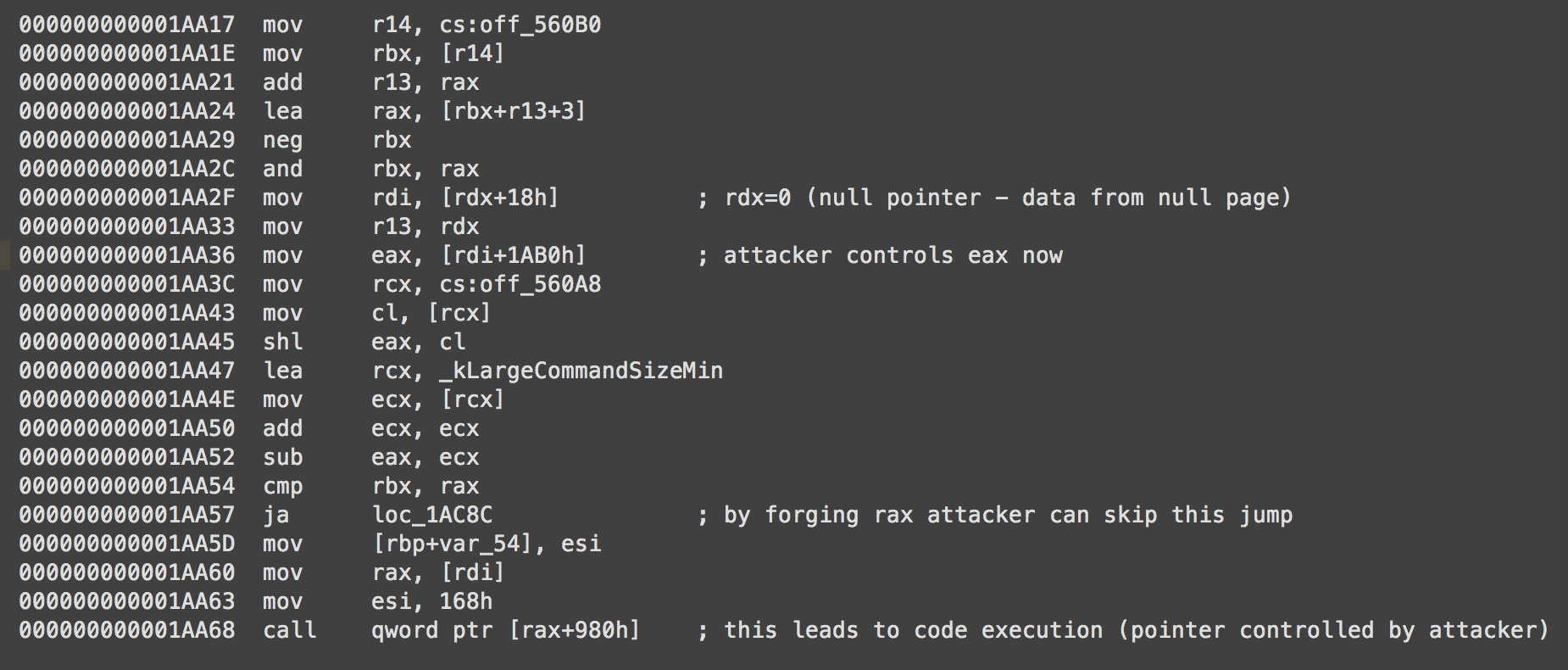
Piotr Bania of Cisco Talos is credited with the discovery of this vulnerability.


Cisco Talos, in conjunction with Apple’s security advisory issued on Mar 22, is disclosing the discovery of a local vulnerability in the communication functionality of the Apple Intel HD3000 Graphics kernel driver. This vulnerability was initially discovered by the Talos Vulnerability Research & Development Team and reported in accordance with responsible disclosure policies to Apple.

There is a local privilege escalation vulnerability in the Apple Intel HD3000 Graphics kernel driver (TALOS-2015-0088/CVE-2016-1743) which Talos has identified on OS X 10.11. Exploitation of this vulnerability requires user interaction, such as executing a malicious executable received via email or downloaded and run on the user’s Mac. With OS X becoming more common in the workplace this can be especially impactful as the common user accounts often do not have root-level permissions.

1

Read more

Authors

Talos Group

Talos Security Intelligence & Research Group

Avatar
Initial HyperFlex Customers
Figure 1: Some Initial HyperFlex Customers

Customers are very good at sorting through hype. In the past couple of weeks Cisco, along with other vendors, has introduced new hyperconverged infrastructure (HCI)products. The competition has heated up and customers expect more substance in these systems – not just hype. They want products that deliver real benefits that can integrate easily into their current and future environments.

At Cisco our engineering and product management teams developed the requirements for Cisco HyperFlex based on what we have learned from our experience with tens of thousands of Cisco UCS customers of all sizes. A start-up, no matter how good their technology, just doesn’t have this type of insight. We realized that customers wanted us to solve a broader set of issues with HCI. They liked the benefits of HCI, but they didn’t want to add more complexity.  Continue reading “Cisco HyperFlex – Customers Embracing Real Hyperconvergence”

Authors

Ken Spear

Sr. Marketing Manager, Automation

UCS Solution Marketing