You can think of collaboration tools—messaging, meetings, calling—as the central nervous system of the modern organization. But traditional collaboration platforms, with their disparate applications, interfaces, and delivery models, have often been complex and frustrating—both for end-users and the businesses implementing them. Part of the problem has been balancing everything that global enterprise and government customers need. On the one hand, they want collaboration capabilities that are totally flexible, available everywhere, and easy to update with new experiences. On the other, they want enterprise-class security and data sovereignty.
At Cisco, we think they shouldn’t have to choose. We’re unleashing the next revolution in collaboration with Cisco Spark. It combines our industry-leading collaboration capabilities into a single, cloud-consumable “as-a-service” (SaaS) offering for the first time.
This is a huge win for enterprise customers, who no longer have to license software, and maintain onsite infrastructure and staff to run it. But it’s an even bigger deal for service providers, who can now provide next-generation collaboration capabilities more easily, while leveraging their networks to deliver them with rock-solid security and control.
Service providers like Verizon, Dimension Data, and others can provide differentiated, seamless collaboration experiences—from mobile devices to the boardroom—with a lot less capital and operational investment. They can use a single cloud-based platform to extend these services to businesses of any size. And, because Cisco Spark has open APIs, they can add their own capabilities and services to bring amazing new experiences to their customers. It’s a winning combination—and a $24 billion global opportunity.
Technologist and network architects alike are leading companies into a new digital frontier directed by technology-enabled platforms. These platforms are very powerful as they can enable a new ecosystem for business models, customer engagement and value creation.
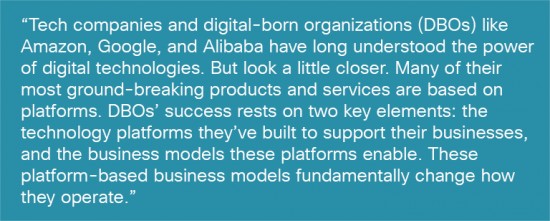
In Accenture’s recent Technology Vision 2016 research, the “Platform Economy” explains that:
Omni-Channel Approach to Architecture
In my previous blog, I identified that modern-day architects are challenged to define architectures that blend the physical and digital worlds. These architectures will be based on an omni-channel approach focused on seamless experiences, with rich context and situational awareness. Accenture’s perspective on the Platform Economy expands on this notion with three important insights:
Whether a company ‘owns’ a platform ecosystem or is plugging into another’s, what matters is having a platform strategy and the business know-how to exploit it.
Although platform business models are driving a major macroeconomic shift, adopting them does not mean giving up on existing business (value chain) models.
Digital leaders will create platforms on which customers, employees, and partners can experience all of the five senses—together—in any environment they choose.
The implications are twofold:
Platforms become the cornerstone building blocks of open ecosystems between “owners” and “participants.”
Integrating platforms across open ecosystems requires a new type of thinking and architecture technique.
The challenge is the level of integration and data connection complexity combined with the ability to deliver a context-based, situationally aware, loosely coupled architecture.
Making It Happen—Patterns Are Key
I consider this new thinking and architecture technique as software interconnection patterns.
A pattern can be defined as a reusable solution to a commonly occurring problem within a given context.
While the term pattern is not new, using them to solve the heterogeneous architecture and design problems of today is needed more than ever. Software interconnection patterns describe interactions between entities that occur at the right time, can be trusted, and maintain both predictability and repeatability across an ecosystem. The lifespan of software interconnections is a key characteristic. Interconnections may have a long, temporary or repeatable lifespan that is completely based on the situation and context.
Dealing with Complexities
The future of realizing business outcomes from technology depends on applying software interconnection patterns effectively. The architecture for interconnection patterns incorporates the advancements in IoT, hyper-distributed computing and microservices to achieve the desired business outcomes. This requires a new level of abstraction that will allow architects to deal with the complexities of connecting many different applications, systems, devices and technologies together in a coordinated fashion.
One of the best references that describe the vision of what the new world will look like is the Internet of Things Architecture (IoT-A) provided by the European Lighthouse Integrated Project. This video showcases the power of platforms in an IoT context; connecting traditionally siloed applications and technologies across multiple industries to save critical time and lives, which without connection would not be possible.
In the video, the interconnections highlighted are event driven and involve multiple entities, devices and systems. The key to the interactions is determining which ecosystem partners need to be involved and what data is important to relay.
As the video illustrates, using platforms to blend the physical and digital worlds must be governed by design simplicity and usability. Simplicity is made possible by understanding the context and interpreting the data. Context and interpretation enable:
better interaction with the people (e.g. personalization)
knowing when and what actions to take (e.g. insights and control)
orchestrating multiple dependencies to achieve the proper outcome (integration and connectivity).
Other examples in the video highlight that today, and in the future, there will be a diversity of interactions between entities. Interactions between such things as:
applications
standalone devices
embedded devices within the human body
anything that can communicate, which is monitored or controlled across a network.
Note: these examples are not constrained by a single person, corporation, process or protocol.
Critical Patterns to Support
In thinking about all of the various combinations and permutations of software patterns, the 80-20 rule (Pareto principle) prevailed; 80% of interactions that cross business, IT and OT systems can be captured within three primary interconnection patterns:
Orchestration patterns – covers methods and technologies that provide automation and coordination of processes and data across an ecosystem.
Interaction patterns – covers methods and technologies that provide access to functional capabilities and data based upon a given situation or event trigger.
Acquisition patterns – covers methods and technologies that are focused on gathering and distributing data to systems, applications or people at the right time.
These three software interconnection patterns are based on a configurable platform that can handle a variety of process orchestrations scenarios, ever-emerging integration scenarios and utilizing both traditional and new types of data sources. A configurable platform is one in which the constitution parts are modular, maintaining independence yet can be used together with minimal effort. For the tech junkies, this is like component architecture meets API Economy and microservices.
The Path Forward
As technologists, it is our responsibility to balance complexity, simplicity, viability and individual capability through the use of abstraction. In today’s software-driven world, we can learn to effectively do this by examining how abstractions have been used in other disciplines. For example:
In the network world, Software Defined Networking (SDN) is a combination of methods and technologies focused on making the network programmable and adaptable to diversity in applications.
In the systems architecture world, Model Based Systems Engineering (MBSE) is a combination of methods and technologies focused on using graphical models versus text documents to describe and exchange information on building systems.
In a similar fashion, modern-day architects should invest their time and innovation into developing methods and technologies that expand upon the notion of software interconnection patterns. This can begin with reviewing existing work that has been done related to the concepts of platforms, digital business and the API Economy.
Below are some resources that I have found helpful in my journey. If you want more reading suggestions, post a comment and I’ll respond with a few others.
I have never shied away from talking about Cisco’s commitment to interoperability, and here we are in 2016 and we are still talking about it? Haven’t we learned anything from the mobile phone industry? I don’t ever hear Samsung and Apple talk about how their phones can call one another. That’s table stakes. No one would ever buy a phone that couldn’t call any other phone on the planet.
Our approach to interoperability is simple: every endpoint that Cisco makes will be able to connect with any other standards-based endpoint from any other vendor – hard or soft. Full stop. And yes, this also includes the ability to share and receive content as part of the discussion. Some continue to ask, what about Skype for Business? While many say Microsoft is not truly standards-based, to us, it is just another endpoint. As far as we’re concerned, any strategy that deviates from this is a going out-of-business strategy – for anyone in the industry.
The fact that we acquired Acano should ring loud and clear that Cisco is committed to interoperability. Acano was the furthest along in driving true interoperability for the enterprise, especially with Skype for Business. That’s a big asset and one that we are further developing. If you hear rumors to the contrary, it’s someone spreading FUD for their own gain.
At the end of the day, I’m in the business of collaboration and making sure users can easily connect to get things done. So with my team, we will focus on things that differentiate our products – like great design and delightful user experience and intelligent features that enhance the video experience. I really want to be able to stop talking about interoperability as if it’s an option, because it’s not. It’s the price of admission. It’s really just table stakes.
How many times have you been at an ATM and wish that you had a bank teller to help you?
In Malaysia, customers that use the Bank Simpanan Nasional (BSN) now have the luxury of getting their banking done at an ATM but also having that human touch. That’s because BSN is employing virtual teller machines (VTM) to assist customers with their transactions.
And Cisco is a big part of this partnership.
A VTM is a lot like a typical ATM, except bank customers have the option of talking to a teller who appears on a TV screen located above the VTM. Customers can ask the tellers anything from simple account inquiries to which banking products should be used when it comes to a loan. With over eight million customers and 400 branches, BSN began this program at branches with less traffic so those tellers can assist colleagues at busier branches.
Making sure that the virtual tellers connected with their customers was Cisco’s job. The solution included the Cisco Catalyst 2960X and 3850 Series switches as well as Cisco UCS sever as the main hardware components. Adding Cisco software like Cisco Business Edition 7000 platform with Cisco Jabber and Cisco DX650 provided the infrastructure for the voice and video feeds.
BSN has been happy with the Cisco partnership.
“Cisco was with us every step of the way—from strategic business concept to the technical design and implementation,” said Mohd Kahlil Omar, Vice President, Information Technology at BSN. “They actively collaborated and partnered with our organization at all levels to make sure the project was successful.”
A new Cisco technology and success? That’s a partnership you can take to the bank!
Across the board, digital transformation is revolutionizing multiple industries. Healthcare is among the most prolific of these industries as digital transformation leverages the capabilities of a robust wireless network. Healthcare organizations are delivering innovative patient care, streamlining connections between patients and providers and improving collaboration among colleagues through connected devices on the Internet of Things (IoT).
With the large number of patients, healthcare professionals, administrative support and visitors in hospital environments, it’s very possible for network performance to suffer due to the crush of thousands of devices trying to get online. Wi-Fi-enabled devices such as smart phones, tablets and even wireless health devices can remain connected and operable in high density client environments when Cisco’s robust wireless network products such as the Aironet 2800 Series Access Point and the Aironet 3800 Series Access Point features such as Cisco’s High Density Experience (HDX) are deployed.
Can’t remember the last time you had a tetanus shot or the exact dosage of your medication? No problem. Doctors, nurses and other professionals can access your medical information on mobile devices that are securely connected to their facility’s network through its robust wireless network. Secure and fast connectivity means patients can use their Wi-Fi-enabled devices to update social pages, read digital editions of their favorite magazines or even connect to hospital entertainment networks.
Nurses can’t be in every room at the same time. But when patient monitoring devices connect to a nurse’s mobile device to tell them patient needs assistance – they don’t have to be. With a robust wireless network, connections between multiple patient IVs, heart monitors, respirators and any other smart equipment are more reliable and can be better monitored so nurses can get to where they’re needed most.
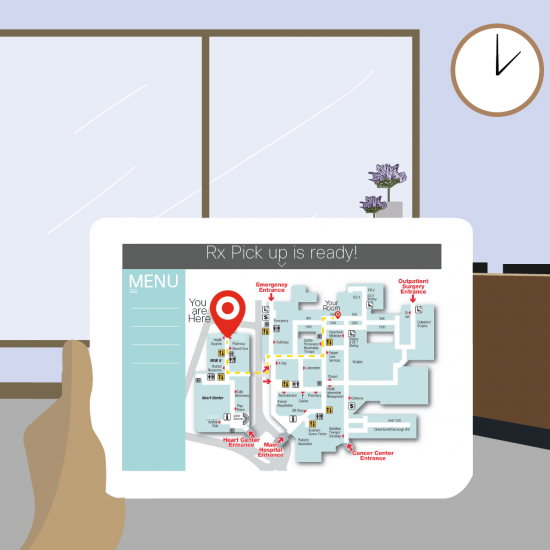
A trip to the hospital or a doctor’s office can cause a flurry of emotions and the last thing a patient needs is a myriad of hallways to navigate to reach a pharmacy, lab or doctor’s office. Healthcare organizations can offer enriched patient experiences with a robust wireless network, such as location based services like Cisco’s Connected Mobile Experience (CMX) to help patients easily navigate hospitals and mobile engagement apps that will deliver healthcare related alerts.
Due to their complexity, radiology and cardiology images are saved as huge files. In the past, these images couldn’t be sent over Wi-Fi networks for doctors to easily share with patients, due to their size; patients were often moved to other rooms just to review their results. With high bandwidth applications, doctors can view these images from nearly anywhere without moving the patient, allowing patients and family to easily incorporate information into medical care.
It’s the final countdown for this E-rate filing season. In order to apply for E-rate funding, schools must file their FCC Form 470s by April 1st – that’s one week from today!
E-rate funding can help your school upgrade its network to support digital learning and enhance educational opportunities for students. The Universal Service Administrative Company (USAC) oversees the E-rate program, which offers $3.9B worth of discounts to K-12 schools and libraries each year on the purchase of internet access, networking equipment, and maintenance. Due to the $1.9B in rollover funding, there is an unprecedented $5.8B available for the 2016 funding year, so don’t miss this opportunity!
So make sure you get your FCC Form 470 filed by Friday, April 1 at midnight Eastern Time. If you need more information about how E-rate funding can help your school, go to Cisco’s E-rate page here or visit the Cisco E-rate Helpdesk for Cisco product eligibility information. If you’re ready to submit your Form 470 or need more detailed information on the submission process, go to the USAC website to get started.
Data protection and privacy are red-hot topics right now, as they should be. We are facing a watershed moment that could determine government and organizational policy for years to come. Weighing personal privacy against national security, for instance, is not as cut-and-dry as it may first appear. In our data-centric world, organizations are hungry for insights about their customers and clients, but how can organizations balance trust with the need for data privacy?
I recently participated in a podcast hosted by Connected Futures, along with Michael Kaiser, executive director at the National Cyber Security Alliance (NCSA), to discuss these questions. The moderator, editor-in-chief Stefanie McCann, noted that consumers are willing to divulge a certain amount of their personal information in return for services. However, there is a “trust cliff” – a steep drop-off in willingness to share data beyond the basics. How can organizations avoid falling off this trust cliff? How can they respect customers’ and prospects’ privacy while getting the data they need to drive business intelligence for issues like improved customer service and new revenue streams?
Here’s my perspective: the balance between data sharing and privacy is highly contextual. It comes down to our expectation of privacy. You aren’t going to share with your therapist or lawyer the same things that you share on social media, for instance. There are notions of balance between privacy and security, safety and data integrity, ownership and fiduciary responsibility. These notions aren’t fixed; they change over time. It’s similar to driving a car; the rules change based on road conditions.
Data privacy isn’t just about data that an organization is going to use for business insights. Sometimes it’s about data that will never be used again, as for a one-time financial transaction, but if that data gets lost or stolen, the customer’s privacy has been violated. In this respect, data privacy is a lifecycle issue. Think of it this way: if you hand someone a dollar bill, the money doesn’t diminish in value just because you’ve given it to another person. It still has value, and it still needs to be protected.
This topic will continue to be debated in the public arena, and that’s a good thing; we need a multiplicity of voices and perspectives to help create a path forward in this digital frontier. I hope you’ll listen to the podcast, and I hope you’ll share your perspective in the comments section below.
The variety of interpretations about what hybrid cloud is, should be or could be continues to evolve ….
This is why for quite some time whenever hybrid cloud comes up I have tried to discuss hybrid cloud in very practical terms. The most popular interpretations of hybrid cloud typically fall across the following main categories:
Some organizations are subscribing to multiple cloud services from different cloud service providers for different IT or business requirements; therefore, they believe they have a hybrid cloud (well … maybe not quite 🙂 )
Other organizations believe that hybrid cloud is simply an IT environment that uses a mix of public cloud services and dedicated IT assets including virtualization and private cloud
A more elaborate perception of what hybrid cloud should be is offered by another group of organizations and includes the concept of workload portability and the ability for workloads to burst across public and private cloud resources as needed
Last but not least, a few organizations emphasize the cloud management angle, positioning hybrid cloud as a way to manage IT resources including public cloud, private cloud and traditional (non-cloud) IT using the same service catalog, SLAs and resource provisioning automation
Incidentally, these are the same categories we review during our Cisco BCA workshops. As briefly discussed in one of my latest blogs, even though different companies define hybrid cloud in different ways, hybrid cloud use is growing, with over 64% of cloud adopters consuming some form of hybrid cloud.
IDC defines hybrid cloud as “an enterprise IT architecture that unifies automated, policy-based, consumption-aware self-service configuration; provisioning and management of public and private cloud infrastructure (IaaS), middleware (PaaS), and database/application (SaaS) resources; and physical, virtual, and software-defined non-cloud IT assets.”
However, please do not expect this very same definition to be shared by all the major analyst firms either ….
A more interesting question to advance the dialog is ‘what are the requirements that most organizations believe should be associated with hybrid clouds?’
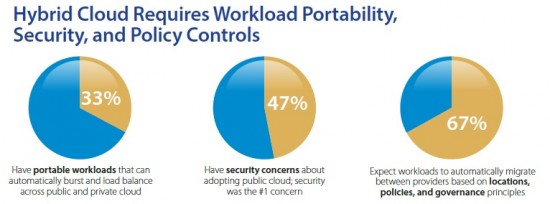
It turns out that – based on a broad number of responses – ‘getting hybrid cloud right’ requires workload migration, security, and policy-based control. In fact, 33% of organizations expect to migrate data between public and private clouds and have high security and policy requirements. Most IT organizations also expect that they will increasingly act as internal brokers of services. Some of these services are put together by their own developers and some are sourced from the public cloud. In this emerging role, IT needs solutions to support a single view of the services they provide, irrespective of the sourcing model, and to support governed, policy-based access to these services, wherever they may be (Source).
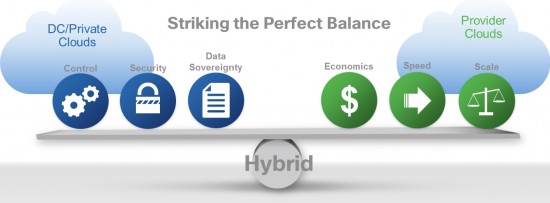
Additionally, it is very much true that most organizations want and need to place the right application on the right IT environment based on a variety of criteria. However, it is hard to take into due consideration cost, scalability, control, performance, security, and governance all at the same time – just to cite a few requirements – and get to a conclusion. Sometimes this analysis will point to public cloud, and sometimes this analysis will point to the use of dedicated/private cloud resources. Progressively, it may point to a combination of both, in an effort to ‘strike the perfect balance.’
No matter what though, putting an advanced hybrid cloud in place requires an infrastructure that enables workload portability and that includes security, policy-based management across heterogeneous environments to support enterprise governance principles.
At Cisco, we remain committed to help you advance your ‘multi-cloud’ journey, at your own pace and based on your objectives. Visit our website to learn more.
The digital transformation of business is fueled by several megatrends – Mobility, IoT, Analytics and Cloud. First, mobile traffic is expected to exceed wired traffic by 2017. Second, IoT devices will triple by 2020. Third, 75% of all companies are planning to, or are already, investing in Big Data. Fourth, 80% of all companies will primarily use SaaS by 2018. Thus, to go digital, businesses will be focused on three priorities: simplify and automate processes, empower workforce efficiency and innovation and personalize customer and citizen experiences.
But this digital wave creates new questions: How do you make it easy to provision and scale? How do you build a resilient network? How do you secure the network? How do you gain visibility into the network?
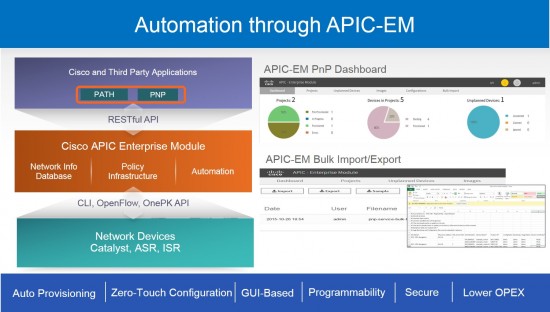
Automation: the Cisco Catalyst 6800 Series Supervisor Engine 6T supports Cisco Application Policy Infrastructure Controller Enterprise Module (APIC-EM). This replaces complex manual network operations such as provisioning with the click of a button. It is implemented as a software application (like PNP or PATH) packaged as a virtual machine on a UCS server.
The software application communicates through RESTful API’s to APIC-EM, which then communicates with network devices through CLI, OpenFlow or the OnePK API’s, exposing network intelligence for business innovation. This offers the ability to run the same commands on any Supervisor Engine 6T within your network without worrying about details such as IP Address, logins etc.
Visibility: Flexible Netflow collects and measures data allowing network devices to become a source of telemetry and monitoring. A wide range of packet information for IPv4, IPv6 flows can be tracked including IP Addresses, Ports, Multicast and Layer2 VLAN entries amongst others. This is due to product capabilities such as new Layer2-Layer7 fields, scalable flow monitors, customizable policies with Embedded Event Manager and a broad collector ecosystem. Key use-cases for such visibility include: real-time network monitoring, application and user profiling, network planning, security detection & classification, accounting & billing, troubleshooting, data warehousing and mining. The next-generation Supervisor Engine 6T supports up to 1M Netflow entries offering superior visibility into your network infrastructure.
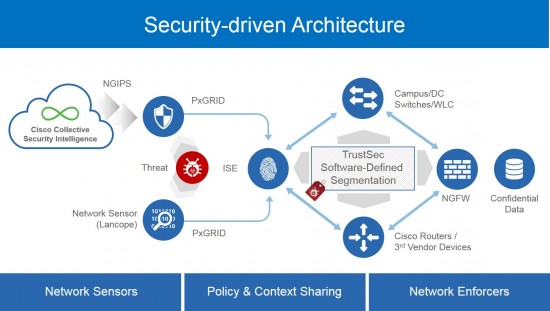
Security: A threat-centric security model is based on three stages within the attack continuum – before, during and after. ‘Network as a Sensor’ means that Cisco Lancope StealthWatch can be used to detect anomalies affecting the environment.
Cisco Identity Services Engine can then translate this “visibility” and “detection” to actionable feedback for the network, which could range from proper segmentation to threat remediation. Since the security group within Cisco TrustSec becomes the common classifier for network devices; customers can leverage the Network as an Enforcer concept to simplify security operations, automate remediation based on detection and secure their investments.
Resiliency: An architectural approach to resiliency comprises the following components: upgrade management, operational resiliency, network resiliency, link resiliency and infrastructure resiliency. Resiliency-based software features on the Cisco Catalyst 6800 Series Supervisor Engine 6T include Bidirectional Forwarding for static routes and logical interfaces, Flexlinks, Virtual Switching System, 16-way Layer 3 load balancing, and configuration rollback amongst others. Such features are meant to provide deterministic and automated recovery and simplify network design by eliminating spanning trees and first-hop redundancy protocols.
Software services on the Cisco Catalyst 6800 Series Supervisor Engine 6T create value throughout the various phases of the digitization journey – from base automation in existing deployments to complete software control through policy-based automation for greenfield scenarios.
As you can tell, the new Cisco Catalyst 6800 Series Supervisor Engine 6T offers the optimal combination of simple, smart, scalable and secure network services for the next-generation campus.
If you would like more information, please visit here.






 These three software interconnection patterns are based on a configurable platform that can handle a variety of process orchestrations scenarios, ever-emerging integration scenarios and utilizing both traditional and new types of data sources. A configurable platform is one in which the constitution parts are modular, maintaining independence yet can be used together with minimal effort. For the tech junkies, this is like component architecture meets API Economy and microservices.










![introduction[1]](https://blogs.cisco.com/gcs/ciscoblogs/1/introduction1-550x309.jpg)