I mean, the money would be great, the constant job offers would be nice, and I suppose the freedom to show up to work wearing anything you want would be a bonus, but the actual programming? Ick. It seems awfully tedious.
I can’t imagine the patience it would take to write line after line after line of code, only to test it, find out there’s a bug, then have to locate the bug, fix it, and repeat. And really, that’s the least of it. You’re constantly having to learn how to use new languages and new tools and figure out how to stitch them together so they all cooperate and deliver the new and improved developing experience you’ve been promised. And then if you’re successful with that endeavor, finding out that yes, the new tool did solve one enormous longstanding problem, but it created ten new, small, perpetually annoying problems.
Again, I just can’t imagine having to possess that kind of patience (and employ it five days a week).
The good news if you’re a developer though is that this really does seem to be the golden age of innovation when it comes to tools that make the job less tedious. The whole array of PaaS offerings hitting the market right now are all meant (in one way or another) to help automate as much of the development process as possible and allow you to avoid more and more of the repetitive processes that even the most patient among you probably deplore.
Case in point: Project Shipped from Cisco. It’s a hybrid devops platform that makes it easy for developers to build, deploy, and run containerized microservices.
Not sure what that means?
Well, in short, it means developers can build applications the way they always have with the tools they’ve always used, BUT they can deploy those applications across a variety of internal, private and public clouds without lock-in, AND they can run their applications across multiple deployment locations in a CI/CS and application-intent framework. It’s crazy cool. The kind of things developer dreams are made of.
Need further explanation? That’s what webinars are for. And it turns out we’re having one about Project Shipped tomorrow morning at 9:30 AM Pacific! Lucky you! To get in on the fun, register here.
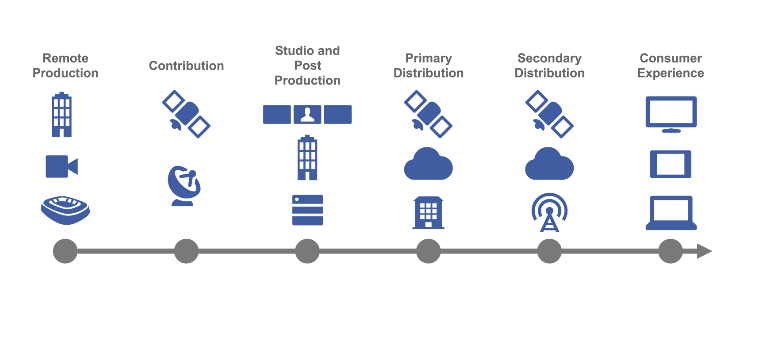
Today’s broadcast media production companies are facing an environment of enhanced formats, evolving platforms, faster processor speeds, and OTT delivery that allows for video to be watched on pretty much any device. These exponential technology advances have had a tremendous impact on the media industry. Video can be shot, produced, edited, and delivered by creative artists linked through powerful networks distributed across multiple specialist studio locations. The business opportunities are boundless, but all of this is happening in a connected world that presents mounting security challenges. This week at the NAB Show media companies will learn how to thrive securely in this new media-optimized IP environment.
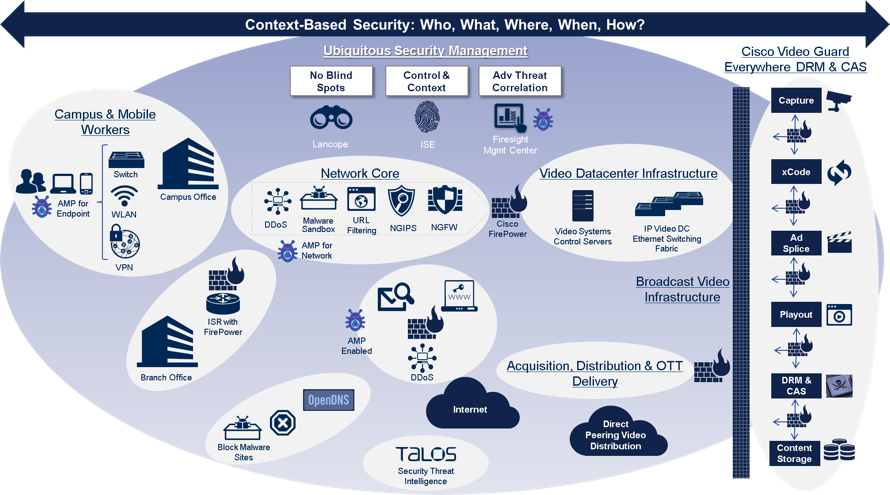
Today, financially motivated hackers are increasingly targeting the creative industry. The connected and disaggregated world of video production represents a growing attack surface that can be exploited by bad actors – pun intended! We have all heard about the Sony hack, finding the source of the breach was a nightmare. There is still speculation on where the theft originated. And, what about the TV5Monde broadcast and social media hijacking? Who saw that coming? A recent nScreenMedia report found that 28% of media organizations admit to having experienced a cyber attack of some type or another. What can creative artists do to protect their work? They want to create award-winning films, not worry about who might be trying to steal their content, or even worse, hold it hostage for a big ransom payment. Video production and distribution companies need a cloud-scale solution to protect their creative assets and distributed infrastructure.
Media production networks, corporate IT, media storage locations, and customer data must be access controlled and defended against intrusion. To mitigate threats, you need to block access to potentially malicious webpages or email by the creative team or corporate staff, without inhibiting the creative process or other activities to run the business. You need to defend the network perimeter and continuously monitor the entire IT environment in case unknown threats get in, so you can quickly detect, contain, and remediate breaches. Only Cisco delivers the comprehensive security solution to safeguard your media assets and critical business data from creation to consumption.
Don’t just take our word for it; NBC Olympics selected Cisco for its production of the 2016 Olympic games in Rio. NBC will deploy Cisco Media Blueprint with premium network protection to ensure their on-line staff, content and live feeds from Rio stay safe from cyber attacks. Included are Cisco ASA Firewall with Virtual Private Network services (VPN), Firepower Next-Generation Intrusion Prevention (NGIPS) and Advanced Malware Protection (AMP) with Stealthwatch network flow analysis.
Cisco’s Threat-Centric Security Solutions for the Media Industry are designed to protect your video content and broadcast infrastructure so you can focus on developing compelling content that can be delivered securely to your viewing audience. With Cisco, you are protected by the #1 in data center security and the #1 in video security. Our multilayered solutions work together to ensure that your content, services and business are protected from advanced cyber threats – across the attack continuum – before, during and after an attack. BEFORE the attack, our solution strengthens the network perimeter, enforces secure access, and safeguards media content across networks, systems, users, and data. DURING the attack, it provides real-time detection and mitigation from known threats. And AFTER the attack, it helps you to quickly discover malware that gets in and resolves these unknown attacks to prevent your business from being compromised.
Once your content is ready for primetime, Cisco’s VideoGuard Everywhere provides a comprehensive and proven multi-DRM (digital rights management) based security solution to protect video delivery to multiple screens. To mitigate illegal online content streaming, VideoGuard Everywhere Streaming Piracy Prevention helps to locate, identify, verify, and eliminate such activity. And our global team of Operational Security experts constantly tracks pirates to stop them from impacting our customers’ business.
Cisco has your back. With our holistic approach to data center security and a full range of secure broadcasting solutions we are the trusted security partner for the broadcast media production industry. Read George Tupy’s blog to learn more about Cisco’s cloud-scale media experience that will be showcased at the 2016 NAB Show in Las Vegas.
Citigroup has just released a report projecting European and American banks are going to cut over 1.7 million jobs in the next 10 years. The reason… fintech advancements. This estimate represents close to 30% of current staff levels and is in addition to the 750K jobs that have already been shed since the financial crisis.
This report speculates that retail banking will be the most affected in Europe, which is contrary to the past few years where most cuts have been in the investment management side of the industry. Technologies focused on relationship management are key to this prediction putting intense pressure on the traditional branch model.
About the Author: Paul Brooks is a Business Development Manager at Rockwell Automation and is the lead for the Industrial IP Advantage, a coalition of like-minded companies driving community, thought leadership, and promotion of standard, unmodified Ethernet and Internet Protocol.
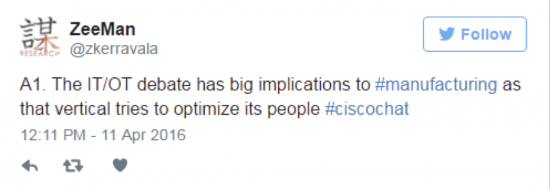
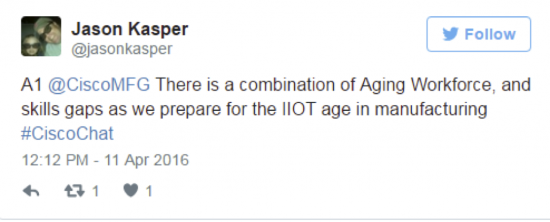
We’ve all seen the numbers. Baby boomers are retiring at a rate that’s outpacing new talent onboarding, leaving us with a global skills gap challenge. Additionally, the industry is requiring new, enhanced skills and the roles for information technology (IT) and operations technology (OT) professionals is shifting due to the convergence of information.
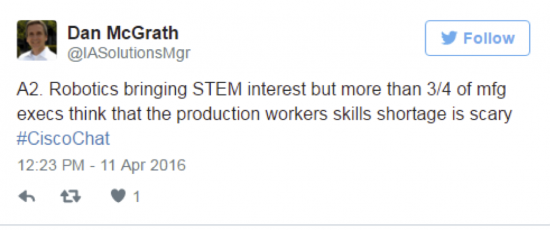
To address these challenges, I hosted a #CiscoChat this week with Paul Taylor, Strategic Alliance Manager at Cisco, Dan McGrath, Senior Business Development Manager at Panduit, and Jeff Gao, Corporate Director at Cisco. We discussed workforce challenges such as the IT/OT knowledge gap as well as how to attract and prepare workers for the changing industry landscape.
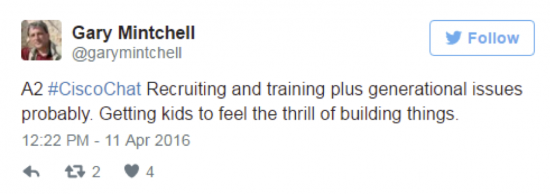
We kicked off the chat by asking: What are the biggest workforce challenges in manufacturing?
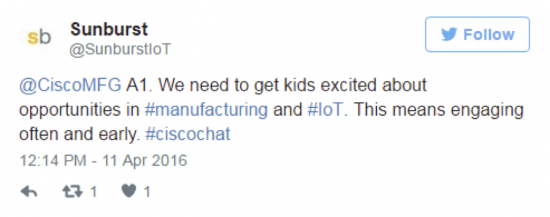
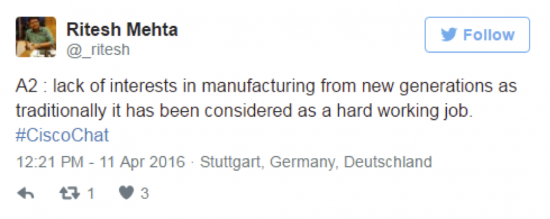
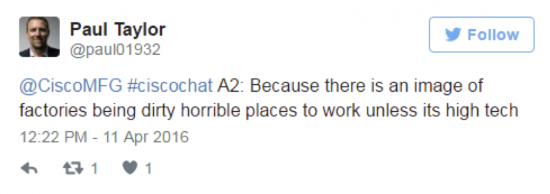
Based on the comments about keeping pace with the emergence of IoT, we then asked: Why are manufacturing jobs going unfilled? Many chimed in and explained that manufacturers struggle to appeal to younger generations. That may be true, but I pointed out that once people are exposed to it, many like me find manufacturing to be both fascinating and fulfilling.
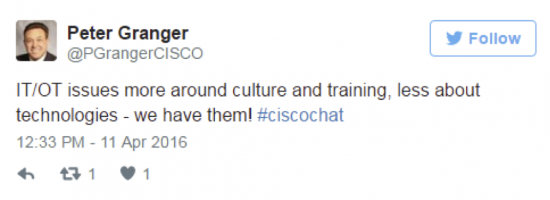
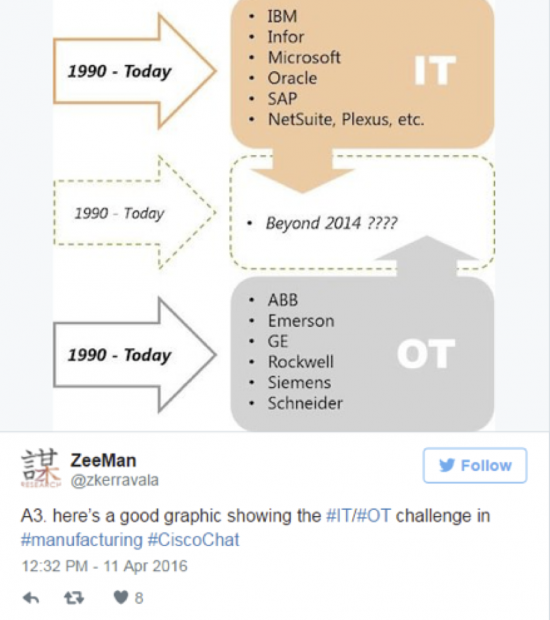
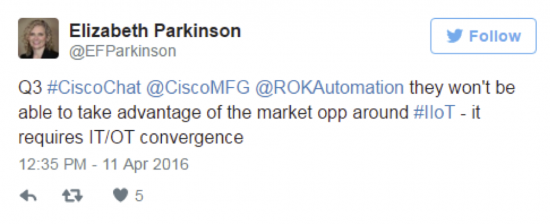
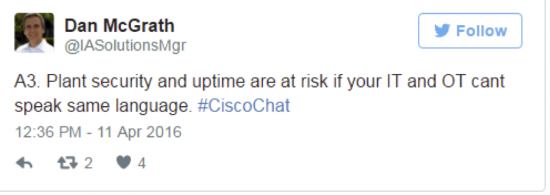
Among recruiting challenges, the IT/OT knowledge gap was top-of-mind for many participants. And because this issue is widespread, we asked: What challenges arise as a result of the IT/OT knowledge gap?
The gap in collaboration between IT and OT was a reoccurring theme throughout the chat. In fact, a great question was brought into the conversation – “is IoT just a buzz word, or do people really understand it?” Through IT/OT convergence, manufacturers can start to take advantage of the $3.88 Trillion opportunity within the next 10 years by connecting operations to business outcomes. This can only be achieved by training and recruiting the workforce.
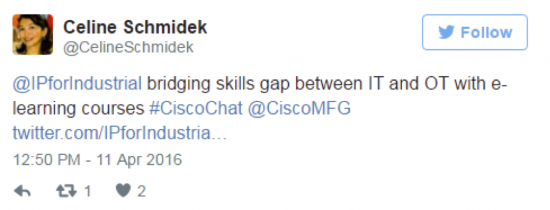
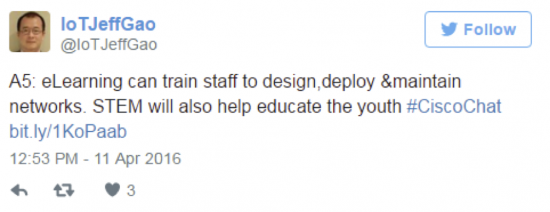
This leads us into the last questions: How are manufacturers working to bridge the IT/OT skills gap? What skills are needed to bridge the knowledge gap and how can training help?
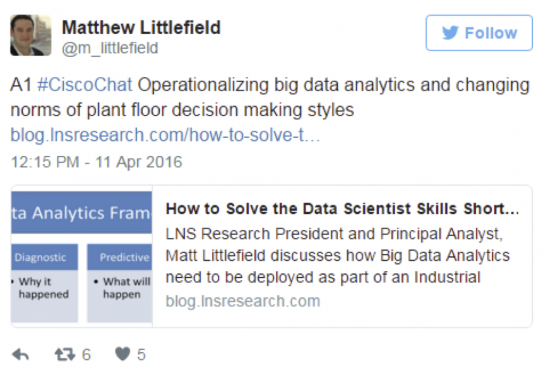
ELearning opportunities will help employers and their employees bridge the manufacturing skills gap. As the industry continues to evolve, job requirements will shift as a result. Manufacturers have a lot to gain with Big Data, as skilled workers will enable companies to increase productivity and improve risk mitigation. You can learn more about eLearning opportunities from Industrial IP Advantage.
If you didn’t have a chance to attend the #CiscoChat, you can get a full recap of the questions and responses by reading our Storify. We will have more discussions in the future, so be sure to follow the @CiscoMFG team and keep up with the conversation using the hashtag #CiscoChat.
Guest Blogger: Jeffrey Lo, Principal Engineer, Enterprise Networking Group.
Jeff is a member of the founding engineering team that led the execution for IOS-XE and later evolved IOS-XE to enable a converged software stack across the routing, switching and wireless platforms in Cisco’s Enterprise Networking portfolio. He sets the technical direction and oversees execution for the evolved IOS-XE implementation in areas like data plane forwarding management, wireless and switching integration, various infrastructure components, manageability, programmability and analytics. Jeff has an MSEE from Stanford University and BSEE from Imperial College of London.
I was reading an article a few Saturdays ago, about how the automobile industry has evolved from the first steam-powered automobile capable of human transportation in the late 18th century to the futuristic self-driving cars that are now in trials. Humans are finally able to build an artificial intelligent system that is capable of visualizing and normalizing massive amount of input data, analyzing and reacting to fast changing and unpredictable traffic and environmental conditions and take the first steps towards truly self-driving technology.
Being a 20-year veteran in the computer networking industry, my natural instinct is to relate this evolution to the computer networks of tomorrow. The network will be intelligent, self-managed and provisioned with absolutely no human intervention other than having to connect the wires and specifying what the business outcome ought to be. Operational excellence and simplicity are as critical as the closed loop between device data, network visibility and learnt device behavior, as it will truly enable automated networks just as self-driving cars are able to make autonomous real-time decisions in an ever-changing landscape. In this blog, I discuss the aspects of the Evolved IOS-XE that enable such operational excellence.
As our customers continue to strive towards lowering operational expenses and delivering networking services with high quality, it is important that they are able to manage their entire network easily, at scale and with confidence. Cisco has taken on the challenges via its recently launched Digital Network Architecture (DNA) company-wide initiative to ensure that we partner our customers as they continue on their journey towards operational excellence with simplicity.
In evolved IOS-XE, we believe operational excellence can be achieved by focusing on the ease of network management at scale, richness in the set of programming interfaces akin to the customer chosen workflow, network operational consistency and network visibility.
Realizing the importance of operationalizing a Cisco evolved IOS-XE device right out of the box with zero touch, evolved IOS-XE supports zero touch provisioning via its open Plug and Play (PnP) bootstrap capability. PnP enables the initial configuration download, image upgrade, and licensing using a wide array of standard protocols.
Massively scalable data center customers have unleashed the power of automation-at-scale for managing large numbers of servers. Automation tools such as Puppet and Chef are popular as the declarative, cadenced-based enforcement of the user intention enable large number of devices to be operationalized with ease. Cisco has similarly enabled this automation trend to extend to Evolved IOS-XE based enterprise gear through direct support of Puppet, Chef and Ansible automation interfaces. Leveraging Cisco DevNet and the power of the open community, thousands of Puppet/Chef resource types have been added. We are aligning our major OSes, Evolved IOS-XE, XR and NXOS to support the open resource types and to offer a consistent cross OS automation user experience.
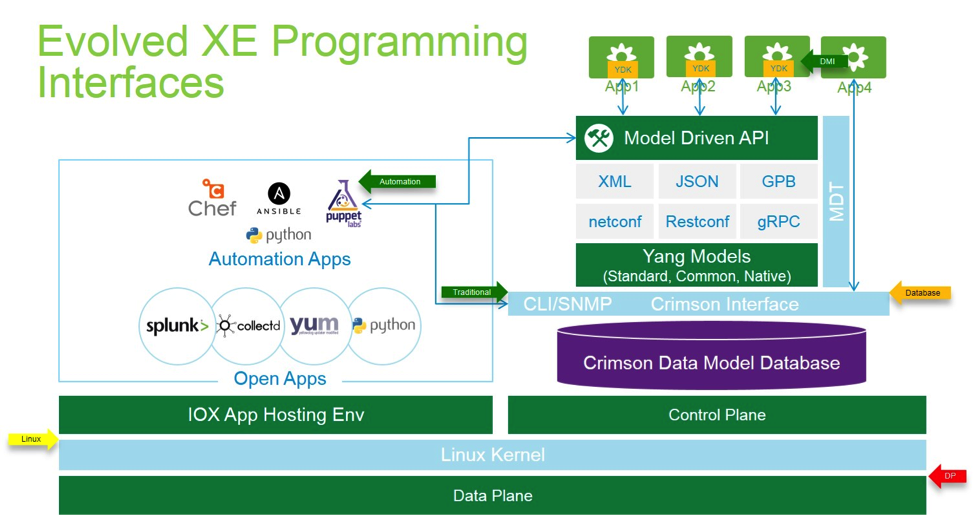
The industry is moving towards the use of data model driven interfaces (DMI) for configuration and operational state accesses. Standard model based interfaces provide consistency, openness, structure and efficiency. Leading the way towards operational consistency and ease of use, evolved IOS-XE provides a full set of northbound programmatic interfaces based on IETF standard Yang models.
The diagram above highlights the wide array of programming interfaces available with evolved IOS-XE in addition to the traditional Cisco CLI and SNMP. Evolved IOS-XE Crimson database also offers a native set of model driven interfaces via its graph execution engine (Green) for remote database query and configuration. This offers the application maximum efficiency while keeping the overhead of model translation to a minimum.
For network operations to be able to manage, monitor and troubleshoot their network effectively, visibility into the network is very important. Looking to the future, we are taking steps to realize the power of model driven telemetry (MDT). This enables a wide range of auxiliary data handling capability including but not limited to filtering, cadence-based or event trigger data export, choice of encoding, transport and QOS treatment.
Taking a bold step towards operational excellence in the digital era, Evolved IOS-XE offers state-of-the art technologies that form the foundation towards offering our customers the foundation toward a “self-driving” network that offers a different level of operational simplicity and lower cost.
I urge you to learn more about evolved IOS-XE from Suresh’s recent blog and discover more about the Cisco Digital Network Architecture (DNA) vision and strategy here.
The upcoming OpenStack Summit will be Cisco’s first Headline sponsorship at this semi-annual gathering of the OpenStack community…and it’s a good thing we’re headed to Austin because we need a Texas-sized venue to share everything.
The Cisco booth (C11) at the OpenStack Summit is going to be filled with great demos and presentations that will show how you can innovate, develop, think, and work Beyond the Stack using the power of OpenStack to build and connect clouds and cloud applications with unmatched speed, flexibility, and security. Here is a taste of what you can experience at the event with Cisco.
Network Function Virtualization and Network Function Virtualization Infrastructure
As you probably already know, the Austin Summit will be hyper-focused on Network Function Virtualization (NFV). We’ll have a team of specialists available to provide an NFV introduction as well as a deep dive on how Cisco can help deploy carrier-class NFV for your business with Cisco’s tested and validated Network Function Virtualization Infrastructure (NFVI).
Private Cloud
If you’re interested in an on-premises managed private cloud, come by and talk to the Cisco Metapod experts. You’ll see how Metapod can quickly be tailored to provide the perfect on-prem private cloud as well as see how Metapod integrates with both Apprenda and Pivotal’s Cloud Foundry to accelerate your Platform as a Service (PaaS) initiatives.
Unified Computing System and Software-Defined Networking
Want to manage your own private cloud? Come and talk to us about Cisco UCSO, which combines the Cisco Unified Computing System (UCS), Cisco Nexus, and the Red Hat Enterprise Linux OpenStack Platform. There will also be demonstrations of Cisco’s Application Centric Infrastructure (ACI), Cisco’s comprehensive Software-Defined Networking (SDN) architecture. The demos will feature OpenStack on ACI using Group Based Policy and the OptiFlex Neutron plugin.
Shipped and Mantl
We’ll also be showing Shipped (ciscoshipped.io) and Mantl (mantl.io), two of our newest open source initiatives. Did we just say “open source?” Come by and see for yourself. The Cisco DevNet (developer.cisco.com) team will be on-hand to share their latest round up of tools and resources available to developers.
And, if that wasn’t already enough, we’ll have a huge, interactive, touch-screen display loaded with over a dozen more videos, demonstrations, and presentations. Our only request…please make sure to wipe all the BBQ sauce off your fingers before you check it out.
By Adam Davies, Product Marketing Manager, Cisco Service Provider Video Software and Solutions
If I had a nickel for how many times we get asked about why we decided to divest our set-top line to Technicolor last year … well, I’d have a lot of nickels. And no answer is more refreshing (and accurate!) to impart than our ongoing work with brands like Roku to expand the services offered by broadcasters and multi-channel video providers — large and small.
Consider: Cisco, with our Infinite Video platform, has already enabled 25+ global customers to offer their branded services on Roku streaming players. Our work happens behind the scenes, so we don’t expend a lot of energy talking about it — in a way, it’s not our party, it’s theirs.
An obvious next step for us is the Tier 2/3 service provider marketplace. Smaller operators are under enormous strain (understatement of the decade) to continue to support traditional linear video services, given the galloping price increases passed on to them by content owners.
Many operators are seeking a way to provide “skinny bundles” to consumers or to distribute their own branded streaming service. Roku licenses its streaming platform to such operators as part of the Roku Powered program. Operators can leverage Roku’s streaming players and platform to deliver their services to the home. Sky is a great example of this, in UK, Germany and Italy and also Telstra launched its ‘Roku Powered’ Telstra TV Box in Australia last year.
Such developments are a big part of why we are dedicating time and energy on innovating in this area. We are now positioned to collaborate on equal footing with the over-the-top ecosystem leaders, like Roku.
We’ll be showcasing our Roku collaboration and lots more within the OTT video mantle this week. Come by and check it out at the Cisco booth in the South Hall, SU8502CM. Hope to see you!
I think there are a lot of people like me at Cisco. I’m 49 years old, and the house I grew up in didn’t even have a computer. Now I’m a Technical Writer for the dCloud Data Center & Virtualization team, which means that I write about complex Cisco technologies. I use my smartphone for everything and keep up with friends on Facebook, but until recently the more social spectrum of social media always ran together for me in a TwitterSnapChatInstagramPodcastYouTube blur.
In a recent speech at the Women of Influence conference, Silvia Spiva called me a Tech Icon. Of course, she spelled it #TechIcon, but the point is, she should know. She means that I’m active on social media, developing a personal brand, amassing followers, and generally “getting known” out there – who would have seen that coming?
I started using Twitter to talk about my dCloud demos because my boss’s boss said it was a good idea. I was unenthusiastic, because I already have a day job and because I wasn’t looking to add another form of social media to my life. It was hard at first, because I worried a lot about saying the wrong thing and getting fired. But I learned a few things along the way:
It’s Not Stupid
You don’t have to say it, I thought so too. Why bother? Two big reasons – this is where the people are, and this is where you can be heard. The biggest companies monitor their Twitter accounts. I tagged a company account at Cisco Live, and five minutes later a VP was at the dCloud booth. I engage with my upper management daily. I think “Why not?” is becoming a bigger question every day. Don’t get left behind.
You Don’t Have To Be All-In
You can choose your level of engagement. And once you do, it’s empowering, not frightening. When I started following people who were tweeting about APIC, UCS, Cisco Live and other topics I wanted to tweet about, my tweets got more engagement and I found myself having real conversations with people about my work. It doesn’t “interfere” with my day job – I tweet less on busy days, more on light ones. Now I consider it a necessary part of my job, and I make time for it.
Twitter is a Great Equalizer
I think it’s fair to say that my colleagues, my boss, HER boss, and even HIS boss know a lot more about me than they would if I wasn’t on Twitter. (Hi Ron!) I love my job, and I’m very proud of my work, and it’s nice to tweet about something I wrote and get a ‘❤️’ from two levels up. It’s a fun, easy style of communication that keeps me feeling validated and motivated, as well as visible.
You Be You
I express myself freely on my Twitter account. It’s like any other conversation. Sometimes you talk more, sometimes you listen more. Sometimes you’re funny, sometimes you’re serious. There’s room for every style and personality out there, and when you get used to having your voice heard, it’s addictive.
For me, social media has become one more reason to #LoveWhereYouWork.
If you’re following the 2016 NAB landscape, you know that broadcasters and media companies (like yours!) are bracing for a traffic tripling, in and out of their data centers, as they grow content production for on-demand, multi-screen and 4K viewing.
It’s all part of the pursuit of technologies and workflows that will help content creators, and their providers/distributors, to transform viewers into fans. Which is all about attractively personalized experiences — no matter the size of the screen, and experiences that are launched easily from the cloud.
When you work for a company that innovates, pretty much literally, at every whistle-stop along the video/media ecosystem, you wind up heading into a show like NAB a little concerned about how very much you have to say, because of how very much you’ve been innovating, along so very many product lines.
This is one of those NABs, for us. So much innovation, brewing for so long, along so many trajectories, from “camera to eyeball”! I mean, really: If you’re in charge of getting the word out, what’s our leading pitch? Welcome to the “inside baseball” of the major tradeshow “messaging.”
Media Blueprint is our approach for helping customers get to Cloud Scale Media Experiences. It includes the set of infrastructure and software components we’ve been busy building, the broadcast partner applications critical to our customers, and our services for media to integrate and validate systems and performance. It’s also our way of saying, in two words, how we’re accelerating the production, delivery, and monetization of immersive content.
You can read all about what our Media Blueprint comprises by reading the press release You can ask your colleagues at NBC Olympics, and CBS News Digital– they’re on board, among lots of others.
Or, if you’re cruising the Las Vegas Convention Center, navigate yourself to the Cisco booth at Upper South Hall, #8502. We’re at the ready with a really informed, really great line of stuff that will make your work-life better. That’s the whole point of the Media Blueprint, and it can only get better with … you. (Yes! You!)











 connect clouds and cloud applications with unmatched speed, flexibility, and security. Here is a taste of what you can experience at the event with Cisco.