Avatar

The WeAreCisco employee tribe is everywhere, especially in social media. We’re on Twitter, we’re on Instagram, and now we’re on (wait for it) Snapchat!

If you’re a Snapchatter, you know that it’s a messaging app with fun filters that lets you post “snaps” with everything from rainbows streaming out of your mouth to having a halo of stars. Video, pictures, emojis, text, drawings – it’s a great way to show off your “story” to the world.

And WE think the WeAreCisco tribe has a lot of great stories. (You will too.)

So Cisco employees are taking over Snapchat starting this week.

Want to see our annual employee Crawfish Boil in Texas? How about a tour of our Raleigh office? What’s it like to be a polite Cisco Canadian?

You never know what story they’ll share, and each story only lasts on Snapchat for 24 hours! So you’ll want to be sure to check back in regularly.

Follow along with our username: wearecisco. Or, just use the handy Snapcode below.

wearecisco snapcode

Authors

Carmen Shirkey Collins

Social Media Manager

Talent Brand and Enablement Team, HR

Avatar

As we gear up for EMCWorld, I’m excited that Cisco will be co-hosting the Community Appreciation Wrap Party with EMC and VMware – especially as it will be in the Bourbon Room.  This will be a great opportunity to take a break after the show floor closes and catch up with the community over delicious beverages before the Customer Appreciation Party (with Duran Duran!).

Invitees include Cisco Champions, EMC Elect, and vExperts along with distinguished speakers, and other fun guests from EMCWorld 2016.  Awesome folks attending Interop are invited too.

Please RSVP if you’re going to stop by – this should be a great way to finish off the week!


Authors

Lauren Friedman

Marketing Manager

Enterprise Networks

Avatar

Over the past few years, Cisco has partnered with the University of Queensland to bring educational transformation to their campuses through the use of Cisco technology.

The University of Queensland has deployed an extensive wired and wireless network across multiple campuses that supports educational outcomes for staff and students.  The UQ network provides the platform for digital services to be developed and deployed to better improve the student experience.

To showcase our partnership and to better understand the impact that digital transformation has on campus and community, we’ve interviewed Robert Moffatt, the Director of Information Technology Services at the University of Queensland in Australia.

https://www.youtube.com/watch?v=-Ler00FYbWc

Read on to see what he had to say about the digitization of education and UQ’s Cisco partnership.

How have educational institutions become more dependent on technology to meet the needs of students and educators? 

Robert Moffatt (RM): Universities are typical of any large enterprise where you’ve got a lot of people. Students and staff come from a society that’s used to using social media and used to having communications on tap. So, if you provide them with an environment that is conducive to their collaboration and their ability to access information, then you have an engaged community – a successful community.

In a university, that’s what it’s all about — student success. It’s also important for staff to utilize new pedagogies, and utilize technology to enable the delivery of new pedagogies. Technology underpins all of our initiatives.

How has technology specifically impacted your campus?

(RM): About five years ago our campuses at the University of Queensland were pretty barren in terms of technology and communications infrastructure. We embarked on a very large program of improving connectivity both between campuses and on campus, providing ubiquitous wireless technologies and ensuring that we had the bandwidth, the access and the communications facilities in place to underpin all that we wanted to do to deliver content.

How important is digital transformation to your university?

(RM): It’s vital. What digital transformation enables us to do is deliver more and more useful services to our university community. Digital is all about leveraging technology and enabling us to innovate, enabling our students to innovate and enabling them to be successful.

RobMoffattQuote

How has Cisco helped in achieving that vision of digital transformation?

(RM): Cisco is a fundamental partner for the University of Queensland. They’ve been with us for a very long time now, and they’ve assisted us in the transformation of our campuses to a more digital, more connected environment.

They’re partnering with us to ensure that we can leverage the investment that we’ve made, and the commitment we’ve given to our university community to better affect.

Watch this video to learn more about how universities are leveraging digital technologies to transform higher education around the world, and visit cs.co/digitalcampusanz to see more. 

https://www.youtube.com/watch?v=q8lNisqbuSg

Authors

Reg Johnson

General Manager, Education

Cisco Australia and New Zealand

Avatar

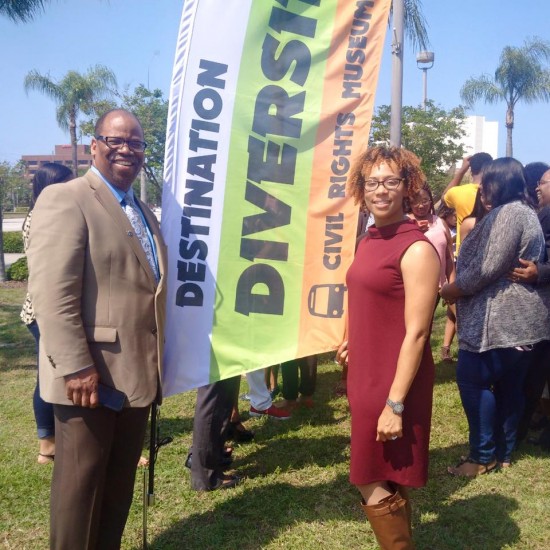
Well that’s a wrap! After 10 days, 4 states, 5 speakers, hundreds of students, and thousands of miles, the Destination Diversity tour has officially come to a close. I’ve had the best time meeting students all up and down the East Coast, hearing from some inspiring speakers about civil rights history, and being able to share my adventures with our Civil Rights Digital class in Florida and New York using Cisco TelePresence.

After our slight bump in the road on the way from Washington, DC to Greensboro, NC, the rest of the road trip went much more smoothly. The bus arrived safely at the Martin Luther King, Jr. Center for Nonviolent Social Change in Atlanta, Georgia. The guest speaker for that day’s class was Ms. Barbara A. Harrison, the King Center’s Director of External Partnerships. She worked with Coretta Scott King for over thirty years, so you can image how much history she had to share with our students!

Barbara Harrison speaking to students via the bus’s TelePresence system

Next stop: Tampa, Florida! It was a long drive – 12 hours – but totally worth it. The bus arrived in Florida right on schedule, giving Jefferson High School’s 1,700+ students a chance to check out the Civil Rights Museum on Wheels.

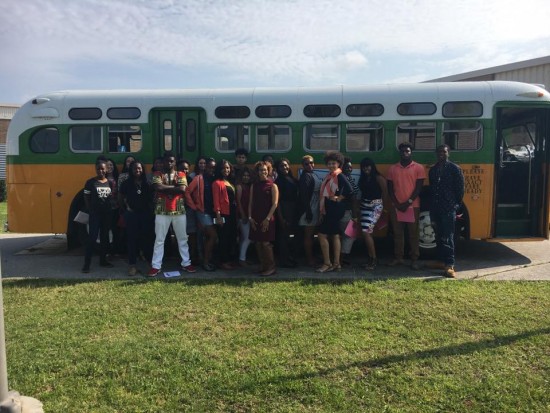
Hillsborough students pose outside the bus.

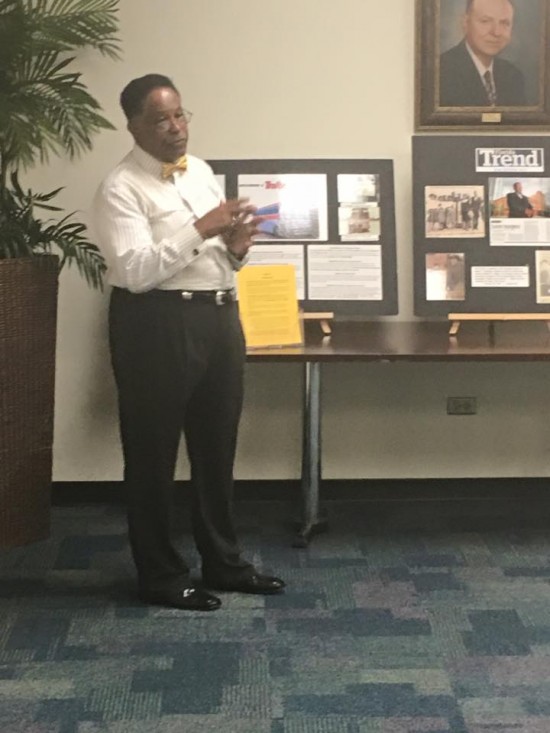
Our class that day featured one of my favorite guest speakers yet, Mr. Clarence Fort. When he was just a teenager, he refused to give up his seat at segregated lunch counters in Tampa. Later in life he would become a respected county law enforcement officer. Talk about an inspiring story!

Clarence Fort speaking in Tampa, Florida.

I had the best time on the trip, and I think the students did too. They were able to learn so much more about the civil rights movement through both the speakers and the bus itself, and I was able to showcase just how amazing technology can be as an educational tool. Special thanks to everyone who helped make the tour possible, and everyone else who was part of Destination Diversity at any stop along the way!

Me and Ivy, from Hillsborough schools.

While we did make it successfully to Florida, our journey has only just begun. So like us on Facebook, follow us on Twitter, and be sure to check out our website to continue to follow along. See you soon!

Authors

Van Henri White

School Board President

Rochester City School District

Avatar

“Technology must be like oxygen: ubiquitous, necessary and invisible.”

– Chris Lehmann

Most companies view technology this way. Crucial to survival, technology powers growth and enables people to do great things. Getting to a place where technology is ubiquitous, necessary, and invisible is no easy feat. Obviously, it requires great technology. But, technology alone can’t solve problems or achieve amazing things.

Organizations need to bridge the gap between having great technology and using that technology in great ways. I help turn technology into outcomes you can care about.

I’m currently helping this bank think through using real time communication tools to help customers, removing the need to pick up the phone at all. These real time communication tools help improve other the overall banking experience, allowing the bank to move faster to approve loans and serve customers.

It’s easy to notice technology when it lets us to do amazing things, but technology becomes that much more noticeable when something goes wrong. I advised a large retailer to help ensure uptime within their distribution centers. For this specific retailer, if the technology failed in one distribution center they’d lose $500,000 in net profit every hour it was down. You could see why making sure they have technology that works was important to them.

I experienced the ubiquity of technology first hand when I travelled abroad to help advise companies in Europe. Traveling between offices meant my office (and the tools I needed to do my job) couldn’t be constrained between four walls. As I rode the train, my calls, meetings, and communication followed me.

AR48910

I’m amazed by what humans have been able to accomplish with technology and excited to see where technology will take us. I’m especially excited for advancements to come in areas like data science, business analytics, and the Internet of Things.

When we bridge the gap between technology and people, and make it invisible, ubiquitous, and necessary, we accomplish great things.

Authors

William Ho

Senior Advisor

Advisory Services

Avatar

#CiscoChampion Radio is a podcast series by Cisco Champions as technologists. Today we’re discussing VBrick with Cisco experts Patty Yan and Rob Morris.

Cisco Champion 2016Get the Podcast

  • Listen to this episode
  • Download this episode (right-click on the episode’s download button)
  • View this episode in iTunes

Cisco Guest
Patty Yan (@PattyYan8), Recording and Streaming Product Portfolio
Rob Morris, VBrick Technical Recording and Streaming

Cisco Champion Hosts
Sebastian Leuser (@sleuser), Systems Engineer
Brad Haynes (@gk_bradhaynes), Client Solutions Specialist

Moderator
Brandon Prebynski (@prebynski)

Continue reading “#CiscoChampion Radio, S3|Ep. 11: VBrick”

Avatar

By Michal Brenner, Marketing Manager, Service Provider Video Software and Solutions, Cisco

In the global digital revolution unfolding around us, the media broadcast segment is particularly well-stocked with opportunity. It’s well proven (time and time again!) that direct-to-consumer video delivery brings with it new levels of intimacy and invaluable insights about what viewers want — which correlate predictably with new revenue streams. It’s also well proven that the mission-critical shift from “traditional” infrastructure to IP, for video production and delivery, really does create flexibility, agility and operational efficiency.

But — and it’s a big “but”! – these changes in how video content is produced, delivered and monetized require a well-considered security strategy and comprehensive mindset. Why? Because an open, interconnected, IP and cloud-based environment, with all its benefits, exposes new and continuous threats. Worse, those threats hail from a ridiculously large and growing range of attack vectors. Some pirates gun for live streaming content, selling illegal services for a profit; others hack at Over-the-Top (OTT) apps and consumer devices. Still others muckrake the world’s data centers with distributed denial of service (DDoS), malware and ransomware attacks.

Indeed, the volume of risk spans the entire video value chain. It mandates close and continuous attention, to keep the business healthy. There’s just no way around it – doing business in the digital age requires holistic thinking about security.

And why is Cisco blogging about this, during this week of the National Association of Broadcasters convention? (Hint: It’s definitely coincidental.) It’s because we want to make sure that the world’s video/media ecosystem knows that we’re resourced and ready to be a solid and end-to-end security partner.

And what qualifies us for this heavy challenge, you ask? Let’s start with technology. We represent unmatched breadth and depth in both video and infrastructure security solutions, so you can get all you need from one vendor. No need for an endless mixing and matching of point products that invariably result in security gaps. With Cisco, you are protected by the #1 in data center security and the #1 in video security. And we see it as our ongoing mission to protect our customers’ evolving IT, media, and video broadcast networks and stay up to date against the latest threats.

What’s happening on this inside of this mission here at Cisco, for video content and service protection, is this: Our longstanding leadership in broadcast TV security is now being applied to the worlds of multiscreen and OTT. Proof points: We have the longest “unhacked” track record in the market — going on 14 years — with our field-proven VideoGuard Everywhere conditional access (CA), and multi-DRM-based protection solutions. Thanks to our experience with market leading customers, VideoGuard Everywhere can today enable premium experiences, with support for additional consumer devices and advanced service features — while ensuring that our security remains robust, and with a design that reduces deployment and operational costs.

More proof points: Our anti-piracy solutions span multiple technologies, like web monitoring, fingerprinting and watermarking. We also tie in advanced capabilities like analytics and data science, combining different elements into solid solutions so as to help our media and service provider customers combat all stripes of video piracy. And, our infrastructure security offering uses a multilayered approach, to ensure that your content, services and business are protected from advanced cyber threats – read more in Sam Rastogi’s blog which speaks to recent and now infamous cyber attacks, and how they can be avoided.

What’s emerging, as the worlds of media and IP converge, is the need for combined expertise — equal parts video, and IT infrastructure. At Cisco, we get that. We’re acting on it, continuously. We’re building the innovations that combine security elements from different disciplines to give our customers better protection – for example, using DRM technology to strengthen the security of sensitive data residing in your infrastructure, be it pre-released video content, the scripts and storyboards for your next big hit, or high-value subscriber data – at the individual asset level.

But technology isn’t enough in itself to achieve robust security. Intelligence is just as important. It’s kind of hard to solve for threats you don’t know about, for instance. At Cisco, “mission-critical” is synonymous with knowing how pirates pirate, and how hackers hack, so that our customers can stay (at least!) one step ahead. That’s why we fund top-notch and in-house global research teams focused on operational security and cyber security, who advise our customers on security threats and countermeasures. Pre-emptively, our security engineers interpret the intelligence, to build better technology.

So: Technology + intelligence can combine to make highly effective security. However, here’s this from the Department of Lots Of Experience: Help is usually needed to determine the optimal security solution, and to deploy it. That’s why Cisco offers a range of services that ease security implementation, so that you can focus less on security and more on your business. We work with you assess your infrastructure, then “right size” the best solution for your business.

You could take my word for it, sure. Or, you could take our customers’ word for it! Security being security, and blogs being blogs, we can’t list them all. But check out our work with Sky, for instance, and British Telecom — two cutting-edge customers who chose us to help them secure their business initiatives. We are grateful and motivated to keep them (and their customers) safe and secure!

And this ends my soliloquy on the super-important intersections of security and video/media. I thank you for indulging me. In closing, two questions: Is your media business secure? Are you sure? 😉 Let’s talk … we’ll be at booth Upper South Hall, #8502, or visit us at #NABShow for a discussion. Here’s a link to our website, too, to learn more.

https://www.youtube.com/watch?v=Log1FfjM7e0

Authors

George Tupy

Market Manager

Service Provider, Video Solutions

Avatar

Today’s Guest Blog comes to us courtesy of Adam Burke, Vice President of Partnerships at Quest.

Adam Burke Quest headshotTechnology is here to help you run your company. But as that technology becomes more complex, it’s easy to lose sight of what you’re trying to achieve as a business. So what’s the secret to getting the most out of your network?
Don’t invest in technology. Invest in capabilities.

This is possible with hybrid networks that leverage on-premise equipment and public cloud resources. Hybrid networks give you the flexibility and scalability to build out your network capabilities quickly and easily while minimizing your capital investment. Here at Quest, we’ve been helping clients manage their technology for over 30 years. As an IT company, we have the tools and experience to help you extend your capabilities far beyond the limits of your data center:

Quest Guest Blog image

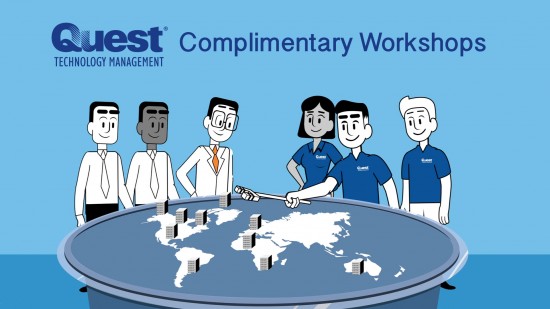
Assessment Services: Not sure how to proceed? Quest offers a number of different Assessment Workshops to help you determine the current state of your company, where you need to go, and how you can get there. For example, our Security Workshop identifies your current security vulnerabilities and how to shore them up through a threat-centric approach to security, facilitated by Cisco next-generation technology. Similarly, our Disaster Recovery Workshop assesses your company’s preparedness and how you can strengthen weaknesses to minimize the impact of a disaster or disruption to your business continuity.

Cloud and Managed Services: Quest was one of the first companies to offer Cisco Powered services in Private, Public and Hybrid delivery options. Today we offer a powerful combination of Cisco Powered services, including IaaS, DaaS, and DRaaS. We’ve continued to evolve our services and are now also one of the leading providers and integrators for the Cisco Cloud Architecture for the Microsoft Cloud Platform.

Professional Services: Need to figure out how to implement a specific application? Our internal application development team can work with you to build exactly what you need. We can even help with augmenting your IT staff.

At Quest, we believe in taking a company-wide approach to your network. The impact of IT affects the entire company. After all, the best security and disaster recovery plans won’t work if the people they are protecting won’t work with them. This means the right stakeholders need to be part of the process of determining how to get the most out of your network.

“Quest is fundamentally different from its competitors.” That’s what Mike Perusse, CTO/CIO of MegaPath, had to say when his company turned to Quest to help them move to the cloud. Perusse acknowledged that a managed cloud environment could deliver savings of at least 20% as MegaPath evolved into three separate businesses. “Quest evaluates your business – your goals, strengths, and weaknesses – and then responds based on what you need, not based on what they offer.”

Discover all the different ways Quest can help your business adapt and thrive with evolving technology through our online Playbook. You can also learn more about each of our Quest Workshops by contacting programs@questsys.com.


Adam joined Quest in 2010 with the charter to expand the Quest Partner Program and channel sales organization which is a primary pillar of Quests national growth strategy. The program has since grown to over 200+ ecosystem partners providing cloud and managed services to help customers design and implement IT solutions to meet their business needs. Prior to joining Quest, Adam was an Infantry Captain in the United States Army whose military experience includes Airborne, Ranger and combat leadership experience with the 101st Airborne Division. Adam holds a BS in Economics from UC Davis.

Authors

Xander Uyleman

Senior Manager

Global Partner Marketing

Avatar

At Cisco, we are continuously working with our Enterprise and Service Provider customers on the  many issues they are facing with the transition to Cloud Native and Hyperscale in the datacenter. What we have discovered is that with  this transition, administrators are struggling with the the increasing complexity in the data center, policy, and data management areas.

This complexity is primarily driven by not just the modern application development stack (containers, orchestration, etc) but also the data management platform needs, especially around analytics to drive business intelligence and machine learning. As a result of this complexity, lots of snowflakes are being created by the application development teams and this increased the complexity of the data center operations.

Cisco started working on an open source project called Mantl about 2 years ago.  Mantl is a batteries included end to end solution for your microservices infrastructure. Mantl’s ethos is to focus a community around an end to end solution, not around an individual component; designed to solve business and team challenges, one glue, improved by the community, tested everywhere. We have worked very closely with Mesosphere because Apache Mesos is a critical component of the modern application development model with the large ecosystem of frameworks that have been developed in the community.

mesosmantl

We are very excited to be one of the 60+ innovative companies that are joining Mesosphere with the open-sourcing of DC/OS under ASL2.0 License announcement today. The evaluation of DC/OS has gone very well and we are excited to support this effort as Mantl and DC/OS make running containers in production easy.

Easy to Use

The installation and running of a production cluster is simple and well-documented. There are several “How-To” step by step guides provided for easy startup. We have discovered with Mantl that by getting the entire microservices architecture up and running quickly and glue-lessly,  developers can focus on their code which results in a continuous innovation and experimentation lifecycle. Additionally, with the flexibility and extensibility, there is no reason not to try new frameworks and services.

Solves Real Problems
This is not just about getting a cluster up and running with DC/OS, the result is something more tangible, where getting the cluster up and running is just the first step but not the last step. The goal here is to enable developers to focus on continuously producing code that produces business outcomes desired while enabling data center operators to reduce the complexity and improve the network, security, and policy governance for the business.  We have the following use cases today:

  • IoT: Manufacturing organizations are leveraging Mantl to enable fog computing with integrated data management to produce business outcomes.
  • Finance: Large banks are taking advantage of the microservice architecture Mantl enables to spread risk across multiple services and maintain high performance, quality, and enhanced security with the continuous deployment capabilities they are realizing.
  • Cloud Native Transformation: Mantl’s main use case today is enabling the cloud native transformation in the enterprise since it provides an end to end solution designed to solve business and team challenges in a cloud framework agnostic way.

Complete Solution
Cisco is excited to be part of the DC/OS launch as we have seen that together, Mantl with DC/OS provides everything you need, ready to run, out of the box. This isn’t crippleware. And because it is based on Mesos, it is battle-hardened. This is critical for the success of your business. Re-learning lessons that have already been learned by the community does you no good.

Stay tuned to DC/OS and Cisco Mantl as we approach Mesoscon and Dockercon to get access to early previews and more!

Authors

Kenneth Owens

Chief Technical Officer, Cloud Infrastructure Services