Avatar

This blog post was guest-written by Kimberly Bowman, Marketing and Communications 1c8bbd6Specialist, Cisco Community Relations.

It is the start of the annual holiday season. In the United States, we have a day for getting deals (Black Friday), a day to support local businesses (Small Business Saturday), and a day to buy goodies while shopping online (Cyber Monday).

Then, we have #GivingTuesday — celebrated annually the first Tuesday after the Thanksgiving holiday — a day for “doing good” through the power of social media and collaboration. In its fifth year, #GivingTuesday is becoming a global phenomenon among philanthropists and techies alike.

In a day and age where social media allows you to connect with old and new friends, give updates on daily routines, and keep tabs on your favorite celebrities, Cisco will use that power to “do good” on #GivingTuesday.

As part of our Be the Bridge: Annual Giving Campaign, we will use our corporate social media handles on Twitter, Instagram, Facebook and Snapchat to highlight the good work of over 20 of Cisco’s nonprofit community partners in local communities around the world. We’ll be providing our employees and our social media following the opportunity to “Be the Bridge” to these organizations.
BTB 2016

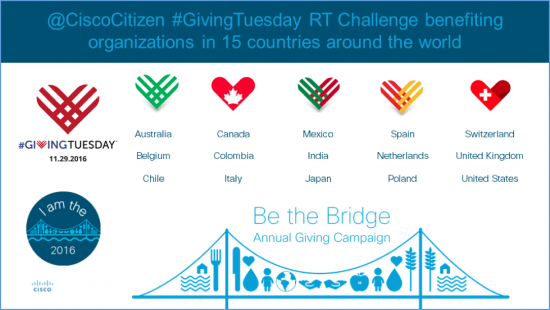
Starting with Australia, moving from East to West and ending in the US, we’ll release a tweet acknowledging the donations from our employees around the world. For every retweet, whether it’s from an employee or anyone else on Twitter, we’ll donate an additional $1 to those organizations, up to $10,000 (aggregate total contribution for all participating organizations). The retweet challenge closes at 6 p.m. local time in all markets.

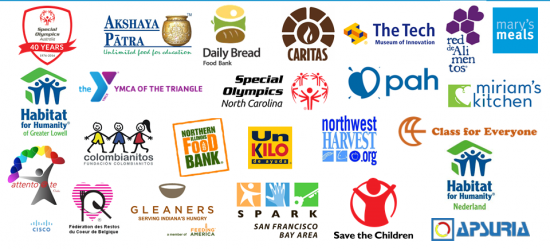
The locations listed below reflect areas where Cisco has a presence and employee base. The nonprofits were selected based on employee donation trends in the past, and a genuine need for amplification of the great work that happens in local communities around the world. If you retweet this blog post, we’ll split all funds generated equally among these 26 organizations!

Location

Organization

Australia  Special Olympics Australia – @SOAustralia
Belgium  Restos du coeur – @Restoducoeur
Canada  Daily Bread Food Bank – @DailyBreadTO 
Chile  Red de Alimentos – @RedAlimentos
Colombia  Colombianitos  – @colombianitos
India  Akshaya Patra – @AkshayaPatra
Italy  Attento a te – @AssAttentoAte
Japan  Class for Everyone – @class4every1
Mexico  Un Kilo de Ayuda A.C. – @Unkilodeayuda
Netherlands  Habitat Nederland @HabitatNL
Poland  Polish Humanitarian Action (Polska Akcja Humanitarna) – @PAH_org
Spain  Apsuria (Fundacion Apsuria) – @apsuriafunda
Switzerland  Save the Children Switzerland – @STC_Schweiz
United Kingdom  Mary’s Meals – @MarysMeals

U.S. Location

Organization

Austin, Texas  Caritas of Austin – @caritasofaustin
Carmel, Indiana  Gleaners Foodbank – @GleanersFBIndy
Chicago, Illinois  Northern Illinois Food Bank – @ILfoodbank
D.C. Metro  Miriam’s Kitchen – @miriamskitchen
Greater Atlanta, Georgia  Partnership Against Domestic Violence  @PADVAtlanta
Greater Atlanta, Georgia  Atlanta Community Food Bank @ACFB
RTP, North Carolina  Special Olympics North Carolina – @SONC_BeAFan
RTP, North Carolina  YMCA of the Triangle – @YMCATriangle
Boxborough, Massachusetts  Habitat for Humanity of Greater Lowell – @LowellHabitat
San Jose, California  Spark Mentoring Program – @SparkProgramSF 
San Jose, California  The Tech Museum of Innovation – @TheTechMuseum
Seattle, Washington  Northwest Harvest – E.M.M. – @NWHarvest

Now through December 16, we hope to inspire thousands of employees worldwide to support the cause of their choice, and together, raise more than $5 million in donations and matching funds through our Be the Bridge: Annual Giving Campaign.
Join us in spreading the word by using social media to let the world know how you are “being the bridge.” Share your stories by using the #BeTheBridge and #WeAreCisco hashtags and inspire others by posting to the Cisco CSR Facebook page.

If you’re a Cisco employee and want to donate or volunteer, visit our internal Annual Giving Campaign community and learn how you can start making a difference locally or globally today.

Authors

Austin Belisle

No Longer with Cisco

Avatar

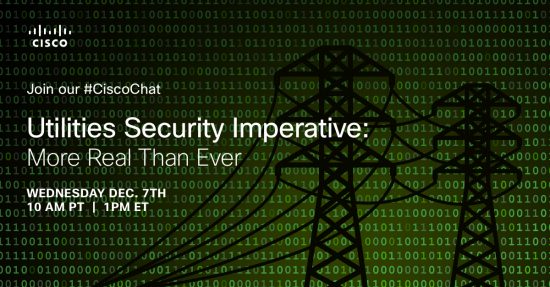
Utilities across the globe are telling us that cybersecurity risks and protecting data from intrusion and manipulation are among their highest concerns. To shed light on this critical topic, we are hosting a #CiscoChat to learn how utilities are approaching their cybersecurity strategies on Wednesday, December 7th at 10AM PDT/1PM EDT.

CSCQ316-2_Q3_CiscoChat-Dec7_Social_R5_LI-1200x627

I’ll be joining Patrick Miller, Edna Conway, Marc Blackmer, Eric Ehlers, Jon Judson, Jon Stanford, John Reno, and our moderator @Cisco_IoT as we discuss these questions:

  • What are the main threats that Utilities today face in cybersecurity?
  • How are Utilities addressing industrial cybersecurity challenges?
  • What levels of security have you applied to your substation control infrastructure?
  • How are utilities planning against attacks and vulnerabilities?
  • How can you mitigate risk introduced by the increasingly connected grid, IoT and IP-based sensors and assets, and the vulnerabilities introduced via the supply chain, your vendors, and customer endpoints?
  • Aside from technology, what else should utility companies be doing to manage risk?

How-to-enrol

  • Make sure you’re logged into your Twitter account
  • Go to Twitter and search for the #CiscoChat hashtag using the search bar on the upper right side of the page
  • Click on the “Live” tab in the middle of the page. and be sure to refresh this page to follow the conversation
  • Open a second window to the Twitter homepage to create your responses to the chat
  • The Chat moderator @CiscoIoT will begin welcoming guests at 10AM PDT/1PM EDT and will start questions after intros are done. Introduce yourself to us and the other attendees! Funny memes and photos from the event are encouraged
  • Be sure to use the #CiscoChat hashtag at the end of each tweet, so that others can find your contributions to the discussion. Refresh the page over the course of the chat to see all the responses
  • Preface each tweet with “1A, 2A,” etc. in order to make it easier for others to follow along with the conversation
  • For @ replies to specific participants in the discussion, please use a “.@” at the beginning of the tweet, so that your question or comment will appear in your public twitter feed
  • Prepare any links or images you want to share during the discussion in advance of the chat

Feel free to bring your own questions to the discussion as well. See you there!

Follow us at @CiscoIoT and view our past Ciscochats here and here.

Authors

Jon Judson

Marketing Manager

Industry Marketing

Avatar

This post authored by Nick Biasini and Edmund Brumaghin with contributions from Sean Baird and Andrew Windsor.

Executive Summary

Talos is continuously analyzing email based malware always looking at how adversaries change and the new techniques that are being added on an almost constant basis. Recently we noticed some novel ways that adversaries are leveraging Google and Tor2Web proxies to spread a ransomware variant, Cerber 5.0.1.

This particular campaign looks to have started on November 24th and has been ongoing for the past several days. This campaign did not use advanced techniques that we sometimes see used by adversaries that include well written, professional looking emails, with legitimate signature blocks or other identifying characteristics. In this campaign, the emails were anything but professional. However, they did vary significantly with what we typically see from a ransomware distribution perspective.

Today, spam based ransomware infections are heavily skewed toward Locky. The majority of spam messages we see today are affiliates producing large amounts of spam that leverage various types of script-based file extensions to download the Locky executable and infect systems. This campaign looked different in that the messages didn’t contain an attachment and were extremely short and basic. What we found was a potential next evolution for ransomware distribution that relies more heavily on Tor to obfuscate their activity and hinder the ability to shut down servers that are hosting the malicious content.

Read More >>

Authors

Talos Group

Talos Security Intelligence & Research Group

Avatar

The Chinese calendar calls 2016 the year of the monkey, but looking back on our industry these past 11 months, I would call it the year of the customer. Why? Because as digital disruption takes hold and transforms the way we do business, the most important reality we all need to accept is that the customer is in the driver’s seat today.

Digitization and transition to a subscription-based business model is one that requires a shift in strategy – one that is focused on the customer journey and on driving loyalty after the initial point of sale. Evolving our business practices and knowing how to best engage with the customer, empower them, and of course, sell to them, is essential if we’re to stand out from the pack. And that, in a nutshell, has been the focus of our Customer Success Talk webinar series, which was launched this year. If you missed it, you can catch highlights from episode 1 of the series below and see a business case for post-sale lifecycle management and Customer Success as a critically important strategy and revenue generator in today’s IT industry.

https://youtu.be/gIEJ9jxTl44

Customer Success Talk Rewind: Get caught up on what you’ve missed. Watch highlights of all 2016 sessions.

We’re On a Shared Journey

At Cisco, we’re evolving and innovating across our entire organization, and because partners are so central to our business, we want to share what we’ve learned about the changing IT landscape with you. This past year at Cisco we’ve stood up a powerful combination of people, process, platforms, content and analytics — an entire movement focused on continuously delivering value to the customer throughout the relationship. We’ve set our sights on helping our partners do the same and evolve their customer success practices along with us.

As you put your 2017 business plans in motion, I invite you to check out the Customer Success Talk webinar series or visit our growing library of Customer Success resources within SuccessHub. The goal is to help you build your own customer success practice—because we’re on a shared journey and Cisco is moving “full speed” to help you create customers for life!

Authors

Scott Brown

Senior Vice President

Global Virtual Sales & Customer Success

Avatar

Responsible disclosure of vulnerabilities is a key aspect of security research. Often, the difficulty in responsible disclosure is balancing competing interests – assisting a vendor with patching their product and notifying the general public to prevent a 0-day situation. It is uncomfortable to acknowledge that if a white hat team has discovered a vulnerability in a high value target, it stands to reason their adversaries may also be trying to exploit the same issue. Researchers must carefully balance the needs and capabilities of vendors to fix a product with the safety and security of our customers and the community as a whole.

Talos has been measuring the timelines, industry responsiveness, and end results with regard to our responsible disclosure policy and today, we are announcing a few changes. The full text of the Vendor Vulnerability Reporting and Disclosure Policy can be found here:

http://www.cisco.com/c/en/us/about/security-center/vendor-vulnerability-policy.html. These changes include timeline adjustments based on vendor feedback and industry changes since we last addressed our Disclosure Policy.

Authors

Talos Group

Talos Security Intelligence & Research Group

Avatar

Tasked with answering the question of “Why is a Remote PHY Architecture is better than a Remote MAC/PHY architecture” it would be prudent to articulate first what advantages Remote PHY has to offer over other proprietary solutions and let the readers draw their own conclusion. Let’s first call out immediately that the only ratified specification for DAA (Digital Access Architecture) is that of “Remote PHY”, whereas Remote MAC/PHY is classed as a “Technical Recommendation.” That immediately should raise some concerns about how a “technical recommendation” can be interpreted differently by vendors and silicon manufactures alike. The whole remit around standardisation is to drive interoperability and cost effectiveness with a standard, however, that advantage is diminished for the MSO with no more than a suite of guidelines and recommendations.

So what exactly is Remote PHY trying to solve for the MSO that its contemporaries cannot.

Let’s break some of the key advantages out for discussion.

A20423x01F-2

  1. The point about Standards vs Proprietary is already made, but the first advantage of R-PHY would be the independent scaling between the MAC and the PHY layer. Scaling these individually immediately adds a cost benefit to the MSO. In contrast a combined MAC/PHY concept with some future forecast bandwidth requirement would necessitate the need to provision from day one “full capacity” for the MAC. A MSO having a view to potentially scale to 10G per SG would actually mean provisioning that initial 10G, even though the immediate aggregate requirement would be far less at time of deployment. The question of stranded capex is brought in to question with a MC/PHY approach.
  2.  Centralizing the Software to the CCAP Core has the effect of amortising the costs and efficiencies across multiple RPD’s. Any ECN’s or updates to the DOCSIS MAC can be effected immediately in a more effective manner. Yet it is noted that even in a MAC/PHY with the aid of a “pseudo” Virtualisation of the nodes, that automation for upgrades can be achieved, however I see this as counterintuitive to the fact that one of the key drivers for Remote Phy DAA was to simplify the network and have as few as complex elements as possible external to the CCAP core. Centralizing the SW also adds for a more effective way of adding not only additional MAC capacity mentioned above but also scaling out the DOCSIS Scheduler. In a DOCSIS 3.0 world the CPU impact on the DOCSIS scheduler is proportional to the data rate, in a full spectrum DOCSIS 3.1 world the full the absolute impact on the scheduler is not known thus like above, to minimize unnecessary field upgrades to MAC/PHY nodes, a centralized SW construct offers a greater advantage.
  3.  A consistent architecture for all services is something that a MSO take for granted to drive for. Remote PHY offers exactly that. It uses the same protocols for DOCSIS, Video and OOB; Think of the Remote PHY protocol as a pseudo wire manager able to support multiple services over a common architecture. Makes sense right? Then what would be the compelling reason to shift away from that level of simplicity to add further complexity to an already “siloed” solution for Video, DOCSIS and OOB and use R-PHY for Video and R-CCAP for a DOCSIS.
  4.  Maybe contrary to popular belief, but Remote PHY should be considered as a natural evolution to the existing CMTS architectures for Cable. DMPI (DOCSIS MAC –PHY interface) gave us the Silicon to silicon interface on a line card, M-CMTS took that a further stage by remoting the DS element on an Edge QAM whilst Remote PHY completed the evolution by providing both DS and US remote PHY elements. So in my mind, given the fact that the intellectual property has been developed over the past decade (2000 for DMPI and 2005 for DEPI) I am inclined to favour an established suite of protocols and interfaces rather than going through revolution of architecting the MSO to adapt a “split R-MAC/PHY software model” and the pain that goes with the initial deployments.
  5. It’s stated that a MAC/PHY approach is common with other technologies and not a new concept in the Networking and Telecoms industry. Yet opinions would suggest that it is a rear view perspective of where Networks have been previously architected yet with “Virtualisation of Networks” a new approach of Centralised Software and a simple Remote Hardware is required. To support the above comments I subscribe to the notion that it’s not just CCAP/CMTS that will adopt a “centralised Software” with Remote Hardware to facilitate “True Virtualisation”, technologies used in the Mobile , PTT and OTT space will also adopted  the same approach and subscribing to the same approach. I fear the case made for Remote MAC/PHY may meet some of the immediate objectives but has little life expectancy for true NFV if both MAC and PHY are remoted.
  6. With the simplicity requirements of the (RPD) Remote PHY Device, it will be possible to reduce the implementation down to a single piece of silicon. This silicon could be located deep in the network at a tap location and convert from a FTTC plant back to an HFC plant in order to maintain backwards compatibility with existing CM and STB but in the same time adds a platform for support of new and emerging developments within DOCSIS. A simple end point to facilitate Fiber to the Curb and DOCSIS to the home with potential for DOCSIS EFR (Extended Frequency Range) DOCSIS FDX (Full Duplex DOCSIS) R-MACPHY and R-CCAP have too complex of an end point design that will not provide them the evolution velocity, and same reduction on power and cost. Do you really want an entire CMTS at the curb?
  7.  Last, but certainly not exhaustive of items to compare but industry acceptance is always key. There is an abundant of silicon talent in the industry that can design a PHY chip. It however requires a different skill set and more investment to get the MAC right. A number of prominent Silicon, manufactures, MSO’s and vendors have endorsed the Remote PHY architecture and are building towards a common DAA goal. This in turn will lead to a greater level of innovation and ultimately cost effectiveness which as I mentioned above is one key attribute of driving a common standard.

With Vendors moving ahead with expediency to bring to market RPD’s (Remote Phy devices) in multiple guises and support from silicon manufacturers engaged in the standards and product initiatives, the momentum for Remote PHY as a DAA architecture of choice is overwhelming.

In parallel MSO’s are adapting strategies to leverage the deep fibre Remote Phy deployment to augment current capacity needs as well as a springboard to future “Virtualisation of the Core CCAP elements.

To learn more, visit the Cisco CCAP page.

Save

Authors

Daniel Etman

Product Marketing Director

Cisco's Cable Access Business

Avatar

Shrouded bards of other lands, you may rest, you have done your work, Soon I hear you coming warbling, soon you rise and tramp amid us,Pioneers! O pioneers! – Walt Whitman, “Pioneers! O Pioneers!” 

There’s a certain irony to looking to a 19th century poem as a sort of battle cry of the age-old tug-of-war that exists in any multi-generational organization. That said, this comparison is a perfect metaphor for how we should be looking at learning in today’s corporate environments.  Stay with me here.

Published in 1865 as part of Walt Whitman’s poetry anthology, Leaves of Grass, “Pioneers! O Pioneers!” was written as a sort of tribute to the great westward expansion that had taken over the U.S. This was a time of the California Gold Rush, of Conestoga wagons and pioneers traversing a new frontier. Similarly, we are now exploring a new frontier in learning. We have the most multigenerational workforce we’ve ever seen, and technology is advancing at a breakneck pace. Even the basic fundamentals of where and how we work have changed – for instance, the latest Global Workplace Analytics report found that some 3.7 million U.S. employees work from home (or in other non-office settings) at least part of the time. That’s roughly 2.8 percent of the workforce, but that number is rapidly growing.

While technology, and the where and how of work is changing, organizational learning isn’t always evolving as rapidly. A sort of generational hierarchy still pervades the structure of many organizations. Younger employees are constantly being told they can from their more senior peers, but the truth is, that this knowledge exchange should go both ways – and organizations need to recognize this in order to thrive. The old ways of doing things aren’t always better, and when it comes to learning, there’s a strong case to be made for what’s called reverse mentoring. In other words, just as older people can teach younger people, the opposite is also true.

AS43242 (1)

Crafting the workplace for a new generation

Millennials have grown up in a different era, and require new and different types of learning.

A report by PWC, “Millennials at Work,” found that 35 percent of respondents said they were attracted to employers who offer excellent training and development programs so they can be continuously learning.

Employers must carefully consider how training and development should be structured for this generation.

Take the example of one of the very first mainstream learning apps – it was called iLecture and it was pretty much a virtual lecture hall. This is not going to fly in today’s business world. There’s a difference between dreaming something up and just digitizing what already exists – and for millennials, also sometimes called digital natives, there’s a higher propensity for them to pursue this. This generation has grown up with so much more advanced technology that the staid old videotapes of a traditional classroom setting aren’t going to work.

Today’s workforce demands training that fits the employees’ needs, rather than a system that requires employees to adjust to the training methods. This includes providing social and mobile content that can be accessed any place, any time and in real-time. It includes building in newer technologies that promote active engagement as opposed to passive engagement, incorporating interactive components and peer-to-peer sharing.

By requiring something new, a different approach, millennials have the opportunity to help drive overall engagement in learning. Improving your organization’s ability to provide employees with timely and useful coaching isn’t just a benefit to millennial workers, but to the entire staff.

The efforts of those who have come before us is much appreciated, but now it’s time for a new generation of workers to build the learning organization of our future. In other words, shrouded bards, your work is done and the torch can be passed.

Authors

Ryan Rose

Director of Product Management for Skills & Certifications

Cisco Learning & Certifications

Avatar

Digitization is critical for businesses everywhere – and the opportunity for service provides lies in their ability to enable it. This is why it requires a new approach to networking that is simpler, more efficient, and enables carriers to grow their business.

See for yourself…

  • Global IP traffic will triple in the next five years,
  • While mobile traffic will explode by 10 by 2019
  • Additionally, 86% of IT services will be hosted in multiple clouds.

As a networking leader, Cisco offers carrier solutions based on three key innovations in its Open Network Architecture.

These are telemetry and data analytics, programmable network elements – both physical and virtual, and Segment Routing.

How do they work together?

Telemetry and analytics is about knowing, in real-time, what is happening in the network and being able to act on it.  Maybe it’s about re-routing traffic around congestion before it happens to keep your customers happy.

Programmability means that automated processes can now change and configure the network without manual control. Whether it’s about adding a new service, or running a virtualized assurance application programmability is about making software defined networking a reality.

Segment Routing – an industry standard led by Cisco ensures that an application can now tell the network what it needs to work in a seamless and scalable manner.  For example, financial data between two banks will require low latency and highly available performance and can be guided as a high-priority flow in the most effective way – without manual configuration.

These three components are available in the Cisco IOS-XR operating system.

The result is a network constantly adapting to ensure optimal transport of customer data, already demonstrating their effectiveness among major operators:

  • 52% lower  TCO (blended)
  • 54% higher – operational efficiency through automation
  • 49% of transport costs across data center and WAN convergence

Together, let’s build the most innovative network….

Learn more about Cisco Evolved Programmable Networks here or get more Expert point of view on this topic.

Authors

Greg Smith

Sr. Manager, Marketing

Cisco Solutions Marketing

Avatar

Since CloudCenter makes it easy to add AWS to your data center-based hybrid cloud service offerings, and automate deploy and manage of applications, I thought a “Top 10” list was in order.

Register for the Dec 15th live demo webinar that will highlight these features.

CloudCenter is an application-centric hybrid cloud management solution. It lets you build on your Cisco infrastructure foundation, and extend application deployment and management capabilities to include public clouds like AWS.  Most enterprise IT organizations I work with already have experience with a public cloud like AWS. And, are now looking to broker multiple public cloud services to IT consumers. CloudCenter has a significant TCO advantage over hybrid-cloud or multi-cloud solutions that are environment specific or use hard-wired automation.

CloudCenter integrates seamlessly with AWS and “Abstracts the cloud” so developers and users get the power of automated application deployment and management, without having to understand AWS API calls.

1 – Deploy a virtual machine on demand. Easily integrate with service catalogs such as ServiceNow or Cisco Prime Service Catalog, a custom IT front end, or use the out-of-the-box enterprise marketplace. Give your IT consumer self-service on demand “One click” deploy an OS image with CPU and memory to user’s choice of regions, Virtual Private Cloud (VPC), and availability zone. The IT organization centrally controls who, what, where, when and for how long OS images are deployed. You can track costs and usage with roll-up or drill down reporting by application, cloud account, user group, and more.

2 – Manage images in multiple regions. Automate management of OS images across multiple AWS regions. Whether you build cloud specific images, check out and harden an Amazon provided AMI, or rent vendor updated images, a simple CloudCenter API call updates logical to physical OS image mapping to simplify maintenance, and make sure users are always consuming the latest IT approved OS images.

3 – Deploy any application stack on demand. Users can self-service deploy a fully configured infrastructure and application stack, including databases, middleware, application and web servers, and load balancers. CloudCenter automates deployment of existing enterprise applications or cloud-native micro service architectures. You get cloud-scale features with traditional applications without refactoring or changing application code. And you get full flexibility with composite topologies including a mix of OS images, application services, containers, configuration tools, and unique AWS services.

4 – Automate Continuous Deployment. Did you know you can deploy from Jenkins to any data center or cloud with one CloudCenter plugin? A code change can trigger a build which then triggers a deploy of a full stack environment including the latest build. CloudCenter makes it easy with a Jenkins plugin, and simple API call integration with other popular build automation tools. And CloudCenter abstracts the cloud so your developers don’t have to spend time learning cloud specific API calls, or writing hard-coded scripts for different AWS regions and availability zones.

5 – Auto scale across availability zones. You need to deploy applications in multiple AWS availability zones in order to get AWS 99.995% uptime guarantee. You can deploy master and slave components in different availability zones and autoscale across them both. You don’t need complex scripting in a cloud formation template. You don’t need deep knowledge about security groups or network Access Control Lists (ACL). CloudCenter makes it easy.

6 – Migrate across regions. You can use powerful migration features to move an application from one AWS region to another. Once an application is deployed, users can select an application, pick target region, and “one click” migrate the application and optionally the data if needed.

7 – Automate micro-segmentation. When a cloud agnostic Application Profile is deployed in AWS, CloudCenter automates creation of Security Groups and Access Control Lists that deliver micro-segmentation with white list communication. You can easily deploy and manage a large number of applications without using shared segmentation that opens security risk of East-West traffic.

8 – Including AWS specific services. In general, we recommend you use cloud-agnostic services to model Application Profiles to a single profile that can be deployed to data center, AWS, and other clouds. That is key to lower hybrid cloud TCO. But you also have the choice to model AWS-specific services as part of an application profile, or use call outs to call unique AWS services when needed.

9 – Benchmark price and performance. Compare price performance metrics to determine when AWS is the most cost effective choice. Or determine price differences between AWS regions. Performance across regions shouldn’t vary. But, price in different regions can. Also, use benchmarking to find out when multiple small instances are more cost effective than one large.

10 – Stay in control. CloudCenter is an enterprise-class solution that includes governance and security features that meet the needs of the most demanding and complex IT organizations. Multiple AWS accounts? Multiple groups using a single AWS account? No problem. Control usage and get complete cost and usage visibility with policy-base guardrails that give users self-service on demand deployment, with IT oversight that help users make the right choices every time.

Register for the webinar to see CloudCenter and AWS in action!

Read the Datasheet – CloudCenter with Amazon Web Servies

Watch AWS re:Invent session Dev211: Automated DevOps and Continuous Delivery


Authors

Kurt Milne

Marketing Manager, US

CloudCenter Marketing