Avatar

It’s been a year since I wrote this blog detailing our software innovations aimed at helping Service Providers address the ever-increasing challenges imposed by digitization. IOS XR for cloud-scale networking has really taken flight since then and I am proud to share with you some highlights from the journey thus far.

Our strategy is essentially to simplify networking in terms of its operations, usage and ability to support more innovation.

That starts with the foundational layer – offering best Silicon choice that support fixed and modular form factors, the right silicon diversity across in-house and merchant silicon and flexibility of HW consumption with different scale points. So with this in mind, we built the best hardware that supports our innovation and delivers the right price/performance ratio.

I am particularly proud that this richness of portfolio does not come at the expense of feature sets and operational consistency. All these platforms are powered by a single, scalable software paradigm – IOS XR.

Cloud-scale enhancements to IOS XR – ruthless automation, visibility and control, simplification and open innovation – bring you significant operational improvements across your entire network infrastructure. We are thus able to offer customers the flexibility and agility to deploy the right hardware depending on their place in the network architecture.

In that respect, we’ve seen many customers embracing cloud-scale networking and using our equipment to satisfy different business contexts. From interconnecting data centers with highly-scalable routing platforms to dense 100G aggregation applications for content and caching infrastructure to transforming traditional central office with scaled-out infrastructure to support the virtualization of services.
IOS XR

XR’s model-driven programmability is built on data models that are expressed in a variety of YANG models – industry driven OpenConfig models as well as standards driven IETF models.  With a paradigm of any data model (Native, OpenConfig, IETF), any encoding (XML, JSON), and any transport (NetConf, RestConf, gRPC), our Operating System is very adaptive to your operational environment. In the last year, we have tripled the number of OpenConfig models we support and increased the number of XR native models by roughly 50%.  Furthermore, we introduced model-driven APIs to simplify the adoption of data models and made them available to the larger community as an open source project.  We are not stopping here.  We remain committed to offering the most comprehensive set of data models along with model-driven APIs and tools to accelerate the adoption of software automation.

Model-driven telemetry is another critical area we are furthering the agenda on. Telemetry exports critical state and statistics from your infrastructure. Model-driven telemetry does that many times faster than traditional monitoring technologies, providing deep insights into the real-time operation of the network.  The system is also fully configurable using telemetry YANG models. I would like to share an interesting customer use case: within two weeks of deploying model-driven telemetry in production, one customer turned off SNMP because they didn’t need it any longer! Model-driven telemetry provided the mission-critical network data at a higher frequency, in a more automation-friendly format, with less load on the network. With programmability and telemetry combined, the network definitely moves into a self-driving mode.

The final innovation I want to list is application hosting that gives customers a platform for leveraging their own tools and utilities. The transition of IOS-XR from 32-bit QNX to 64-bit Linux paved the way for better integration with industry-standard DevOps tools, furthering our goal to “automate everything”.  Support for containers in an LXC or Docker format along with the ability to run custom apps and scripts natively to manage the box, enabled our customers to be more flexible in the way they operationalize their network. Further, to deepen our ties with the Open Source DevOps community, we released support for configuration management tools like Ansible, Puppet and Chef, with more modules coming up in the future. As we release an IOS-XR vagrant box on a bi-weekly basis, we expect the developer community to grow even stronger and make IOS-XR the leading platform for DevOps integrations in the routing space. With the application hosting toolbox, customers can now truly extend the capabilities of their network infrastructure.

Fundamentally, I am proud of the work we have accomplished with XR and would like to thank every team member, customer and partner who has accompanied us on this journey. Cloud-scale Networking gives you the operational efficiency, flexibility and openness to equip your network for being a transformative engine for the digital age. We are pushing the limits of networking excellence and we invite you to join us on this journey.

For more information download this ebook.

Save

Save

Save

Save

Save

Save

Save

Save

Save

Save

Authors

Sumeet Arora

SVP Engineering

Core Software Group - US

Avatar

To celebrate the launch last week of my book, Building the Internet of Things, I am taking a short break from my current series on my “Recipe for IoT Success” to offer an excerpt from the book:

We are all aware of the environmental challenges facing both the developing and developed worlds. Polluted air in cities, lack of potable water, industrial waste, dirty and inefficient energy sources, to name a few. The good news is that the Internet of Things (IoT) is starting to help in many of these areas. Cities are deploying systems that monitor air quality and noise levels and can recommend actions as simple as regulating traffic and vehicle access to the city center. Governments and cities are installing tsunami, flood, earthquake, or wildfire warning systems. Select farmers from India, Sri Lanka, China, Kenya, South Africa, the United States, and Italy are already benefiting from smart irrigation systems that reduce water consumption, increase yields, and improve predictability of crops in the fields and in greenhouses. Several cities in California are using smart water meters to monitor and reduce water use by households during drought. We all know how much food is being wasted and spoiled during improper transportation and storage in both poor and rich countries. When entrepreneurs combine the power of IoT telematics and cloud-based systems with micro-payments and with modern supply chain best practices (replacing traditional and highly inefficient informal distribution networks), the resulting market structure transformation can dramatically reduce both spoilage and the cost of food to consumers.

AR35244

Entrepreneurs, governments, non-government organizations, enterprises, and research institutions are increasingly adapting IoT technologies to the realities and cost structures of the developing economies. A key to the success in these efforts has been not to blindly implement solutions from the developed world, but instead to identify specific issues or use cases particular to a given country or a region and to leverage IoT technologies combined with creative funding and business models to address them. As a result, potable water and air quality testing tools, animal protection, or deforestation control systems and even clean indoor cooking solutions are being piloted in Africa and Asia.

HFC00723In the spring of 2016, Germany reached the milestone of providing almost all of its energy needs from wind and solar power at least for part of the day. Portugal ran four days entirely on renewable power. Denmark set similar records. Wind power has increasingly been a key component of energy strategy for many countries driven by their carbon footprint and sustainable development initiatives. A wind farm is a perfect example of a sophisticated and highly complex IoT system in action that incorporates all four fast payback scenarios. It is a combination of sensors, predictive analytics, predictive maintenance, remote monitoring, fog, and cloud, plus a myriad of wind turbines connected into what functions as a single integrated organism tightly coupled with the power grid. Jorge Magalhaes, senior vice president of engineering and innovation at Vestas, one of the leading manufacturers of wind turbines, summed it up perfectly: “IoT allows us to not only combine but correlate multiple inputs such as weather and wind predictions, expected demand for electricity, current dynamic performance and usage of component and materials to make decisions ahead of time about how best/how hard to run which turbine in the system, when to plan and schedule maintenance when it is most economically viable.”

We are just getting started. From tsunami or wildfire warning, air pollution monitoring and prevention to smart agriculture, food management and safety and finally to clean energy, I am optimistic that IoT-based solutions can help address key environmental issues across the globe. The key to their success is that they make both economic sense and help the environment. However, it is critical that these technical solutions be both grounded in hyper-local business and cultural realities, as well as accompanied by business process and market structure innovations sorely needed in many countries.

Next week I’ll return to the “Recipe for IoT Success” series with Ingredient #3, focus on solving real problems.

Authors

Maciej Kranz

Vice President and General Manager

Corporate Strategic Innovation Group

Avatar

Cisco and Ansible HappyWe’ve talked about how Cisco is helping network operators leverage the tools of the data center to better manage the network. To show a real world example of this a few weeks back Cisco and Ansible teamed up for SDx Demo Friday. We showed how to manage large-scale networks using Cisco IOS XR application hosting infrastructure and Ansible version 2.2.
Cisco technical marketing engineer, Akshat Sharma, presented a demo to manage large-scale networks by using tools and insights pioneered in the datacenter to simplify network management.

The demonstration focuses on a real-world use case – that of a network operations professional responding to an alert. An issue is causing service degradation and is affecting a large number of routers.

Using the application hosting infrastructure available on IOS XR 6.1.1 and linux tools like iPerf he quickly troubleshoots the issue and resolves it on a pair of routers.

Next, Akshat uses Ansible, a tool that application and infrastructure owners use to orchestrate changes in the data center, and a set of playbooks developed by Cisco to manage network devices, to remediate the issue across a fleet of routers automatically to save time and reduce errors.

To see the full demonstration check out the demo here on SDx Demo Friday and you will see how:

  • Large scale networks require investment in DevOps workflows for efficient management
  • Integration for Linux tools and support for containers is imperative
  • Support for config management tools, such Ansible, is a pre-requisite for large scale deployments

Other resources on Application Hosting and hands-on resources are at @xrdocs on github. To learn more about using Ansible with Cisco IOS XR 6.1.1 see Cisco’s tutorial on github.

Besides the demo we’ve also got a webinar. Akshat recently co-hosted a Cisco Knowledge Network webinar on Cloud Scale Application Hosting, providing a primer on how Cisco IOS XR Application Hosting can benefit you.

What do you think? We’d love to hear from you on what you want for future demonstrations. Give your comments on this SDx Demo Friday Event and about our new IOS XR 6.1.1 Application Hosting software innovations.

Save

Authors

Gina Nienaber

Marketing Manager

SP Infrastructure

Avatar

Just over a year ago Cisco announced the general availability of APIC-EM (#APICEM), a software defined networking (SDN) platform for the enterprise branch, campus and WAN. In just over 12 months, we have seen over 1400 enterprise customers deploy APIC-EM in their production environments managing over 600,000 network devices and connecting over 1.5 million hosts! APIC-EM went on to win TechTarget’s Network Innovation Award and was a finalist for the Best of Interop SDN category.

Five months later in March 2016, Cisco launched its Digital Network Architecture (DNA) a strategy for enterprises looking to win against the competition by using new innovative technologies to transform their business. Cisco has aligned its Enterprise Networks product portfolio around the key pillars of DNA – Virtualization, Analytics, Automation and Management – the central component being Cisco APIC-EM.

apicem

Driven by the demand we are seeing in the market for SDN solutions, we have added a number of new applications and features that have enhanced customer value when using APIC-EM. Last month, Cisco released Version 1.3 of APIC-EM and while there is a long list of exciting new features some of the key highlights are:

  • General availability for EasyQoS, an end-to-end QoS management application.
  • Enhanced certificate authority management for greater security.
  • Faster branch deployments with the IWAN App that now supports ISRG2 routers.
  • Improved network assurance capabilities with Path Trace.
  • Expanded automation capabilities with Plug and Play (PnP).

Openness is a key mantra of DNA. In this latest release, we have also enhanced our API support. The APIC-EM APIs are published for anyone to use. If you would like a deeper dive into API support for release 1.3 you can learn more in this blog series from my co-worker Adam Radford a Cisco Distinguished Systems Engineer.

As IT moves faster to meet business demands, Cisco is moving as fast with an agile development process that enables us to deliver customer driven features faster than ever. Don’t believe us? Brian McEvoy, Sr. Network Engineer at Symantec has seen the following benefit of APIC-EM,

QoS rollouts were once 6-month projects costing over $200K. With Cisco APIC-EM EasyQoS, we will go from months to minutes with nominal costs.”

Get started on your digital journey today by downloading APIC-EM free of charge from here and start laying the foundation to your digital transformation today.

Authors

Kiran Ghodgaonkar

Senior Manager, Enterprise Marketing

Intent-based Networking Group

Avatar

What if the world’s leading mobile devices communicated at a deeper, more trusting level with the world’s leading corporate networks? That was the question that Apple and Cisco asked themselves when they announced their new partnership last year.

Their answer: a faster, more engaging user experience for iPhone and iPad users on a Cisco Wireless network.

Over the last year, engineers at Apple and Cisco worked tirelessly, tweaking the existing standards to tackle two very important aspects of enterprise mobility: optimized Wi-Fi roaming and prioritized business applications.

When I decided to cover these innovations on TechWiseTV, I went over to building 23 on Cisco’s San Jose campus where this tight-knit group of engineers had been holed up.   This is where they continued to relentlessly test every combination of load, app, and scenario that a Cisco customer could possibly encounter.  I always assumed this kind of thing happened…but it was good to see the depth of scenario testing being done.  

https://www.youtube.com/watch?v=HISzB4luGAI

To fully appreciate what these two industry leaders have accomplished, I thought it would be helpful to pull back the covers a bit, and level set on how things are usually done.  This can help highlight where and how these tweaks can improve your own enterprise experience:

Optimized Wi-Fi Roaming

Mobile isn’t mobile if you can’t work with the  same level of confidence you have with the hardwired network.   Cellular signals inside buildings can often be inconsistent, and when it comes to real-time voice and video, Wi-Fi roaming has its challenges.   

Simply walking across the office will usually involve a number of challenging hand-offs.  The transition from one access point (AP) to another involves the exchanging of several keys. And while fast, that negotiation can often take longer than the 50ms threshold required for high voice quality.

The 802.11r roaming standard goes a long way toward speeding up that authentication handshake. Unfortunately, most networks have it turned off because not all clients can associate SSIDs with 802.11r enabled, making it pretty complex to configure. (Watch our latest TechWiseTV episode to find out why.)

Show 205 V1.00_04_15_29.Still012

In addition, how do mobile devices decide which access point to connect to as they roam?  They typically rely solely on signal strength, not which AP has better bandwidth available at that moment.  And this leads us to the next problem that Apple and Cisco solved.

Prioritization of Business apps

In most workplaces, a corporate video conference should get higher priority than bandwidth-hogging apps that are not work related. But that’s easier said than done.  We have tools for prioritizing application traffic on the LAN, and Quality of Service (QoS) on mobile devices, but up until now, there hasn’t been a good way for the network and mobile endpoints to agree on specific QoS definitions.

The tight integration between Cisco and Apple means that today, IT managers can easily turn on QoS that extends from the device, over the air, to the wireless network, ensuring that specific apps, as defined by the IT manager,  get the right priority on their network.  (In fact, be sure and catch “Enterprise Network Automation with APIC-EM” to see how EasyQoS makes policy mapping something you look forward to.)

Show 205 V1.00_03_22_07.Still010

Transforming Business Mobility

Mobility is transforming how we get work done. But to truly transform the mobile enterprise, it takes native business applications running on the best devices over the world’s best corporate networks.

And we have the results to prove it:

  • Higher reliability for real-time apps (20% increase in audio quality)
  • Reduction in web-browsing failures (up to 90%)
  • Reduced management overhead due to fewer SSIDs  (Up to 50%)
  • Reduction in network message load from device during roaming (Up to 86%)

I encourage you to learn more by checking out our recent episode of TechWiseTV: Fast Tracking the Mobile Enterprise. In it, I talk to Cisco engineer, Jerome Henry, @wirelessCCIE about the challenges and technical underpinnings of these solutions, and how they can be easily deployed in your network.

Robb

@robbboyd

http://www.techwisetv.com

P.S. Don’t miss our workshop on these new Apple and Cisco innovations taking place live in January.  To get reminders for these and other events from “the geeks you can trust,” follow us on Twitter @techwisetv.

Authors

Robb Boyd

Producer, Writer, Host

Avatar

Over the past few years, I have seen IT organizations adopt cloud in very different ways. Some organizations prefer to standardize their cloud infrastructure to drive efficiencies in their data centers. As a result, they eventually reduce the number of suppliers across their entire IT value chain. Conversely, other organizations adopt a ‘best of breed’ approach and tend to put in place complex and heterogeneous IT environments that enable them to optimize their IT infrastructure for the specific applications they need to run.

For example, a large enterprise – whose CIO recently visited our executive briefing center – runs their backend ERP system in their data centers; they rely on public cloud providers primarily for a portion of their office productivity applications. They also have multiple LoB applications running in their self-managed on-premises private cloud. Additionally, they have deployed a large portion of their customer-facing billing applications in a hosted private cloud environment managed by a large system integrator. This type of mix of environments to suit different business needs is typical in the organizations I have worked with.

As organizations continue to increase their appetite for cloud services, do we expect senior IT decision makers to increase or decrease their choice of cloud providers? We asked IDC to help us understand these trends on a global scale and we sponsored a broad cloud market research study, which was completed earlier this year. The market study highlighted important findings.

Organizations with Advanced Cloud Strategies Use Multiple Cloud Providers

Diversify, Diversify, Diversify. I know just common sense you may think … We see this principle being applied by smart investors (they diversify their investment portfolio to better manage risk across a number of possible and unpredictable market conditions.) We also see the same principle applied when selecting suppliers (for example to increase your bargaining power.) We can all think of other examples I am sure. So you may wonder, why would we expect the thinking behind the formulation of cloud strategies to be radically different?

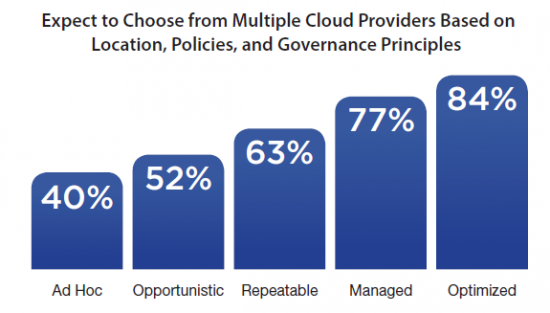
The use of multiple cloud providers is another hallmark of mature cloud organizations. The most mature organizations expect to be able to choose from multiple cloud providers based on location, policies, and governance principles. This was one of the key findings of the IDC study.

Mutliple Cloud Providers

Source: IDC InfoBrief, sponsored by Cisco, Cloud Going Mainstream. All Are Trying, Some Are Benefiting; Few Are Maximizing Value. September 2016 (N = 4,590)

More interestingly, as organizations get better regarding their ability to extract maximum value from their cloud environments their appetite to consume cloud services from multiple cloud providers grows. In fact, 84% of organizations with ‘optimized’ cloud strategies expect to choose from multiple cloud providers. Similarly, organizations with more mature cloud strategies are more likely to have implemented collaborative business and IT governance to define cloud management policies and SLAs.

The Challenge

However, multicloud environments can increase complexity. The challenge many organizations face is that of being able to manage and orchestrate that diverse portfolio of cloud-based applications. And this where we can help.

Specifically, Cisco CloudCenter™ is an application-centric hybrid cloud management platform that securely provisions infrastructure resources and deploys applications to data center, private cloud, and public cloud environments.

With our Cisco CloudCenter application-centric technology, you can:

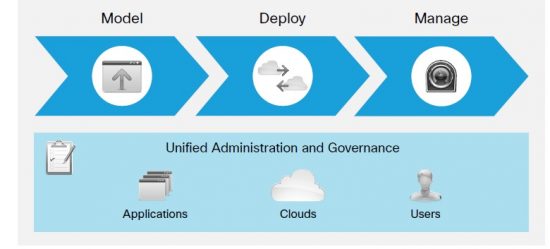
  • Model: Quickly and easily build a cloud-independent application profile that defines the deployment and management requirements of an entire application stack.
  • Deploy: Use one click to deploy the application profile and related components and data to any data center or cloud environment.
  • Manage: Apply a wide range of application lifecycle actions to set policies to enable in-place scaling, support cross-environment bursting or high availability and disaster recovery, and stop the deployment.

Cisco Cloud Center

Cisco CloudCenter administration and governance capabilities span applications, clouds, and users. Administrators can centrally manage cloud accounts, better control costs with financial plans, and report on use. They can also manage tenants and users and provide tag-based governance and role-based access control (RBAC). If you focus on the application, you can tailor IT services to meet the unique needs of your users. With an application-centric service model – IT stays in the loop wherever workloads are deployed

All of this helps IT organizations pursue a well-diversified and hybrid IT strategy that includes IT as a service (ITaaS), automated DevOps or continuous delivery, temporary capacity augmentation, and permanent application migration capabilities. And if you need help navigate the multicloud maze our Cisco Cloud Professional Services portfolio can provide additional guidance and reduce your risk profile.

Capitalize on the hybrid IT advantage, learn more by visiting our web site and request a demo.

Additional resources:

Authors

Enrico Fuiano

Senior Solutions Marketing Manager

Cisco Cloud Marketing Team

Avatar

I’ve always had compassion for the plight of many in Africa. I think it started from me being overly sensitive at a young age and taking the old dinner table saying “finish your food, there are starving children in Africa” to heart.

RAS Blog Kali Alphonsine[1]
Alphonsine and me at the RAS Gala.
This is why I was so touched by Alphonsine Imaniraguha’s story. I couldn’t believe that a Cisco engineer working at my site was also a Rwandan Genocide survivor! I immediately offered to support her non-profit, Rising Above the Storms (RAS), which helps children who are in devastating situations such as the one Alphonsine was once in.

I’ll never forget meeting her for the first time, I felt like she was a celebrity! But Alphonsine is the most humble and grateful person I’ve ever met and this actually fueled me to take on more and more responsibility in her non-profit! I know that other Cisco employees can agree, because the majority of volunteers that serve RAS also work for Cisco!

The marvel of this really struck me when RAS hosted its first fundraising gala this past September. Because RAS is a new non-profit, we needed to find volunteers that could effectively help the planning and execution of the event. Sure enough, our 2 emcees, the photographer, a volunteer coordinator, and an event planner were all Cisco employees who stepped up to help make it such a wonderful success.

How successful was it? We had over 100 attendees come to the gala and over half of them were Cisco employees! From that night alone we were able to raise about $8,500, all from individual donors. I met so many incredible colleagues that night, and it was the first time I realized that the “Cisco Family” is a very real thing.

One Cisco employee even flew in from California for the event. She has been volunteering with RAS for a long time, and that night was the first time she met Alphonsine in person. It was such a great example of how Cisco truly can connect people across the world, even if they had never met in person.

Cisco Team Giving Back
The “Cisco Family” giving back together.

RAS has benefitted tremendously from Cisco’s giving back initiatives. It is listed as an approved Community Connect organization, so for every hour an employee spends volunteering, Cisco donates $10 to RAS. Cisco’s Time2Give days (where we are given fives days off per year to volunteer) were also incredibly useful as RAS was preparing for the gala. Alphonsine and I cherished the days we took off to prepare for the gala.

Cisco also matches employee donations to RAS, which has really impacted our ability to earn the $50,000 we are trying to raise to establish a learning and community center in Rwanda! Largely because of Cisco, we have raised about 40% of our goal.

I am so thankful for the opportunity to serve RAS and thank Cisco for introducing me to Alphonsine, who is now a great friend of mine. I know the RAS wouldn’t be nearly as successful without the support of Cisco employees and the generosity of Cisco’s giveback initiatives.

Meet great people and make a difference? Yeah! Apply to become a Cisconian.


Authors

Káli Pike

HR Representative

Human Resources Talent Brand

Avatar

I recently had the pleasure of joining a twitter #CiscoChat co-hosted by @CiscoServices and Zeus Kerravala @zkerravala of ZK Research. We started the chat to debate the pros and cons of software support, but as we dove into the costs of downtime, it became evident there was no debate. Software support is a must in today’s increasingly digital environment. You can see the full chat here. For those of you interested in the short version, here are the top 3 things we learned on digital business transformation, deploying software, and how to choose the right support.

1. Software is a major enabler of digital business transformation

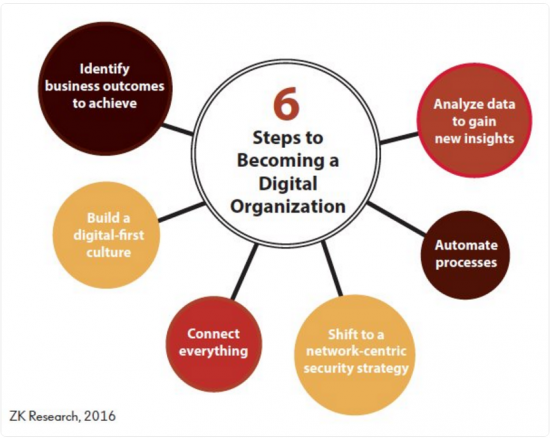
6 Steps to Becoming a Digital OrgAccording to ZK Research, there are 3 primary drivers of digital transformation: transform business models, create new customer experiences, and empower workforce innovation. These drivers all require a much higher level of business agility. Software is much more dynamic and agile than hardware, so it better enables digital transformation.
As Zeus aptly pointed out, software plays a key role at each step in the journey of becoming a digital organization.

For starters, the agility of software enables companies to align IT with business outcomes.

The automation capabilities of software can help improve productivity and empower the workforce. For instance, automating processes such as expense reporting and audits reduces the time spent on data entry.

A software-driven approach to product development and marketing can deliver new insights on customer behavior, which can help improve service and customer experience.

2. Don’t overlook software testing, QA, and support

Several chat participants stressed the importance of good software testing and quality assurance during the development phase to ensure that software performs up to standard. Even for packaged apps, testing shouldn’t be overlooked. A few suggested best practices for testing and QA, include:

  • Don’t over customize. Too much customization leaves more room for coding errors and bugs
  • Consider the benefits of SaaS. The QA and testing is moved to the cloud.provider, which drives new features faster
  • Shift to a DevOps model to help ensure long lasting, good quality software

Many of our chatters also agreed that once software is deployed, having the right support is also critical. Keeping up with the latest updates, version upgrades, and bug fixes is key to making sure the software continues to perform reliably and reduces the risk of security breaches.

3. Downtime can be catastrophic. Choose software support wisely

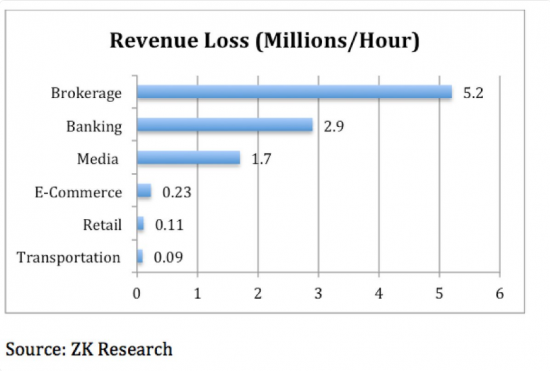
No matter the industry vertical, downtime can have a catastrophic impact on any business. Zeus shared some alarming figures from ZK Research on the cost of downtime by vertical. Even one hour can be incredibly damaging ($5.2 million an hour for a brokerage firm!).

Avg Cost of DowntimeDowntime not only costs money, but also can damage a company’s brand reputation and cause customers to churn. If a company is bleeding customers, in the end the amount of money lost doesn’t really matter. The bottom line is that downtime can be catastrophic, so have the right software support in place to minimize the risks of downtime.

When choosing the right software support, what should you consider? Here are a few recommendations from the chat:

  • Understand your internal skills and map them out against your future requirements. Align support services to fill any gaps you have
  • Determine what level of risk you can tolerate and align Service Level Agreements to make sure the severity of the issues are addressed accordingly by the subject matter experts you need, when you need them
  • If your IT team is unable to keep up with software updates, choose a vendor that can also help you keep up with the routine updates and software upgrades. Maintenance goes a long way toward preventing downtime
  • Choose a vendor based on the reputation of its support organization and one that can support your future growth needs

Here’s some final food for thought. As one of our chat participants reminded us, “software is eating the world.” As business and technology require more agility and flexibility that only software can enable, we need to “feed and nourish” the software with the right support. If you are evaluating any of our Cisco ONE or Collaboration products, learn more on how Cisco can support you.

If you didn’t get a chance to join our #CiscoChat, leave me a comment. What do you think is important to consider when choosing the right software support?

Authors

Denise Denson-Hanson

Marketing Manager

Enterprise Solutions Marketing - Services

Avatar

Effective security is simple, open, and automated.  In the last blog, I described several efforts by Cisco to pursue simplicity.  Now let’s talk about how we are executing on the open part.

Openness is about playing well with others. As a kid I heard it from my parents, and now I find myself saying it to my kids. When kids play well together everyone is happier (including parents!), they get to play longer, and I see them building skills that will benefit them in the long run – working together, appreciating each other’s strengths, and learning from each other.

The same holds true for security.

Today’s threat landscape is vast and changes every day – beyond the ability of any single vendor to confront. That’s why many security organizations report vendor sprawl as a challenge, adding new capabilities to overcome the lack of integrated effectiveness in others. Most organizations who pursue a best of breed approach believe there is a significant people and effectiveness pay-off, but often the chosen solutions don’t play well together and result in a tough-to-manage “frankenstructure” for their operators. Some of them have even told me: “I probably wouldn’t have invested in C if A and B worked together.”

To truly be effective, security solutions must be built with openness in mind. Real openness fosters solutions that actually deliver on the promise of best of breed because they can interoperate. Customers can purchase technologies that solve incrementally more of their security problem and know that they will work together and strengthen defenses.

Cisco builds products designed to interoperate across your entire security infrastructure, not only across our portfolio. We are set on providing products that work well with others. Cisco has really accelerated its openness and multi-vendor integrations in the past couple of years, and I’m excited to share this progress with you.

We view open in three principal areas – open standards and API, open-source communities and our ecosystem of technical partners.

Open APIs, Standards, and Programmability

Open means that products include APIs to extend and automate their security services. Cisco offers more than a dozen APIs and integration points.

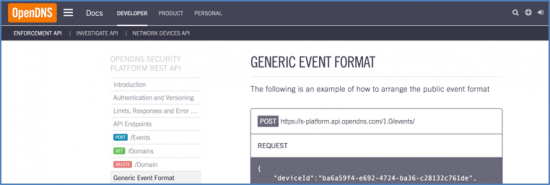
  • Cisco Umbrella API – Part of the portfolio via our OpenDNS acquisition, Cisco Umbrella publishes APIs in the public domain. With these APIs, you can feed threat intelligence from any source to the Umbrella product to ensure consistent cloud-based enforcement across all protected devices.odns
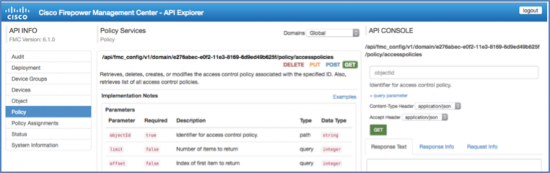
  • Cisco Firepower API Explorer For strong network security integrations, Cisco Firepower, our next-generation firewall and threat appliance, offers multiple REST APIs. You can use multiple firewall technologies (from Cisco, other vendors, or even your own proprietary technology) and share, access, and manage policies across management platforms.

firepowr api

  • OpenAppID – Use the LUA language to develop your own open application detection and application control to share with the community, or deploy on your Cisco Firepower or Snort.
  • Cisco Threat Intelligence APIs – This pragmatic, operationalized threat intelligence service and data model shares known threat information and provides inputs to threat analysis.
  • Cisco Platform Exchange Grid (pxGrid) SDKA published, technical specification open to every company with relevant security technologies, even Cisco competitors. This framework enables multivendor, cross platform network system collaboration among parts of the IT infrastructure such as security monitoring and detection system, network policy platforms, asset and virtually configuration management, identity and access management platforms, and virtually any other IT operations platform.
  • Security-group eXchange Protocol (SXP) – An open standard and one of several protocols that supports Cisco TrustSec. SXP is a control protocol for propagating IP-to-SGT (Security Group Tag) binding information across network devices that do not have the capability to tag packets needed to enable real-time network segmentation.
  • eStreamer API – Stream richly detailed Firepower System events to external client applications. You can stream host, discovery, correlation, compliance white list, intrusion, user activity, file, malware, and connection data from a Firepower Management Center.
  • Host Input API – Import data from vulnerability management solutions and other sources on your network, such as vulnerability assessment systems, to augment monitored host information in Cisco Firepower platforms.
  • Remediation API – Create remediation that your Firepower Management Center can automatically launch when conditions on your network violate the associated correlation policy. A remediation is the response your custom software executes to mitigate the detected condition.

But openness is far more than just APIs.

Open Source Communities

Open source technologies and the communities that surround them allow the world’s greatest minds to come together for innovation. We backup our commitment to openness through leadership in open source communities, such as Snort, OpenAppID, PhishTank, ClamAV, SenderBase and SpamCop. Indeed, open source security is woven into the fabric of Cisco’s vision. Just in the last few months, our Threat Grid team has contributed a rules engine and a way to do rate limiting for multi-node web apps using Redis.

Let’s look quickly at our progress with just 2 of these communities.

  • Snort – Snort is the global standard for open source intrusion detection and the foundational technology for Cisco’s network security portfolio. Aside from the OpenAppID rollout two years ago, we’ve been busy working on the next generation of Snort, providing a simpler configuration and an entirely new rule language. Snort shows no signs of slowing down, adding over 1,000 new users a week.
  • pxGRID – The 42 member strong community enabled by pxGrid continues to grow quickly. There have been over 800 downloads of our SDK in the last year with 22 new non-Cisco integrations and many more under development. pxGrid is also published as “XMPP-Grid” and is standards-track in the IETF.

We continue to invest in community-based models that enable users to create, share, and implement novel solutions in this dynamic and rapidly changing world. This openness sets the stage for an ecosystem where, together, we accelerate innovation and security effectiveness. Stay tuned for more announcements on this in early 2017.

Security Ecosystem and Technical Partner Community

The Cisco Security Technical Alliance program assembles this ecosystem so you can get more from your existing security investments – better protection, faster detection and resolution of critical events, and lower TCO.  We are open to over 120 security partners across all relevant security technology areas allowing our solutions to integrate with security components you have already deployed or plan to deploy– from SIEM to mobile device management to vulnerability management. Partners in the program integrate through open APIs, standards-track integrations like pxGrid, as well as point-to-point integration points. They benefit from interacting with a dedicated team that Cisco provides to help build and maintain integrations.

We won’t stop with the above. Openness lets us integrate security for more integrated threat defenses. At Cisco, we leverage open standards like IPFIX to share flow data from any layer-2 or layer-3 device. As an industry we see more use of common threat languages like STIX and TAXII for a consistent way to share threat information between security products for more effective, automated security. Practically, this means formerly disconnected products like next-gen firewall, email, identity, and web security will now efficiently share and consume threat information, pushing us closer toward our goal of seeing a threat with one product and being able to protect against it everywhere plus deliver an enriched data set for consumption by tools from other vendors.

The need to play well with others is much more than just a rule for the school yard or the back yard. It’s a watchword for one of the key elements of security effectiveness – openness. When products are built with openness in mind they make the entire ecosystem better and dramatically change the security landscape.

Can you say that your organization is leveraging all of the “open” capabilities already built-into the Cisco portfolio? Register for our Cisco Security Community and submit feedback on areas you’d like to see us innovate.

Stay tuned for the final part of the discussion when I’ll focus on how Cisco is incorporating automation into our portfolio of solutions to make security more effective and take the burden off of IT teams.

Authors

Jason Lamar

Senior Director

Security Product Management Group