Avatar

#CiscoChampion Radio is a podcast series by Cisco Champions as technologists. Today we’re Getting Deep On Cisco DNA with Dave Zacks.

Cisco Champion 2016Get the Podcast

  • Listen to this episode
  • Download this episode (right-click on the episode’s download button)
  • View this episode in iTunes

Cisco Guest
Dave Zacks (@DaveZacks), Distinguished System Engineer

Cisco Champion Hosts
Stewart Goumans (@WirelessStew), Mobility Consultant
Bill Carter (@CCIE5022), Senior Solutions Analyst

Moderator
Breana Jordan(@breanajordan12)

Continue reading “#CiscoChampion Radio, S3|Ep. 14: Getting Deep On Cisco DNA”

Avatar

At UTC 2016, utility companies and thought leaders discussed how to tackle many issues impacting IT and telecom initiatives in the water, electric, and gas utility industries. To continue the conversation from the event, I hosted a #CiscoChat on Twitter with Bob Lockhart (@BobLockhartUTC), Eric Ehlers (@egehlers), Peter Granger (@PGrangerCISCO), and Jenny Gomez (@JRGoGreen).

We were joined by many industry analysts and thought leaders to discuss the themes from the event, the challenges facing the industry, and the future of the grid.

If you missed the chat, the full recap is here and I’ll share a few of the highlights:

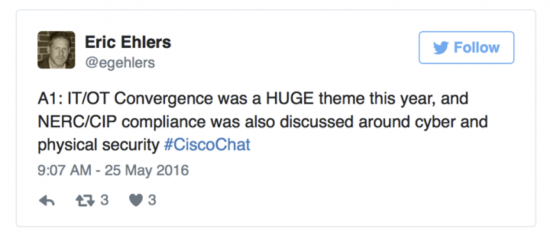
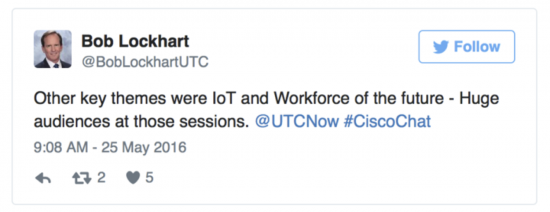
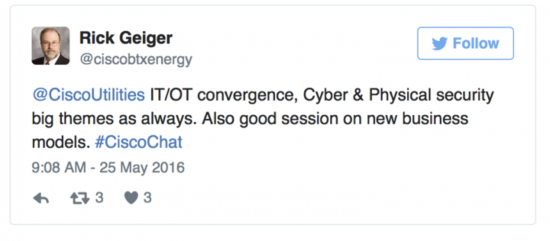
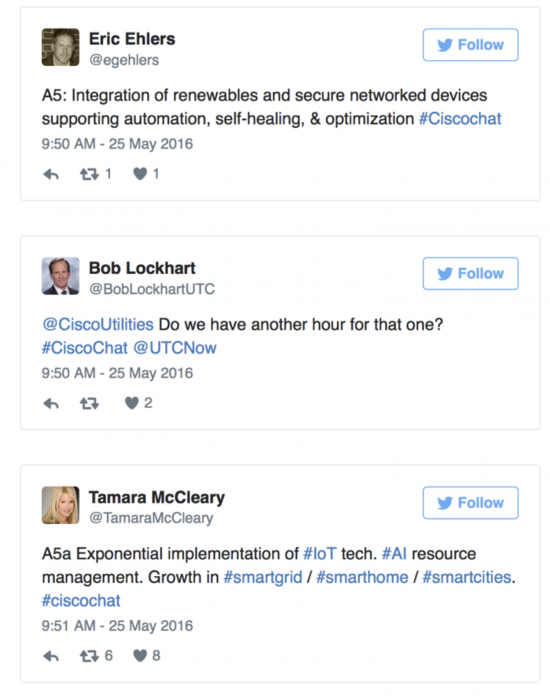
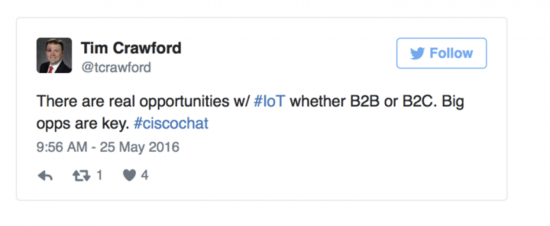
We kicked off the chat by asking: What themes did you hear at UTC 2016?

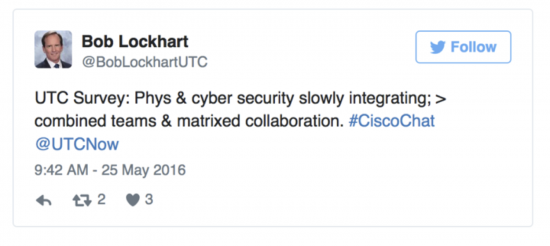
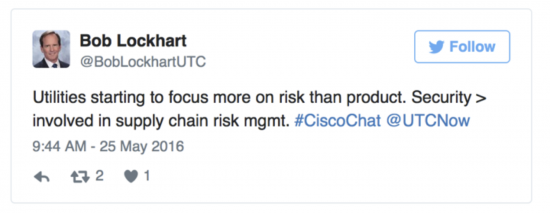
utc1

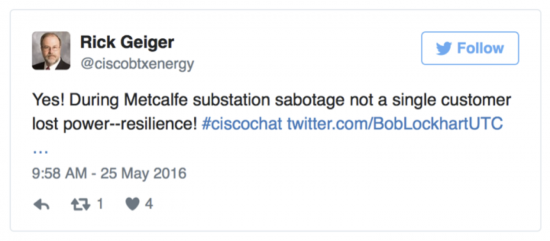
utc2

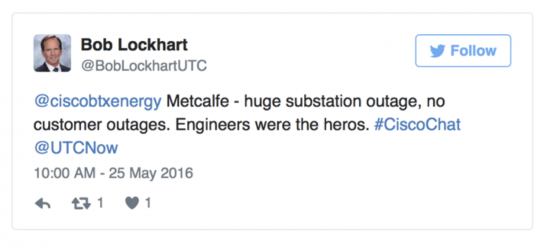
utc3

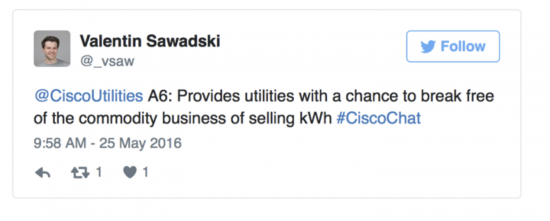
utc4

utc5

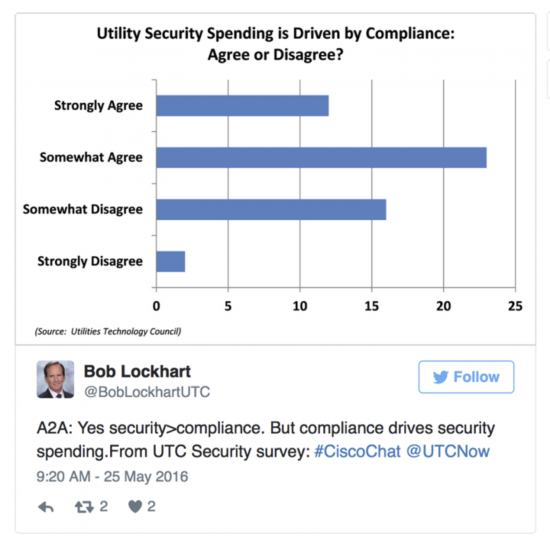
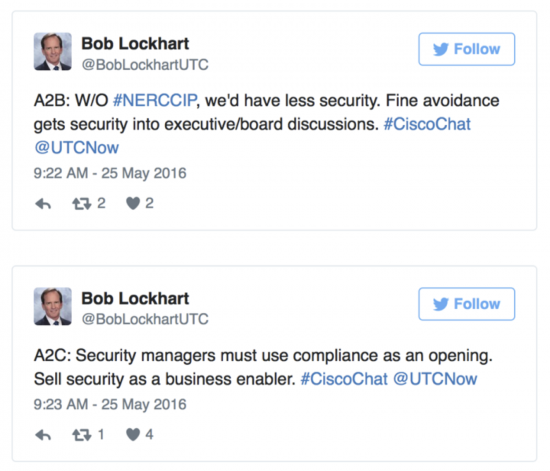
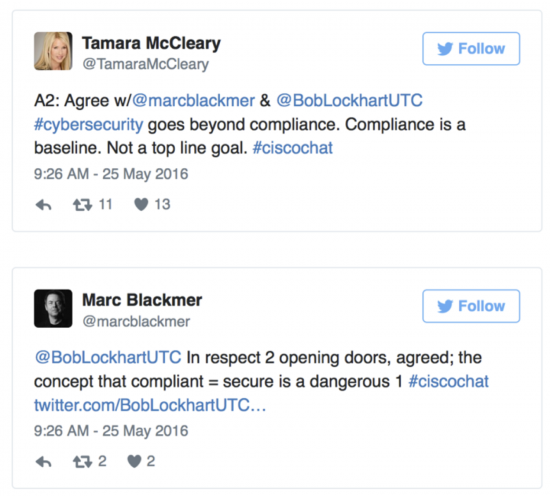
Since security was a hot topic at the event, we asked: One big trend is that compliance is not enough to thwart cyber threats- what are your thoughts on this?

utc6

utc7

utc8

utc9

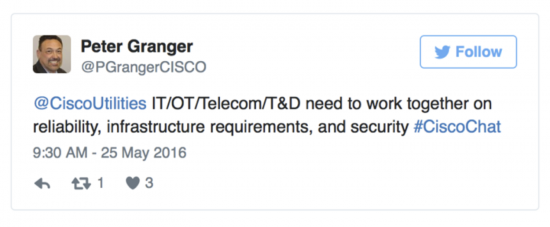
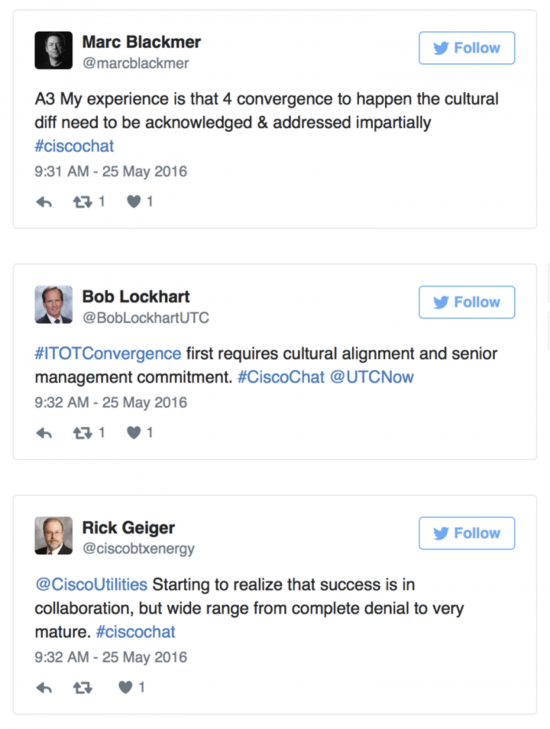
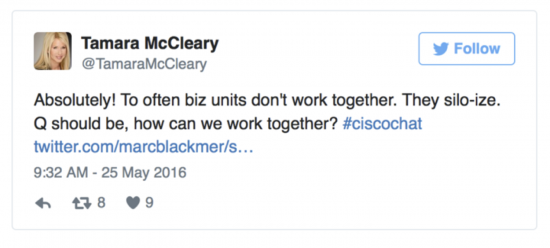
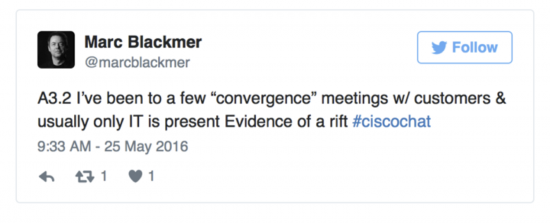
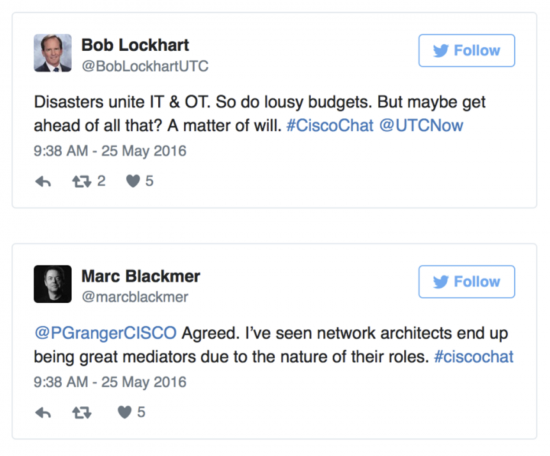
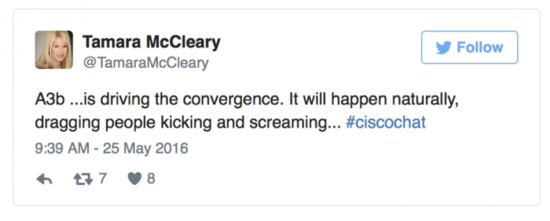
We had an insightful discussion when we asked: Where do you think utilities are going in IT/OT Convergence?

utc10

utc11utc12

utc13

utc14

utc15

utc16

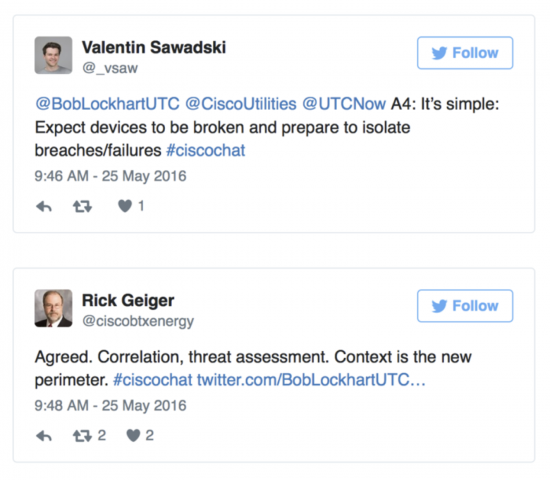
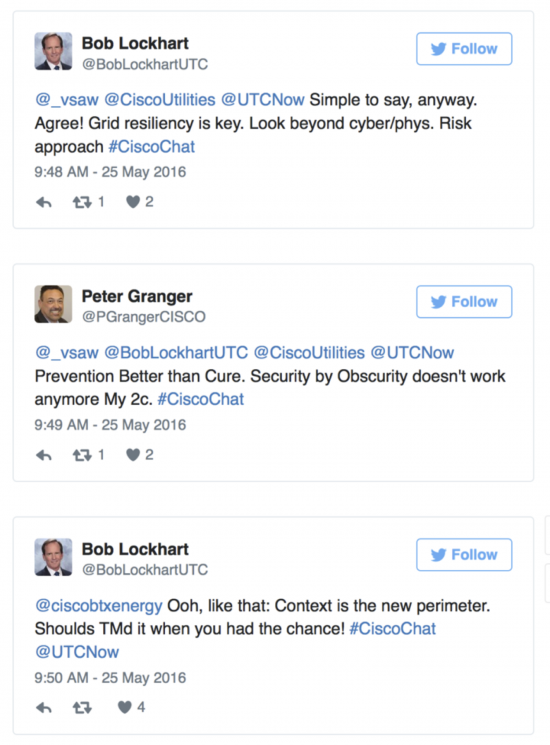
We then followed up with the question: What approaches are you seeing companies take when it comes to cyber & physical security in utilities?

utc17

utc18

utc19

utc21

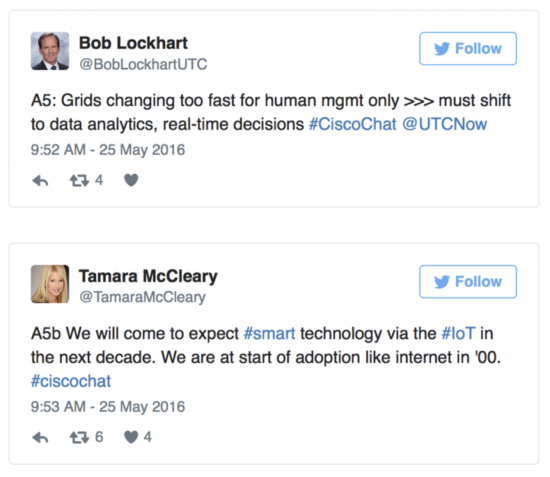
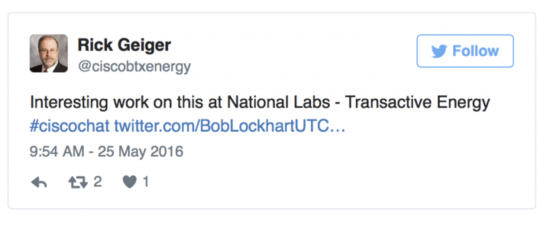
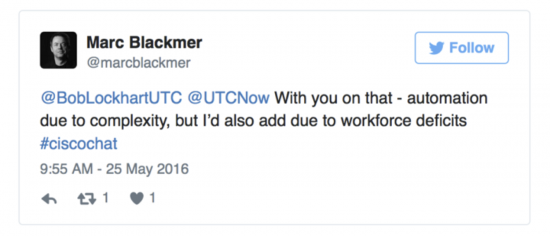
We received another rich dialogue when we asked: What’s the future of the grid?

utc34

utc35

utc36

utc37

utc38

utc39utc40

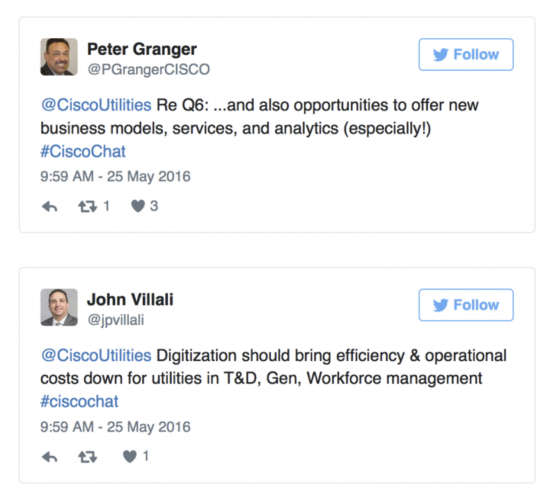
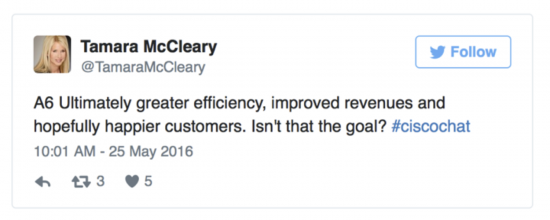
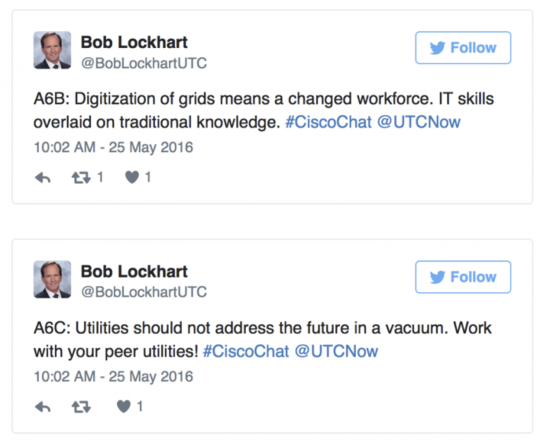
Finally we finished the chat with the question: What’s the value of Digitization for Utilities?

utc41

utc30

utc31

utc32

Overall we had an exciting hour of conversation and I encourage you to check out the full chat to see everything we discussed and a funny back and forth with a surprise guest. If there is something you’d like to add or would like to see in our next #CiscoChat, leave me a comment below.

And if you’d like to learn more, we invite you to join us at Utility Day at Cisco Live.

utc33

We look forward to seeing you in the next #CiscoChat!

To get our blogs delivered straight to your inbox:

subscribe

Authors

Rick Geiger

Executive Director

Utilities and Smart Grid

Avatar

Growth is a part of any successful business. Unfortunately so are the pains that come with that expansion. Consider Louisiana’s largest non-profit, academic, healthcare system: Ochsner Health System. During the last 10 years, Ochsner Health System has exploded from one hospital to 28 owned and affiliated hospitals, 50 health centers, a fitness chain, hotel, retail stores and more.

That’s a Manute Bol growth spurt.

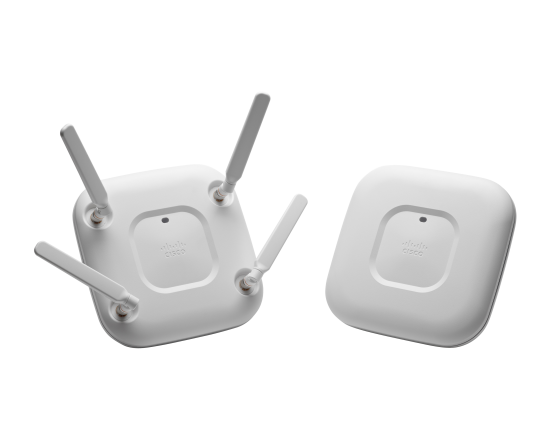
2700

Within any business, but especially hospitals, communication is key. That’s why the Ochsner IT department was charged with making sure that all of these new organizations were gathered under the same umbrella, network-wise. To make sure that everyone was speaking the same language on the same strong, flexible and manageable infrastructure, Ochsner Health System turned to Cisco.

The wireless network infrastructure was put into place by using Cisco Aironet 2700 and 3700 Series Access Points along with Cisco Catalyst Series switches. Once the hardware was up and running, the hospital group needed to be on the right side of HIPAA and PCI compliance; that’s when Cisco Identity Service Engine (ISE) was deployed. The use of ISE limited the impact of security breaches and allowed the hospital to enact new services like BYOD for their employees.

With the new wireless network Ochsner Health System is turning its gaze towards the future by allowing their physicians to partner with on-site doctors in rural locations. This allows them to see patients in hard-to-reach areas without leaving their offices.

Ochsner Health System CTO Roy Sookhoo says that this is just the beginning. He envisions hospital staff getting phone alerts from bedside devices through wearables and third party apps, as well as Louisiana specialist treating patients from around the world without leaving the hospital campus.

To view the case study, please go here.

Authors

Byron Magrane

Product Manager, Marketing

Avatar

Easy to buy, easy to change, and quick to get, virtual managed services take potential clients off the fence and into your balance books.

It’s not news that expectations of cloud business services are changing fast. Today’s companies are looking for more than just network access; they’re seeking offers that deliver to all their managed services needs. For example, they might start with some basic VPNs, add direct Internet connections, add enhanced security services, and so on up through applications. The common attributes are easy to buy and quick to get, and this means virtualized and cloud managed. In a 2015 Cisco survey, 59 per cent of respondents said they would prefer to purchase a managed firewall as part of their access package, and 40 per cent were considering managed web collaboration[1].

Businesses want managed services, and are very willing to get these from a network service provider. It’s creating a great opportunity for operators who can deliver them. Wide area network (WAN) users in the US anticipate further spends on managed network and security services. According to the survey, more than 80 per cent of businesses with a WAN expected to purchase managed antivirus, web and email security, Wi-Fi, and other services.

ACG Research claim the worldwide market for managed services will reach $62 billion by 2018. It’s a huge opportunity, but many network service providers are struggling to capitalize. Why? You may be contending with complex network architectures with expensive custom hardware and CPE. It might take months for you to introduce a new service that may require new network equipment, plus the operations support system (OSS), and integration. Let’s face it, customizing and scaling new services for specific customers and vertical markets isn’t as easy as it should be.

Addressing customer concerns

Business customers are worried about their networking costs. High upfront and recurring costs? No way! Manage multiple versions of hardware and software? You have to be kidding! They want to trial new features and services to be sure they work, without having to commit to them first. Networking isn’t their business; their business is healthcare, retailing, manufacturing, or whatever else. There’s never been a better time to help them.

This is where Cisco Virtual Managed Services (VMS) comes in. Our VMS can help you to roll out personalized, highly secure new services, at web speed, on demand. With VMS, you can offer innovative new services in minutes, not months, using prepackaged software that’s easy for your customers to personalize and purchase via your portal. And they can connect to these virtual services from the cloud using their existing CPE – less cost and risk for you.

Customers like VMS, and the research proves they value the ease-of-use, visibility and control it provides, no matter the size of the business. Seventy-six per cent of survey participants said they were willing to pay more for VMS than they would for traditional managed services[2]. Customers like the self-service portal. It lets them monitor their network, try out new services, and cancel them if and when they’re not needed.

Best of all, VMS provides an excellent springboard for growth. It’s a platform you can set up and deploy quickly, and that you can expand and integrate with your own applications. According to ACG Research, VMS can drive a 200 per cent increase in ROI, and enable you to expand your reach into new markets and business customer segments.

You’re in a strong position to capitalize on the VMS transition. Customers want the flexibility that it can deliver, with the majority willing to switch to a service provider that offers a VMS-like solution[3].

Find out more

To learn how a virtualized approach to service delivery can help your organization, visit http://www.cisco.com/go/vms.

[1] Cisco GSP-SPTG, U.S. Businesses, December 2015
[2] Cisco GSP-SPTG, U.S. Businesses, December 2015
[3] Cisco GSP-SPTG, U.S. Businesses, December 2015

Authors

Wayne Cullen

Senior Manager, Service Provider Architectures

Avatar

Another debate is over … and I am not referring to the US presidential election … I am referring to the growing maturity of OpenStack and its level of adoption in the marketplace. Over 7,500 people attended the last OpenStack Summit in Austin, TX. The energy at the event was palpable. Various organizations stepped forward and touted the virtues associated with their OpenStack implementations.

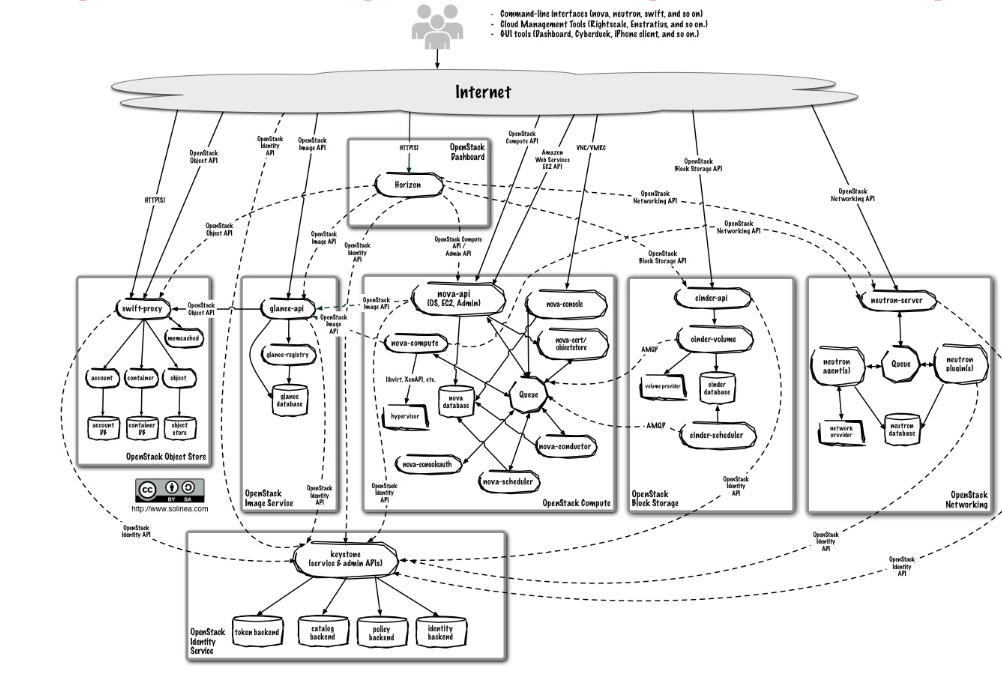
However, talking to developers and IT architects one of worst kept secrets inevitably continues to bubble up. OpenStack can be complicated. It can be argued that OpenStack is primarily a project and not a product per se. Numerous new projects and a rapid six-month release cycle make it difficult to keep up with innovation while still achieving return on your investment. There is no easy way to test upgrades, and when you need support there is no ‘easy button’ or toll free number to call.

OpenStack Logical Diagram

Source: OpenStack Training Guides

Nonetheless, the benefits are outweighing the risks. OpenStack is of strategic importance to a growing number of organizations. In fact, 65% of cloud adopters say OpenStack is important to their cloud strategy, via open source and/or commercial distributions (Source: IDC InfoBrief, sponsored by Cisco, Don’t Get Left Behind: The Business Benefits of Achieving Greater Cloud Adoption, Aug 2015) And the most cited benefits include and are not limited to the ability to reduce costs and accelerate innovation while avoiding vendor lock-in.

These are some of the dynamics that have prompted us to offer our customers a variety of consumption models that can dramatically simplify their OpenStack deployments. In fact, with Cisco you can:

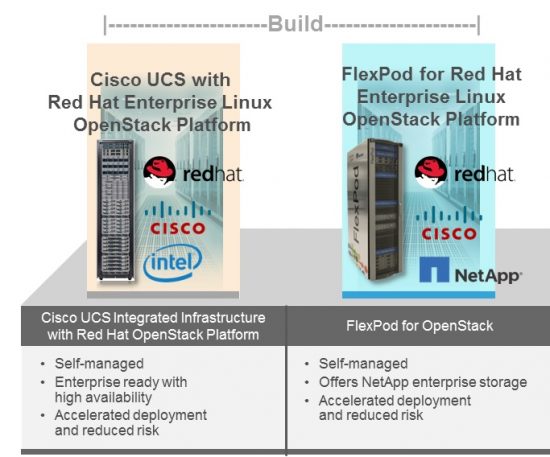
  1. Build and manage your OpenStack environment yourself on Cisco UCS or FlexPod while tapping directly into the OpenStack APIs. Skilled developers can leverage their existing capabilities and customize the deployment to their liking.
  2. With Cisco Metapod, you can consume your OpenStack private cloud as a service while retaining ownership of your IT assets and running your private cloud on premises. A team of Cisco experts builds, deploys, and provides ongoing operations, proactive monitoring and response, and upgrades via this production-ready solution 24 hours a day, 365 days a year.
  3. And you can use Platform as a Service (PaaS) solutions like Pivotal Cloud Foundry or Apprenda that work well on OpenStack and provide additional capabilities to develop your applications. They can simplify the deployment of hybrid cloud applications, or help your developers move more quickly existing Java and .Net applications to OpenStack environments.

UCSO and FlexPod for OpenStack

Regarding option #1, jointly developed by industry leaders Cisco, Intel, and Red Hat, Cisco® UCS® Integrated Infrastructure for Red Hat® Enterprise Linux® OpenStack Platform combines computing, networking, storage, management, and cloud orchestration into a single platform for deploying IT-as-a-Service environments and beyond. With documented design and deployment guidelines, proven configurations with bills of materials, coordinated support, and expert services, this integrated solution accelerates deployment and delivers the scalability, manageability, reliability, and high availability needed for production operation.

Deploying Red Hat Enterprise Linux OpenStack Platform on Cisco UCS Integrated Infrastructure provides broad functionality for your cloud environment without requiring complicated integration. In essence, this jointly engineered solution can:

  • Reduce deployment complexity and risk
  • Increase flexibility for future cloud deployments
  • Improve operational efficiency
  • Accelerate your Return on Investment

There has never been a better time for you to deploy your OpenStack cloud on Cisco UCS and quickly demonstrate its business value in your organization. For a limited time, at no cost to you we can provide a loaner hardware kit, evaluation software, fixed-scope starter services delivered by Cisco and Red Hat (see our POC Program details). This offer is applicable only to qualified use cases and opportunities in the Americas and Europe. Contact your account representative or email us to find out more and discuss eligibility criteria in more detail.

Additional Resources

Cisco OpenStack Website


Authors

Enrico Fuiano

Senior Solutions Marketing Manager

Cisco Cloud Marketing Team

Avatar

After very visible media and video broadcast industry attacks, everyone in the industry is worried about security, and let’s face it, there’s good reason to be. According to Novetta, there is evidence that the Sony hackers have been at work since at least 2009, and they are still at large. Media executives have reported that the number of security incidents over the last 12 months has jumped 17%. The attack on TV5Monde saw the station’s 12 channels taken over and helpless for 18 hours. You want to focus on creating the most audience captivating video experiences, without the fear of your latest creation being stolen or compromised before your vision becomes a reality. And when you get ready to deliver the content, you want to ensure that only your authorized customers are able to enjoy your services.

Security can be a business enabler. You want to take advantage of today’s digital technologies such as IP, cloud, and over-the-top (OTT) delivery, and not be deterred by security concerns. Robust security is crucial to protecting your business, your content and services, and your customers. By protecting your entire network and content creation and video broadcast infrastructure from cyber criminals, you can then fully monetize your investments. Imagine finding one vendor with deep experience to secure your infrastructure so you can deliver premium content, at any time, and on any screen. Imagine one solution to rule them all.

Cisco combines best of breed security products and services – the #1 in data center security and the #1 in video security – that deliver unmatched depth and breadth. Our proven VideoGuard Everywhere, conditional access (CA), and multi-digital rights management (DRM) based protection solutions have the longest unhacked track record in the market, spanning 14 years. This long-standing leadership in broadcast TV security makes us the trusted security partner for hundreds of customers worldwide, protecting over three hundred million devices. VideoGuard Everywhere’s anti-piracy services prevents your content from being redistributed illegally by locating, identifying, verifying, and eliminating such activity. Our global team of Operational Security experts constantly tracks pirates to stop them from impacting our customers’ business.

Cisco’s approach to video headend and media data center security safeguards content and customer data from advanced cyber threats when it is created, distributed, and consumed. With granular access control over as well as enhanced visibility and control of everyone and every device on your network, you lock down the video broadcast and media infrastructure to stop potential threats before they can cause damage and quickly remediate if they do manage to get in.

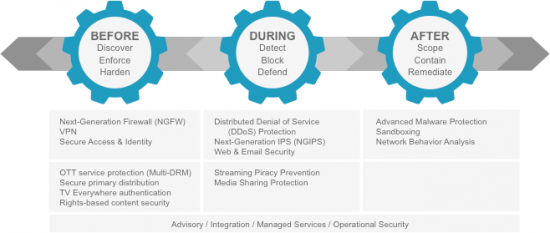
Cisco’s Threat-Centric security solutions are designed to protect your video content, broadcast infrastructure, and critical business systems. Our multilayered solutions work together to protect your business from advanced cyber threats before, during and after an attack. BEFORE the attack, our solution strengthens the network perimeter, enforces secure access, and safeguards media content across networks, systems, users, and data. DURING the attack, it provides real-time detection and mitigation from known threats. And AFTER the attack, it helps you to quickly discover malware that gets in and resolves these unknown attacks to prevent your business from being compromised.

Diagram. Threat-Centric Security Solutions: Before, During, and After

diagram

Cyber crime against the media and video broadcast industry is on the rise. Cisco’s holistic approach to infrastructure and broadcasting security solutions makes us your trusted partner for business expansion.

Learn more about End-to-End Video Security in this video:

https://www.youtube.com/watch?v=UrZC3utm3hk

For more information on Cisco Video solutions visit us at CommunicAsia and Broadcast Asia 2016.


References:
Novetta: http://www.reuters.com/article/us-sony-cyber-idUSKCN0VX1IR
Jump to 17%: http://variety.com/2015/digital/news/sony-hack-anniversary-cybersecurity-data-1201633671/
TV5Monde: http://www.independent.co.uk/news/world/europe/tv5monde-hack-jihadist-cyber-attack-on-french-tv-station-could-have-russian-link-10311213.html

Authors

Sam Rastogi

Senior Product & Solutions Marketing Manager

Avatar

A couple of weeks ago, I had the opportunity to lead a session at the SAS Global Forum, along with Intel VP Steve Brown and Lori Schafer, SAS Retail Executive Advisor, on how retailers can create better in-store context for today’s connected customer. SAS Institute is a Cisco analytics partner and we had some exciting discussions during this event.

Defining the Connected Customer

Let’s take a minute to define what we mean by the connected consumer.

First, let’s not get too focused on the idea of Millennials or Generation Y – users of all ages are very active on their mobile devices and social media. What we are talking about is not an age group, but a group of consumers that is always connected via their smart devices.

Second, they are on those devices a lot. Customers look at their smartphone about 1,500 times a week, and are on their phones 174 minutes per day. To put this into context: Studies show that mothers spend an average 117 minutes a day on childrearing, while men spend 62 minutes per day!

Finally, today’s shoppers are looking for what Cisco describes as a “contextual relationship.” In other words, they have high expectations for their relationship with you. They expect you to know about them, what they have been doing, and what they are doing right now, during every interaction; and they want you to use this context to guide how you respond.

Moving Context from Online

As a retailer, you are doing a better job every day on leveraging the information you gather on online shoppers as they research and shop. You are also doing a better job of leveraging the wealth of digital data about your customers collected from eCommerce and third-party providers, FICO, Experian, and your own transactional and loyalty data. Online, this easily provides a context for what your shopper is doing, researching, and purchasing.

However, to deliver the same type of contextual relationships in the physical store, you need to leverage consumer data there too. That’s why one of the key areas of investment is solutions that allow retailers to use wireless, video, and collaboration technologies to track in-store consumer behavior. This data is then assessed for predictive (predicting what the customer needs or wants) and responsive (real-time data) analytics to guide your actions toward the customer.

Such solutions require a network smart enough to do analysis at the edge and use those metrics to initiate real-time responses, such as automated messages to customers; alerts to store employees; and notifications to executives, data centers, and HQ.

Use Case: Context in Today’s Store

A number of retailers Cisco works with are already using context to make better operational decisions, such as better conversion rate analysis, store pathing, operations, and merchandising.

This year, we are seeing the transition from store- and department-level analytics to aisle, shelf, and even product-level analytics. This increasingly granular information will unlock whole new eras of precision retailing. By combining data on shopper dwell time, body language, gaze tracking, product handling, and even demographics and mood, we can ask and find answers to even very specific questions, such as “What is the impact on conversion if I move product X to a new position on the shelf or change its packaging?”

For example, a customer walks into the store. His mobile device is automatically detected and securely connected to the store application, which sends him an automatic greeting. He navigates the store based on a provided map. Wi-Fi-enabled analytics software automatically notes his product interests and browsing patterns, and notifies internal systems to send targeted ads directly to the shopper’s device or to the nearest in-aisle digital display.

As he browses, the app may also offer him gift recommendations, wish lists, style choices, and other personalized services to enhance his shopping experience. The customer receives sales announcements and promotions based on previous shopping behavior, and opportunities for cross-sell and upsell. He may also consult with a sales associate or virtual expert to learn more, or view a product video or broadcast. Based on information gathered from these activities, systems may then be configured to consistently recognize the customer from now on, in any store branch, online, and on social media.

Achieving Context in the Future Store

Cisco is building a future store business model in which retailers and suppliers can anticipate and respond to shopper needs and wants, providing the optimal product mix, layout, and service at the point of sale. Combined with increasingly powerful AI techniques, you provide the “hypercontext,”which includes not only information about the shopper and their history, but their real-time situation from moment to moment. Based on a constant exchange of data, you become empowered to reach a new level in your relationship with your customer.

Learn about the idea of hypercontext and hyper-awareness in our white paper here.

Authors

Ed Jimenez

Business Transformation Lead

Retail & Hospitality

Avatar

Hello all. I trust it has been a good week for you.

I am happy to report I am back in-country here in Southern California after a week in Shanghai. I went to visit my fantastic technical product team as we kicked off a new program that will bring five new models in the next couple of years. Exciting times to be had for the team. I am lucky to have such a bright and energetic team.

The switching and wireless teams also kicked off new product programs recently, so rest assured, the process continues in bringing to market the best networking in the industry.

Back to teams – why stop at one fantastic team right? We are also very lucky to have a small team based on the beautiful campus of UC Santa Cruz. I paid a visit to them last year, and what a delight to be around such energy! This team has been producing videos for us for about a year, with the scope being varied in nature. We are planning technical, “how-to’s”, informative feature shorts, and even light product datasheets.

So with that here is a new video highlighting the new RV320 and RV325 with the new web filtering feature. This awesome short features Zhill Olonan who does a great job on this.

Great job Zhill!

By now, you have probably seen or heard of some of the new products we have launched this year. We have new switching news, including new SG350X and SG550X stackable, managed switch models. The switching portfolio continues the path to the best in the business.

Shhhh, between you and I, there are more models coming out this fall……

We also released a myriad of Wireless Access Points, including the WAP571 and outdoor cousin, the WAP571E. There are also new 300 and 100 Series models that were just released. The wireless portfolio continues to impress.

I personally have been busy, as I released a number of new RV Series models including the two above, the RV130 and RV130W with web filtering, and the new DSL/Ethernet combo models, the RV132W and RV134W. My work is not done, there will be more coming next year!

Please check out each respective technology page on Cisco.com for more information, or please contact your local Cisco Partner.

Enjoy!

Authors

Marc Nagao

Product Manager

Small Business RV Series Routers

Avatar

Securing intellectual property and protecting reputation are essential to research universities around the world.

Major intellectual property theft can have serious repercussions on universities, especially in their ability to attract and retain students, faculty and researchers.

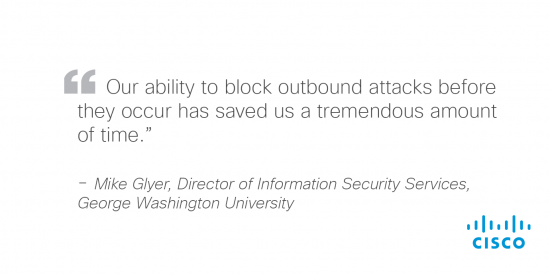
For George Washington University, a research university situated in the heart of the nation’s capital, malware was a major concern for the engineers and IR team on campus. OpenDNS provided the university with a high level of protection with a low level of interaction to implement the solution, allowing the team to focus on protecting only the most critical data.

OpenDNS

Watch this video featuring Mike Glyer, Director of Information Security Services, to see why OpenDNS is the security solution of choice for George Washington University.

https://www.youtube.com/watch?v=gQ8PY_Bn8tI

Authors

Alexia Crossman

Senior Cross-Portfolio Messaging Manager

Cisco Marketing