Avatar

Having personally spent a lot of time at Fortune 500’s, I know that individuals tend to develop blinders when dedicated to an organization, and begin to accept that things are done a certain way, and there is an order about things. It may come as a surprise then, when others don’t do things the way your organization does, or ignores certain areas altogether.

A quick google search will reveal there are over 45,000 companies listed on stock exchanges across the globe – this doesn’t even take into account small and medium size businesses or organizations that aren’t listed (e.g. schools, universities, non-profits, etc.). When you realize the gravity of those numbers, you begin to realize that something as specific as incident response isn’t a luxury that everyone can afford to have on staff. Let’s look at ‘House of Lies’ for a moment, to illustrate.

The team (and company) in ‘House of Lies’ is focused on management consulting- they run numbers, consider business strategies, and more, to ultimately provide recommendations and devise the best path forward for their customers. They even use technology to accomplish these goals and have some IT staff on hand.

That is why I applaud the fact they were smart enough to reach out for help when they were breached (albeit comically) by their competitor. If incident response isn’t your strong suit, you should never be embarrassed about making a phone call and bringing in external assistance. Even large and very mature organizations that have IT staff will still enlist outside assistance to help augment their organizations and recover from a breach.

Once you have the right folks engaged to assist in your breach, you should not make any hasty decisions, but rather do your best work to understand the scope of the attack, which ultimately allows you to make the best call as to how to move forward. In many cases, the path forward may require additional resources, to include tools that may be outside of your normal IT staff and existing technology sets. For example, application teams who may be required to patch and regression test their code, legal teams who may provide input and guidance, public relations personnel who may work to soften the external blow, and more could be tapped to become part of the incident response team, once a plan is developed.

As for tool sets? Visibility, containment, and environment hardening may come into play, let alone specific forensic tools to piece together the attack and track down the attacker(s).

In the show, you’ll see they called on Cisco Advanced Malware Protection (AMP). In the real-world, it actually is a tool that organizations and incident response firms use to quickly understand the full scope of a compromise and take action. AMP uses behavioral indicators and continuous analysis of file behavior to quickly detect malware if it’s already inside, and then shows you where the threat came from; what led up to the attack; when the system first saw it; where else the malware has been; and what the malware is doing. Then, with AMP’s built-in containment and remediation capabilities, you can eliminate the threat with a few clicks.

Again, given the sheer number of organizations, not all organizations will have access to all of the required resources, or even the bandwidth available to respond. In the end, it’s imperative to bring in the right people for the job- and the rights tools- even if it requires an external phone call.

While the team at Kaan & Associates may not be the best all-around role models, they would be the right example to follow this time around, in regards to reaching out and asking for help.

See how Kaan & Associates enlisted the help of Cisco to get to the bottom of their breach.

Authors

Sean Mason

Director, Threat Management & Incident Response

Cisco Security Advisory Services

Avatar

We often wish people “safe travels”.. yet how much do we consider what it means in today’s hyper-connected world?

More than ever, technology has given us the ability to change the world. Inbar Lasser-Raab, recently shared how digitization is forcing cities and businesses to reimagine their business models to innovate and thrive. Another example of how this impacts our everyday world is in the Transportation industry. Like every other industry, it’s evolving but innovation here has the opportunity to leapfrog. By using a digital-ready network, governments are able to create a safer, faster way to get drivers and cargo where they’re going – there’s never been a better time to build safer and smarter roads.

Print

One of the more compelling stories on Connected Transportation comes from ASFINAG, Austria’s Audobahn Corporation. ASFINAG, developed a smart highway that prevents traffic jams by connecting thousands of sensors to an extensive network. These connections are made using the Cisco IP interoperability and Collaboration System (IPICS). This technology enables communication with all systems and helps prevent emergencies by directing rescuers and police to the site of an accident more quickly. They also used the opportunity to turn that data into something they could actually use to benefit residents and visitors.

Another technology that provides analytics about end users or customer mobility patterns from the network is Connected Mobile Experiences (CMX). In this example, you can leverage intelligence from the network to provide a better experience to travelers by sharing travel times and predicting traffic patterns. These location-based insights and analysis transform a connected road into a smart road.

However, CMX isn’t just for connected transportation. Many different businesses and industries can benefit since it can be easily managed from the cloud or on-premises. With a digital-ready wireless network, organizations can:

  • Engage and deliver a more personalized experience to mobile users – ultimately improving customer satisfaction and loyalty to achieve better business results
  • Analyze visitor behavior onsite to learn dwell times, high traffic zones, and heat maps to provide better user experiences and operations
  • Locate and track mobile assets more quickly and accurately within 1 to 3 meters

Take a look at the Cisco Hyperlocation White Paper to learn how your organization can benefit from an ultraprecise location solution.

Authors

Romil Khansaheb

Director, Marketing

Enterprise Networking and Mobility

Avatar

mzelyez (002)By Melissa Zelyez, Cisco Marketing Manager

Why are 50% of all businesses open to changing cloud providers? Service providers can be the top choice, if they prepare now…

Today most businesses currently using cloud services do so through cloud providers, value-added resellers (VAR), system integrators, and other vendors; not through direct relationships with service providers.

Enterprises need to decide how they will manage their networking needs and their cloud environments. Service providers can be the top choice – if they deliver a great end-user experience.

According to a recent survey by AMI-Partners,* said they would switch to a service provider to get these 5 infrastructure benefits: Continue reading “Building an Experience-Centric Network”

Authors

Wayne Cullen

Senior Manager, Service Provider Architectures

Avatar

eHealth week is June 8-10 in Amsterdam, The Netherlands, and is going to center on three main themes – Empowering People, Trust & Standards and Social Innovation & Transition. eHealth innovation across the globe continues to be fueled by technology and key healthcare policies, and this will be another great venue to learn more about this exciting and evolving space.

If you’re attending eHealth week, be sure to visit Cisco booth N4 to experience our healthcare solutions – Patient Connect and Tropo for Healthcare.

  • The Cisco Patient Connect solution provides a single platform for delivering digital content (such as wayfinding or wellness education), streaming media (live TV), and personalized patient information. It also facilitates collaboration with care providers using voice, video and collaboration services. Engage with patients, visitors, and staff at all points in the healthcare journey.
  • Tropo for Healthcare solution is a cloud based API platform that can be leveraged by care providers to improve patient experience in areas such as ePrescription or patient appointment reminders.

Cisco experts will be at hand to answer your questions, so stop by and check out the solutions.

Shaping a world of healthcare without boundaries!


Authors

Tapan Mehta

No Longer with Cisco

Avatar

Confession: I read the ends of books long before I get to the last chapter.  If you’re like me, you like to know what’s to come so you can linger along the journey a bit more.

Over the next few weeks we are going to talk more about your success and how we can help you including:

  • The difference between digital transformation, digital network architecture, and digital ready networks.
  • How you can capitalize on all things digital and what does it means to your customers.
  • Ways to drive adoption, expansion, and renewal of every offer.
  • How to save your customers money and grow a predictable revenue stream.
  • New tools and resources are available to your sales and marketing teams.
  • 5 key benefits digital network architecture brings to business – yours and your customers
  • Get ready for Cisco Live US!

That’s a small sneak peek at what’s to come. Come back to our blog daily to learn more.


The Power of Partnership

We love a good story. Particularly one with a happy ending where the hero triumphs over a villain. One of our recent favorites is the story of a come-from-behind IT shop that does more with less with the help of three Cisco partners working together. (Hint: the villain of this story is the network.)

Westmont

Read how Westmont College transformed its network to help it achieve…wait, I don’t want to give away the ending. You’ll have to read the story to find out the outcome.


Newsworthy


What’s next?

The partner weekly rewind and fast forward is designed to give you a snapshot of what you missed and what’s to come. Tell us what you think and what you want to hear about in the comments. And come back next week for more!


Authors

Jill Shaul

No Longer With Cisco

Avatar

“Enterprises won’t need systems integration and professional services if they shut down their IT Operations and move to the cloud.”

– Light Reading, May 31, 2016

Without any context, that quote could be wildly misinterpreted, and create some angst for you. Because if you’re reading this, you’re probably a Partner providing System Integration or Professional Services, or you do IT Ops for an Enterprise.

Let’s first acknowledge that there is obviously movement to the cloud, some to private, some to public. The reality is that workloads are moving to both. The quote above, however, is referencing public cloud specifically. I mean, if there’s no IT Ops, there’s probably no private cloud.

So what’s underneath the statement?  It was made in this excellent article from Mitch Wagner.  His objective was not to cast some gloom & doom story over Partners.  Quite to the contrary, it profiles how Hutchinson Networks, a Cisco Partner in the UK, is shifting its business and competing more effectively, in part, by leveraging automation with Cisco Application Centric Infrastructure (ACI).

Problem

Hutchinson anticipated that as its small/medium sized customers moved parts of their business to public cloud, need for their services would decrease, which would make growth challenging. Stephen Hampton, CTO for Hutchinson Networks said, “If this continues to accelerate, the need for in–house skills reduces further, and the need for our services starts to erode.”(1)

In this case study, Hampton added, “We see companies moving towards cloud connections and simple campus networks, which limits our ability to continue growing through consulting services.”

So what did they do? Hampton said, “We decided to turn this problem into an opportunity. We could use our deep networking expertise to deliver cloud hosting with advanced network services normally not seen in the cloud.”

Solution

Their new solution is called Fabrix and its based on ACI. It provides several differentiators (outlined in the resources below) including a heavy emphasis on automation.

“Many companies have managed data center services that they call a cloud, but the way we see it, a true cloud infrastructure should be completely automated,” says Hampton. “Cisco ACI and the Cisco Nexus 9000 Series Switches are built from the ground up for automation in a way that traditional platforms aren’t. The result is automation that is relatively easy to implement for Fabrix.” (2)

Rationale

SDN, Orchestration and Why Fabrix Went Cisco ACI is a post that, as the title would imply, covers some of the criteria for selecting ACI as the platform on which to build Fabrix. It covers several areas including cost, programmability and flexibility. It says, There are of course very cost effective combinations of open source controllers and white box switches. However, in most cases a lot of in-house development work is required. The Cisco ACI starter kit is very competitively priced. Also, the APIC (Application Policy Infrastructure Controller) has the considerable force of the Cisco development team behind it rather than just our own in-house DevOps. As a result, we expect to lower the total cost of ownership with Cisco ACI.”  The post continues with “Cisco APIC and the Nexus 9000 have been built from the ground up for automation…Easier automation in turn leads to easier orchestration.”

Cisco UCS Director is being used for orchestration and “is preconfigured with orchestration workflows that are integrated with the Cisco Application Policy Infrastructure Controller (APIC) to deliver unified deployment and provisioning across the entire environment, including Cisco ACI ecosystem partners, such as F5 for application delivery and Nimble for storage.” (3)

As far as flexibility, the post mentions that “… a very significant feature for Fabrix is Cisco ACI’s ability to support bare metal connections…” Along these lines, Light Reading mentioned “Cisco differentiates from VMware in that it integrates API with hardware, while VMware operates an overlay model. ‘We’re not building a different network and overlaying something on top’ ” Hampton says.

Since we’re on the topic of flexibility within the context of cloud, its worth mentioning that “Hutchinson also offers application extraction – the ability to move applications between multiple cloud platforms – using services from CliQr, which was acquired recently by Cisco, as well as Pivotal and Apprenda. Extraction can be tricky for non-cloud-native apps, which require policies around security and app delivery, as well as moving large data sets.” (4)

At this point, I do need to inject a little biased editorializing by saying I think its pretty cool how they are leveraging Cisco for compute, network, orchestration and public cloud extraction/movement. They don’t need to, because they could, for example, use ACI’s northbound API’s to integrate with other orchestration tools like OpenStack. In any case, it would appear they place a heavy emphasis on automation.  The ability to use consistent policies to accelerate and simplify automation across all these platforms is unique to Cisco.

So, we’ve covered Hutchinson’s problem (business disruption), solution (ACI) and the rationale used for arriving at the solution. Hampton summarized all of this nicely by stating:

“Cisco ACI is built for automation, giving our services the speed and cost-efficiency that our customers expect.” (5)

But Wait – There’s More!

Hutchinson Networks is one of five different customers profiled yesterday in this Press Release discussing how Service Providers worldwide are adopting ACI. I don’t have enough space to cover each of them here, but would encourage you to check out how ACI is positively impacting business at Integra, NTT DOCOMO, Tele2 and Manx Telecom, as well.

References/Resources:

(1) Light Reading article

(2) Case study

(3) Case study

(4) Light Reading article

(5) Success story

Hutchinson Post

Press Release


Image source: Pixabay

Authors

Craig Huitema

No Longer with Cisco

Avatar

There is a new role of voice in today’s communications. While we increasingly use text messages, instant messages, video, chat, and other technologies to communicate, voice continues to be a strong application that we use to reach out to each other.

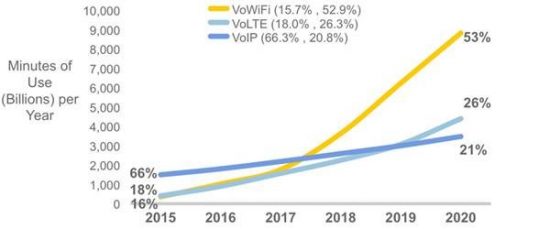
The methods of connecting voice calls have evolved over the years, and now Voice over Wi-Fi (VoWi-Fi) appears to be growing in adoption to complement Voice over LTE (VoLTE). According to the Cisco Visual Networking Index, VoWi-Fi is going to surpass VoLTE by 2016 and VoIP by 2018 in terms of minutes of use. By 2020, VoWiFi will have 53 percent of mobile IP voice, up from 16 percent in 2015. VoLTE is expected to surpass VoIP minutes of use by 2019.

vowifi 1

This growth in VoWi-Fi is attributed to the recognition that 95% of data consumption occurs indoors, with Wi-Fi used as a popular method for users to connect on their mobile devices. In addition, VoWi-Fi can also be adopted by non-SIM devices, increasing the devices able to make voice calls.

We recently worked with two leading analysts, Monica Paolini from Senza Fili in her webcast with RCR Wireless and Ray Mota from ACG in Cisco’s Knowledge Network webcast about their perspectives on the growth of VoWi-Fi.

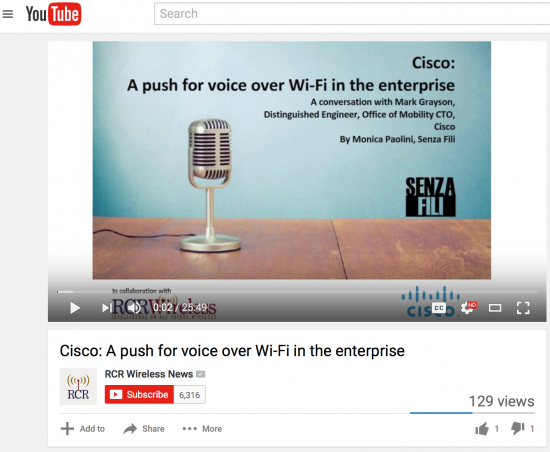
In Monica’s webcast with RCR wireless, “Voice comes to the fore, again. VoLTE and Wi-Fi Calling redefine voice,” Monica discusses not only how VoWi-Fi is integrated into the existing mobile networks’ architecture with the IMS core, but how VoWi-Fi and VoLTE appear to be complementing each other instead of competing with each other to ensure that voice services are best delivered to the mobile subscribers. To complement the webinar, Monica spoke with Cisco’s own Mark Grayson, Distinguished Engineer from Office of the Mobility Cisco CTO, about how VoWi-Fi will also benefit enterprises in addition to Service Providers.  Mark states ““if we look at the enterprise in the broader sense, there is a set of enterprises that want to serve their users, their visitors, irrespective of carrier affiliation. Here we see Wi-Fi Calling has some benefits over the alternative licensed propositions, in terms of being able to serve all the users, all the visitors to a particular venue, irrespective of their affiliated carrier.”

vowifi 2When Ray Mota joined Cisco’s Peter Curtin in the Cisco Knowledge Network webcast, “Voice over Wi-Fi: An Economic View,” they discussed VoWi-Fi from the angle of economics.  Ray has published more details about the financial comparisons in his whitepaper “It’s about APPU and QoE, not ARPU”.

vowfif 3Clearly, 2016 is the year of VoWi-Fi, as Ray eloquently stated in the Cisco Knowledge Network. Not only are the subscribers adopting it due to increased Wi-Fi connectivity, but there are benefits for both operators and enterprises financially and to help serve their constituents.   Watch the recent webcasts, listen to the interviews, and read the latest whitepapers to learn more:


Authors

Maywun Wong

Manager, Market Management

Avatar

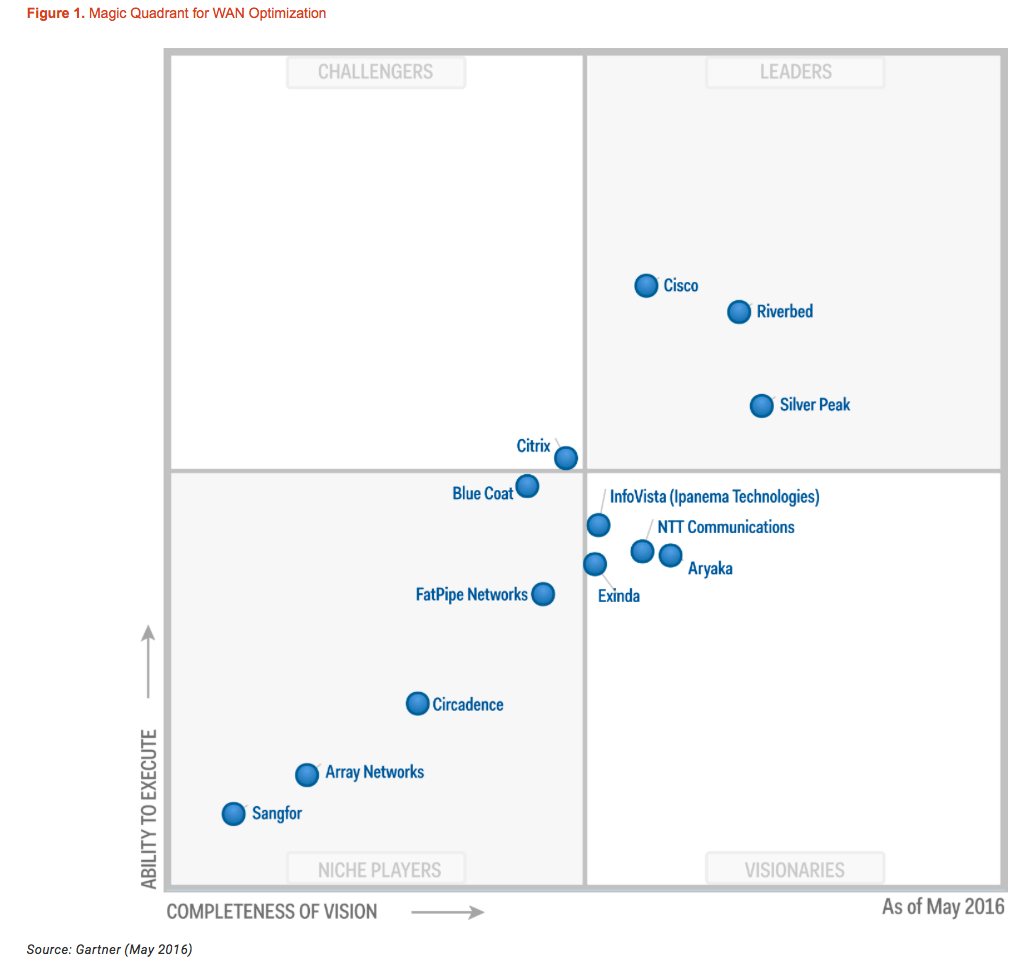
I am excited to share that Cisco, once again, secured a leadership position in Gartner 2016 WAN Optimization Magic Quadrant. This comes shortly after the Best of Interop win in Las Vegas for Cisco Enterprise NFV. According to the report, Leaders in this Magic Quadrant have a broad feature set, including QoS, generic compression, protocol acceleration and file system acceleration, with the majority of features proved in substantial real-world implementations. In my opinion, these recent recognitions are a testament to Cisco’s Digital Network Architecture solutions in providing an open, software-driven, service-centric network to accelerate our customers’ digital transformation initiatives.

Cisco Enterprise WAN Magic Quadrant

(Source: Gartner, Magic Quadrant for WAN Optimization, May 2016. G00276843)

This graphic was published by Gartner, Inc. as part of a larger research document and should be evaluated in the context of the entire document. The Gartner document is available upon request from Cisco.

Continue reading “Cisco Recognized as A Leader in Gartner WAN OP MQ, 2nd Year in a Row”

Authors

Prashanth Shenoy

Vice President of Marketing

Enterprise Networking and Mobility

Avatar

Recognition for Cisco UCS continues! Forrester Research recently positioned Cisco as a “Leader” in their report: The Forrester Wave™: Big Data Hadoop-Optimized Systems, Q2 2016. Built on innovation, designed for business acceleration, and engineered with scale and performance in mind, our Cisco UCS Integrated Infrastructure for Big Data solutions continue to grow in all major industry segments and geographies. We believe Forrester’s evaluation of Cisco provides yet more evidence of our strength and capabilities.

In their own words, here is how Forrester summarizes Cisco for Hadoop: “Cisco Systems provides a viable midsized system at attractive price point. Cisco UCS Integrated Infrastructure for Big Data provides a secure and scalable infrastructure to support enterprise requirements. Cisco’s UCS solution comes pretested and prevalidated for Cloudera, Hortonworks, IBM, and MapR, providing a lower-cost and scalable storage platform to support Hadoop deployments. Management tools such as Cisco UCS Manager and Cisco UCS Director allow for simple configuration of big data Hadoop clusters that can adapt dynamically to changing workloads. Cisco’s key differentiators lie in its ability to offer a wide range of configurations, its strong focus on internet-of-things (IoT) use cases, and its broad partner ecosystem.

Cisco UCS Integrated Infrastructure for Big Data, a set of reference architectures optimized for performance, scalability and TCO, is the foundation for our Big Data and Analytics offerings. This solution, as mentioned by Forrester, supports and is available for the leading Hadoop distributions: Cloudera, Hortonworks, IBM, and MapR. Additionally, we collaborate with leading analytics providers such as Platfora, SAP, SAS, and Splunk providing even more choice, which highlights our openness and breadth. Investigate our Big Data and Analytics offerings by visiting the Cisco Big Data Design Zone here.

Cisco UCS Integrated Infrastructure for Big Data delivers a spectrum of value, too as these customer comments reflects:

  • “We chose the Cisco Unified Computing System because of its dense form factor, scalability, and high performance. Our computational power is now about 80 times greater than our legacy server infrastructure.”

Brad Anderson, Vice President, Big Data Informatics, Liaison Technologies

  • “Data scientists can design complex queries that run against multi-terabyte data sets and get more accurate results in just minutes rather than hours or days.”

Alex Shaw, Head of Technology Operations, Quantium

We are not done yet! We will continue to innovate and bring new Big Data oriented solutions to the market, which will afford Data Scientist productivity gains, reduced risk via our validation and support processes, and of course, easily scale as your data volume grows. Stay tuned! Feel free to visit www.cisco.com/go/bigdata to learn more.


Authors

Raghunath Nambiar

No Longer with Cisco