With the inevitable explosion of more wireless devices and Wi-Fi hungry apps, does your current wireless network have the ability to handle multi-gigabit speeds?
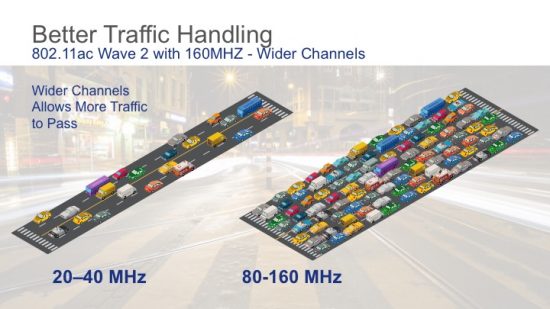
If it doesn’t, there’s no need to worry, one of the key innovations of 802.11ac wave 2 allows for greater over-the-air throughput by providing wider channels. The channels will grow to 160MHz and allow users to more than double their throughput.
A simple way to think of this if your current 20MHz channel is a two-lane road, the new 160MHz channel would be a 16-lane super highway.
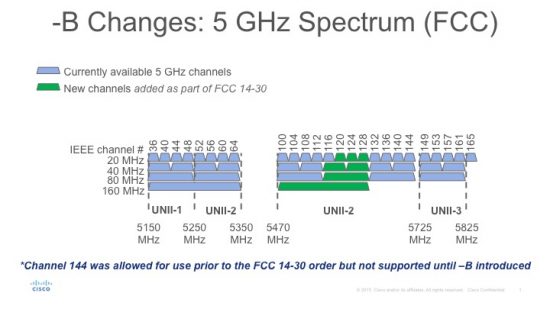
With the June 2nd 2016 publishing of the FCC 14-30 Order, the FCC now allows the use of three additional channels (120, 124, and 128). This order allows you to configure your wireless network as either:
• 2 x 160MHz channels
• 6 x 80MHz channels
• 12 x 40MHz channels
• 25 x 20MHz channels
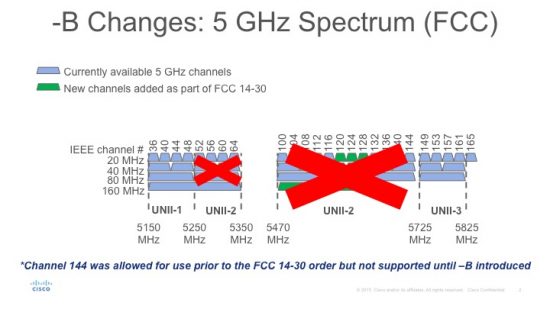
Other Wi-Fi vendors have not worked as closely with the FCC as Cisco and have not followed the FCC 14-30 order. The have chosen to vacate the entire UNII-2 band instead by completely dropping DFS channel support. This has a huge impact on the network because a majority of client support DFS channels. This means that they are cutting the number of 5GHz channels by almost 70%, resulting in less overall client capacity, due to non-compliance with the FCC 14-30 order.
By removing UNII-2 channels, other vendors can only use:
• 0 x 160MHz channels
• 2 x 80MHz channels
• 4 x 40MHz channels
• 9 x 20MHz channels
This is equivalent to buying a brand new McLaren F1 and driving it on a dirt road.
If you have the Cisco Aironet 2800 and 3800 Access Points , what does this mean for your wireless network?
Cisco paves over that dirt road and provides the asphalt for your McLaren. Two 160MHz channels, in combination with the 2016 Best of Interop Award-Winning Flexible Radio Assignment, provides you with up to 5.2Gbps over-the-air. This is three to four times the wireless speeds of any other access point on the market, with three times the number of channels supported. That means you won’t have to worry about the amount of devices brought into your office, nor the applications that are being run.
Flexible Radio Assignment give your access points the ability to optimize your wireless network for capacity and coverage by allowing for dual 5GHz radios, configured with 160MHz channels, while other Wi-Fi vendors are still choking on a cloud of dust.
To learn more about Flexible Radio Assignment, click on the Cisco Aironet 2800 or 3800 pages.
Submitted by Kelsey Kusterer Ziser, the Editor of Upskill U at Light Reading.
In order to reap the full benefits that virtualization provides in greater network flexibility and reduced opex, service providers need a strong strategy for developing their big data and advanced analytics capabilities. These two components are critical in establishing a self-healing, self-managed network in the world of NFV and SDN.
Starting June 10, Light Reading and Cisco are launching a series on Big Data Analytics at Upskill U, a free online university providing must-have education on themes relating to the overall business transformation taking place in the communications industry. The first course in the four-part series on Big Data Analytics will examine the fundamental questions as to the role of big data and advanced analytics and explain what service providers need to be doing as they prepare for virtualized networks. Future courses will deep-dive into big data analytics through the lens of security, customer experience management and IoT.
Secure your seat for these exciting courses as Upskill U wraps up a series on Cloud Platforms & Services and launches the Big Data Analytics learning module:
Ethernet & the Cloud (Friday, June 10, 1:00 p.m. ET): Chris McReynolds, Vice President, Cloud & Data Services, Level 3 Communications, will discuss how the rise of virtualization is creating new demand for network-as-a-service options that combine physical and virtual network elements flexibly, while also delivering on the quality promises for which Carrier Ethernet has become known.
Assuring Security in a Cloud-Based NFVi (Monday, June 13, 1:00 p.m. ET): In this lecture, Patrick Donegan, Chief Analyst, Heavy Reading, covers ways of ensuring that security is preserved in the NFV environment and the security orchestration and other technologies needed for virtual networks.
Analytics & Virtualization 101 (Wednesday, June 15, 1:00 p.m. ET): Sachin Katti, Assistant Professor, Electrical Engineering & Computer Science, Stanford University, will examine the fundamental questions as to the role of big data and advanced analytics and explain what service providers need to be doing as they prepare for virtualized networks.
Big Data Analytics & Network Security (Friday, June 17, 1:00 p.m. ET): In this lecture, Ray Watson, Vice President, Global Technology, Masergy, explains how analytics can be used to strengthen network and advanced threat protection capabilities, and automate threat intelligence to detect, analyze and remediate attacks.
With the communications industry changing ever more rapidly, it’s crucial for network engineers and enterprise decision-makers to reskill and stay relevant. In Cloudifying the Network on May 20, Upskill U guest lecturer Mary Stanhope, Vice President, Marketing, Global Capacity, said, “You are doing a great service with Upkill U and hopefully the listeners agree. It’s a great source of information… I really encourage everyone to share it with other parties they know and work with because it’s really exciting and thank you so much for setting it up.” Tune in to Upskill U and stay ahead of the curve amidst industry-wide changes. Take a look at the rest of the exciting courses in Upskill’s curriculum, and I’ll see you on the chat boards: www.lightreading.com/upskillu.
Suppose there is a treasure at the top of a mountain worth $405B. It is more than one person alone can carry back down the mountain, and you have a chance at that treasure. Many people want the treasure and will work hard to get to the top to claim it. All you have to do is make a plan on how to get to the top of the mountain quickly, so there is some left, and then determine how you can take as much of that treasure with you. But where do you start? How quickly will you need to move to beat others to the top?
This scenario is playing out in the retail banking industry right now. Cisco just released a comprehensive research study, “A Roadmap to Digital Value in the Retail Banking Industry.” The study highlights a massive opportunity for those banks that digitize and innovate: $405 billion in potential digital value from 2015-2017 (the treasure!). The path to that value isn’t easy, and the report underscores that banks are challenged by everything from agile fintech disruptors and changing customer expectations, to complex compliance demands and outmoded IT investments.
However, unlike the mountain example above, where no clues are provided about how to get to the top and obtain the treasure, we know that more than 90 percent of that $405B is driven by key digital use cases; such as sales and services transformation, next-generation workers (workforce transformation), mobile payments, video advice, and virtual tellers. We also know that a key aspect of these plans must be a robust foundation of cybersecurity.
Further, we can assess your current strengths and starting point, helping you to more quickly get to a point where you are adopting and combining the right digital use cases for your needs. All while doing it securely, so you capture your share of the $405B treasure.
https://youtu.be/s9Ep-7bLO-g
Luckily, a key aspect of your treasure map leverages the expertise, financial advice, and customer service retail banks have traditionally provided. It just involves providing all of that digitally — with, for example, bank associates empowered with real-time data insights and the ability to service more customers than ever before, in the branch or beyond, via video.
And while traditional branches may have less of a place in the plan to capture the digital value, digitally enabled branches will continue to be another source of differentiation that online fintechs simply can’t match. As in retail, bank customers still want to visit a space where they can carry out their transactions, receive financial planning assistance, and learn about new financial products.
The treasure is real, and we have many clues on how to provide the kind of experience that is convenient, relevant, and seamlessly integrated with all channels through which the new digital customer accesses services. Your starting point, combined with these clues, is your Digital Roadmap!
It is an exciting day for Cisco and IBM; as it marks the next step in our long-term strategic relationship. I’ve blogged recently about the importance of industry collaboration. Within the vast world of technology, there isn’t one vendor who can address all challenges with a single product. This is why alliances like Cisco and IBM are so important. It brings together industry leaders, best in class technology and collective minds in an effort to address collective challenges.
Cisco has been on the cutting edge of innovation for many years. Like trailblazers, we have always been forward-looking; searching for new territory to explore, tame, and make useful for others. Sometimes we do it on our own and sometimes we do it with other like-minded and proven companies. That is why today, we are combining our edge and fog analytics capabilities with IBM’s Watson IoT Cognitive Computing to create a first of a kind technology collaboration.
This new venture combines Cisco and IBM’s collective strength to make data and analytics the key to abstracting value in hyper-distributed environments. Hyper-distributed environments develop as massive amounts of data are being created in a very distributed way, outside the four walls of the data center. As you can imagine, to control and leverage this data has been a complex undertaking to say the least. However, that was then. This is now.
Now, industrial organizations and those in remote locations with intermittent network connectivity can take advantage of the cloud, cognitive computing and network intelligence, working together – analyzing sensor reading at the point of collection, eliminating the need to transfer all, or unessential data to the cloud. The combination of these technical capabilities provides the flexibility of processing and analyzing data everywhere, at the edge and in the cloud, so it can be leveraged in time and context as the business needs to use it.
Early adapters across verticals are transforming their business by taking advantage of this technology. Bell Canada has improved performance reporting and reduced service interruptions by only transmitting the most important data from remote locations over the mobile network for analytics. The Port of Cartagena has increased productivity and streamlined operations with condition monitoring analytics to spot patterns in vibration, temperature and speed on shipping containers, which might have been otherwise missed when manually processed. SilverHook Powerboats can now detect the need to throttle back and reduce speed for one-half second to help ensure engine governors can continue to keep the boat’s speed steady and performing optimally.
I am personally very excited about this announcement and our ongoing collaboration with IBM. Through this integration of connected things and people we can enhance the quality of each business decision – whether it be right now, next month or next year – this is value of a complete data and analytics strategy.
Another day, another gathering focused on the evolution of technology at Code Conference. Big names, big ideas, and a lot to think about. Executives and activists. IBM, Google, Facebook, Gates Foundation, Twitter, Cisco, Musk… It’s too much for one post, but here are some highlights.
Internet Trends with Mary Meeker KPCB’s Mary Meeker set the stage for the day with an overview of her annual Internet Trends report. She covered a lot of territory from the report, which – as she describes it – is really designed to read at your leisure on the device of your choice. And honestly, trying to keep up with her to tweet and take notes? Close to impossible. In part because she’s sharing so much so quickly, but also because the information is so good that you don’t want to pause to type. I’m a data geek and a word geek. So when you can integrate Candace Payne of YouTube Chewbacca mask fame into your fine-detail data, you get my vote. Meeker manages to dig into the real data in the world without losing track of the real world. So, here’s Mary Meeker’s Internet Trends 2016 report to peruse at your leisure.
Bill and Melinda Gates on Philanthropy The Giving Pledge is an interesting example of a different way people are collaborating. Specifically, it’s a commitment by the world’s wealthiest individuals and families to dedicate the majority of their wealth to philanthropy.
“We’re finding places where innovation makes an enormous difference,” says Melinda Gates. “Sometimes people underestimate how what they’ve done in their business can be applied to philanthropy.” In fact, more than $2 billion of the money distributed by the Gates Foundation goes toward pure R&D.
The Gates Foundation is focusing on issues including women’s health issues, polio eradication, education, and vaccines. According to Bill Gates, “negative rumors about vaccines have killed literally millions of people.”
How do technologists rate as philanthropists? “Compared to other industries, the successful people in technology are the most generous,” said Bill Gates. ”There’s no other industry area that’s this generous. Most leaders in the industry – not all – have made the commitment and are getting involved in philanthropy, even at a young age.”
For good measure, here’s a book recommendation from Bill Gates: The Master Algorithmby Pedros Domingos.
Cisco’s Chuck Robbins and Customer Focus
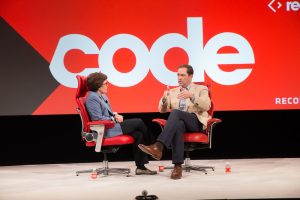
In his first visit to the infamous Code Conference red chairs, Chuck Robbins sat down with Kara Swisher to talk about his focus at Cisco. While there’s always focus on Cisco’s networking hardware, Robbins pointed out that the majority of engineers at Cisco are actually software engineers – 23,000 of them. Hardware or software aside, he stressed that the real focus is to deliver what customers want and need to achieve. And partnerships follow the same thread, stressing that the real anchor of successful partnerships is coming together to create better value for customers.
Chuck Robbins and Kara Swisher at #CodeCon.
Swisher isn’t known for pampering anyone with fluffy questions, so she asked Robbins for his perspective on competitors, especially in the collaboration space. “Whenever you see competition in the market, you know you’re in a good market,” he said. “There’s always going to be good competition, but we have to focus on serving the customer.”
He talked about how Cisco Spark fits into our overall collaboration architecture and how we look at development overall, explaining that “In everything we build there are 2 fundamental requirements: It has to scale and it has to have inherent security.” He also talked about Spark’s open APIs, the developer community, and the $150 million Cisco Spark Innovation Fund.
When it came to identifying a “killer app” for IoT, Robbins pointed to the emerging need for preventative maintenance of connected devices. Likewise, he believes “our collaboration architecture will be an element of how #IoT use cases are realized by our customers.”
When it comes to innovation, Robbins acknowledges that we’ve made mistakes. Is that a bad thing? “If you don’t have things that are failing, then you’re not trying hard enough to innovate,” said Robbins.
Elon Musk Lands on Stage
Artificial intelligence has been a common thread throughout the day. Instead of theoretical “what-if” discussions, the conversations are much more about the actual application of AI in real-world business. And beyond that, the changes it involves – both what it requires to succeed and how it will impact us going forward.
The commentary was pro-AI, for the most part. And then Elon Musk shared his perspective, most easily explained as “not all AI futures are benign.” For Musk, it’s less about AI as a concept but more about the people who may control the systems. Honestly, I think he melted my brain for the first segment of the interview with Walt Mossberg and Kara Swisher. At one point I found myself attempting to figure out whether hypersonic velocity and grid fins were somehow related to a really fast shark that’s kinda square. (I’m pretty sure I was off base…)
Overall, Musk covered a lot of territory. But don’t take my word for it, check Recode’s Facebook page for the video. A few soundbites on topics covered in his talk.
Mars:
“If you’re going to choose a place to die, then Mars probably isn’t such a bad place.”
Musk: “We should be able to launch people in 2024 with arrival in 2025.” Mossberg: “Is that more a certain schedule than United Airlines?”
“Why would we abandon earth? It’s nice here.”
Batteries: “There’s so much nonsense out there about batteries that you can believe about half of what you read.”
The election: “I’m glad the Constitution saw it fit to make sure the president is a captain of a large ship, but with a small rudder.”
Hyperloop: “I kind of have my plate full running Tesla and SpaceX.”
Innovation: “40 years ago we had Pong – two rectangles and a dot.”
But before I go, I leave you with “Meeker for Millennials,” released yesterday in anticipation of today’s release of the Internet Trends report:
Mic drop.
Photo credit: Asa Mathat for Vox Media
Follow Recode’s own coverage, including posted and live video, on Recode’s Facebook page.
Oil and gas executives are often asking these tough questions:
Where is the oil industry going?
How will it get there?
How soon does it need to get there?
I answered some of these points in a study I was proud to help create last year (A New Reality for Oil & Gas). I’m now pleased to announce a further updated report that looks at Digitization itself: what it means to customers, partners, and the industry.
The price of oil is riding a roller coaster. A few weeks ago, oil was close to $30 a barrel. This week, it is approaching $50. Who knows where it will go? One thing’s for certain – those companies and organizations who embrace the new world of digitization will thrive. The laggards will not! Our new report found that:
Adoption of digital solutions is accelerating.
Digitization is disrupting and redefining industries.
Digital technologies are becoming more mature and pervasive.
New digitally driven business models are changing the nature of competition.
The consumer sector is now driving significant digital value.
One enormous challenge is the huge deluge of data when we look directly at the oil and gas industry. We found that the number one driver for digital investment is linking to data analytics for faster, better decision-making.
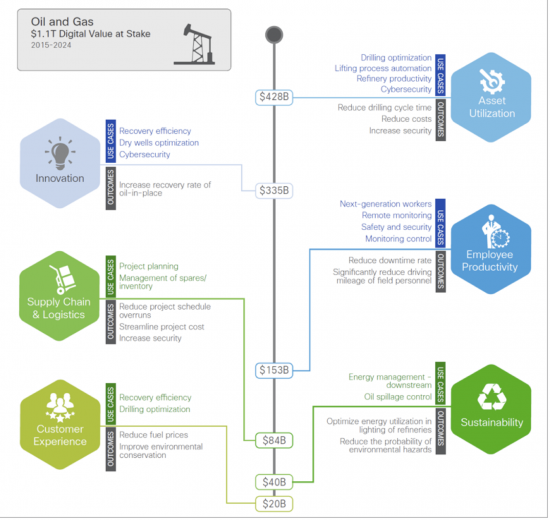
We also found that O&G companies can drive $86 billion in Digital Value by integrating cybersecurity directly into their digital platforms to reduce security breaches — and drive growth.
It doesn’t end there. I’ve often blogged about the adoption of next-generation worker technologies such as mobile collaboration, bring your own device (BYOD), and video collaboration. We found that these will generate $45 billion in Digital Value across the industry.
When Oil stood at $100 a barrel, many companies were doing very little to improve business efficiencies and were more interested in maintaining market share. Now cost savings and revenue growth are even bigger business imperatives, driven by new technology that allows digitization to becomes reality.
But how do you start?
It’s easy as 1-2-3:
1. Find out where you are on your digital transformation journey.
Some companies are looking for technologies to enable their transformation. Others are looking to enhance their customer experiences via digitization. Those in the know are already using the technologies to define their strategies with new business models.
2. Select digital use cases that deliver high-value business outcomes.
Here are some examples: simplifying and automating processes, empowering your work force to be more efficient and innovative, and getting close to your customers with more personalized experiences.
3. Develop digital business agility.
This hinges on three capabilities: Hyperawareness, informed decision-making, and fast execution. The first is about detecting changes and monitoring your business environment. The second is about having the ability to augment human judgment with superior data analytics throughout the organization and its processes. The third point is obvious, but is often neglected: carrying out plans quickly and effectively, and focusing on successful change management.
All of this needs the confident adoption of digitization technologies. In some cases (since budgets don’t always cooperate!), the investments aren’t entirely new. You can digitize by augmenting your secure and reliable network. If you chose Cisco for your network infrastructure, then digitization will be easier for you since you can build new capabilities into your existing network – including pervasive security and manageability as Cisco uses an architectural approach.
Let me leave you with a final thought from the revised report:
“When it comes to digital transformation, the real cost lies in not digitizing.”
Imagine a school where students use mobile devices to learn from anywhere at any time. Students can interact face-to-face with classmates around the world. Where students and educators who can’t be present in a classroom can still be part of the class. Educators, superintendents, administrators and deans come together virtually to collaborate with video conferencing.
Imagine a school where learning has no limits. This is the power of video.
Education institutions constantly look for ways to make learning more accessible for students. Making access easy and convenient for students can lead to an increase in registration, participation, and engagement.
“The technologies of tomorrow are already being tested in select classrooms today, laying the seeds for the future of how students could learn. A few of these technologies have already made headway into education, and others are poised for mass distribution, with the promise of ground-shaking change in their wake,” notes EdTech magazine.
Video helps schools:
Optimize learning experiences
Extend classroom environments
Increase administration efficiency
“Online video in education is the new normal. It has become one of the dominant ways people learn. This trend does not negate the value of traditional education, nor does it indicate that YouTube cooking tutorials can replace a good culinary school education,” states an article, The State of Education Video 2016.
How Schools Can Transform Education This transformation starts with three principles.
Bring educators and students together to collaborate in real-time. Use interactive, media-rich experiences to address evolving student learning styles. The Journal reports that one-third of students access online video on their own initiative to help with their homework, and 23% of students access video created by their teachers.
Simplify access to experts. Extend learning beyond the traditional classroom. Give students, teachers, and guests the power to connect and collaborate across geographic locations. U.S. education spending has doubled over the past 20 years. The fastest-growing segment of spending is digital education technologies, which is expected to increase by 3.2 million by 2018, reports Deloitte University Press.
Make mobile teaching and learning possible. Deliver access to services and support on any device. Broaden the learning experience by enabling distributed, virtual classes. “On average, college students spend more than 3.5 hours per day using their mobile phones, and Information Week reports that students own an average of 2.7 devices,” states a 2015 Higher Education Horizon report.
Many schools are already benefiting from video to transform across physical and virtual environments. Check out these real-life examples of how schools are experiencing the transformation:
Meet Thorben, a 10-year-old inspiring, funny, and smart boy battling cancer. Video helped keep him connected to the outside world and his classmates while he was unable to attend school in person.
San Jose State University uses Cisco WebEx Meeting Center, Cisco Jabber, and video conferencing end-points to offer flexibility to students and faculty, and extend collaboration with learning institutions internationally.
“Cisco’s video and collaboration solutions enable educators to teach and students to learn from anywhere on any device,” says Greg Mathison, a senior manager of education solutions at Cisco. “It does this while enabling virtual face-to-face relationships that are fundamental to education.”
The opportunity is here. The technology is available. There’s no better time to use video to improve education.
Whether it’s your first or tenth time at the INTX show, it is still an exciting and happening place. This year 9,000 attendees gathered at the INTX 2016 to learn about the best products and solutions which exhibitors brought to this glamorous event. There were quite a few social media communications going around evangelizing what is hot, new and exciting in the word of Internet and Television.
Cisco established its presence with an executive suite where we presented several key solutions and had a number of discussions around the topics of cable access and video solutions, such as Infinite Video and Virtualized Video Processing.
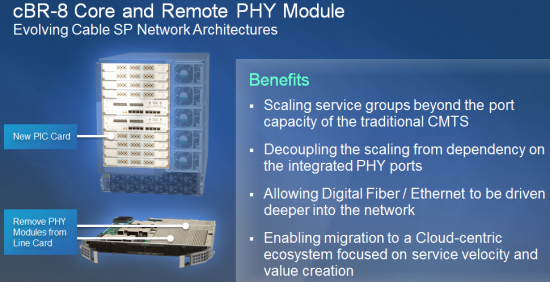
Cable access is represented by a converged broadband router (cBR-8) which is a flagship device with multiple benefits. The Cisco cBR-8 is a next-generation Evolved Converged Cable Access Platform (CCAP) that helps cable operators support these services with the industry’s lowest TCO over the next five years.
There were plenty of attendees who came to the executive suite and have shown great interest in learning about the benefits of Cisco cBR-8. Multi-gigabit delivery and deployment were the key topics of discussion. But that was not all. It was inspiring to know that the attendees had strong familiarity with the DOCSIS3.1 value proposition and the benefits of rolling out DOCSIS3.1 specifications.
There was a lot of interest in the Remote PHY (R-PHY) solution. Our visitors wanted to understand how cable access solution can scale with the R-PHY in place. So we went at length to describe how R-PHY will increase scale and density. We explored how R-PHY gives the headend more bandwidth and creates opportunities to deploy various functionalities. The Cisco Remote-PHY solution provides a cost-effective digital fiber-based DOCSIS solution and with R-PHY in place, the next step of virtualizing CMTS becomes possible.
Infinite Video team gave a remarkable presentation. They appealed to their audience that Over-the-top (OTT) delivery of TV and video content is growing at an exponential rate. Infinite Video is delivered as a service from the cloud. That means it will get you to market quickly, without large upfront costs.
Another video solution, Cisco Virtualized Video Processing, provides an open, programmable, scalable, and extensible platform so you can innovate rapidly. It lets you support video processing applications in your headend and data centers without being tied to the operational features of the underlying infrastructure. By orchestrating end-to-end workflows from video acquisition, processing, and delivery, Virtualized Video Processing provides you with greater agility and time to market.
At INTX, we also celebrated Cisco’s Yvette Kanouff, SVP Service Provider Business being inducted and accepting membership in the Cable TV Pioneers Society.
All in all, it was a great show as the show’s motto this year indicated: “Harnessing Disruption: Turning Today’s Chaos into Tomorrow’s Growth” thus fueling the ideas of tomorrow. And then there was some creative leisure. One could play miniature golf or a game of giant chess.
See you at our next show stop: SCTE Cable Tec Expo to be held in Philadelphia, September 26-29 2016.
In case you’ve missed it, the U.S. government has been making calculated decisions over the past few years modernize its approach to technology. That modernization, however, is much more than just buying the latest pieces of equipment and software, and it’s no secret that government has typically been behind private industry when it comes to embracing the latest technology has to offer. To fully embrace digital practices, government has been making a concerted effort to strengthen its connection to technology’s innovative minds in Silicon Valley.
As my colleague and Public Sector Vice President Larry Payne points out in a recent Bloomberg Government article, this process is well underway with agencies like the Department of Defense and Department of Homeland Security helping buttress that relationship with new outposts in Silicon Valley. Additionally, the current administration has recruited several Silicon Valley veterans and brought them to Washington, D.C. to help change the culture of how technology is used and viewed by government agencies.