A recent study analyzed more than 100 million emails and 60 million calendar entries from a 100,000-employee company over three months. The results are interesting. When two people were in the same business unit, function, and office, they interacted 1,000 times more often than two people in otherwise similar roles, but different units.
This is an important finding. Consider that 64% of private-sector digital value at stake is tied to people-centric connections.The technologies mainly used for employees to collaborate today—such as email—are often aligned to the traditional organizational structure, communication dynamics, and decision-making processes in the hierarchy of the organization. As a result, they are not set up to leverage the convergence of digital technology, including the Internet of Things and collaboration platforms, to unlock knowledge from email inboxes and stored away on hard drives.
It can’t unlock knowledge from email inboxes and stored away on hard drives. How siloed is communication in your organization?
Today’s business calls for simplifying information flow and idea sharing among teams. Cisco Spark provides room- and team-based messaging with content sharing and video. People create virtual spaces where they can message, meet, and call via text, voice, or video.
For many industries, neglecting to adopt new digital technologies for employee productivity translates to abandoning significant opportunity. Let’s take manufacturing. Cisco estimates that 33% of digital value at stake in manufacturing is tied to employee productivity.
Adopting mobility (BYOD), telecommuting, and video collaboration alone can translate to a 35% gain in knowledge-worker productivity, while reducing business travel up to 17%.
What digital value are you leaving on the table? Don’t let it become your nemesis.
Join us at Cisco Live to see how your business can benefit from Cisco Spark. See how we’re making it easier than ever to deploy and use our collaboration portfolio.
If you are heading up an application develop team or are running an IT organization and you are looking at your developers initial steps to developing cloud native applications, I want to share some experienced insights gained from PaaS customers. For me it is a view of the path many of you may be heading down applying some best practices that can optimize Dev and Ops together.
Apprenda, one of our ACI ecosystem partners, and Cisco recently hosted a series of presentations, we called PaaS Days, about the Application-Centric Enterprise to share how private PaaS and policy driven automation together can address real-world problems such as application time-to-market, datacenter security and corporate compliance. I want to share some insights I gained there about different application strategies for cloud. Depending on the company’s cloud maturity level and whether the management is centralized or not, the application strategy can take on a project oriented or an organization level scope.
The primary value drivers for an application strategy scoped at the project level were to address specific application concerns quickly such as
scalability and availability, or
the need to use cloud native patterns not yet supported by IT.
In this case, developers are adopting technology independent of IT and are driven by immediate business needs.
With an application strategy scoped at the organizational level, the primary value drivers are
to support the business need to rapidly deliver new software,
standardize the architecture for the organizations applications, and
to provide developers a service that parallels a pure public cloud offering.
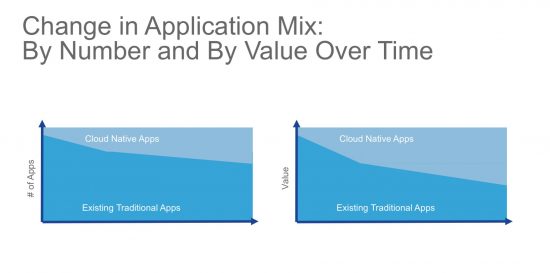
For a business transforming itself into a digital enterprise, the composition of applications in the application portfolio changes over time. The percentage of cloud native applications expands but existing traditional applications will still exist to sustain key systems of record. The new systems of engagement built on cloud native applications are expected to deliver greater customer value, drive revenue growth, and contribute to improved bottom line results for the enterprise.
If application developers take a project oriented approach they may simply focus on a cloud native platform for their one project. When there are many projects, developer efficiency improves by using a Platform-as-a-Service approach.
When this approach can support cloud native applications AND existing applications, value delivery by the application portfolio can be better optimized. IT leadership will want to see shared efficiencies and controls to ensure scale, performance, and compliance with security mandates as the value associated with the cloud native applications expands to real significance and strategic importance.
A simple example to appreciate the value and synergy by integrating the cloud stack from the PaaS layer to the infrastructure is to look at security policy for customer data in cloud native applications. Tenant isolation and white list policies can be specified at the PaaS layer for the cloud native application and automatically applied by Cisco’s Application Centric Infrastructure. See my blog ACI Policy Enables Secure PaaS and More at CLEUR for more details.
If the application platform strategy supports a common policy framework based upon the ACI policy model, the enterprise gets the operational simplicity, security, and agility delivered by ACI. The Developer team benefits from speed, efficiency, and secure policy driven application deployment using Apprenda PaaS for example. The Operations team benefits from automated workflows linking the application and infrastructure control and monitoring. And the end result is good for scaling the number of applications and delivering greater customer value using an open, agile, and secure architecture for IT.
As we gear up for one of the premier global IT education conferences, ISTE 2016, we’d like to speak to our partnership with iSchool Initiative and the iSchool bus that will be making an appearance at the annual conference.
iSchool Initiative’s vision is to revolutionize the education system and promote a culture of mobile learning through technology. They enable this culture by teaching with their iSchool bus tours, community and district awareness seminars, hands-on student and faculty trainings, and step-by-step technology roadmap planning.
CEO Travis Allen first developed the idea for iSchool Initiative when he had a negative personal experience while using a mobile device in school. In 2009 Travis’ phone was confiscated while taking notes during class because of his district’s ban on cellular devices. He went home that afternoon with a driving desire to figure out a way to show educators the benefits of using mobile technology.
Fast-forward to 2016 where iSchool Initiative has worked with 7 countries, 42 states, and more than 250,000 teachers to help implement mobile learning across the world.
Together with iSchool Initative, Cisco can help drive meaningful change in the education space.
According to CEO Travis Allen, “building the mobile learning culture requires a reliable and secure network infrastructure,” which Cisco provides.
Because of our partnership with iSchool Initiative, they’re able to bundle services at a discount of up to 35%. Learn more about these bundled services here.
The next big stop for iSchool Initiative is the annual ISTE conference, taking place in Denver, Colorado, June 26-29. Travis and team will be providing tours of the iSchool bus (equipped with Cisco Meraki equipment), demonstrations of their services, as well as an “Escape the Bus” game every 45 minutes.
If you’re going to ISTE, stop by the iSchool bus (booth #1300) and follow along with @CiscoEDU on Twitter for live updates from the conference.
Last month Cisco was thrilled to participate in the Department of Defense (DoD) Trident Spectre 2016 annual exercise conducted at Joint Expeditionary Base Little Creek-Fort Story, VA. Trident Spectre is an annual event for special operations, intelligence, interagency, and law-enforcement personnel to test and evaluate emerging technologies both from government and commercial industries in tactically-focused scenarios.
During this year’s event, we demonstrated our Next-Generation Encryption (NGE) technology as part of a secure classified mobile solution. Cisco partnered with Optio Labs and Sonim Technologies to create a secure mobile solution that gives soldiers real-time access to mission critical data such as high definition drone feeds. On-demand secure video feeds from military drones are transmitted to a Sonim Secure XP7 handset with security by OptioCore embedded into the device. Then, Cisco’s NGE technology not only makes sure the device stays secure, but it also enables administrators to manage policies and provides access to the mobile handsets remotely from private networks, private clouds, and even the public cloud.
Additionally, Cisco AnyConnect VPN was included to extend secure communications to the tactical edge. This enables remote, on-the-move users to have constant access for real-time communications, leveraging chat, voice, and video while utilizing a variety of last-mile connectivity options.
Cisco’s NGE solution enables soldiers to obtain secure, real-time information, creating increased situational awareness to help make informed yet fast decisions on the battlefield. The ability for administrators to access mobile devices through multiple secure platforms gives the DoD and our soldiers the flexibility they need to carry out their missions successfully, no matter what.
This is truly a unique offering in that it offers defense-grade security on the world’s most rugged device, and Trident Spectre was a great opportunity to demonstrate these unique capabilities for soldiers operating in constrained environments. We’re looking forward to next year’s event already!
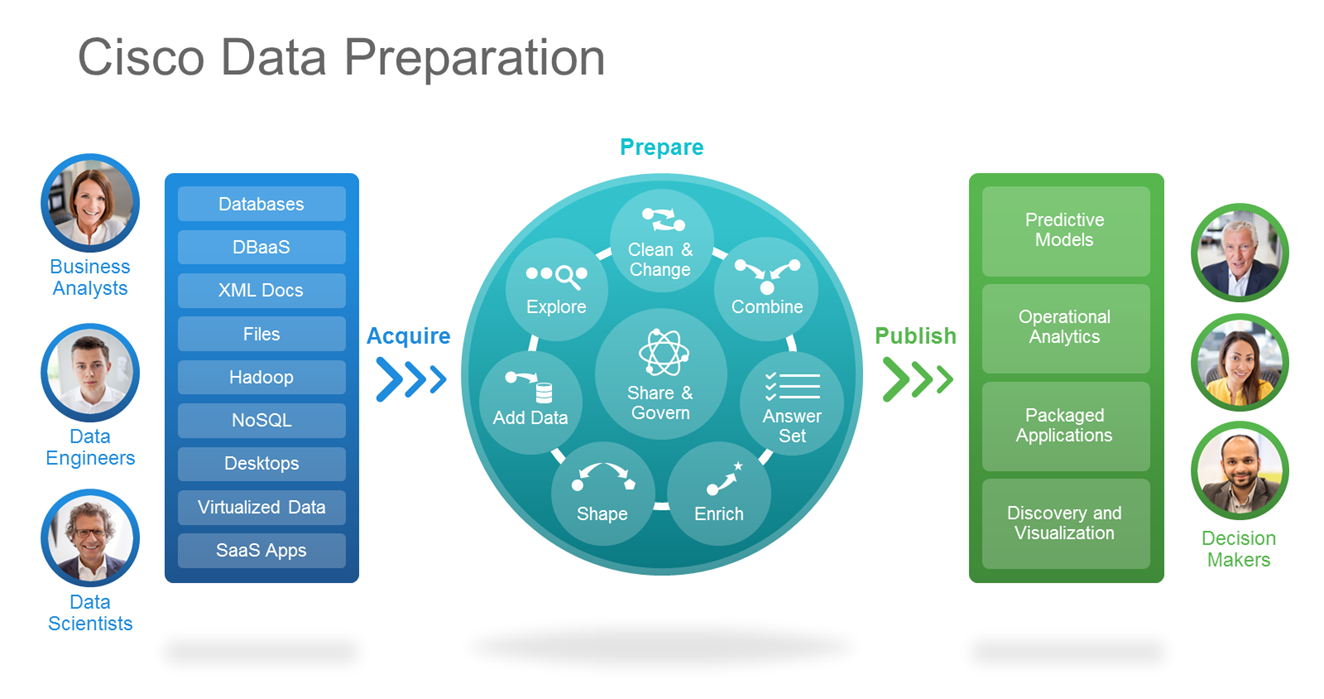
In just three short years, self-service data preparation has gone from a nascent concept into what one IT analyst firm called the “Next Big Market Disruption” at their recent BI and Analytics conference.
Benefits to Data Preparation Adopters Are Significant
A myriad of benefits are driving this accelerated adoption. On the business side, these include far more insights, sooner, which lead to positive and significant business outcomes. On the IT side, data preparation greatly expands data integration capacity by adding a new workforce (business analysts) and a new “Mode 2” exploratory data integration approach that complements “Mode 1” Operational IT. I recently blogged on this win-win for business and IT.
Analyst Firms Recognize and Advance the Trend
With a close ear to both the user and vendor communities, analyst firms have gathered an assortment of data on self-service data preparation. Based on these inputs, historical insights, future projections and more, these firms are now publishing seminal research reports across a range of perspectives.
To give you a sense of the what analysts are saying about data preparation, I recently did a search on several firms’ sites. In 2016 alone, nearly 20 Gartner analysts have contributed to 41 research reports covering various aspects of data preparation. Forrester Research is prolific as well with a dozen analysts contributing 19 research reports.
IT analyst firms have done us all a good service with their published research. If you have a subscription, then take advantage.
But there are many other paths to data preparation insight. Vendors such as Cisco have also done a good job providing multiple learning options. Check out our Intro to Data Preparation video on Cisco Data Preparation’s homepage.
Cisco Systems is participating in the Federal Law Enforcement Training Center’s (FLETC) Cybercrime Conference, held July 6-8, 2016, in Glynco, Georgia. The purpose of this event is to foster education and awareness of the current threats and innovations that may impact today’s law enforcement officers and the manner in which they deal with cybercrime. The intent is to educate investigators with exhibits, lectures, demonstrations, and hands-on labs. During the conference, attendees will have the opportunity to collaborate with other FLETC training division staff, Partnering Organizations, as well as vendors.
I will be representing Cisco and presenting on “Dynamic Malware Analysis and Threat Intelligence for Law Enforcement”, on July 7th at 9:30am EDT, in Room 43 of Building 217. In addition from 6-7 July, I will be giving demonstrations of the AMP Threat Grid platform for dynamic malware analysis and threat intelligence, including the integration with EnCase Forensic.
Participants in the FLETC Cybercrime Conference will be eligible for the Cisco AMP Threat Grid Law Enforcement Program. The no-cost AMP Threat Grid for Law Enforcement program is for state and local agencies with less than 1,000 sworn officers. Once empowered with AMP Threat Grid, within seconds of a threat intelligence query or within a few minutes of a submitting a suspicious file or URL for analysis, an investigator has the ability to view and download an easy-to-read and comprehensive report detailing the actual behavior of the submitted file, including changes to the file system, registry, command-and-control communication, downloads, code injection and other malicious activity. In addition, AMP Threat Grid will correlate the file with the millions of samples and billions of artifacts in the threat intelligence database, providing instant global and historical context.
Although the no-cost program is designed for small state and local agencies, Federal law enforcement officers who attend the FLETC Cybercrime Conference will be able to enroll in the AMP Threat Grid for Law Enforcement program. June 20, 2016 is the deadline to register to attend the conference.
What do analytics, software, install base refresh, and giving back have in common? Google doesn’t have the answer but we do. This week we’re talking about:
A real time intelligent view of everything happening in your network
What our journey from hardware to software means for you
A fresh perspective on install base refresh
A key ingredient to innovation
How kids explaining the Cloud is raising money for St. Jude’s Hospital
Do you know what’s happening in your network? And your customers networks?
This week we launched Tetration. See if you can find which blog has this simple description of what it is, and what it means for you and our customers:
It’s the first Analytics Platform in the market that provides pervasive and complete visibility across everything in the data center, in real time – every packet, every flow, every speed. A single Tetration appliance monitors up to one million unique flows per second. Think of it in this way: if a problem in a data center were a grain of sand in the desert, Tetration would find it!
>> Fast Forward. We’re going to talk more about Tetration this month so come back for more.
The journey from hardware to software: what it means for you
Software is a key to our transformation. Hear our CEO, Chuck Robbins’, vision for our partners as we shift from hardware experts to software specialists. Together. Watch the video.
Software is a key ingredient to innovation
SVP John Bridgen says, “Overly complex software will slow implementation and impede innovation. Consumption models will need to align closely with a company’s needs, IT budget and timetable for adoption of new technology.”
Are you investing in the right (Cisco) software to meet your customers’ needs and speed innovation? Read more about what John has to say in this blog.
>> Fast Forward. We’ve got a great line up of blog authors and social posts coming up to keep you informed on software and all things digital.
A fresh perspective on install base refresh
Sales 101: Refresh the install base. Make more money.
Are you read to take this one step further to make more sales, make more money, and make more customer happy? Find out how to focus on post-sales engagement and create customers for life. Help your sales teams look beyond refresh and beyond the sale in this Blog.
Kids explain the cloud; St. Jude’s Hospital gets money
What’s interesting, humorous, and generous? When kids explain the cloud, our friend’s @Meraki will donate $10 to St. Jude’s Children’s Research Hospital.
The partner weekly rewind and fast forward is designed to give you a snapshot of what you missed and what’s to come. Tell us what you think and what you want to hear about in the comments. And come back next week for more!
This is the second of a two part series on Tetration Analytics, a platform designed to help customers gain complete visibility across their data centers in real time. Part 1 covered challenges, an overview of the solution, and components. Today, I’ll cover use cases, benefits and additional resources for you to get more details.
Use Cases
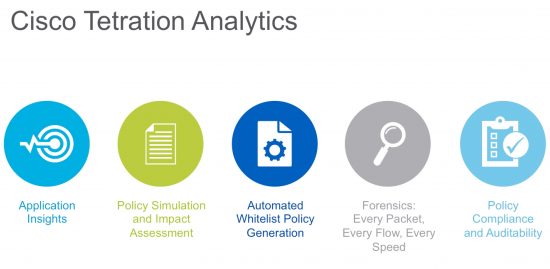
There are 5 key use cases I want to call out. These will help illustrate how Tetration Analytics provides such pervasive visibility and will help clarify why we call it a Data Center Time Machine.
Application Insights: I spent quite a bit of time covering the problems associated with this use case in the Challenges section of yesterday’s blog. The bottom line is that most folks simply don’t have visibility into their infrastructure. They don’t know all the apps on their network and even if they do, they don’t know where/how they’re communicating, or all the components a given app relies on to function properly. Tetration Analytics provides application behavior based mapping of processes and flows based on unsupervised machine learning (i.e. it figures stuff out so you don’t have to). It collects all of the flows North-South as well as East-West. It is smart enough to map and group your applications autonomously. You can also intervene and teach Tetration Analytics to learn new groupings if you have unique circumstances. As it maps the application components and all network traffic between them, this ultimately results in simplified application operations, migration and disaster recovery planning. It also allows you to convert this information into policies for ACI.
Policy Simulation & Impact Assessment: When we call Tetration Analytics a time machine for your DC, the inference is that you can look at the past, present and future. Here is an example of how you can look in to the future by simulating policy. With this use case, a user can essentially do an impact analysis using historical or realtime data – and NOT affect production traffic. This lets you see how new policies would affect actual traffic flowing through the network. You can also assess which flows will be classified as compliant, noncompliant or dropped. It lets you, for example, simulate a whitelist policy and assess its impact before applying it in the production network. Seeing the impact of a change before you make it clearly has huge benefits and can keep you out of trouble.
Automated Whitelist Policy Generation: I’m guessing you come from a blacklist world, i.e. any source can talk to any destination by default, unless you explicitly deny communication, through an ACL, for example. With whitelist policy, it’s just the opposite – nothing talks by default, unless you explicitly allow it. This is a beautiful thing, because it reduces your attack surface – exploits are kept from propagating across applications, tenants and data. This has obvious benefits in terms of security, but also compliance, since it is basically self documenting. This means no more scrambling to collect ACL’s for an audit, since compliance can be validated quickly by comparing actual traffic flows to the whitelist policies. As compelling as the whitelist policy model is, it can also be a challenge to move to if you don’t have visibility into all your apps, their communications, and their dependencies. Tetration can provide an automated whitelist policy that can be exported and deployed within your infrastructure for a true zero trust model.
Forensics: Tetration Analytics collects and stores all data flows allowing you to search them when, where and how you want. This significantly reduces the time to investigate and solve problems. You can look at things in real time or historical views of what happened in the past. Today, I’m guessing when you have a problem you instrument the area (enable a span port, use a tap, bust out a sniffer or whatever) and see what you can find. There are a whole set of challenges with that approach, but suffice to say they go away when Tetration Analytics is everywhere, constantly watching everything, allowing you to replay whatever you need, whenever you need it.
Policy Compliance: I mentioned this earlier, but in short, Tetration Analytics documents the policies in place and can compare the traffic flows against them, flagging exceptions and providing remediation.
Benefits
Tetration Analytics provides a multitude of IT and Business benefits. Benefits were covered here, and I’ll summarize a few more of them below:
IT Benefits
Make informed operational decisions driving intelligent changes with predictable outcomes (e.g. validate a change before it’s executed by understanding the change’s impact on applications)
Validate that policy changes have actually been applied and taken full effect
Bring greater reliability to data center operations with complete knowledge of interactions and dependencies in the data center
Long-term data retention supports forensics and analysis with an easy to use interface
Business Benefits
The benefits above translate into superior visibility, which lead to a more secure environment, as well as a more agile and highly available infrastructure. This means the business can better guard against brand damage resulting from security breaches, better avoid unplanned outages as well as move with more speed and confidence.
Resources
There is a lot of Tetration Analytics information in many different forms. Here is a quick overview to help you sift through some of it more efficiently:
2 minute overview video – what Tetration Analytics is
3 ½ minute overview animation – how Tetration Analytics works
A bunch more content at this web page…I’d especially recommend scrolling down to “I need to…” and checking out the whiteboard videos there
Thanks for checking out the blog. I hope you can see why we are so excited about the ways Tetration Analytics will help our customers gain pervasive visibility across their Data Centers.
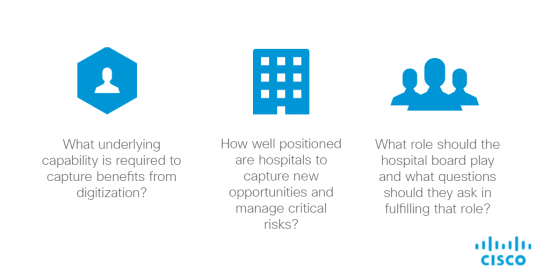
Dandolo Partners has just released a new report looking at the contribution of information technology to innovation and digitization in Australian hospitals. The report is a result of discussions with a range of key hospital stakeholders (hospital executives and board members, government representatives, technology experts) and secondary research. The work focused on three questions:
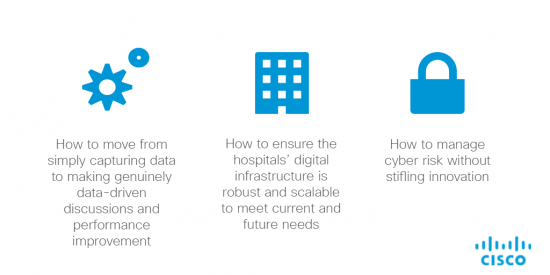
The report addresses the role of the hospital board and senior executives in capturing the benefits associated with this digital transformation. It looks to make the distinction between the enormous innovations that have driven the clinical procedures and device areas and the relatively slow rate of transformation in the information technology sector in Australia. It identifies the major information technology based issues that have prevented hospitals from capturing value from innovation and digitization in terms of three specific challenges:
Innovation is the engine that drives digitization in our hospitals. It creates the ability for hospitals to use information technology to capture the needed improvements in care quality and cost that will enable our communities to address its pressing challenges. Hospitals need to foster their capabilities in both areas to enable success. This process needs to be driven from the most senior leadership positions within hospitals. The aim of this report is to encourage the issue of digital transformation becoming a key responsibility of the board.
The report concludes with a final discussion about risk and highlights the implications of doing nothing or not enough as being “potentially devastating.” The possible outcomes of inaction encompass leaving poor performance undetected, systems inoperable, patient and organization data exposed and the institution deemed culpable.






 The primary value drivers for an application strategy scoped at the project level were to address specific application concerns quickly such as