In several parts of the world December 6 is a day that especially children look forward to: It’s St. Nicholas Day and children hope to be on St. Nicholas’ good side to receive a small gift. If you want to read more about the different activities to celebrate St Nicholas Day, you can learn more about it on Wikipedia. Numerous stories, some miraculous, are told about Nicholas, and often IT professionals are tasked to do work that borders on miracles or at least a many good stories can be told.
Now one of the best gifts anyone can give or receive is the gift of time. As we all know most IT professionals spend their waking (and non-waking) hours to keep the lights on. This is to stay out of trouble (fewer troubleshooting tickets is good), have more time to respond, and deliver on business needs (not responding in a timely fashion to line of business and developers is bad).
If you are an IT professional you know that to free up time in your day-to-day work, networkprogrammability and automation is crucial for being on the right (good) side of your customers. To help you with achieving that. a few months ago we released an updated whitepaper on Network Programmability and Automation with Cisco Nexus 9000 based on Cisco NX-OS, where we talked about the concept of the “data center strategy” becoming a “critical part of business strategy overall”.
Today, more than ever, the ways and means of IT deployment can make the difference between an efficient, successful organization and an inefficient one. That is because today’s apps and services support increasing numbers of business operations and create competitive differentiation in many industries. However, the resulting proliferation of apps and their underlying infrastructure is increasingly placing greater burdens on IT staff, demanding more from IT than ever before. One of the major burdens is the management complexity and the time required, which is considerable when you factor in what’s involved in configuring, deploying, and managing this infrastructure.
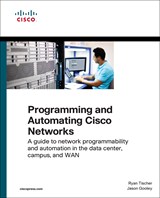
In addition if you are looking to gain a deeper understanding of Network programmability and automation, or still looking for a (St Nicholas) gift Cisco Press has the right book for you with ‘Programming and Automating Cisco Networks: A guide to network programmability and automation in the data center, campus, and WAN’.
Three Keys to Success Preparing Your Mobile Network for 5GDownload our new 5G ebook
The concept of slicing is a fundamental component of the 5G architecture and it permits network customization that can reach a personal level. One could call this the personalization of the mobile internet. We can do this by taking the slicing concept to a granular level not seen before by combining three main technologies of control and user plane separation (CUPS), virtualization and end to end automation.
By adopting the new architecture of CUPS, and moving to an NFV deployment and enabling automation for many of the typical operations, not only will the current service provider’s subscribers gain a richer suite of services, new opportunities and business models become available.
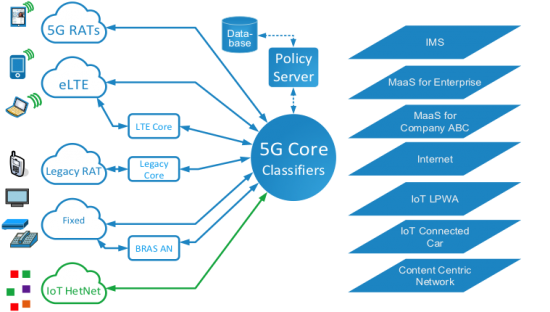
Figure 1 A 5G capable core can cross connect multiple access to multiple applications
Mobility standards bodies have agreed that separation of control plane and user plane shall be a corner stone of the 5G architecture. Service providers need not wait for standards though and can start deploying this architecture to address existing and new opportunities. For example, we now have the option to scale the user plane orthogonally from the control plane which significantly reduces the integration work needed to introduce a new network element.
Network Function Virtualization has received mixed press recently as the benefits of the technology are not always clear to see. However, when we consider 5G, slicing and the need to connect multiple access technologies with diverse customers, the need for a homogenized platform to deploy and manage the network functions becomes paramount.
Automation is the final key to the path to 5G and opens up a world of possibilities. Lifecycle and service configuration automation allow service providers to concentrate on innovating new applications for their diverse customers rather than worrying about integration issues. Automation simplifies an already complex network that is further complicated by separating out the user plane from the control plane and the exposure of the VNF virtual machine building blocks. By taking full advantage of the ETSI MANO framework Cisco’s automation solutions hide the complexity and management difficulty of an NFV deployment. Cisco’s automation also extends to service configuration by abstracting the configuration to a model rather than a node specific configuration file that requires manual handling.
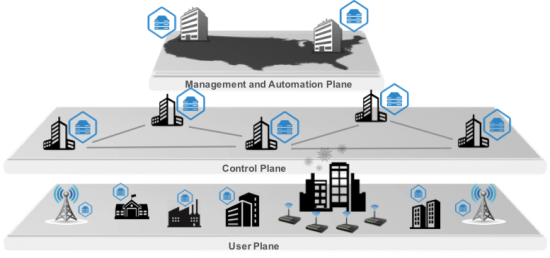
The simplification of node introduction has another overlooked yet positive consequence. Not only can we make the nodes more specialized, but we can make them smaller and even consider service chaining micro-services. The control plane will still maintain state and standard signaling interfaces to the RAN and subscriber databases, while the user plane and the IP services that compliment it are now software entities that are managed and controlled by the automation suite working alongside the control plane.
The user plane is under control from the upper control layers and the service automation, allowing that critical function to be distributed, to be reduced in size to reduce failure domain, and enable the introduction of micro-services in totally new environments.
For more information on 5G download our new, ebook and see our 5G White Paper Series here.
As I blogged in July of this year, Cisco supports protecting and enabling the international flow of personal data that furthers a progressive economy. To that end, we received official word that we are loud, proud, and on the list for the Privacy Shield – the voluntary, self-certification framework for EU-US data transfer.
Why is Cisco participating? Isn’t Privacy Shield being challenged along with the rest of the data transfer mechanisms? Although there have been challenges testing the effectiveness of our transatlantic partnership, we have seen that data privacy matters to Cisco employees and customers. Privacy is the authorized processing of personally identifiable information according to moral, legal, ethical, and sustainable fair principles. That’s a mouthful to be sure, but when we break down privacy governance into explicit, commonly shared and understood, managed, and accountable steps, we can achieve safety and governance – but also so much more. When we break down our fiduciary responsibility whenever we are exposed to personally identifiable information, we find value. We can prevent harm. We can promote high-quality data. We make better and more meaningful and lasting decisions.
We become better employees, companies, citizens, and people when we protect and govern our data and that of our fellows around the globe. Privacy is great for business. It should make our customers happy to know we work every day to keep them as secure and protected as possible, particularly when a new asset class such as data is created, combined, or shared anywhere along a value chain. But the real Cisco behind the Shield is so much more. I dream of a new world where we have even a centimeter more safety; where data tells a true story; and where businesses can create new and better experiences tailored to their customers’ needs and wishes. And when I think about my half century on this planet, I realize my interface with people will be my lasting legacy.
We strive for data excellence in all its forms. But we are joyful for the innovation and advancement of the experiences that can exist in a world of privacy and ethics-engineered infrastructure. That’s the good stuff.
Privacy Shield provides EU-like data protection for personal data processed in the United States. Complying with Privacy Shield signals that Cisco takes privacy concerns very seriously, because it is the right thing to do for individuals and businesses. Ultimately, it drives trust in business and confidence with regulators and citizens alike, which is good for Cisco and our customers. So, we signed up and will keep striving to make our products and processes even better every day.
Data centers house servers, physical or virtual, that provide storage, communications, and networking to the growing number of networked devices, users, and business processes in general. The growing importance of data analytics—the result of big data coming from ubiquitously networked end-user devices and IoT alike—has added to the value and growth of data centers.
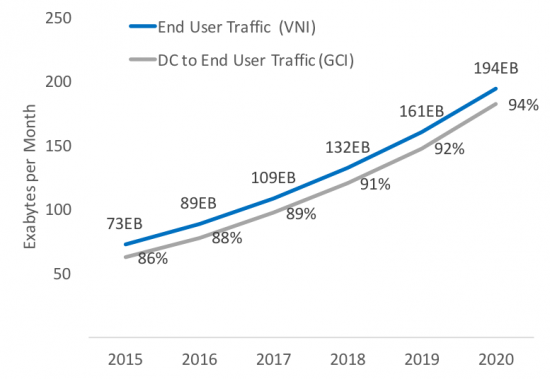
We can experience the impact of data center growth in our daily lives with our ever increasing digital footprints driven by online behaviors. Consider the “network effect” that occurs when we do an Internet search, watch a movie online, make online purchases or connect with friends over social networks. In our professional lives, many of us are also adopting new cloud-based business processes and applications. In the coming years, increasing amounts of end user traffic will be touching a data center. In 2015, 86 percent of the total end user/device traffic (per the Cisco VNI Forecast) touched a data center and this traffic share is expected to reach 94 percent by 2020.
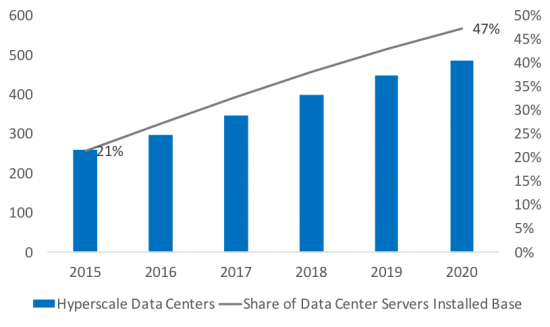
In our latest Global Cloud Index (GCI) Forecast 2015-2020, we estimate a near doubling of large hyperscale data centers in the public cloud space. A hyperscale data center is operated by one of the twenty-four operators, having billions of dollars in annual revenue across the categories of infrastructure as a service (IaaS), platform as a service (PaaS), or infrastructure hosting services, software as a service (SaaS), Internet, search, and social networking and e-commerce/payment processing (for more details on criteria please see the whitepaper, Global Cloud Index (GCI) Forecast 2015-2020). The number of hyperscale data centers will grow from 259 in 2015 to 485 by 2020. This is a clear indication of not only the data centers growth in general but a growing reliance on the cloud data centers with faster delivery of services and data, increased application performance, and improved operational efficiencies.
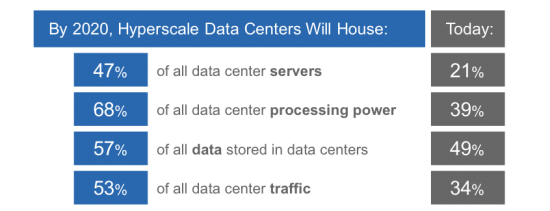
Why is this hyperscale data center growth important, you ask. This is because of the consolidated share of data processing power these represent – indicating the faster adoption of public cloud relative to private cloud and traditional data centers. By 2020, 47 percent of the total server installed base across all data centers will be in these hyperscale data centers representing 68 percent of all data center processing power and carrying more than half (53 percent) of the total data center traffic.
Data center traffic will continue to grow unabated in the foreseeable future, from 4.7 Zettabytes annually in 2015 to 15.3 ZBs by 2020. However, data centers themselves will undergo a big transformation with the evolution and deployment of new software-based architectures, cloud applications, more robust, faster, secure and intelligent networks. For further insights into these and other trends emerging from cloud and data center growth, please check out the Global Cloud Index (GCI) Forecast 2015-2020.
To further engage and ask questions, please join the GCI community. We also invite you to share your comments and opinions about this or other topics.
After 22 weeks of co-development efforts from ideation to prototyping, the Cisco-TAG.PASS Demo Day event held on Sep 22, 2016 was a huge success. The six finalists from Korea and Singapore gave their presentations to more than 100 attendees, including investors, incubators, commercial partners, and Singapore government officials.
In addition, we saw some new business opportunities emerging from the programme, including some solutions that complement Cisco’s existing solutions portfolio.
Watch the video on the Cisco-TAG.PASS Inaugural Demo Day 2016.
One of the important lessons we’ve learned throughout this programme is that a strong partner ecosystem is the key for successful co-innovation. What also stands out for me is how corporations and startups can win together by leveraging each other’s strengths. That’s especially true where I’m located in Songdo, South Korea.
Songdo is not just one of the new cities emerging in Korea. To our team at the Cisco Innovation Center Korea, it’s the very place where we’re creating a culture of co-innovation by partnering with our ecosystem partners and the local government through the Living Labs Initiative.
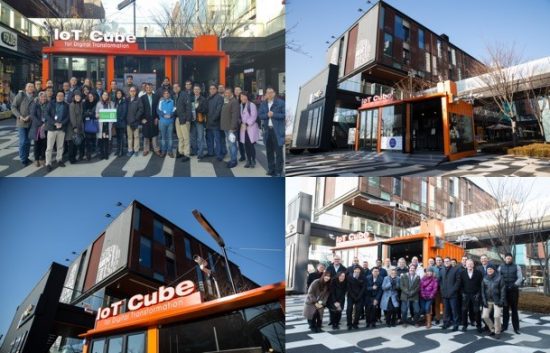
You can find the detailed story of our first living lab called IoT Cube in this article on The Network.
At the Cisco Innovation Center Korea, we’ve been partnering with our solution partners, startups, developers, and universities to co-develop innovative solutions. Again, I’m excited that we’re building a strong partner ecosystem that shares a spirit of innovation that will play a key role in powering co-innovation powered through our living labs. It will also enable our partners to be ready for increasingly shorter innovation cycles and time-to-market.
And equally important, the whole idea behind the living lab is that we’d like to foster a user-driven open innovation based on a business, citizen, and government partnership. The idea is to facilitate broad collective action, letting users take an active part in the innovation process.
As we’re partnering with the local government, we’ve launched our second living lab called Innovation@Park at Center Park in Songdo. It’s exciting to watch citizens discover the living lab concept and be part of the innovation process. Songdo can serve as a testing ground for the future as we co-develop solutions.
Check out the video clip about Innovate@Park and learn more about the Living Lab Initiative.
We’re planning to expand our living labs in many parts of Songdo, and Songdo will be a truly living and breathing lab, where new innovations are embraced by the citizens living in Songdo.
In fact, our innovation center is not shy about opening our door to the public. We’re planning to let them be part of our innovation process from ideation, prototyping and validation to refinement through the Living Lab Initiative. I believe that innovation should be more social than personal based on interaction and collaboration.
Again, it’s amazing to witness innovation happening all around the world, but it’s equally exciting for me to be part of co-innovation efforts led by the Global Center of Excellence and other Cisco innovation centers around the world.
I’ll keep you updated on progress we make through our co-innovation activities.
When you start working at Cisco, you quickly realize folks here have their own language. Sure, there’s tech lingo and acronyms galore, but it goes much deeper than that. You hear, quite a bit, in those conversations that people have a “Cisco Family” – and when you first start, you aren’t quite sure you even know what that means. Maybe you’ve never experienced “family life” before in the work place, maybe you just don’t think that’ll happen to you…but, then…it all comes together and you GET what everyone means. We are more than just co-workers here.
A little over five years ago I began the interview process after graduating college, and in January 2012 I got the call – I was hired by Cisco! I found out that I would be working out of the office in Raleigh, North Carolina (affectionately known as “RTP” by Cisconians). During my on-boarding experience I realized that everyone had a local team while my team was mostly based in Cisco’s San Jose Headquarters – clear across the country. Not wanting me to feel left out or underappreciated, my hiring manager Tara Fortier hopped on telepresence and met with me right away. We had an instant connection.
Tara said of that time, “It is not often you meet someone and connect so deeply and instantly with. I remember how nervous I was getting a brand new hire, on a different coast in an infrastructure team, who had a degree in marketing! I thought, ‘Oh man, I have to make this work and make it meaningful!’”
Tara took “meaningful” to an all new level, as I look back on that meeting and think of her first words to me, “Marcello, you’re my very first college hire! So, I’m going to be more like your Den Mother and you are my cub!” And Tara was right. She was there every step of the way as I began to navigate life at Cisco.
I never once felt like I was alone in RTP, and even through some more difficult times Tara has always been available to me. Whenever I had a question or concern, I’d just ping my Den Mother and she would respond immediately. It didn’t take long for me to understand what the “Cisco Family” was all about.
A little while into my career at Cisco, I had an opportunity to move out to San Francisco – but I wasn’t sure I was ready for such a big move just yet. When I told Tara about it she encouraged me to take it and told me never to underestimate myself. So I went for the job, and I got it!
Tara’s role as my Den Mother doesn’t stop there though. When I told her I had landed the job, she was even willing to go apartment shopping for me and was sending me photos in her free time of places where I could live. Now that I’m here in California, she still takes care of me and is my mother away from home.
To this day, we have a reoccurring meeting on our calendars – neither of us usually attends the meeting – but it’s a sitting reminder to check on one other at least once a month, to look out for one another. And isn’t that what family is all about?
Love, and family, like this is special – and for it to come from your very first manager out of college? It’s no wondering why I love where I work! This way of life is a core to what working for Cisco is all about. We are truly family here, and I hope that is something every new hire gets to experience for themselves as they begin their journey with us here.
Want to join a company that cares? We’re hiring! Apply now.
In our highly connected business environments, the need to respond to the inevitable security breach is on the minds of every CISO. An increasing number of organizations rely on the services of a Managed Detection and Response (MDR) provider. According to the Cisco 2016 Annual Security Report, 42 percent of surveyed companies outsourced incident response, compared with 35% the prior year.
Contracting with an MDR service is far different then contracting logistic or facility services. Responders will gain intimate knowledge of your business operation. Their recommendations will have far reaching impacts into information services.
As a senior incident response analyst on the Cisco Incident Response Service team, I work with customers every day to ensure they have solid incident response readiness and response strategies. A customer-focused approach to incident response means that when we approach a customer to assist them in responding to a potential breach, we go in with an open mind listening to the needs of the customer. We create response plans with the customer’s business obligations at the highest priority.
Responders are comrades in the battle against the cybersecurity adversary, walking alongside their client through the valley of uncertainty. Incident responders need to be more than a technical asset: they need to be a trusted partner as well. The responder needs to appreciate their client’s business objectives. Recommendations must balance the client’s risk tolerance with their business objectives.
The trust relationship between the incident responder and the client is a two-way street. Responders’ recommendations will be incomplete at best if the client is not forthcoming with relevant information about business objectives and technical environment, for example. As part of building a new business relationship with a client, the responder will require information about business operations. For example, it is helpful to know the client’s business objectives, hierarchy of their security organization, logging capabilities, and high priority information systems. The client’s responses to these questions will affect the success of the incident response plan.
Imagine a situation where an incident response service is brought in to perform root cause analysis and provide a recommendation for containment, eradication, and recovery from the incident. The customer requesting the response services is not comfortable with providing a list of high priority assets due to a lack of trust with the responders. During analysis, incident responders identify a number of assets which could have been impacted by the incident. Since high priority assets were not communicated, it is impossible for the responders to prioritize their work flow. As a result, incident responders may inadvertently focus on low priority assets or give inappropriate recommendations such as to take down a service needed for the business to function.
Risk mitigation and successful recovery from a cybersecurity incident is mutually beneficial. The impacted organization wants to find the source of the incident, determine the extent of the impact, and implement controls to mitigate the incident from reoccurring. The responders’ reputation relies heavily on their ability to deliver on those objectives. Responders also have a genuine personal sense of responsibility to resolve the incident. Most of us entered this field because we enjoy helping others to solve problems. We become emotionally invested in finding the solution.
Cultivation of a relationship of trust is absolutely necessary for a successful response engagement. It is through this relationship that we can provide a customer-focused service. If you are interested in learning more about Cisco’s approach to helping our customers with incident response support, read “Combatting Cybercrime with an Incident Response Plan”.
Did you know Pokémon Go set the record for the Apple App Store downloads in the first week? Not only that, it has gone on to break five Guinness World Records:
Most revenue grossed by a mobile game in the first month
Most downloaded, first month
Most international charts topped simultaneously for downloads
Most international charts topped simultaneously for revenue
Fasted time to gross $100 Million by a mobile game
Today the game is averaging $10 Million a day in gross revenue and change the value of Augmented Reality (AR) forever. The best part, nobody saw this coming outside of the developers and The Pokémon Company. What made this possible was the latest Smartphone architecture that combined a camera, GPS, always on connectivity, fast CPU, and HD monitor into a package that fits in your pocket.
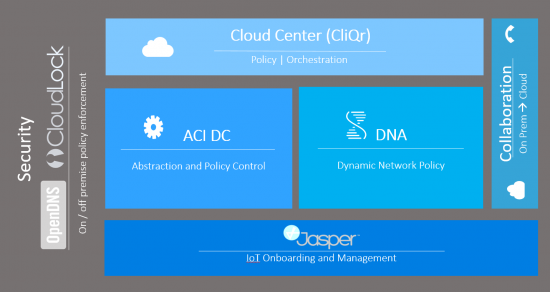
In my last blog post (Okay, but what are you trying to do?) I discussed how our thinking needs to evolve to be about architectures. It must in order to move our companies to capture the new digital frontier. I made a comprehensive statement about the way the new technology discussions should happen with the below image.
This spurred many tweets, comments, and e-mails asking for more detail such as this one from Samantha:
“Finally, someone put some context behind the value of digital. I really like the graphic with boxes, would be great if you could expand on how they link together in another blog post. Thank You!” – Samantha Gee
Sure Samantha, it’s really all just about the agility the architecture enables. The secret to enabling your company for Digitization is three key things:
Analytics – Visibility to understand what is going on and even predict what will be needed
Automation – Create an environment with policies that can address situations as they occur, self heal, self-optimize, increase agility while lowering operational burden
Virtualization – Move network services and application workloads where they are the most efficient
Let me give you an example of this type of thinking: Tesla. They started from a digital strategy that the car needed to be able to dynamically update itself after it left the factory, without coming into a dealership. A Tesla vehicle is full of sensors that perform local analytics to automatically adjust for road conditions and the way the driver uses the car. But it also sends all that information back to Tesla so they can understand how people are using their cars. In addition, they watch social media and correlate the information with customer service contacts. When drivers in San Francisco had an issue with the cars rolling back before moving forward on hills, Tesla issued a software update overnight. When they had the battery fire from road debris flying up into the bottom mounted battery pack, they transmitted an updated to increase the ride height overnight. As consumers became comfortable with semi-autonomous driving, the vehicles were already built with this in mind, so again an overnight update changed capabilities. The point is, they built a platform based on digital architectures to give them the speed and agility to automatically adapt to changing requirements.
Cisco’s architectures enable this same type of agility represented by the graphic. If we think about the Application Centric Infrastructure (ACI) SDN architecture, it was created to enable these principles for rapid application deployment, scaling, and changes in the Data Center. However; applications are not consumed in the Data Center, they are used in the branch and campus. Cisco’s Digital Network Architecture (DNA) uses these principles to ensure optimal application delivery in both environments and automatically change as conditions change. Our Cloud Center lets you quickly move workloads between the Data Center, cloud vendors like AWS and Azure, and even to compute in the branch router. This concept of Fog Computing is designed to make sure applications have the agility to be ensure the best user experience.
Speaking of cloud, our Collaboration architecture is seamlessly linking application from on premise to the cloud so users have a pervasive experience. If you create a meeting in Microsoft Outlook it automatically creates a Spark Room and inserts the WebEx room information into the invite. Start a meeting on Spark on your iPhone and pick it up on your Telepresence in the office. The lines between on premise, cloud, and mobile are clearly being blurred for the better. Cisco DNA helps here too ensuring those mobile devices, especially Apple devices, work amazing when they enter your environment.
The Internet of Things is changing the way people and businesses interact while creating challenges for IT departments trying to securely onboard new devices. Jasper automates the policy, onboarding, and analytics to simplify this for IT, increasing the speed while minimizing bad behavior. Our partnership with Mist allows companies to deploy virtual beacons right from the Cisco access points so you can dynamically change the environment for mapping, information, and offers. You move a products, you move the virtual beacon. Then you can deliver a virtual catalog item from compute in branch and capture the analytics to know who is doing what. From that beacon event you can spin up a Spark room, enable training, or even use augmented reality to change the engagement.
Unfortunately this technology pervasiveness can mean increased security risks. Using application aware analytics, Cisco’s virtualized and cloud based security solutions automatically detect and defend threats in real time. These policies can follow users and devices regardless if they are in your environment or if they go mobile. These architectures use automated policies that significantly reduce the risk of human error, one of the biggest ways the bad guys gain access to your environment.
What do all these modules have in common? They enable the business and the IT staff to move faster and allow the environment to dynamically change to provide the right resource at the right time, automatically. Customer and business demands no longer give IT the time to manually make changes and evaluate the environment, nor will the business give IT unlimited resources. It is critical that we think in these connected architectural solutions to increase our revenue opportunities through agility, reduce our costs by simplifying operations, and keep ourselve secure with holistic unified policies.
Who knows, your company may be the ones that want to create the next Pokémon Go; will you be ready?
Virtualization is an overloaded word. Originally it was used to describe a form of hardware emulation, but these days it appears that any form of software abstraction is called “virtualization”. In the context of the CMTS the term cloud native more accurately describes the upcoming evolution of the CMTS than virtualization.
Cloud native is becoming popular as a way to describe the cloud deployment approach used by the large web companies. In a nutshell, the cloud native approach sees the application as the center of the universe, not the network. This is a different view than ESTI-NFV because in the cloud native world the “network function” is just an application that, as long as it roughly conforms to the “12-factor app” guidelines, can be deployed, scaled and protected the same way any application can.
How does the virtual CMTS fit into the cloud native perspective? In this rush to label anything as virtual, a key point is often missed…
Virtualization is a means to an end and not a goal in itself.
The end goal is to achieve:
Service velocity through DevOps and CI/CD (continuous integration/continuous deployment)
High Availability
Flexible and rapid scaling
The cloud native world has a framework to achieve all the above and virtualization is only a part of it. In fact, the form of virtualization used in those cloud native deployments is called “containers” and if anything, it’s a very lightweight form of virtualization.
Another term that is frequently associated with cloud native is “micro-services”. The key concept behind the term micro-service is the ability to create small and well-contained software packages that can be upgraded and scaled separately. It’s common to associate a micro-service with a container.
Many other concepts in cloud native can be traced back to multi-processor designs and mainframe architectures dating back to the 1970s. Well modularized software is the ABC of software architecture and containers have been around for a while. Given that, what is the key innovation in the cloud native approach?
One might argue that it is the ability to build a cost-effective high availability system from low-availability components. The cloud native one is fundamentally a load-sharing distributed system, if any component fails then its load can be moved to a different place. Furthermore, scaling up/down can use the same load sharing and distribution system and in that respect a failure is simply a case of a “forced scale down”. Similarly, software upgrades are using the same distribution and load-sharing infrastructure: as the old version is being scaled down the new version is scaled up and as a result software upgrades can occur without service interruption.
Once we have a method for reliable in-service upgrades of software combined with micro-services we start a virtuous cycle: because upgrades are less risky an operator can upgrade more frequently and that results in smaller code changes between upgrades which reduces the upgrade risk even further. Eventually feature velocity increases because software changes can be phased in more quickly.
The cloud native environment also encourages in-production testing. Because the overall system is highly resilient the staging phase of new software can be much shorter. Some companies take the concept even further and force random faults (e.g. forced software crashes) into a live production system on purpose to make sure it indeed recovers from anything that gets thrown at it.
We believe that the virtual CMTS can be broken into micro-services and deployed in a cloud native form and the reliability, scalability and feature velocity seen in the web and business app space can be applied to the virtual CMTS as well.
Look for more on this topic – we’re excited about making the CMTS “cloud ready”!



 ition if you are looking to gain a deeper understanding of Network programmability and automation, or still looking for a (St Nicholas) gift Cisco Press has the right book for you with ‘Programming and Automating Cisco Networks: A guide to network programmability and automation in the data center, campus, and WAN’.











 Many other concepts in cloud native can be traced back to multi-processor designs and mainframe architectures dating back to the 1970s. Well modularized software is the ABC of software architecture and containers have been around for a while. Given that, what is the key innovation in the cloud native approach?