Avatar

Part 1: What does it take to win in an OTT world?

In this blog trilogy, I will try to shed some light on one of the more intriguing topics in the video industry– OTT video. I will discuss the reality of OTT video, the service provider’s perception of it, the future of the paid video industry and what service providers should do today in order to win in an OTT world.

I just returned from beautiful Budapest. But alas, I was not touring. Instead, I spent a couple of days with a group of smart people from the pay TV industry; service providers, media producers, analysts and technology vendors. We were gathered together to discuss the future of TV.

Over The Top video, or in short OTT, was top of mind in the discussions.

Let’s remind ourselves of what OTT video is.

It’s the delivery of video over an unmanaged network, meaning the Internet, as opposed to managed networks, like pay TV cable.
Screen Shot 2016-11-30 at 12.02.49 PM

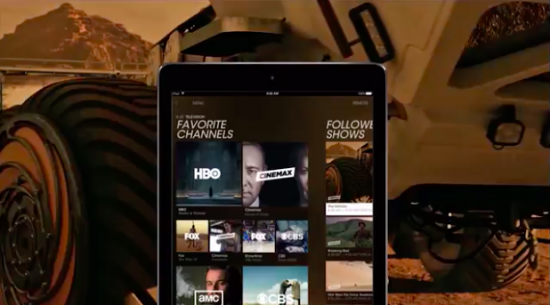
Over 80% of IP traffic today is video. Practically speaking, this is OTT video. It comprises paid VOD libraries, like the Netflix’s of this world, as well as free video of all kinds, like YouTube. Very little of it is in fact linear video (like TV channels).

What does this mean for the pay TV industry? Is OTT even a concern?

Well, given the fact that OTT dominated most of the discussions, I’d say it’s a big concern.

Attendees were asking:

  • “Is it an opportunity or a threat for our business?”
  • “What does it mean for us?”
  • “How will the future with OTT look?”

It was interesting to note that most of the viewpoints expressed at this conference discussed the short and mid-term implications, rather than the long term impact. That’s because most attendees felt that OTT does not present a risk for the pay TV industry. Here are some of the reasons that they gave:

  • “It’s not targeted to our subscribers, nor localized to our market. Our subscribers wish to see the content they like, in their language, and only local SPs can provide it”
  • “Our subscribers care first and foremost about linear channels and OTT doesn’t provide them”
  • “Subscribers are using OTT as a supplement to SP services, not instead of them”
  • “There is no real commercial benefit in moving to OTT… our subscribers will not save much, if at all”

The majority of attendees nonetheless felt that SPs should integrate OTT services into their guide. After all, subscribers do want them. And so it’s better to ensure that they get all they need directly from the service provider, rather than sending them to the Internet.

It was also clear that service providers should offer OTT services, mainly to serve mobile devices, but also home CE devices.

But let’s be clear.

There was no commercial justification or revenue opportunity behind these sentiments. They were about satisfying subscriber demand in order to maintain loyalty and avoid churn. My impression was that service providers were treating OTT more as a necessary evil, the unwanted guest. It seems that they don’t see OTT video as an immediate threat. But they do feel it needs to be addressed.

Are they being too ambivalent with respect to OTT?

I will discuss that in my next blog by examining what we can in fact learn today from OTT video providers and where their business is going.

Stay tuned for my next post, but in the meantime check out this brand new eBook: Transform your video services with a cloud platform


Save

Save

Authors

Yaron Agami

Senior Manager

SP Product Marketing, Cable and Satellite Segments

Avatar

In my previous post, I shared the challenges of innovating within a large enterprise. I also shared some solutions, including our creation of Startup//Cisco—our grassroots effort to accelerate startup up DNA within Cisco.featured image

Since launching this program a year ago, we’ve experienced success (see my previous blog) and have made some mistakes. But we’re okay with that, because we knew the only way to encourage a startup culture was to try to mimic how startups work, as much as that’s possible inside a large corporation.

So far, we’ve identified five steps critical for successful startup-like innovation. They include:

  1. Get the right people on the bus.
  2. Get the mindset right—thinking like a startup.
  3. Build the engine.
  4. Run, fall, get up, learn, and run again.
  5. Scale.

This post covers the first step: Get the right people on the bus.

A little bit over a year ago, I was in charge of the development of the top two percent of talent in the company, focusing on senior managers. At the same time, a clear message from our executives was (and still is) that we needed to move faster and faster in the innovation space.

Putting these two things together—our top talent and a mandate to innovate—became the starting point. We began by exploring our existing internal innovation programs, working to understand our internal state of innovation. We also looked outside of Cisco to see what other companies were doing.

It became clear that making it easier for internal innovators to go from an idea to contributing to the business’ top or bottom line would be a very valuable focus area. With this in mind, we engaged with Eric Ries, one of the most visible figures of the Lean Startup movement, and that led to contacting Steve Liguori, GE’s former head of innovation.

We assembled a cross-functional team with some of Cisco’s top two percent of talent, creating what we call Startup//Cisco. We likened it as much as possible to an internal startup. Together, a team comprised of Andrew Africa, Edgardo Ceballos, and myself co-founded this “startup,” later to be joined by Rick Tywoniak, Sharon Wong, Ananad Jayaraman, Donald Graham, Craig Wirkus, and many others who’ve been instrumental in getting this effort where it is today.

I’d also like to give a nod to Jim Collins’ Good to Great for inspiring the title for this step. How do you identify the right people for such an effort? There’s obviously no formula or checklist, but here are the characteristics that stood out as critical for us:


  • A truly diverse team:
    Many people approach diversity as something we should strive to achieve because it’s the right In our case, it was the only AS53883
    thing that would have made our team work. We had diversity at many levels (perspectives, ethnicity, etc.) but the most interesting to highlight were our professional backgrounds. Among our team we had former startup founders, engineer turned sales person, engineering thought leaders—and even an anthropologist and a former family counselor.
  • Risk takers: When embarking in any project with high levels of uncertainty (like us trying to bring a startup flavor to innovation in a large corporation) you need people that are comfortable with risk.
  • People with strong personalities—and an even stronger EQ: Big change is not going to happen without a big sustained effort. And one of the first barriers is changing prevailing mindsets (more on that in my next post). Hence, you need people with a strong personality, with strong points of view—but who also have an even stronger Emotional Intelligence. This is crucial for everyone to: (a) have an opinion; (b) not be threatened by others’ opinions but, instead, being able to listen, assimilate; and (c) together choose the best path forward.
  • Cross-functional and well connected: Finally, large companies are composed of internal organizations. Sometimes it’s hard for these organizations to find the balance between the efficiency to achieve their results and what’s best for the company as a whole. Having people bringing the perspective from different groups—and who are well connected in them is crucial to moving forward.

In my next post in this series, I’ll share what we’ve learned regarding a very interesting component—the right mindset for such an effort.


Authors

Oseas Ramirez Assad

Senior Manager, Business Development and Innovation Enablement

Strategic Innovation Group

Avatar

When it comes to over-the-top (OTT) video distribution, we are seeing many of our customers opt for a multi-DRM approach. This means utilizing the DRM client that is pre-integrated into the viewing platform instead of installing a DRM. These natively available DRMs – the native DRMs – are developed and deployed by Microsoft, Google and Apple to enable their device and software ecosystems to playback rights-protected content. Android devices and the Chrome browser come pre-integrated with the Widevine DRM; iOS devices and Safari come pre-integrated with Fairplay; Windows devices, IE/Edge browsers and also numerous OEM devices such as smart TVs come pre-integrated with PlayReady, thanks to Microsoft’s licensable DRM SDK.

The native DRM clients provide essential technology to process a DRM license, and decrypt content, but where does the other system functionality come from? A working content protection system needs to support content preparation, license generation and client device playback, and do this across multiple native DRM technologies. The native DRMs generally provide sufficient functionality out-of-the-box for client device playback, but fall short on functionality for license generation and content preparation.

For license generation, a typical content protection system needs to handle device identification and activation (i.e. associate a uniquely identified device to a specific household/account), validate license requests, authenticate the requesting device and subscriber, authorize license requests, determine applicable business rules and subscriber-entitlements, translate entitlements and business rules to the terminology and functionality supported by each native DRM scheme, supply the appropriate encryptions key(s) and generate the license in compliance with the relevant native DRM spec. System monitoring, logging, reporting and management interfaces are also required to be implemented.

When deploying more advanced content protection features like key rotation on live channels, event-based entitlements or concurrency controls, then authorizations, license request and license issuance requires further development to make work on top of the native DRM client.

The content protection system also needs to be integrated with the content preparation workflows to generate, store and supply content encryption keys, encrypt each streaming format to spec (HLS, HSS, DASH, etc.) and append the correct DRM meta-data to the content.

So what exactly do the native DRMs provide beyond client playback support? For the most part, they provide you with a spec, SDK, or sometimes a rudimentary cloud service to generate the license, but you are mostly on your own when it comes to implementing the system functionality described above. FairPlay provides a DRM client and a specification for how to generate licenses. PlayReady provides an SDK and specifications for how to incorporate business rules into the license. Recently Microsoft has added an Azure hosted DRM license service option, but it too needs to be integrated with an authorization service and the content preparation workflows. Widevine provides a cloud-based license service that receives a token that tells it which business rules to incorporate into the license.

In summary, multi-DRM does not mean that you get your content protection system for free – it simply means that you will not deploy a DRM client to the playback device. Building out the rest of the system requires an experienced team to architect, build, integrate and maintain over time.

P.S. Securing the content protection system itself against attack is a serious and non-trivial consideration that was not discuss in this blog post. How do you protect, detect and respond to service breaches and incidents of piracy? You can read more about that in our Multi-DRM Strategies for Video Service Providers Whitepaper.

Authors

Amit Wohl

Video Security Product Manager

Service Provider

Avatar

I need to preface this blog with a full disclosure statement. I love shopping! And apparently I am not alone in my affinity for all things retail. Let’s face it, many people enjoy the thrill of acquiring a new “bright shiny thing” or the high of getting a deal on something you need. However, the increasing demands of work and my growing family have put a bit of damper on my shopping excursions. Juggling a toddler and a career in Silicon Valley, limits my mall visits to brief “retail reconnaissance missions” that require speed, efficiency and ninja-like precision. No longer can I leisurely shop, peruse endless racks of gear, or pore over store displays with potential new acquisitions. I’ve got to get in and out quickly.

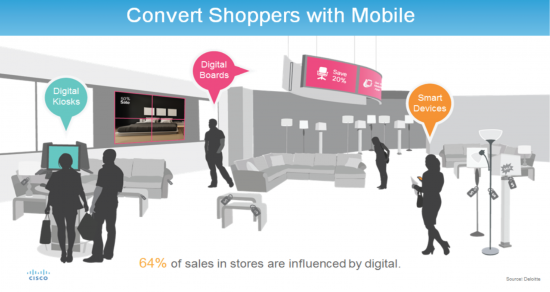
On my annual expeditions to my birth country (India), it is almost a tradition for me to visit my local stores to buy some outfits and goodies. Over the last few years, I have seen malls come into being with small stores and some big name brands consolidating under one roof. Very convenient for me now versus traveling to different areas of the city and struggling with traffic to get to my favorite stores. But most interestingly, during my last holiday trip when I was at the mall near my family’s home that I was astounded at the technology that was being used and the experience that ensued. As soon as I entered this local mall, I was greeted by a mall associate who asked me if I would like to sign up for a 20% coupon at any store in the mall and all she needed was my mobile number. I love a good deal (just can’t pass it up!) so I shared it immediately and received the coupon through a text message. But what was even more astounding was what followed. As soon as I walked through the mall, I would receive (via my mobile phone) the features or daily specials for stores in my immediate proximity. It seemed as if the mall knew what I was looking for and was actually helping me shop.
Screen Shot 2016-12-01 at 10.56.48 AM

This blend of location-based marketing, mobile technology and data analytics made my experience an extremely efficient one. Fantastic! In fact, digitization and the application of big data in a person’s retail journey is increasingly becoming popular to understand a customers’ behaviors and preferences. And with more and more people using smartphones and wearables (e.g. smart watches, health monitors, etc.) these days, the customer journey can be enhanced and increasingly personalized. Cisco’s Visual Networking Index (VNI) predicts that the proliferation of smartphones will increase by 13% globally from 2015 to 2020 and wearables will grow by 44% throughout the forecast period. What does that mean? A retailer can target a customer (who opts in by sharing their mobile number) and make their experience within a store extremely customized and tailored to their preferences. This level of digital customer service and awareness can create loyalty and potentially life-long patronage. “Customers want brick-and-mortar stores to be as efficient as ecommerce,” according to e-Marketer. This illustrates how consumer expectations are crossing over such that the retail customer experience efforts must now transcend historical boundaries of digital and physical stores. This is made possible by today’s trend toward digital transformation as is described by the concept of “Phygital” retail in Brian McDonald’s blog.

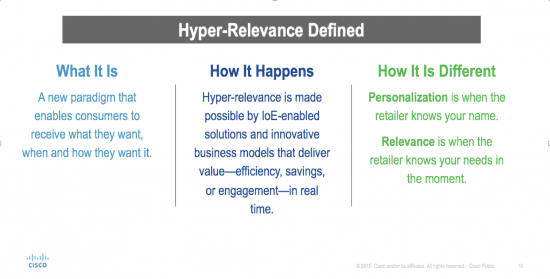
The digital transformation in retail will also bring hyper relevance to customers and enable new ways of experiencing products. According to Gartner, “by 2020, 100 million consumers will shop in augmented reality.” Whether they allow you to try on makeup or place virtual furniture in your home, immersive technologies such as AR increase consumer engagement by enabling them to fully explore features and conveying additional information that can aid in a buying decision.”

Learn more about the technologies behind digital transformation in the recent paper The Future of Retail on the Cisco Retail website.

Screen Shot 2016-12-01 at 10.57.52 AM

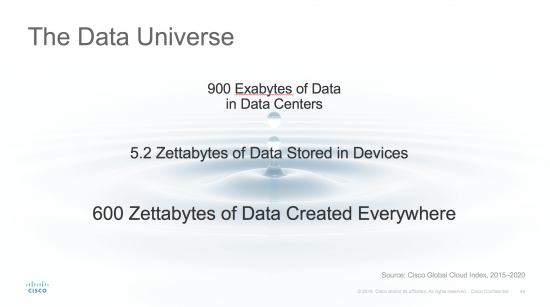
This digitization and the increasingly digital customer journey will also bring about another important aspect – massive amounts of new data being generated. Which brings in to question how much of this data will actually be used and analyzed. According to Cisco’s Global Cloud Index (GCI), the amount of data generated everywhere by all devices and connections in the data universe will be 600 ZB by 2020. Knowing how much of that data will find its way to a data center or be used/mined in some fashion is the “wild card” yet to be determined.

Screen Shot 2016-12-01 at 10.58.50 AM

Many large retailers like Macy’s, Walmart etc. have already incorporated big data and analytics into their infrastructure thus ensuring a better and more targeted customer journey. And make no mistake, this is not just a tech trend – it’s legitimate big business. According to Adobe Digital Insights, Cyber Monday 2016 was the biggest day in the history of U.S. e-commerce with consumers spending $3.45 billion online (see Fortune Magazine article). I am excited to see what the next phase in the digital customer experience brings. With the holiday season upon us, I hope all of you are able to enjoy your own smart shopping sprees.

Authors

Taru Khurana

Marketing Manager, Product/Systems

Avatar

Three Keys to Success: Preparing your mobile network for 5G.

Learn more: Download our new 5G ebook

While much of the focus in the press on 5G has been around the definition of a new radio interface and the architecture to support such, it is increasingly evident that if 5G is going to deliver on its promise, it must be accompanied by an organizational transformation, where traditional boundaries are increasingly blurred. Virtualization, orchestration, slicing and automation will be core capabilities that cut across conventional domain siloes to deliver assured 5G service.

5G Radio Network Evolution

MarkBlog1

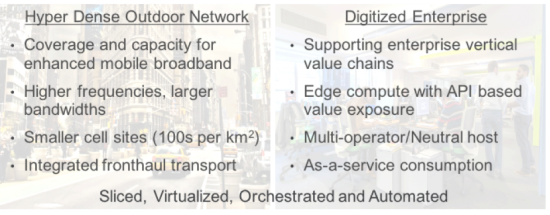
Delivering the hyper-dense 5G outdoor network is going to require a combination of conventional macro sites and higher frequency small cells, working in combination to provide the coverage and capacity required to deliver the pervasive mobile broadband service. However, with some estimates predicting that over 200 small cell sites per square kilometre will be required, an integrated xHaul solution is going to be critical, blurring the boundaries between traditional RAN and Transport domains

Furthermore, 5G’s new radio will be the first time that 3GPP has applied virtualization techniques to the RAN, defining an internal RAN split between a distributed unit that can be realized as a physical network function (PNF), and the centralized unit that can be realized as a virtual network function (VNF). However, unlike when virtualization has been applied to other mobile functions, the impact of the characteristics associated with the transport network between PNF and VNF components will have a critical impact on how much functionality can be centralized in the VNF. This will likely mean that RAN operations, including functional splits and VNF workload placement, need to be intelligently orchestrated taking into account transport network instrumentation.

5G: Bridging indoor and outdoor environments

Untitled

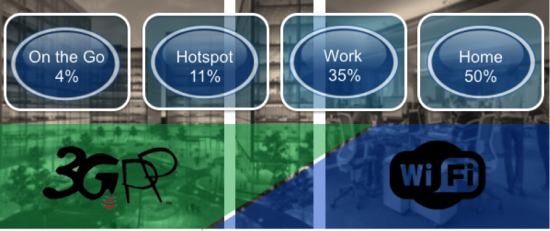
For 5G to be successful, it needs to flourish in an environment where, even today, over 80% of mobile data is being consumed indoors, and where Cisco’s VNI is predicting that by 2020 only 4% of mobile data will be consumed “on the go”. Therefore, 5G needs to effectively bridge the hyper-dense outdoor domain with the digitized enterprise, that today is using Wi-Fi to support its business needs and vertical value chains. With an increasing proportion of businesses wanting to serve all employees, contractors, partners and visitors, irrespective of carrier affiliation, network sharing will become a crucial capability for indoor 5G deployments. Importantly, whereas conventional sharing approaches that use individually licensed spectrum have led to high barriers to adoption, new spectrum allocations, including lightly-licensed and unlicensed, offer 5G systems the opportunity to better serve the digitized enterprise.

Multi-technology, multi-operator, multi-vendor, multi-spectrum and multi-domain are set to become the new normal for the 5G network, download Cisco’s eBook that describes how to prepare your mobile network for 5G.

For more information see our 5G White Paper series here.


Authors

Mark Grayson

Cisco Fellow

Cisco’s Emerging Technologies & Innovation Group

Avatar

Everyday, hackers and cybercriminals are infiltrating networks. And they are especially interested in healthcare. That’s because stolen medical records are profitable, selling up to 10 times more than credit card numbers on the black market. But even more lucrative than identity theft is a ransomware attack. Cyber criminals can charge a hospital millions to unlock their records, patient care, or patient admittance systems. And this isn’t an isolated incident – 91% of all healthcare organizations reported at least one data breach over the last two years.

medical hacker healthcare cybersecurity

The thing is, we know how it happens. We know the cybercriminals’ methods and what devices they use. Over the last decade, not much has changed except the sophistication of the tools and the bad guys’ ability to monetize their dirty work. They look for a means to get inside the secure network perimeter, subjugate a device or endpoint with malware, conduct discovery, pivot, and subjugate additional devices until they reach a system with data they can exploit.

So, we know what they are going to do, and how they are going to do it. Then why are most systems vulnerable? One significant reason is they are usually left in the open. Today we have the ability to secure many types of endpoints, but not clinical devices. That’s why they’re often referred to as “the Achilles heel of healthcare”. Many clinical devices were built at a time when security was not a major concern. Therefore, many don’t have any integrated defenses and can’t be easily secured without affecting their function.

Naturally, the hackers target these ‘sitting duck’ devices. To protect these devices without affecting function, IT needs to wall-off these devices from guest devices, BYODs, PS4s, and anything else that they should never talk to. But the two available options have some serious tradeoffs. One, they can operate a separate network, but that tends to be expensive.  Or, two, they can put the devices in a converged network, but they have to mix with everything else on the network. They can’t keep them separate because there is no structured means to identify clinical devices.

Medical devices locked

Well, there wasn’t until we introduced Cisco Medical NAC, a solution that identifies most clinical devices, onboards them onto a protected segment of your existing network, and monitors them for any potential breach.

The solution uses the Cisco Identity Services Engine (ISE) that offers a special library of more than 250 clinical devices and growing quickly, and use of the library is free for ISE customers. So, you can automate network onboarding of clinical devices and keep devices separate using the network you have in place today.  Medical NAC provides visibility into the network flow using Cisco Stealthwatch, so you can discover exactly what devices and systems the medical devices should be talking to before you create your network segments. It also allows you to monitor clinical device behaviors to help detect if they have been breached. If they have, you can quickly move them into a secure segment using Cisco Rapid Threat Containment.

If you want to know how it works go to www.cisco.com/go/medicalnac, watch the video, and read the whitepaper.

Authors

Andrew Peters

Senior Manager for Product Marketing

Avatar

Project FIRST is lead by Angel M. Villegas. This post is authored by Holger Unterbrink.

Talos is pleased to announce the release of the Function Identification and Recovery Signature Tool (FIRST). It is an open-source framework that allows sharing of knowledge about similar functions used across file types that IDA Pro can analyze. The aim is to create a community for the infosec analysts and reverse engineers that promotes the sharing of information.

The main idea behind FIRST is to preserve an engineer’s analysis of certain functions (name, prototype, comment, etc) by using methods like opcode hashing, mnemonic hashing, locality sensitive hashing, etc. By collecting and storing these signatures centrally the framework can provide them later to the community via the API/Plugin. The goal is to provide quick lookups for similar functions (see Fig. A) to avoid losing time with analysing a function which was already analysed before in another sample or by another engineer.

<< Read More >>

Authors

Talos Group

Talos Security Intelligence & Research Group

Avatar

In the world of cybersecurity, many organizations have implemented some version of the ‘identify, protect, detect, respond, recover’ framework proposed by United States National Institute of Standards and Technology (NIST). Underpinning this framework is an acknowledgement that cybersecurity is not a one-of effort and that there are no protection measures that will withstand a determined attacker. Therefore a robust cybersecurity program needs also effective detection, response and recovery mechanisms.

PayTV providers historically paid a lot of attention and invested significant resources in protecting their content and service from piracy. For most this meant deploying Conditional Access Systems (CAS) and Digital Right Management (DRM) technology mandated by the content owners – the Studios and sports rights holders – to protect content. The more security conscience providers invested in securing also their end-to-end system.

But protection alone has never been enough. Pirate have always found a way around protection measures. In the past, they found ways around the Conditional Access System that protected broadcast content. Today they are finding ways around the DRM system protecting OTT content. And they are also finding other service vulnerabilities that can be exploited.

A good video security system provides robust protection but also acknowledges that there are no silver bullets against piracy and therefore vigilant monitoring and detection of the service are critical.

As the payTV industry ventures outside its traditional closed networks and onto unmanaged devices connected to the Internet, the need to monitor and detect service breach is more important than ever.

And when a breach is detected, it is critical to have a skilled team and the right technology to enable an effective response and recovery. For example, if you find that encryption keys were compromised, you need a way to refresh them. If you find that your DRM client has been compromised, you need a way to effectively deploy a countermeasure/patch to devices in the field. And if you find your content being illegally redistributed on the open Internet or rogue IPTV boxes, then you need to find effective ways to cut off the devices on your service that are feeding these illicit activities.

Cisco Video Security (and NDS before it) had always invested significant resources in expertise and technology to monitor, detect and respond to service breaches. As a result, our customers have been free to focus on their business instead security. In recent months, we’ve expanded our approach to include more comprehensive monitoring for pirated content. See our blog on “a new paradigm for dealing with illegal redistribution of content.”

Authors

Amit Wohl

Video Security Product Manager

Service Provider

Avatar

By Timothy D. Harmon, M.S., CCNA R&S, Security+CE, Cisco Champion

Cisco Tech Day is similar to Cisco Live but on a much smaller scale. Cisco Live is a conference held over four days usually at a convention center with several breakout sessions, keynotes and the famous World of Solutions (WoS). Cisco Tech Day is a one day conference held at a small venue, such as a hotel and it is presented by Cisco on the Road. This one day conference moves from one major city to another with different Cisco partners in each city. San Diego was one of these lucky cities to have Cisco Tech Day. It was held on October 27, 2016 at Paradise Point Resort.

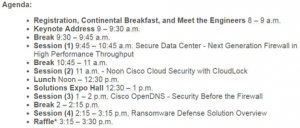
The day started at 8am at the Paradise Point Resort in the Mission Bay area of San Diego, CA with a continental breakfast and networking opportunities with the partners and other attendees. There were about 15 to 20 Cisco Partners participating in the Tech Day and some include Presidio, NetApp and Eaton. The attendees were given a sheet of paper with all of the Cisco Partners listed on it and we had to go to each one to get the sheet signed off. After every partner had signed the paper, we returned the completed paper to the registration desk to be entered into the raffle that took place at the end of the day. This was an interesting way to get all of the attendees to visit each Cisco Partner.

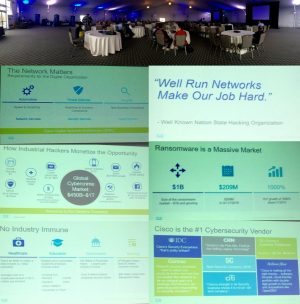
The Keynote was Doug Good, VP Systems Engineering, and he started the keynote a little after 9am. He talked about how technology and business strategies are basically the same. He also discussed topics that include Cisco’s DNA (Digital Network Architecture), the Global Cybercrime Market, Ransomware and Cisco’s OpenDNS. It was a very informative keynote that went over several topics that Cisco has been deploying. I thought that the keynote was helpful in understanding what the industry is facing regarding challenges of the Internet of Things (IoT) and how to protect companies against the latest attack vector of ransomware.

After the keynote, there were four breakout session groups with lunch after the second breakout session. I decided to go with the security sessions as I am a part of the cyber security industry. The first session I attended was the “Secure the Data Center – Next Generation Firewall in High Performance Throughput” and it was pretty interesting as they were discussing ASA, FirePOWER and Firepower Threat Defense (FTD). This session was useful as it relates to the Cisco Certified Network Associate (CCNA) Security certification since FirePOWER and FTD are now a part of this certification. The second session was about Cisco Cloud Security with CloudLock and it was pretty interesting. The speakers in both sessions had extensive knowledge of the topics and were very professional in their presentations.

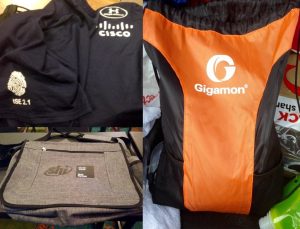
Lunch was provided and it was delicious. I decided to have the Smoked Pulled Pork Grilled Cheese and the Coconut dessert bar. During lunch, attendees can chat with the partners and get their raffle sheet signed by each partner. All of the Cisco partners were giving out free stuff, such as pens, stylus, mugs, bags and other shwag.

The last two sessions were pretty interesting as they discussed Cisco’s OpenDNS and Ransomware Defense Solution. OpenDNS was acquired by Cisco and has been growing ever since. OpenDNS can keep companies covered in ensuring that the users can get to a company’s website during a Denial of Service (DoS) attack on a Domain Name Service (DNS) server by using the OpenDNS servers. The week before the Cisco Tech Day, there was a DoS attack on some DNS servers and Cisco’s OpenDNS was able to keep customers from disruption by using a cached DNS query in order to get the users to the websites. The Ransomware Defense Solution discussed the way it defends against ransomware and how it protects companies that use the solution.

After the last session, the organizers held a raffle drawing for different prizes and I unfortunately did not win anything from the drawings. Overall, I thought the Cisco Tech Day was a very fun and informative “mini Cisco Live.” It gave me insight into the latest developments in Cisco Security and it was a great way to network with others. I recommend the Cisco Tech Day to everyone in the security, networking and collaboration industry.

Authors

Tim Harmon

Cyber Security & Network Professional

Cisco Champion