“Going green” is all about reducing waste and protecting the environment. It’s a movement most of us believe in and try to live by. Who wouldn’t want to reduce waste and protect the environment? In fact, it got me thinking that the TrustSec product management team shares a similar end goal. Let me explain.
In the TrustSec team we are focused on automating network security functions (i.e., reducing waste) and removing complexity (which allows you to more effectively protect your environment). And this is at the heart of one of the significant enhancements in Cisco ISE 2.1, the integration of TrustSec and Application Centric Infrastructure (ACI) security policy groups.
This new capability in ISE 2.1 simplifies and ensures consistent security policy by sharing contextual information and policy group information in both directions. The result?
More effective use of resources by eliminating the need to manually recreate security policy groups
Better protection of your environment with consistent segmentation, simplified security management, and rapid threat containment
With ISE 2.1, intelligence from the branch and campus environment can be repurposed in the data center and vice versa. Specifically, security policy groups can be shared between TrustSec-enabled networks and ACI-enabled data centers (DCs). ACI becomes aware of TrustSec Security Group Tags (SGTs) and can apply these SGTs in the data center to control communication with specific servers. Similarly, endpoint groups (EPGs) created in ACI can be converted to SGTs and used by TrustSec to bring server policies to campus, VPN, and branch environments as well as TrustSec-enabled data centers. This allows you to get more value from the investments you’ve already made and enterprise-wide protection that’s easier to manage.
For instance, if a retail bank needs segmentation in the data center and in branches to reduce the scope of PCI-compliance and also wants to provide controlled DC access to groups such as auditors or ATM systems, TrustSec-ACI integration enables the bank to do this by using a single set of enterprise-wide groups. Within the ACI Controller, APIC-DC, the bank’s administrators can see the TrustSec groups available from ISE, such as the auditor group and ATM group, and allow those groups to access the PCI zone. There’s no need to recreate groups manually by identifying specific IP addresses. The information can be inherited automatically from ISE and the bank can rest assured that there is total consistency.
Similarly, when new virtual machines are created in the data center, endpoint group membership information from ACI is shared with TrustSec policy enforcement points outside of the ACI DC. There’s no need to manually configure a firewall rule or update an Access Control List to protect that virtual machine or application.
Sharing policy groups also makes it easier and faster to contain the spread of malware that has evaded detection and penetrated the network. In ISE 2.1, TrustSec can dynamically change group membership and apply different policies based on Indications of Compromise (IoCs) to contain threats in the TrustSec domain. ACI automatically inherits these group changes to immediately prevent access to sensitive data and applications.
In addition to the campus and branch scenario, TrustSec group-based policies can work together across data centers and hybrid cloud environments, and a TrustSec-enabled data center can link to an ACI data center.
Sharing information in both directions allows you to reduce risk, more easily meet compliance goals, and reduce time and effort spent managing security. This first phase of our integration is just the beginning of allowing our customers to get the best of both worlds – TrustSec and ACI – for effective security made simple, across the organization.
The next generation of entrepreneurs, startups, leaders and developers are the innovators behind the emerging technologies making history in our digital era. To inspire and engage with them, Cisco launched the Innovation Grand Challenge, focused on finding fresh and exciting market opportunities and game-changing trends.
During last year’s competition, dozens of teams competed for a share of $250,000 to jumpstart their ventures. Awarded at the Internet of Things World Forum in Dubai, winners also received access to Cisco mentors, resources, as well as potential partners and funding opportunities.
John Chambers, Executive Chairman of the Board at Cisco, inspects a Green City Solutions CityTree on display at Viva Technology.
We are currently holding the 2016 Grand Innovation Challenge. We thought you’d enjoy a look back at how the winners from the last challenge are disrupting industries impact the world. First up of a three-part “Innovation Grand Challenge: Where Are They Now” series, is Zhengliang Wu, CIO of Green City Solutions.
Green City Solutions has been quite busy since being named a winner in the Innovation Grand Challenge. In fact, just last week, they were busy at Viva Technology Paris, an international start-up event. There everyone got to see Green City Solutions deploy its first “city tree” in Paris. As you see from the pictures, Green City Solutions has a great deal of interest around its deployment; certainly the mark of a truly unique idea. I’ll share some other pictures as well, but rather than keep you waiting, let’s hear from Green City:
Q: Zhengliang, thanks for taking time to speak with us! Please provide a bit of background on your experience and how it helped to start your company’s journey with the Cisco Grand Innovation challenge?
A: I’ve always been intrigued by DIY hacking projects, maker fairs and open source software and hardware. All of this gives people an easy way to build things on their own, educate themselves and help them approach problems differently. That’s why I am also a big fan of using design thinking to compliment an approach to finding a solution.
As far as my education, I studied media informatics in Germany and started out as freelance web designer. When Green City Solutions was founded, I shifted my focus to augmented reality first and then to IoT.
Q: How did the Cisco Innovation Grand Challenge come across your team’s radar?
A: Our Senior Manager of business development was conducting research on IoT market opportunities and discovered the Internet of Things World Forum and the Innovation Global Challenge in Dubai. We thought it was a long shot, but tried our luck, and here we are a year later.
The CityTree currently has the air cleaning power of 275 trees.
Q: We know that Green City Solutions’ innovation lies in helping cities clean their polluted air. Why did your team focus on solving such a massive problem?
A: Air pollution is a global threat that causes millions of deaths. It’s a problem we have to start applying real solutions to.
Every day, 90 percent of cities’ inhabitants breathe polluted air, which is the cause of every seventh death worldwide. The major components of air pollution are nitrogen oxides, ozone and especially fine dust (PM), which 10µg per m³ of air shorten the life span by half a year. At the same time, the global population is going urban and in 2050, 80 percent of the world’s population will live in cities.
Q: It’s definitely a dire situation. How did you approach solving this complicated problem?
A: We took a look at our four co-founders’ roots and created CityTree – a freestanding installation that’s equivalent to the air cleaning power of 275 trees. Each one helps rid the air of pollutants, like nitrous oxides, ozone and other harmful agents. They are 95 percent more effective when compared to power of those 275 trees, and take up less space.
A special moss culture literally attracts air pollutants from the atmosphere, and we use IoT technology to trace where we’ve reduced pollution.
Essentially, CityTree unites horticulture, informatics with architecture and mechanical engineering – our four co-founders’ college majors – to fight a major global problem.
It took years of research and work to create CityTree. A great deal of the knowledge about which plants to use, and how to use them, is based on research conducted over 10 years at different universities in Germany.
We started our venture back in the summer of 2013, and had our first minimally viable product in May 2015. Since then, we’ve grown our development team by three more people and are continuously working to improve on what we do.
Q: We are quite impressed. We know getting a venture like this off the ground wasn’t easy. What would you say was your biggest challenge with, well – everything?
A: For every start-up, finances are always a big issue. Unless you are bootstrapping a software venture, you’ll always need money to back up an idea and a great team behind it.
We were actually pretty lucky we already knew each other as friends and were able to start a company that way, because another big obstacle is finding the right people who share the same vision.
Q: Obstacles don’t end once you join in the Innovation Grand Challenge, right? As you went through the challenge, what kept you up at night and how did you resolve those issues?
A: We actually had two big challenges that were essential for our success. One of them was the videos we had to provide during the application phase.
I spent a lot of time and effort in making those short clips which were only eight minutes in total, but I think people who have experience in video editing know that even short clips can take a long time. In the end a little creativity combined with perseverance and dedication made it work.
The other challenge was of course the final pitch to convince the jury that our venture was viable. The problem we are tackling, air pollution, is invisible to the human eye so I had to rely on other instruments to show that the problem exists. Luckily, next to the venue where the IoT World Forum was held, there was a monitoring station for air pollution and the PM10 levels were quite high on that morning. At the beginning of the pitch I actually used respiratory protection to catch the jury’s attention.
Q: So you fought through those obstacles, obviously, but what were some of the disappointments and revelations you discovered during the Innovation Grand Challenge?
A: I think a big disappointment in the beginning was the realization that our business model did not work as well as we imagined it would. That’s why, like many other start-ups we had to adapt and partly pivot to get to the point where we are now.
Also we are always sad to see friends and people leave our venture to pursue their own dreams and careers, but of course we wish them the best of luck. Since air pollution affects almost 90 percent of all city residents it was hard to believe that actions still take a long time to be implemented due to the decision process and structure municipalities and cities have. It was hard to get people to understand what problem we want to solve because many people don’t know about the dangers of air pollution.
If you can’t see, taste, feel or smell a problem how can you convey the message? But now we know that with all the data that is available already we can use IoT technology amongst other technologies to achieve that goal. And that is why a big success for us was to win the Innovation Grand Challenge and gain Cisco as a partner, for instance for a smart-city project in Paris to help us accelerate our business.
Q: How did the Cisco Innovation Grand Challenge help you grow and expand your profile?
A: The financial support was of course, huge. But, apart from giving us financial support, winning the challenge resulted in a huge marketing boost. With Cisco’s help, we found new global partners and accelerated our expansion.
Q: Be candid – what was the biggest surprise about working with Cisco and your mentors?
A: We were – and still are – astonished by the size of Cisco’s network, their willingness to connect us to people and their openness in sharing their resources with us. We had amazing and knowledgeable mentors from all over the world that supported us with invaluable advice. And together with Cisco, we’ve formed a partnership for a Smart City project in Paris.
Q: Your product is fascinating and we give kudos to your team for creating a solution that benefits the entire world. It sounds like your experience after the Innovation Grand Challenge has been nothing short of incredible. Do you have any advice for future IGC participants?
A: Enjoy the time you’ll spend at the Innovation Grand Challenge Live Finals. Take full advantage of opportunity you now have in your lap to gather new contacts and learn about upcoming challenges.
As far as the selection process, try to work on it with your entire team. And, for the pitch, as always: practice, practice, practice.
Embarking on this challenge is a lot of hard work, obviously. But, don’t forget to have fun along the journey!
Do you have a disruptive idea that will transform an industry or impact social change? The Cisco Innovation Grand Challenge is open for submissions through August 31. Enter it now and visit the FAQ page to learn more.
Forecast. Predict. Tell me the Future. So I can plan how to invest today. So I can be prepared for the worst.
Thus flows the investment thesis in Analytics today. The craze of pure Business Intelligence that ran from say 1990 through 2005, was replaced by the need to become Predictive. This wave is now a good decade old, though this is a slower moving wave – significantly so because it is harder to understand than traditional Business Intelligence.
While companies (and individuals) have been predicting for a long time (in many ways we cannot operate without some measure of assumption about the future), statistical and machine learning based prediction offer the seemingly promising proposition of predicting based on past behavior and pattern in a way that overcomes human limitations.
What are some of these human limitations?
Limits in our ability for consuming raw information
Every day I talk with customers who comment how they need to move with greater speed and flexibility. Automation is required to decrease time-to-market and provide flexible workload placement into hybrid environments. One technique to deliver speed and flexibility is to transform the modeling, deployment and life cycle processes to deliver applications.
Cisco CloudCenter (CliQr) is unique in the industry because it can provide your organization with an automation tool that will deploy cloud-agnostic applications across 19 different data center, private and public environments from a single application profile. Not just any application profile but one with built-in firewall rules, scaling policies, infrastructure configuration and built-in controls that keep your business safe and secure.
Next week is CiscoLive in Vegas – are you registered? There are so many opportunities to learn how Cisco should be your go-to business transformation partner.
If you are an enterprise or cloud architect, cloud administrator or the leader of a DevOps team, this session is a must for your schedule:
When: Thursday, July 14, 2016
Time: 1:00 pm
Session: Multi-Cloud and Application Centric Modeling, Deployment and Management with Cisco CloudCenter (CliQr)
This is not a marketing overview but a demo-driven technical deep dive into:
Application modeling, service definition and security models
CloudCenter and Cisco Tetration Integration
CloudCenter Architecture
CloudCenter Integration with Cisco and 3rd party solutions
Don’t miss this opportunity to get your hands dirty and dig into the capabilities of Cisco CloudCenter. Your business could experience business outcomes like these:
Transformation of a 127-step process into single click deployment of secure, application ready
infrastructure instances within 3 minutes
Reduction in application release cycle from 16 to 12 months while transforming to a continuous delivery model
Elimination of 60% script rewrite process for over 16,000 applications
There’s still time to register both for CiscoLive as well as this session. Begin your journey towards business transformation in Vegas!
Technology is changing the face of business as we know it. The old guard is on its way out. That’s not particularly shocking news.
But over the next five years, digital disruption will displace 4 of the top 10 incumbent industry leaders for any given industry according to The Global Center for Digital Business Transformation. If you want your own business to remain relevant, now is the time to drive digital transformation and collaboration.
But what does that mean? And how do you do it? If you simply run headfirst into a new technological shift, you’re setting yourself up for failure — unless you truly understand the reason for the shift and your place within it.
So that’s what we’ll dig into for #CiscoChat on Monday, July 18. In today’s climate, what’s the best way to drive digital transformation and collaboration?
Journalist and blogger Christopher Isak, founder of the TechAcute technology blog, will join us to address topics such as:
The importance of collaboration in business
How to avoid pitfalls of digital transformation
The future of digital business
Don’t forget to bring your own questions to the discussion as well! See you there!
Join us from 12n to 1p PT on Monday, July 18 for a #CiscoChat on digital transformation with @ChristopherIsak.
Cisco’s collaboration team, @CiscoCollab on Twitter, will moderate the conversation. Be sure to follow the account to participate. We’ll begin welcoming guests at 12pm PT and posting questions for discussion.
To participate in the chat:
Make sure you’re logged into your Twitter account.
Search for the #CiscoChat hashtag and click on the Live tab.
For @ replies to specific participants in the discussion, please use a “.” at the beginning of the tweet, so that your question or comment will appear in the public twitter feed.
If you need multiple tweets to answer a question, please preface each with “1A, 1B,” etc. so it’s easier for others to follow the conversation.
Be sure to use the #CiscoChat hashtag at the end of each tweet!
Cisco Corporate Social Responsibility’s goal is to launch the next generation of global problem solvers; to give people the skills to thrive in a connected world and speed the pace of social change. Every day, we make a difference, from helping social innovators multiply their impact to investing in human potential around the world.
And at Cisco Live US 2016, Cisco’s largest customer event from July 10-14 in Las Vegas Nevada, visit us in booth #3421 to make your impact. Each of our activities ties into Cisco CSR’s key focus areas, including education, healthcare, economic empowerment, critical human needs, and the environment.
Whether you’re looking to extend your wireless network to cover the entirety of your campus or you’re a municipality making sure that your public service departments have their own dedicated wireless network, the suite of Cisco Aironet 1560 Series Access Points (AP) have the solution for you.
The Cisco 1560 Series Access Points offer features that go beyond the 802.11ac Wave 2 standard and can withstand the often-unpredictable elements of the great outdoors. Whether deployed as a traditional access point or as a wireless mesh access point, the Cisco Aironet 1560 Series AP provides the throughput capacity needed for today’s bandwidth hungry devices.
Easy to deploy and flexible too, network operators are given the option to choose access points with either internal or external antennas. Both choices result in the fastest links possible for mobile, outdoor clients. Like the other products in the Cisco 802.11ac Wave 2 standard family, the Aironet 1560 Series Access Points come equipped with a number of Cisco enterprise-level features such as:
• 80MHz Channel and MU-MIMO support for better performance
• Cisco Flexible Antenna Port technology which is software configurable for either single-band or dual-band antennas
• Mobility Express for small to medium sized networks that require simple, fast deployments
• Cisco High Density Experience (HDX) that improves performance in crowded Wi-Fi Networks
• Radio Resource Management for dynamic transmitter channel and power control
Cisco understands that not all outdoor wireless networks are created equal. This is why there are four solutions to best fit your outdoor wireless solution:
• 1562I is an access point outfitted with internal antennas.
• 1562E is an access point with support for external antennas.
• 1562D is an access point that comes with internal directional antennas.
• 1562PS is an access point which operates on a dedicated 4.9GHz public safety band.
With products that span the gamut from low-cost access points to these new outdoor APs, the Cisco Aironet 1560 Series Access Points round out Cisco’s comprehensive line of 802.11ac Wave 2 products. No other company can claim the variety and breadth of solution that Cisco can—Cisco has an answer for any size organization. To select the right Cisco Aironet 802.11ac Wave 2 Access Point that is right for you, click here.
To learn even more about this announcement, click here.
For more information on the Cisco Aironet 1560 Series Access Point, click here. For a deeper, more technical discussion on the Cisco Aironet 1560 Series Access Point, click here.
Share your opinions about the Cisco Airnet 1560 Series Access Point with your peers in the community discussions here.
It’s been a few exciting weeks recently at Cisco. On the heels of Cisco and Apple innovations for iOS 10, came the Tetration Analytics announcement to provide pervasive visibility across everything in your data center in real time. Now, I am ecstatic to continue that momentum with an update to our Digital Network Architecture (DNA) that will ignite your digital journey and drive network innovation for further automation and analytics in enterprises.
What’s new?
The network is an informational highway of intelligence, but today’s static infrastructure can’t see the intelligence. The first step in addressing this issue is increasing visibility into the network with insights and analytics. Next is automating network services to make it easy to deploy, manage and maintain. Cisco’s new network innovations address both challenges, and include:
Insights and Experiences:
Cisco Connected Mobile Experience (CMX) 10.2.2 – a software update with new features and enhancements for better customer engagement, operations and streamlined guest experiences
Cisco Aironet 1560 Series Outdoor Access Point– Cisco’s first outdoor Access Point that extends 802.11ac Wave 2 Wi-Fi to high-density environments, the foundation to enable CMX for your outdoor environments.
Cisco Catalyst 3650 Multigigabit Switch – a new Catalyst Multigigabit technology (based on NBASE-T standards) switch with up to 48 ports (12 MGig) and UPOE up to 60w for voice, video, and data performance assurance
Automation and Assurance:
ASR 1001-HX and ASR 1002-HX– new fixed –HX chassis that offer WAN edge high availability and resiliency with Service Level Agreement (SLA) assurance in a small form factor.
Cisco Unified Compute Services (UCS) E-Series – new 6-core single-wide compute blade for ISR 4000 with enhanced processing, memory and storage for 2x more app hosting.
3rd Party App Hosting on ISR 4000 & ASR 1000 – Cisco now supports KVM-based application hosted as container on Cisco Enterprise Routers, providing more choices and openness support for 3rd party or custom application.
What are the challenges Cisco is helping you overcome?
The roadmap to a digital network may seem simple, but there are significant challenges that must be overcome. With these new network innovations customers can tackle:
WAN Edge Challenges – The WAN is the fabric that connects users to apps and things. It also is the central point between the enterprise core and its edges—from the core to campus/HQ, branches, cloud and fog or among enterprise private data centers. The WAN edge must balance between performance, visibility, and security to ensure the best user experience (i.e. quality of voice, video, and data).
Branch Challenges – The branch is the first node of connection for users and guests to apps and things , as well as the first line of defense to nullify a threat. Given its small IT footprint and often remote locations, the branch challenges include application experience, connectivity, management and automation, threat detection and defense.
Customer Experience Challenges – To deliver a personalized customer experience, two integral steps must happen in tandem: (i) ubiquitous and robust connection, indoors and outdoors, and (ii) user, app, and device intelligence.
How will the new innovations help customers?
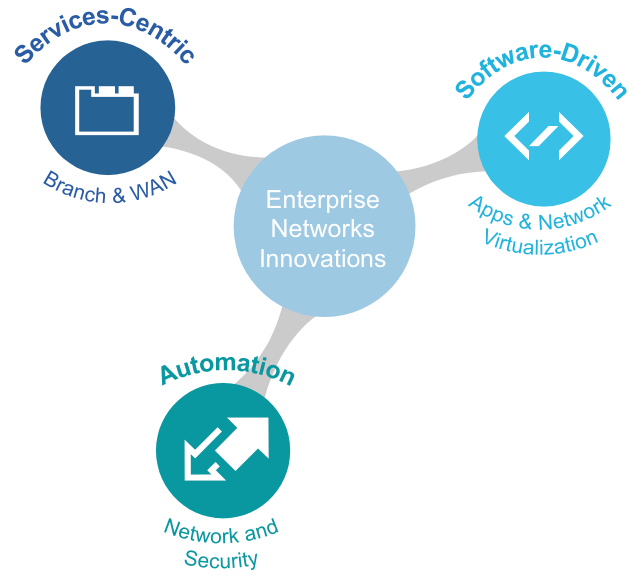
This is always a question we ask ourselves when rolling out any new technology. Focusing on real business outcomes for your enterprise, Cisco and our DNA approach is built on three design principles.
Services-centric to give enterprises the freedom to run services and applications when, where, and how they want it across the WAN and branch. Outcome: Faster service delivery.
Software-driven by virtualizing and optimizing applications and network functions for effective deployment on any platform: physic, virtual, or a mix of both. Outcome: Freedom of choice.
Automation of devices, apps and services for greater agility. Outcome: Less human errors.
Cisco DNA is the future of the network. These innovations allow you to reach greater network agility and achieve real business outcomes. Check out our collection of supporting blogs and Cisco Live US Virtual Experience on Cisco Enterprise Networks Communities for more details.
In case you missed the Red Hat Summit in San Francisco, it was most certainly an event well-worth attending …. there was even a wedding! Yes, that is not a typo. During the second day general session, Red Hat held an actual wedding ceremony. If you needed any tangible sign to convince yourself of the creativity of the Open Source community, well …. this should rank pretty high .. at least in terms of originality.
If we get philosophical for a minute, marriage signals a long-term commitment. And open source projects would not be successful without the commitment of the community, the various vendors and you the lone star developer sharing your intellectual property for the common good. It is hard to imagine how cloud could have reached its current levels of adoption without the support of the open source community. And open source may still be what is required to bring cloud adoption to the next level. Let’s take OpenStack for example. One of the top business drivers associated with the adoption of OpenStack – as reported by the annual OpenStack User Survey – is to ‘Standardize on the same open platform and APIs that power a global network of public and private clouds’. That is quickly followed by “Avoid vendor lock-in with an open platform, including flexibility of underlying technology choices” Can OpenStack become the ‘de-facto’ standard to build hybrid clouds?
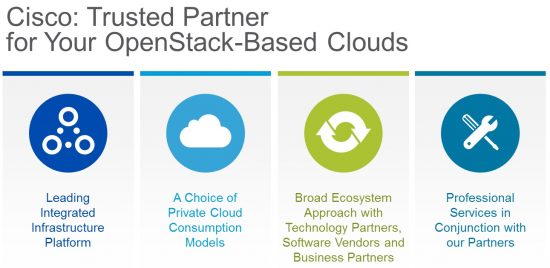
It is indeed about offering choice. Cisco has been an active participant in numerous Open Source projects and we continue to be committed to OpenStack to meet our customer needs. Many of our customers have in place a continuum of applications that have to be developed, updated and supported. They range from traditional to cloud-native applications in what is an incredibly fast-moving market. To support a continuum of application requirements, you also need flexibility of cloud consumption models. With our growing cloud portfolio and partner ecosystem, we bring you that flexibility of consumption models so that you can choose the ‘right cloud for the right crowd’.
These are exactly some of the topics I tackled during my short presentations (minus the wedding part). When it comes to OpenStack in conjunction with our partner ecosystem we can provide you with a broader set of choices.
For organizations that want a faster, easier way to implement OpenStack-based private clouds and achieve business value… Cisco in collaboration with Intel and Red Hat offers an integrated infrastructure and cloud platform solution, deployed according to validated, proven designs. Our Cisco UCS with Red Hat Enterprise Linux OpenStack Platform solution is well-suited for organizations that want maximum flexibility regarding their ability to customize their OpenStack environment and already have (or are willing to acquire) OpenStack expertise.
Conversely, if you cannot or do not want to be in the business of managing OpenStack, Cisco Metapod allows you to consume OpenStack ‘as a service’. Cisco Metapod™ is a Private Cloud as a Service offer that combines Cisco cloud infrastructure (Cisco UCS and Cisco Nexus), a powerful platform powered by OpenStack, and a team of experts who manage and operate the environment 24x7x365. Cisco Metapod can be delivered in your data center, or a colo facility of your choosing. Once the hardware is deployed by you or a Cisco partner, the OpenStack platform is deployed by a dedicated team of experts and becomes production ready in two weeks. In essence, the solution is in your data center, on your hardware and delivered as a service.
If you want to learn more about the solution, you can check out the short slide deck we posted on SlideShare