Last week I introduced this topic, the pervasive problem of “comatose” servers in data centers, based upon an interesting recent eWeek article entitled “30 Percent of Servers Worldwide Sit Idle”, which in turn was based upon the research report by Stanford University in conjunction with the Anthesis Group. In my blog, I described the costs of this problem, ranging from the obvious (e.g. power and facilities) to the hidden (e.g. un-used software licenses). This week I’ll discuss why this happens and what you can do about this problem.
The Problem of Idle Servers – What Can You Do About It
Co-written with Taru Khurana, Senior Analyst, SP Thought Leadership
The ubiquitous nature of Internet of Everything (IoE) is driving a digital transformation in many industries and businesses. This digital disruption has already begun and it’s driving advanced cloud access and network performance requirements for a wide range of devices and machine-to machine (M2M) connections. Faster broadband speeds and lower latencies as well as wider network access are essential enablers for the future of IoE that many envision. The growing number of cloud applications that are being developed for a wide variety of business and consumer uses are dramatically changing the demands and expectations of public and private network services.
The oil and gas industry has been digitized since the 1960s – perhaps longer than any other sector. From digital computers to digital oilfields, the industry has evolved from a monitor and react model, to one of real-time and predictive decision making.
Now, change is coming to the industry. Some compare the scale of this change to what was seen in the Industrial Revolution, one of the most pivotal technological shifts in in history. In that transition, new processes and innovative techniques caused industries to change literally overnight.
Today, we are in the midst of a digital revolution. And once again, industries across the board are on the cusp of radical changes to how they operate and innovate.
During our next #CiscoChat on Tuesday, July 28, 9-10 a.m. PST, we’ll take a deeper look at how the oil and gas industry has embraced this digital revolution, why digital technologies are making companies more competitive, and what it means for the future of the industry.
Digital oil fields, with their sensors and industrial control systems, are a marvel to be proud of. Yet, oil and gas leaders increasingly recognize that this model is plagued with process silos that add expense and cripple agility.
The oil and gas companies that see opportunity are integrating IT, industrial controls, and business processes end to end. They’re breaking silos. They’re defying bandwidth constraints by bringing computing to the data deluge being generated in remote locations.
They’re making sure everything is secure end to end, from board room to well head. They’re using digital technologies to communicate better, keep people safer, and collaborate more effectively.
They’re getting immediate data and better information to make better decisions, faster. And they’re looking toward tomorrow, bridging the talent gap and setting the foundation for an even more amazing digital future.
“How is all this possible?” you ask. This #CiscoChat is where you’ll find the answers.
During our #CiscoChat, @EnergyCisco will be joined by Nicolaas Smit, director of Cisco’s Energy Industry Global Industries Center of Expertise, along with Luis Gamboa, oil and gas market development lead at Rockwell Automation, and Zeus Kerravala, founder and principal analyst of ZK Research. Our panelists will answer questions and provide insight into how an oil and gas firm can transform to be a digital integrated organization through the Internet of Everything. Continue reading “#CiscoChat: Coming Out Ahead in Oil and Gas with Digital Technologies”
Not long ago I was asked to attend a quarterly Board meeting of one of my healthcare clients and to present the recommendations of a Strategic Security Roadmap (SSR) exercise that my team and I had conducted for the organization. The meeting commenced sharply at 6am one weekday morning and I was allocated the last ten minutes to explain our recommendations and proposed structure for a revised Cybersecurity Management Program (CMP).
The client Director of Security and I waited patiently outside the Board Room while other board business was conducted inside. As is the case with many organizations, information security was not really taken seriously there, and the security team reported into IT way down the food chain, with no direct representation in the C Suite. The organization’s CMP had evolved over the years from anti-virus, patching and firewall management into other domains of the ISO27002 framework but was not complete or taken very seriously by those at the top. Attempts at building out a holistic security program over the years had met with funding and staff resource constraints and Directors of Security had come and gone with nothing really changing. Continue reading “Security and the Board”
IT organizations are struggling with how to maintain what they have while also reacting to the rapidly changing needs of the business. Some think this means “transforming” IT into a new, agile organization – instead, we can use “bimodal IT”. But what does it really mean?
I’ve noticed that many business clichés have been invading my language. I’ve been trying to be proactive in curbing the habit. Needless to say, it’s not working. So instead of trying to cut back, at the end of the day I’ve decided to push the envelope and give 110% to using as many as possible in this post. My hope is that this moves the needle in creating my own behavioral paradigm shift.
Has it become cliché to be the “industry leader”? As an industry, we (marketing professionals) overuse the term “industry leading” to the point where it has probably become a rubber stamp. But I think it’s acceptable when credible independent sources do in fact recognize you as an industry leader.
To that end, IDC recently did just that. IDC named Cisco as a leader in the IDC MarketScape: Worldwide Unified Communications and Collaboration 2015 Vendor Assessment — for the second time in as many iterations of that report.
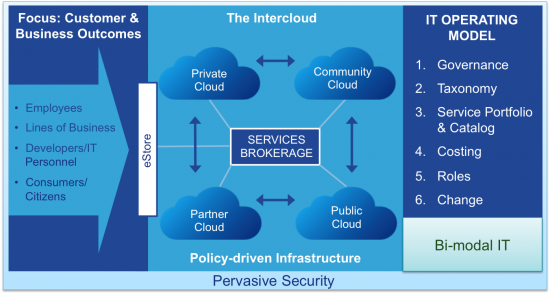
The Intercloud Fabric offers an answer for every enterprise that recognizes hybrid cloud is the goal, yet still faces the inevitable ‘how to’ questions.
The proverbial ‘how do I have my cake and eat it too.”
Fast IT has the power to completely transform the role and the value of IT to the business. It is a critical imperative for those CIOs who want to transform themselves from the mere owners of technology stacks to the drivers of their enterprise’s digital transformation.
CIOs must reinvent the mission and role of the IT department. It’s no longer good enough to be a competent internal IT provider. Going forward, CIOs and their teams must become what analyst firm Gartner calls “trusted brokers” of all IT services, delivered either in-house or by a dynamic roster of external suppliers. Quite simply, it’s a matter of survival: if nothing is done, the traditional IT department will be “Uber-ised”, just like the traditional taxi industry is currently being disrupted.
To understand Cisco’s lean, results-driven approach to Fast IT, please take a look at our latest white paper:
In August of 2010 my journey with Cisco began as I started my career on the Engineering Talent Acquisition Team. Five years later, I can tell you that it is still just as fantastic as that first day because Cisco invests in me and wants me to grow.
When looking for work I knew I wanted to be part of a world-class recruitment function with awe -inspiring leaders, and Cisco fit this bill. Cisco innovates throughout every function within the company.
A typical day for me involves managing the recruitment of Software Development positions across Europe, Middle East and Africa. TA Advisors within Cisco recruit for 15-20 positions at one time, with certain peaks in demand. When these peaks happen our leadership looks at every solution to try and help the situation and we work together as a team to ensure those demands are met. I also enjoy that my position allows me to work in branding, social media, market intelligence, and diversity!
One of the things I love most about Cisco is our culture. There is a true environment here for me to grow from within. Cisco employees are given a lot of developmental training. In my time here, I have worked within Project Management and Sourcing Training as well as Talent Advisory Sessions on Communication and Persuasion. Our teams also benefit from numerous in-house training sessions that explore topics such as Branding and Social Media to Immigration Protocols. The environment that I work in is very organic and all Cisco employees are empowered to work on initiatives to help us develop.
Another thing I’d like to mention is the care and attention that Cisco gives back to its employees and the communities around us. My global team recently completed a Give Back Day where over 200 Talent Acquisition employees volunteered to help various charities around the globe.
I also know that Cisco also cares about me as an individual. They have helped me gently integrate back into the team after just coming back from maternity leave, and they have also supported me through a very difficult time with my father being ill.
Cisco is a great place to work and to grow, both personally and professionally. Our philosophy of “people first” cascades through every aspect of how we work, play, and live.






 Co-written with Taru Khurana, Senior Analyst, SP Thought Leadership









 In August of 2010 my journey with Cisco began as I started my career on the Engineering Talent Acquisition Team. Five years later, I can tell you that it is still just as fantastic as that first day because Cisco invests in me and wants me to grow.