Avatar

“Inbound marketing is more effective than outbound marketing.”  

Sound like a quote from a recent marketing article? It’s actually a key takeaway from my doctoral thesis, published back in 2008 and entitled, “How Companies Use Customer Insight to Drive Customer Acquisition, Development, and Retention.”

No, I’m not Nostradamus, nor do I have a crystal ball. But, for a long time, I have been watching the signs that B2B buyers’ needs and patterns are changing.

Today, buyers – not sellers – are firmly in the driver’s seat. In fact, according to a recent DemandGen Buyer Behaviour report, almost half of buyers create a short-list of potential vendors and a third conduct initial research on solution options before the first communication with a sales rep. (For more on the evolution of buyer behaviour, see my blog post: Smarketing: A Sales and Marketing Love Story)

How are buyers conducting this research? Through search engines, vendor websites, and social media sites.

Hence the tipping point for inbound marketing. But what comes next? Here’s how I see the marketing landscape changing over the next 12 – 18 months:

1. Social media will gain traction in new ways

Social media is playing an increased role in marketing and buyers are now connecting to sellers via social channels rather than just browsing. DemandGen reports that 72% of respondents said they used social media to research the solution purchase.

This total is unchanged since 2013. What HAS changed is that there is a 57% increase in buyers connecting directly with potential solution providers via social networking channels. So they’re no longer just browsing social channels to do research, they’re using social channels to connect directly with sellers.

2. Marketers will adjust their budgets accordingly 

In reaction to buyer behaviour, marketers will continue to adjust their spend on inbound marketing. Sirius Decisions predicted back in 2013 that there would be a slight increase from 51% to 53% spent on inbound marketing by 2015. But what’s really interesting is the portion spent on social media: a big bump up from 36% to 44%.

3. Traditional sales and marketing roles will be turned on their heads   

We used to say, “Marketing opens the door and sales charges through it to close the deal.” Today, social media is driving role reversals within sales and marketing functions.

Increasingly, marketers are learning more about customers through their digital footprint and social media usage. We’re using real-time, behavioural data and analytics to complete a 360 view of the customer. And we’re leveraging this deep customer insight to close deals – because we’re able to make the right offer through the right channel at the right time.

Conversely, salespeople are now using social selling techniques to open doors with clients and prospects. They’re using social channels to connect, start conversations, and share knowledge and content. These nurturing techniques are paying off. According to a recent Social Media and Sales Quota Survey, more than 40% of salespeople say they have closed between two and five deals as a result of social media.

4. Revenue Marketing will become Profit Marketing  

Using Revenue Marketing principles, sales and marketing have begun to ensure that marketing strategies align with sales and business objectives to generate a measurable return to the bottom line.

But that’s just step one. As marketing shifts from a cost centre to a revenue centre, there is a deeper realization of the fact that not all customers are created equal. Inbound marketing tends to generate more new customer logos than outbound marketing. Based on lifetime customer value, new customers could be more desirable to a company which could translate into more importance placed on inbound techniques.

5. Employee advocacy will fuel marketing  

Although traditional advertising techniques (like TV advertising) are on the decline, social media makes it possible for employees to be a company’s best brand champions. Employee advocacy programs empower a company’s employees to support the goals of the brand using content and employee-owned social channels. This approach can have a huge impact on marketing and sales. According to Dynamic Signal, a digital marketing company, “Your employees are already on social all the time. And since people trust their social connections more than marketing messages, you can increase brand awareness by 14x and sales leads by 25%.” (Stay tuned for more on this topic in an upcoming blog post).

When will these 5 trends reach their tipping points? Last time my crystal ball looked 7 years ahead so let’s set it at 5 years this time – 2020! Watch this space….

Are you seeing sales and marketing changes in your markets and geographies? I’d love to hear from you in the comments below.

Authors

Dr. Christine Bailey

Marketing Director

EMEAR

Avatar

The Cisco 2015 Midyear Security Report provides an overview of key threats observed in the first half of 2015, along with insights on current and future trends and advice for organizations that utilize security solutions and services. Coinciding with a theme, The Innovation Dogfight between Attackers and Security Vendors, this year’s report is a clear realization that just as quickly as network security personnel and CXOs innovate their security measures, adversaries and their malware seem to be several steps ahead.

Join our next #CiscoChat on Thursday, August 13, at 10:00 a.m. PST: @CiscoSecurity hosts Talos technical leader, Craig Williams, to discuss the report’s findings and implications for organizations and attack defenders.

TW_CiscoChat Security_MidYear Report Continue reading “#CiscoChat: The 2015 Cisco Midyear Security Report”

Authors

Ana Alessandra

No Longer at Cisco

Avatar

A couple of weeks ago, we had the unique opportunity to support Tech on Deck with Robert Scoble and Scott Jordan. This first-time event was a big success. Remote viewers could actively engage with the hosts and guests, who ranged from Guy Kawasaki to Hap Klopp. The guests joined Robert and Scott using Jabber Guest from as far away as Israel. The discussions were fantastic.

Cisco’s own collaboration SVP Rowan Trollope also joined them from the comfort of his home via a Cisco MX200 G2 endpoint. Robert and Scott were shocked with the quality of the call – especially because it was living-room to living-room.  The quality of the video conferencing coming in over Jabber Guest was also good, but the experience delivered by a purpose-built video endpoint is still unrivaled.

As a marketer for video conferencing, this is the kind of excitement I wish I could bottle up and give to everyone. During a short interview with Robert (recently named #5 in Inc.’s Tech Power Players), we asked him how he uses video in his day-to-day work, about video quality, and the impact video can have in our lives – and how it can be better.

https://www.youtube.com/watch?v=QEa5PTL38Lg
Continue reading “Business Quality Video Conferencing…It’s Magic, Even for the Scobleizer”

Authors

Angie Mistretta

Chief Marketing Officer, AppDynamics

AppDynamics

Avatar

Why Cisco? What’s so great about working here? Why do people come in every day to innovate and change the world?

Let’s ask Cisco employees! Let’s even ask Cisco leaders!

Today kicks off an employee contest on Instagram (Follow us there!) It’s named (and tagged) #IChoseCisco. That way, employees can tell the world why they chose Cisco. Maybe it’ll inspire a new crop of talent to apply! The contest runs through August 13th. Full rules for employees here.

How does it work? It’s an employee-only contest to enter, but everyone can vote for their favorites with an Instagram like! (The more likes, the better chance that employee has to win the contest!) Employees: Post a photo on Instagram, use the hashtag #IChoseCisco and tag Life at Cisco on Instagram for a chance to win prizes. Everyone else: Follow the Instagram account, and like your favorites to help them out!

There are special white boards in some offices where you can write in your answer and Instagram your photo. For those around the world, there’s a PDF sheet to print out and use (but neither of these is a requirement – there are some creative people at Cisco who may chose to answer in out-of-the-box ways!)

Here’s a link to the (employee-accessible-only) rules and printable PDF.

And here are a few examples from a couple of folks you might recognize from our Executive Leadership Team, and some from our enthusiastic interns!

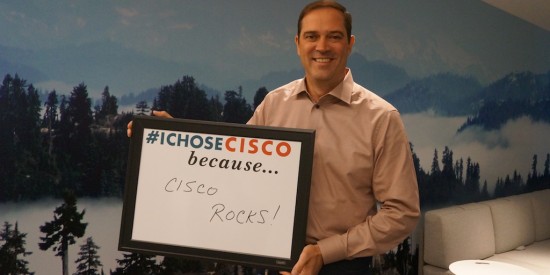
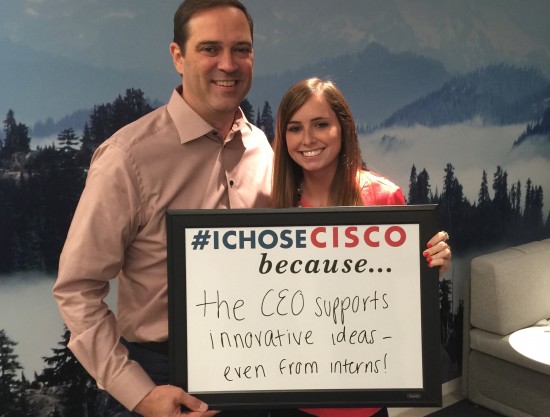
Chuck Robbins I Chose Cisco photo
New CEO Chuck Robbins says it’s because Cisco Rocks (and it does!)
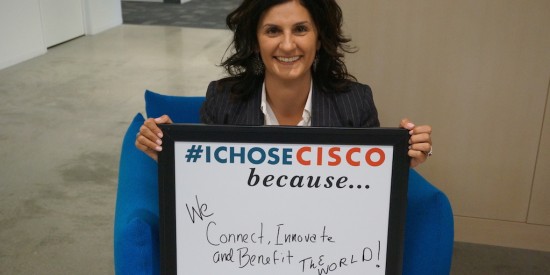
Fran Katsoudas I Chose Cisco  photo
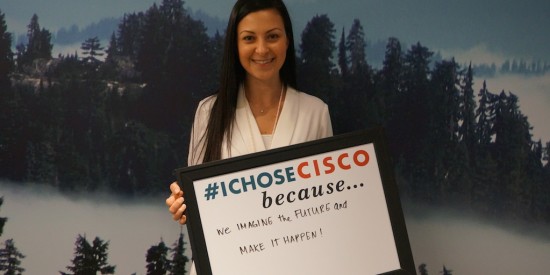
SVP of HR and Chief People Officer Fran Katsoudas wants to change the world!
Ruba Borno I Chose Cisco photo
VP, Growth Initiatives and Chief of Staff to the CEO Ruba Borno wants to make things happen!
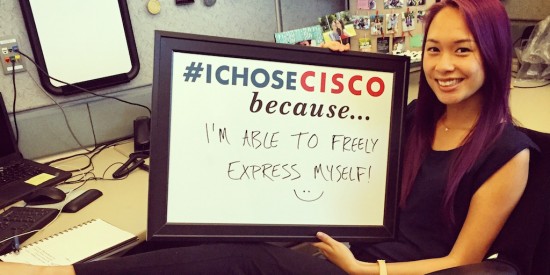
Cisco Intern I Chose Cisco photo
May, a Cisco employee, likes that she can be herself!
Intern Kayla I Chose Cisco
Intern Kayla (Instagrammer extrodinaire) likes the exposure to all levels in the organization!

Employees! Now go, post, and share to get likes. Have fun!

Authors

Carmen Shirkey Collins

Social Media Manager

Talent Brand and Enablement Team, HR

Avatar

Traditional to Big Data to IoT: Transaction Processing Performance Council Establishes Internet of Things Working Group (TPC-IoT)

Over the past quarter century, the Transaction Processing Performance Council (TPC) has developed several industry standard benchmarks for database performance, pretty much in line with major technology trends. The two most influential benchmark standards have been TPC-C (standard for benchmarking transaction processing systems) introduced in 1991, and TPC-D and its successor TPC-H (standards for benchmarking decision support systems) introduced in 1994. These standards have been significant driving force behind the development and advancement of several database, server and storage related technologies. In addition, the TPC laid a solid foundation for complete system-level performance, and methodology for calculating total-system-price and price-performance, that have been widely adapted in the industry.

There is no doubt that industry and technology landscapes have changed and are still continue to change at a fast pace. Two of the technologies that will change the world in next 10 years are Big Data and Internet of things (IoT).

Big Data: Big Data is a popular term now that describes the exponential growth of data, often defined by the 5Vs, and the associated technologies to storage and process effectively and drive business values. The Big Data technology and services market represents one of the fast-growing, multi-billion dollar, worldwide market that is expected to grow to a $60 billion market driving $300 billion worldwide IT spending directly or indirectly by 2020.

Foreseeing the importance, in 2014  the TPC has developed TPC Express Benchmark HS (TPCx-HS)  to provide the industry with verifiable performance, price-performance, and availability metrics of hardware and software systems dealing with Big Data. This standard can be used to assess a broad range of system topologies and implementation of Hadoop systems in a technically rigorous and directly comparable, and vendor-neutral manner. This is the first major step while the TPC continues to enhance and develop new standards in this area such as TPC-DS with support for Hadoop and TPC-Big Bench.

Internet of Things (IoT): IoT  has emerged in the last few  of years, poised to transform virtually every major market segments, which contains a complex mix of technologies and products, from data collection and data curation to complex analytics exploiting the data generated by exploding number of connected devices. According to IDC the global IoT market will grow from $665 billion in 2014 to $1.7 trillion in 2020. To put that in perspective, it’s an absolutely enormous figure; only 16 economies in the world had gross domestic products exceeding $1 trillion in 2014.

As the IoT ecosystem evolves in the enterprises, it is eminent to have a set of standards that enable effective comparison of hardware and software systems and topologies in a technology and vendor-neutral manner. Continuing its commitment to bring relevant standards to the industry, today the TPC announced the formation TPC-IoT benchmark committee tasked with developing industry standard benchmarks for benchmarking hardware and software platforms associated with IoT.

We’d like to connect with companies, research and government institutions, to ensure holistic perspective during the benchmark development process. Anyone interested in our efforts can visit our membership page.

Thank You
Raghu Nambiar
(Chairman, TPC-IoT)

Authors

Raghunath Nambiar

No Longer with Cisco

Avatar

The pace of business is accelerating.  As consumers, the internet has changed our expectations for how to order products, services or information as well as how fast it is delivered.  Think about it.   We access a web page, order what we want and complete the transaction.  In some cases, our orders are delivered within hours.

The process is not so simple in the business world.

You have a new project and you want to get started right away.  After weeks of meetings, IT has identified that they have the resources but it will take six to eight weeks for them to make them available.  How would you respond?

This is not an imaginary scenario.  As the world becomes digitized, businesses need to respond with speed and agility to keep pace.  Your employees expect the same level of service delivery and on-line shopping experience that they have as consumers.   These changes are creating the need to transform traditional models to new, cloud-based models that produce the speed, agility and on-line consumer experience your employees anticipate.

Private cloud is being deployed as a means to meet these new service and delivery expectations.  Private cloud delivers speed not just to your data center but across all layers of your organization.  It allows your business to be more productive, efficient and profitable.  The foundation to private cloud is infrastructure and infrastructure does matter.

The combination of Cisco ONE Enterprise Cloud Suite and VCE Vblock™ Systems deliver a pre-validated private cloud solution with all the essential automation tools and an infrastructure stack designed to accelerate the deployment of a hybrid-ready private cloud.  Watch this video to learn more.

https://youtu.be/N3vRcXlqh78

Cisco ONE Enterprise Cloud Suite delivers out-of-box infrastructure automation that spans compute, network, storage and virtualization.  The self-service portal allows employees to order on demand data center, applications or business services that include your best practices and compliance policies. The built-in stack designer allows architects to combine application profiles and infrastructure templates to create applications as a service.  Built-in hybrid capability delivers the same levels of security, control and management to public providers that is available in your private cloud.

Vblock™ Systems from VCE represent the next evolution of IT – one that unleashes simplicity by delivering efficiency and business agility of private cloud environments.  Integration of best-in-class compute, network, and storage technologies from Cisco, EMC, and VMware deliver resources that can be provisioned and managed quickly to meet the changing demands of today’s business.   Pre-integrated, tested and validated, the combination of VCE Vblock™ Systems and Cisco ONE Enterprise Cloud Suite simplify and accelerate hybrid ready private clouds.

As the pace of business accelerates, you need to be able to respond quickly to changing business needs and business opportunities.  Cisco ONE Enterprise Cloud Suite and VCE Vblock™ Systems deliver a pre-validated hybrid ready private cloud that lets IT better align with business needs as well as deliver new products to your customers faster.

To learn more about Cisco ONE Enterprise Cloud Suite, go to:  www.cisco.com/go/cloudsuite.

To learn more about VCE Vblock™ Systems, go to:  www.vce.com

To learn more about Cisco’s other management solutions go to:   www.cisco.com/go/um


Authors

Joann Starke

No Longer with Cisco

Avatar
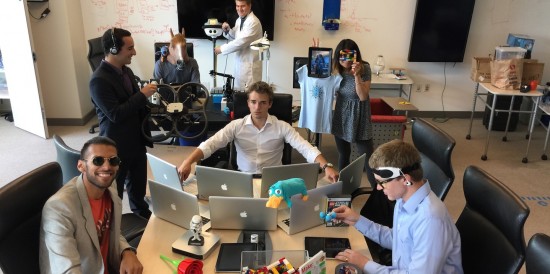
Cisco's geeky Consulting Team
Cisco’s consulting team shows off their full geekiness.

The words “geek” or “nerd” are often thrown about with negative connotations, but not at Cisco! Here, we wear our geek badges with pride, and like to think that being geeky is cool.

Take, for example, Cisco’s Consulting Services Team in San Jose, pictured above. They helped Cisco celebrate geekiness by taking a photo of all of their geek in one awesome photo. These are folks who work in Cisco’s innovation labs, who spearhead initiatives to get new generations inspired in technology, who solve big problems and make big changes. If it takes being geeky to do that, they’re all in!

Ben Varghese, a Cisco consultant (photo, bottom left) thinks being geeky is getting even cooler as you’re reading this blog post.

“My favorite quote about geekiness is from Bill Gates: ‘Be nice to geeks, you’ll probably end up working for one.’ As technology continues to change every aspect of life at an ever-increasing rate, this becomes more true every day.”

Shraddha Chaplot, an engineer at Cisco (photo, top right) makes it her mission to show that women can be geeks and be cool. She tells everyone she’s a geek, and wishes folks a happy “geekend” when Friday rolls around.

“So you don’t like the word ‘geek’?” she says. “Don’t think it’s cool, hmm? Well what if I told you that ‘geek’ is synonymous with wizard, superhero, and mathemagician (yes, I spelled that right). What if I told you that with these super geek powers you can create and build anything from a dream to reality? I get to do that everyday and so many of my friends do too. Being a geek is the coolest thing I’ve ever been.”

How do you embrace your geek? Tell us in comments below.

Know a geek (maybe it’s you!) that would be a great part of the Cisco Consulting Services team? Be sure to check out the open consulting roles here!

Are you, or do you know an engineer that embraces geek style? You can find open engineering roles here.

Authors

Carmen Shirkey Collins

Social Media Manager

Talent Brand and Enablement Team, HR

Avatar

The following post was originally published in The Hill

In 1961, President John F. Kennedy laid out an ambitious goal for our nation – to land a man on the moon by the end of the decade. In doing so, he inspired a new generation and helped ensure U.S. global leadership in technology for years to come.

Today, we have an earthbound, but no less important, challenge. We face a massive skills gap — by 2018, our nation will have 1.8 million unfilled jobs requiring technical skills. Our nation’s business community is uniting to address the challenge.

We need to make sure that students of all backgrounds have the skills and opportunities to pursue a career in STEM– Science, Technology, Engineering, and Math. This requires a national strategy, a chief component of which is STEM mentoring by STEM professionals.

Why mentoring? Because students won’t do what they can’t see. It’s one thing to teach math and science in the classroom. It’s another thing to build, explore, and engage the incredible world of science and technology that is transforming our society in real-time. Hands-on learning is the way to get a diverse group of students excited about STEM.

STEM mentors at Cisco
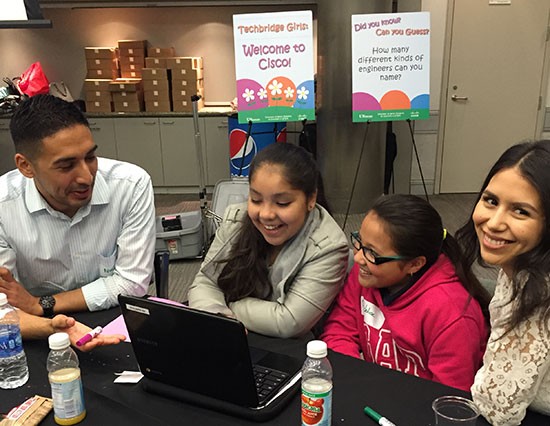
Participants with Techbridge Girls visit Cisco’s San Jose, California headquarters during a STEM mentoring event in February, 2015.

Continue reading “Engineering a STEM mentoring moonshot”

Authors

Kirsten Weeks

Senior Manager for Community Relations

Global Marketing and Corporate Communications

Avatar

The well-known Quarry Worker’s Creed, called out in prefaces to books such as “The Pragmatic Programmer” and “Ship While you Sleep”, posits the notion of IT done right as more than simple engineering discipline – good software development, for example, should not “preclude individual craftsmanship”. Drawing parallels to the construction of large cathedrals built in Europe during the Middle Ages, the quarry worker’s creed points out that while generations of builders advanced the state of structural engineering from one decade to the next, the “…carpenters, stonecutters, carvers, and glass workers were all craftspeople, interpreting the engineering requirements to produce a whole that transcended the purely mechanical side of the construction”.  

We who cut mere stones must always be envisioning cathedrals, says the Quarry Worker’s Creed, and as companies, cities and countries lean on their IT teams to enable the transformation to digital business, the talented men and women that work in technology are not just builders: they are increasingly artisans and craftsmen – experts in the tools of the trade and also nuanced in navigating the vicissitudes that present themselves in the quest to build and secure the technology that powers the next wave of innovation and growth.

Cybersecurity teams in particular have their hands full today. On one hand there are all the new advances that we often can’t get fast enough: crowd-funded financial services, online education, virtual booking for work spaces, driverless cars – to name just a few. All of these need security be conceptualized and built-in from the beginning (or not, to our peril). On the other hand, their adversaries, the often-elusive hackers are increasingly sophisticated actors, who design malware, tweak code and inject vulnerabilities with the same flair and passion of a renaissance architect.  Continue reading “We Who Cut Mere Stones Must Always Be Envisioning Cathedrals”

Authors

Rashesh Jethi

Cisco Services