Avatar

After several months leading the managed security services portfolio at Cisco, I sat down with the social media team to discuss my path to Cisco, the evolution of the security market, and the future of security. [Note: This is an abridged version of the full interview.]

Q: After nearly 20 years at Symantec, why did you decide to move to Cisco?

TP: Cisco has all of the pieces necessary to solve the biggest security problems facing businesses today and into the future. Cisco’s position in the network, its broad security product portfolio, its strong and continued investment in security, and its pivot toward driving business outcomes and solving customer problems place this company in a unique position to lead the charge toward the next generation of security. As a part of a company that builds the cloud, mobility, collaboration, and Internet of Everything technologies driving change in the security market, we have a unique opportunity to proactively build security services that enable the secure adoption of these innovations. Our ability to integrate with networking technologies and all types of connected devices allows us to feed huge amounts of data from across an entire customer network into our big data platform for detecting, investigating, and analyzing threats. I’m eager to take what I’ve learned throughout 19 years in security and put that knowledge and experience to work in building up Cisco’s resources into a next-level suite of solutions. Continue reading “Getting to Know Tom Powledge, Vice President of Cisco Managed Security Services”

Authors

Tom Powledge

VP, Managed Security Services

Avatar

This post was authored by Nick Biasini with contributions from Craig Williams & Alex Chiu

Update 8/1: To see a video of this threat in action click here

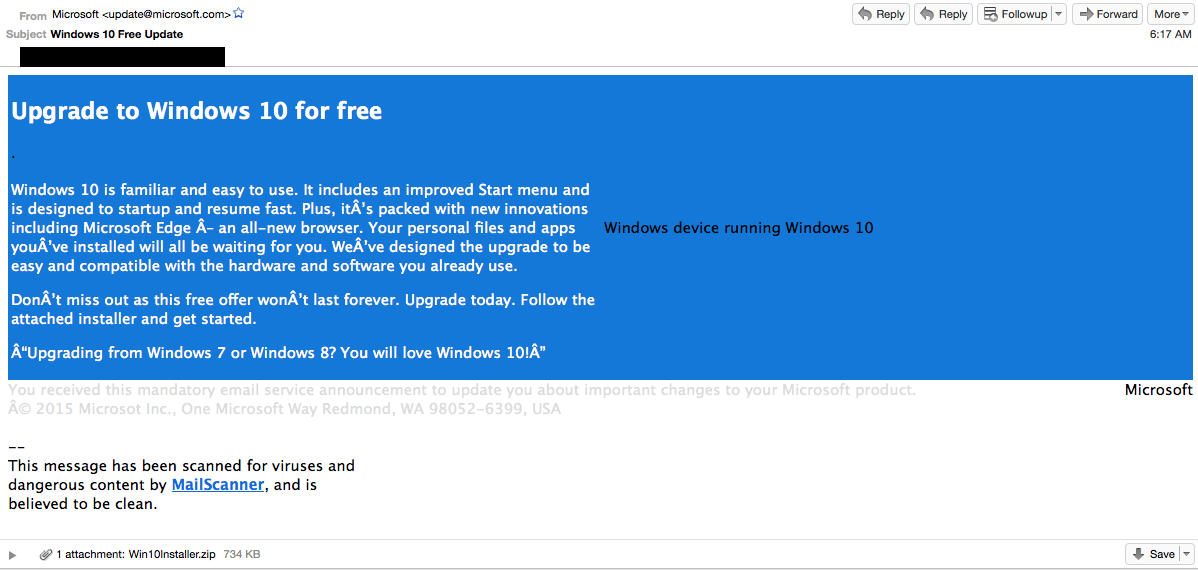
Adversaries are always trying to take advantage of current events to lure users into executing their malicious payload. These campaigns are usually focussed around social events and are seen on a constant basis. Today, Talos discovered a spam campaign that was taking advantage of a different type of current event.

Microsoft released Windows 10 earlier this week (July 29) and it will be available as a free upgrade to users who are currently using Windows 7 or Windows 8. This threat actor is impersonating Microsoft in an attempt to exploit their user base for monetary gain. The fact that users have to virtually wait in line to receive this update, makes them even more likely to fall victim to this campaign.

Continue reading “Your Files Are Encrypted with a “Windows 10 Upgrade””

Authors

Talos Group

Talos Security Intelligence & Research Group

Avatar

Got cloud? 

It’s no secret that implementing cloud technologies allows IT to rapidly react and dynamically deliver new services to any business or organization almost instantly.

In an ideal world, cloud services—whether private, public, or hybrid—allow users access to applications wherever, however, and whenever they need.

Operating in the cloud can help solve some of your most cumbersome business and IT challenges. For starters, it can provide scalability, reduce costs, improve collaboration, and enable automation.

It sounds great, right? So what’s the holdup with cloud adoption?

Continue reading “Serving up cloud options just got easier”

Authors

Adrian den Hartog

Senior Marketing Manager

Field Marketing US Commercial

Avatar

Cisco recently introduced another addition to its Radio Resource Management (RRM) algorithm – Dynamic Bandwidth Selection (DBS). Previously, controllers only had the ability to automatically assign channels and power levels, while the AP channel widths were manually assigned for each AP Group. A choice of 20MHz, 40MHz, or 80MHz channel widths were offered within the Access Point (AP) groups, allowing for the APs to all be on the same chosen channel width. With the addition of DBS, the APs can now be automatically assigned to individual channel widths. This allows the radio resources more opportunities to fine-tune the network according to changing RF conditions for higher granularity.

Independent testing company Miercom recently carried out a full scale RRM testing to run Cisco’s DBS RRM against Aruba’s Adaptive Radio Management (ARM). This testing was performed to validate and benchmark the best-in-class radio resource management feature in Enterprise Wireless. The RRM testbed was designed to achieve real world apples-to-apples comparison between the Cisco 5520 controller with five AP 2702i against the Aruba 7210 controller with five AP 225.

Image 1

The result was a runaway win for the Cisco controllers over Aruba.

RRM is a vital element for strong performance and reliability of a wireless network. RRM involves intelligent management of the channels and power transmission of AP radios based on the environment Radio Frequency (RF) conditions. Cisco introduced RRM on its WLAN Controllers in 2005, and since then has been an industry pioneer in automatic AP channel and power management. Cisco’s RRM has evolved over the last decade to become one of the most important WLAN features. RRM is especially helpful for high-density networks where scores of APs need to assign the best possible channel and power plans. These channels and power plans create minimum RF interference and maximum RF performance.

Miercom independently verified the functionality of both the RRM and ARM over a period of several days to analyze the overall performance impact on the network. They observed each controller with different channel width conditions ranging from 20MHz to 80MHz. Typically the radio management algorithms for both RRM and ARM take a few hours to zero-in on what is considered to be the best channel and power plan by the respective vendor controller. Miercom allowed each test setup a period of 12 hours to settle down to the best possible AP channel and power plan. Continue reading “Miercom Agrees: Cisco Controllers with Dynamic Bandwidth Selection are the Tops”

Authors

Shivesh Ganotra

Technical Marketing Engineer

Enterprise Infrastructure Solutions Group

Avatar

I’ve been blogging a lot lately about how smart organizations in all industries need to embrace a digital transformation in order to innovate and compete at the blistering pace of the Internet’s next wave—the Internet of Everything (IoE). The pace of digital disruption is affecting the transportation industry in significant ways. The IoE is driving safety, mobility and efficiency efforts across the industry. And, while streamlining operations is critical to the success of any agency, it’s even more important when inefficiency can mean the difference between life and death.

The California Shock Trauma Air Rescue’s (CALSTAR) is an example of an organization that is driving its own disruption by embracing Internet of Things (IoT) innovation. Operational efficiency is vital to CALSTAR and seamless communication between hospitals, medical personnel, flying crews and CALSTAR dispatchers is something the company has also always envisioned. When the Federal Aviation Administration (FAA) updated its operational control guidance for air ambulatory operators, CALSTAR re-examined its own air-to-ground communication systems. They saw this as an opportunity to not only comply with FAA changes, but to ensure that transportation was the only concern its flight crews had to consider when transporting patients.

http://www.slideshare.net/CiscoBusinessInsights/digital-transformation-in-transportation

Continue reading “#InternetOfEverything Accelerates Critical “Air Care” for CALSTAR”

Authors

Tony Shakib

No Longer with Cisco

Avatar

We are making some changes to the way Cisco Security provides and shares vulnerability and threat intelligence to make it more consumable by our customers and the security community. The Cisco Security IntelliShield Service has been successfully delivering multi-vendor security intelligence to our customers for 15 years. During this time, the security intelligence market has continued to evolve to more integrated and automated solutions. Similarly, the Cisco Security strategy has evolved to add machine-readable security content.

We have seen an ever-increasing volume of multi-vendor reporting over the years. IntelliShield started publishing security intelligence alerts in May 2000 and we published 1337 alerts that first year. By 2005 that had increased to 1555 alerts and in 2010 to 5210 alerts. In 2014, IntelliShield published 7242 alerts and the volume continues to increase. As the volume of security activity has increased, security teams are faced with the challenge of efficiently handling that increased volume. The solution for this increased volume is to automate the reporting and sharing of vulnerability and threat intelligence through machine-to-machine standardized formats.  Continue reading “Changing the Way We Deliver Vulnerability and Threat Intelligence”

Authors

Jeff Shipley

Manager, IntelliShield

Security Intelligence Operations

Avatar

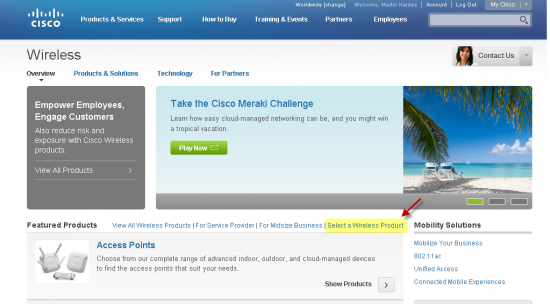
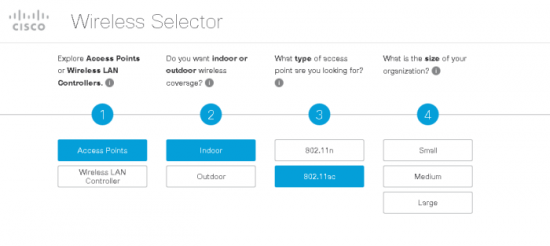
There’s a simple new Wireless Products Selector on Cisco.com that we hope will make it quicker to choose the right wireless product for you. It’s right at the top of our Wireless products page:

WirelessCategory-2

This leads to a very simple, intuitive tool that guides you to choosing the right wireless access point or wireless LAN controller:

WirelessSelector

Feel free to take it for a spin!


Authors

Martin Hardee

Director, Cisco.com

Cisco.com

Avatar

CiscoChampion200PXbadge#CiscoChampion Radio is a podcast series by Cisco Champions as technologists. Today we’re talking about Cisco Cloud Web Security (CWS), which provides industry-leading security and control for the distributed enterprise. Users are protected everywhere, all the time when using CWS through Cisco worldwide threat intelligence, advanced threat defense capabilities, and roaming user protection. Our SME is John Davis, Cisco Technical Marketing Engineer.

Listen to the Podcast.

Learn about the Cisco Champions Program HERE.
See a list of all #CiscoChampion Radio podcasts HERE.
Ask about the next round of Cisco Champions nominations. EMAIL US.

Cisco SME
John Davis, Cisco Technical Marketing Engineer

Cisco Champion Guest Hosts
Jake Gillen, @jakegillen, Senior Security Engineer
Ed Walsh, @vEddieW, Senior Consultant

Moderator
Brian Remmel (@bremmel)

Highlights
What is Cisco Cloud Web Security (CWS)
CWS and AUP Service
CWS security data processing
CWS Essentials and Premium
Advantages of CWS for more robust protection
CWS management tools and reports for end users

Resource
cisco.com/go/cws

Authors

Rachel Bakker

Social Media Advocacy Manager

Digital and Social

Avatar

Today’s digital organization relies on information gathered across the network and out to the individual – from customers to employees to citizens.  Whether your user is a commuter looking for a train schedule or a tourist using a retail app, Cisco’s Connected Experiences software lets you gather data on that interaction, analyze the findings, and respond in real time. With this ability to connect to each person, in any location, you provide a new level of intimacy with users while gathering data that will shape those relationships into the future.

Kansas City brings this vision to life through its new captive portal powered by Cisco Enterprise Mobility Services Platform (EMSP). Using EMSP, Kansas City will create urban social apps that allow citizens to report on issues in real time, making city problems more visible and leading to faster resolution.  Users can also access content and context-aware data and location-based services to help navigate their way through shopping and sightseeing. Continue reading “New Citizen Services in Kansas City Enabled by Mobile and Cloud”

Authors

Peter Mason

Senior Director, Automation and Experiences Platforms

Product Management and Product Marketing