#CiscoChampion Radio is a podcast series by Cisco Champions as technologists. Today we’re talking about Collaboration System Release 11 with Cisco Technical Marketing Engineer Dan Keller.
Get the Podcast Listen to this episode Download this episode (right-click on the episode’s download button) View this episode in iTunes
Cisco SME Dan Keller, Technical Marketing Engineer, Collaboration Technology Group
Cisco Champion Guest Hosts Dennis Heim, @collabsensei, Emerging Technology Architect (Collaboration)
Josh Warcop, @Warcop, Senior Consultant
Bill Carter, @ccie5022, Senior Business Communications Analyst
By Robert Mahowald, IDC Program Vice President, SaaS and Cloud Services
We recently surveyed more than 3,450 executive-level IT decisionmakers in 17 countries to find out their future plans and current state of cloud adoption. What we discovered is pretty remarkable.
According to IDC’s CloudView Survey, 57% of organizations are already using or planning to implement some form of cloud services. Many organizations we surveyed (44%) are using or planning to implement private clouds. But respondents pointed to hybrid cloud — a strategy for operating in a mix of public and private cloud environments — as their dominant operational model, at 64% of all organizations surveyed.
So the Summer of 2015 is quickly coming to a close here in New England, which means Fall is coming, and the leaves will soon begin to change color with the cooler temperatures. But according to ACC Research the Mobile Infrastructure is getting hot again, and starting to grow, which is great news.
Telehealth, according to the Health Resources Services Administration, is the use of electronic information and telecommunications technologies to support long-distance clinical health care, patient and professional health-related education, public health and health administration.1
Cisco’s robust interoperability, security, and video technology have put us at the forefront of telehealth. In addition to facilitating remote clinical services, Cisco video technologies are also used in remote non-clinical services, such as clinician training, administrative meetings, continuing education, and contact centers.
Over the years, our teams have seen a recurring theme of limited deployments in a small handful of areas across healthcare organization. These limited or siloed deployments typically lack a unifying strategy or architecture to be able to accommodate a secure telehealth deployment at scale that includes proactive care, big data, population health management, and a contact center. Cisco can help your organization to establish a vision and architecture strategy for deploying a telehealth program.
SAP just announcedthe release of SAP HANA Vora. SAP HANA Vora is an in-memory query engine that plugs into the Apache Spark execution framework to provide enriched interactive analytics on Hadoop.
Cisco, provider of UCS Integrated Infrastructure for Big Data, is working with SAP to achieve the following:
Process Big Data simply and cost-effectively for real-time business applications and analytics
Provide enterprise-class drill-down insight into raw data
Blend incoming data from customers, partners, and smart devices
Combine business data with external data sources to make better decisions through greater context
SAP HANA Vora running on Cisco UCS consists of the following
In-memory query engine running on Spark execution framework on the Cisco UCS platform
Compiled queries for accelerated processing across Hadoop nodes on the Cisco UCS platform
Enhanced Spark SQL semantic with hierarchies for analytical processing
Enhanced adaptor for Spark and the SAP HANA database for faster query interactivity
Unified administration across Hadoop distributions and SAP HANA
What does this mean for customers who plan to run SAP HANA Vora on the Cisco UCS platform?
Enable more precise decisions through greater contextual awareness
Democratize access for data scientists to facilitate new discoveries
Simplify Big Data ownership through unified administration across multiple tiers
Structured and unstructured data, all part of the Internet of Things, is created each day at an accelerated rate and those companies that are able to take advantage of that data in a business environment, will outpace their competitors in the business world and provide those products in a manner that will be tailored to their customers’ demands.
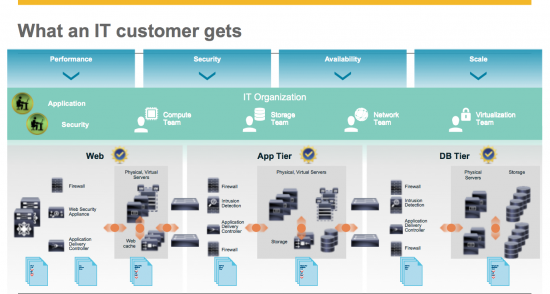
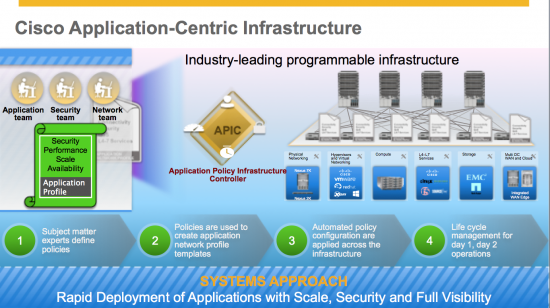
In utilizing SAP HANA Vora on the Cisco UCS platform, not only will the customer demands be met, but it will be delivered via ACI (Application Centric Infrastructure) in an automated, cost-effective, policy-driven way, which can lead to lowering the total cost of ownership of a data center, both from a hardware and software perspective, and decreasing the time an employee spends deploying and managing a critical data center.
Look for more information about SAP HANA Vora on the Cisco Web Site and plan to visit the Cisco booth at SAP TechEd in Las Vegas and Barcelona this Fall.
As a connected consumer, I can buy a book, plan a vacation, or choose a movie from any number of devices and from any location (home, office, car, or airport!). These interactions are not only convenient, they are more and more highly personalized and tailored to my likes and dislikes. We have all experienced this on Amazon and other commerce sites.
Unfortunately, we don’t get this experience from many banks.
In a Cisco survey of more than 7000 smartphone users and bank customers in 12 countries, 43 percent said that their primary bank did not understand their individual needs. Bank customers in China (54 percent), Brazil (52 percent), Mexico (49 percent), and India (46 percent) felt even more disconnected (see chart below).
One of the benefits of cloud is being able to iterate quickly. There’s a saying in the software development world that we can’t post here due to profanity, but if you’re curious, you can view it on the Startup Vitamins website here. Bottom line: Cloud allows you to develop products quickly, so you can launch them, test them, and revise them at minimal cost if you get something wrong.
That brings us to the product name. Certainly, Cisco, like all other big companies, has branding guidelines. Those guidelines are there both to protect the amazing brand Cisco has built over the last few decades, and to give customers a sense of familiarity across a broad set of products and services. When naming a product or service, the expectation is that the chosen name is descriptive. Metacloud OpenStack™ was a recognized distribution of OpenStack, but when we were acquired, we were able to transfer the distribution rights to Cisco. Our distro became “Cisco OpenStack®” and the rest of our product was descriptive. Thus “Cisco OpenStack® Private Cloud” became the new product name.
This is the time of year when summer vacations end and students head back to the classroom. For those of us who have school-age children like me, it’s important that we know that their academic environment provides access to tools and information that will ensure successful learning. Knowledge of our children’s academic resources gives us the power to help shape their educational outcomes.
Perhaps surprisingly, improving young minds is a bit like improving network operations. As in academia, IT environments are highly dynamic – networks support multiple office locations, configurations change frequently to meet business demands and applications require flexibility to meet future trends, such as the Internet of Everything (IoE). Network operations are optimized when IT teams have access to the resources and device data they need to ensure successful business outcomes.
School is in Session: A Network Operations Aptitude Quiz
Do you know if you have all right automation and analytic tools to effectively manage the operational lifecycle of your network equipment? Here’s a simple network “IQ” test to find out. For the following questions, answer “yes” or “no”: Continue reading “Increase Your Network Operations IQ”
In today’s world, technology is changing how we work every day. We’re always on the go – working from anywhere in the world at any time, and we’re increasingly dependent on our mobile devices to keep us connected. We want the best user experience regardless of where we are, and we want to know that we can always connect, that our connection is secure, and that our enterprise apps will simply work.
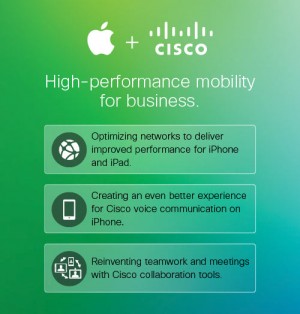
I’m thrilled about our new partnership we announced today with Apple. We are coming together to optimize Cisco networks for iOS devices and apps, integrating iPhones with Cisco environments and providing unique collaboration capabilities on iPhones and iPads. Together, we will enable mobile apps and experiences that deliver the quality and experience we need while meeting enterprise requirements for management and security.
Our two companies share a common passion to create a vastly improved mobile work experience. We also recognize the enormous opportunity we have to bring together the leading mobile platform and the leading provider of secure networks and collaboration to make the mobile work experience what it should be. What makes this new partnership unique is that our engineering teams are innovating together to build joint solutions that our sales teams and partners will take jointly to our customers.
Joint Engineering Efforts
Cisco and Apple both have deep cultures of innovation, and each of us brings expertise in complementary areas. There is no doubt our engineering teams will deliver incredible results as they drive deep joint development.
Initially, our teams will focus on:
Delivering unparalleled performance and end-to-end solutions on Cisco networks and iOS devices
Extending the Cisco Unified Communications experience to the iPhone
Transforming team collaboration with iOS experiences on Cisco Spark, Cisco TelePresence, and Cisco WebEx
Strategic partnerships and co-development are both key pillars of Cisco’s innovation strategy. This relationship highlights the value and innovative customer solutions that result when we do both.
Shared Vision
Together, Cisco and Apple will help employees and businesses collaborate and innovate anytime, everywhere, with an amazing user experience every time. We will do this by delivering a high-performance mobile experience for every employee, and a powerful collaboration platform for every business. This partnership is made for today’s mobile, digital world and we could not be more excited about what is possible as we move forward together.


 #CiscoChampion Radio is a podcast series by Cisco Champions as technologists. Today we’re talking about Collaboration System Release 11 with Cisco Technical Marketing Engineer Dan Keller.






 This new white paper,