Avatar

As summer comes to a close, many of us have kids who are returning to school with shiny new shoes and eager smiles. After a few months off, their minds are ready for the new school year and are open to learning again. Or if you have a high-schooler like me, they may not be as eager and are counting the years until they graduate. Either way, the importance of getting a fresh new start is critical to making the most of their education.

The same is true in the business world. Most of us rush through the day, striving to finish our to-do list, rarely taking time to take a step back and get that fresh new perspective. The opportune time to do this is at the start of the new calendar or fiscal year. As Cisco dives into our new fiscal year 2016, we welcome the new and returning Partner Plus Partners into the FY16 Partner Plus program. This is an exciting time at Cisco and an excellent time for Partners to take that step back and plan out their execution strategy for the new fiscal year.

Follow these steps to optimize your sales performance and achieve maximum Partner Plus Incentive Payouts.

  • Know your quarterly Partner Plus Target. Your quarterly targets can be found in Partner Program Intelligence (PPI). In addition, your Cisco bookings for both services and products are updated daily in PPI so you can see how you are performing against that quarterly target. Make it a habit to check PPI at least 2X per week to stay on top of your bookings.
  • PLAN, PLAN, PLAN. Once you know your quarterly target, build out a plan to reach your goal. Work with your Cisco PAM/VPAM to complete your Cisco Business plan. Make sure you incorporate your Partner Plus target into the plan. Strategize on how you will invest your Partner Plus wallet dollars.
  • Starting Building your Pipeline – early and often. A good rule of thumb is to have 3X your target in your pipeline at all times. So if your quarterly targets average $200K, you would want to have $600K in your pipeline of opportunities. If you have any Partner Plus wallet dollars, invest in some demand generation activities to help build a solid pipeline to ensure you meet your quarterly target.
  • Leverage “Partner Help Plus” as a consistent part of your go to market strategy. Partner Help Plus is an exclusive pre-sales engineering service for Partner Plus Partners only. The Elite level can leverage Partner Help Plus directly. Prestige and Aspire levels can access Partner Help Plus through their Cisco Authorized Distributor. Partner Help Plus level 2 and 3 engineers will solve your case with shorter turn-around times and provide exclusive services only for Partner Plus. Leverage our experts to help increase your close ratios.
  • Hone your Selling Skills. Another exclusive benefit for Partner Plus partners are access to Softskills Selling webinars. These monthly online webinars offer advice from outside consultants on a variety of topics including “Prospecting and Lead Nurturing”,” Cross Sell, Upsell & Renew”, “Closing Strategies” and much more. Look for invitations coming your way soon!
  • Use Winner’s Circle as a Motivator with your Teams. Partner Plus Partners receiving Prestige and Elite level benefits have the opportunity to earn a spot in our annual Partner Plus Winner’s Circle event. This all expense-paid trip is available to top performing Partner Sales Reps who help their company over-achieve Partner Plus targets. Winner’s Circle attendees enjoy first class accommodations at premier locations around the globe and get to network with Cisco executives and have fun while celebrating their success. Make sure your sales teams know about this amazing trip. Keep an eye out for upcoming Winner’s Circle Leaderboards to see if your company is in the running to attend!
  • Work with your Cisco Authorized Distributor to leverage their resources to further maximize results. Your distributor has a wealth of resources that you, as a Cisco partner, can leverage to increase your success in the market. By aligning with both Cisco and your Cisco distributor, you can take your business to an entirely new level.

So, with a wealth of resources and benefits, Partner Plus Partners have a competitive edge in the midmarket which can help increase sales exponentially. Make sure YOU are taking advantage of all these benefits and much more. And if you aren’t yet a Partner Plus partner and are curious how to qualify, please visit our website. Most importantly, take some time to strategize and gain a fresh perspective to maximize your results!

Authors

Karin Surber

Sr. Global Business Development Manager

Global Partner Strategy and Planning

Avatar

PicMonkey Collage 5y

Five years. I still remember the day it all started. My world changed instantly.

Those magical words, “Congratulations on the offer. Welcome to the wonderful world of Cisco!” still echo and it didn’t take long for me to realize that I was living the dream.

It is my 5th “Ciscoversary.” And boy, what a joy ride this has been! Cisco is one of the coolest and most enjoyable places to work. You are always around the best talent on planet, intimidatingly smart people, who just happen to love what they do. Everywhere you look, there are top-notch leaders and mentors who help you find your passion and purpose.

The mentors here at Cisco want you to succeed, as I have been able to experience personally. Back in 2011, I was a part of the Executive Staffing team and happily enjoying my role. My mentor advised me to look for more challenging internal opportunities, as he felt I was ready for a rotation.

I questioned him, “Wouldn’t you be disappointed if I move on to another role as I’ve only been in this one for six months?”

He replied, “I would be disappointed to see you doing this same role for the next 3 months.”

Mentors have a leadership quality where you trust them almost immediately – they have your best interests in mind. So I began to seek those internal opportunities within Cisco. To ensure that I was, my mentor followed up with one-on-one meetings regularly on the progress of my search.

During one of these meetings, I asked him, “Are you sure you’re not just trying to get rid of me?”

He answered, “I want you to grow.”

Finally, I was offered a new role within Talent Acquisition managing internal mobility – it was the same program that helped me to get this role! It felt like Christopher Nolan’s Inception, a dream within a dream, as I always wanted to take up such opportunities.

I longed for a career that would let me combine my passion and aspiration. I found myself at Cisco as part of the Rock Star Talent Acquisition team, working on awe-inspiring projects.

I love the forward thinking, fresh and accommodating vibe around the office. I really feel Cisco has a uniqueness at the heart of the brand which makes it the Absolute Greatest Place To Work.

I attribute a huge part of my success at Cisco to networking and communication. I think it’s important to get yourself a mentor, a person you can trust and whose opinion you value. It’s also important to build your network.

If you’re looking for a career where you can expect to be inspired, empowered, and rewarded Cisco’s the place for you! Employee growth is top of mind at Cisco.  And that is just one of the many reasons why I love Cisco.

The Talent Acquisition in APJC (the global region acronym for Asia Pacific, Japan and China) team just got back from a fantastic trip! We got the opportunity to meet in person and share our experiences with our counterparts from the region, as we planned how we will drive our talent strategy. It was extremely motivating and was a massive success, and a culmination of my journey to get to where I am.

We work, grow, learn and have fun together. We do it all. It can’t get bigger than this. OR can it? Well, watch this space for more 🙂

Want to join the great talent that works at Cisco? View all our open jobs here.

Cisco-A3

Authors

Anjali Bhatia

Talent Adviser

Career Services

Avatar

On the surface, moving your operations to the cloud sounds relatively straightforward. With IaaS, for example, you simply migrate workloads to run on a server in your service provider’s data center instead of your own. In some respects, it is this easy. It is when they need to select which workloads to move that many companies begin to realize how challenging migrating to the cloud can be.

For many companies, the move to cloud is a transition. It begins with a toe-in-the-water approach, so to speak. A few non-essential operations are moved to the cloud to see how it all goes. As the cloud proves itself out, more and more operations can be moved. The organization builds what is known as a hybrid cloud, one that blends the best of public and private clouds with a company’s own data center to maximize performance and efficiency while minimizing risk and cost.

Key to a successful move to cloud is working within your own comfort levels. In the blog, Getting Ready for the Cloud, service provider Netelligent describes some of the key factors to consider as you build out a cloud plan. First and foremost is that you focus on what drives your business, not what drives IT. By understanding your business goals and priorities, you can then more accurately determine how the cloud can best help your organization.

What’s important here is remembering that you are not alone in your journey to cloud. Many providers, like Netelligent, offer a variety of professional services designed to help you make a smooth transition to cloud. You have access to experts who can work with you to clearly identify your business needs and the best way to meet them. They can also help you identify your comfort level so you can move to the cloud at your own pace and have confidence in your cloud plan at every step. You can also utilize professional services from Cisco, giving you direct access to our vast experience in expanding organizations into the cloud.

Don’t invent the cloud on your own from scratch. Learn more about how Cisco professional services or professional services from our partners can help you build the right cloud for your business.

Authors

Xander Uyleman

Senior Manager

Global Partner Marketing

Avatar

vmworld-hero-960x800

We’re off to another edition of VMworld with some great technology to showcase. Our theme this year is your data center is everywhere, the center of innovation. And talking about innovation we will be demoing some recent work around our desktop virtualization solution with VMware. We will have demo pods showcasing our UCS solutions for Virtual SAN and VDI as well as a demo showing graphic acceleration for VDI with Cisco UCS and NVIDIA GRID on Horizon. By the way, did you catch NVIDIA’s announcement today about GRID 2.0. This is pretty exciting news as graphic acceleration is key to a seamless user experience when you virtualize desktops or applications. With Cisco UCS a market leader in blade servers we’re looking forward to bringing virtualized GPUs to our B-series servers. As we see more and more graphic-intensive applications being virtualized to protect intellectual property by keeping data safely in the data center Cisco is working with NVIDIA and ISVs to qualify hardware configuration for specific applications. Read about Esri ArcGISPro recent testing on Cisco UCS C240-M4 and NVIDIA K2 GPU. Continue reading “Agile Application Delivery with UCS-Powered VDI”

Authors

Francoise Rees

Marketing Manager

Customer Solution Marketing, Cisco Intersight

Avatar

When it comes to the Internet of Things (IoT), cities have enormous potential. A city needs to manage many different processes and priorities ranging from trash collection to traffic management, for hundreds of thousands to millions of people distributed over a large area. Many of these processes can be enhanced through the use of IoT.

During the past several years we have seen more and more technology solutions being deployed to help cities optimize these processes and provide additional value to its citizens. Smart parking is perhaps one of the best known and perhaps the most visible for city inhabitants.

Typically an IoT solution stack for these processes is build on several layers: (1) sensors to measure, (2) for each type of sensor there is typically a compute infrastructure at the edge of the network near the sensors, to perform simple aggregation, protocol/access technology conversion and local processing/analytics, (3) connectivity (wireless, backbone) to transfer data to the cloud, (4) cloud for deeper analytics, business processes and long term data access.

No two cities however are the same and each city has its own unique challenges. Backbone network infrastructures are managed in different ways, and local views on privacy and security can differ substantially. Light poles form a natural infrastructure to connect sensors with the edge of the network as it provides power and physical security. However cities upgrade their physical infrastructures with different time tables, and upgrades take time (and money), which leads to different alternative IoT infrastructure deployments at the network edge. Each city is organized differently which means budgets are managed differently. The latter can be especially challenging if new services touch multiple departments.

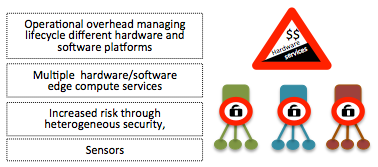
But cities also face common IoT challenges. Different types of sensors typically come with their own edge hardware and service management software. If a city deploys multiple sensor platforms this leads to so-called box proliferation and service management siloes (what some people call the vertical approach to IoT). This is not only undesirable from an aesthetics point of view, but makes it harder (more costly) to manage the whole city IoT infrastructure.

Challenges edge services

More sensors also means an increased security risk. Certain sensors have little processing power (to save money and battery life) which can make them targets for security attacks. While network security can filter out a lot of attacks there is still an increased risk of infecting the whole city infrastructure, specifically on an application level through data obfuscation. Sensor platforms do offer a certain level of security, but it is not always the primary focus within the solution and dealing with multiple platforms leads to multiple different security solutions.

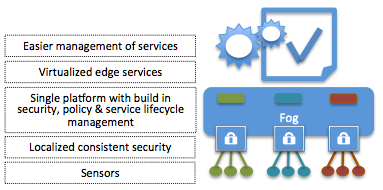
The above challenges make it harder to scale up IoT in cities. Therefore a paradigm shift is needed towards a hyper distributed architecture of smart nodes: The heterogeneous edge hardware and software platforms should be replaced by a platform on which the virtualized services of the providers can be deployed. This so-called fog platform has hardened security as well as common libraries, features and hardware that can be used by the service providers to deploy their virtualized edge services. The fog platform also provides uniform edge service life-cycle management, policy based data and service access, as well as multi tenancy, reducing the cost for a city to manage such an infrastructure.

Fog: a platform to reduce cost, increase security and amplify IoT

The fog platform is a win-win for the city and its edge service providers. Service  providers can focus on their core competence of sensors, data aggregation/processing and business logic while leveraging standard security and processing features from the fog platform as well as the possibility to easier share and combine data (sometimes referred to as the horizontal approach to IoT) between different services.

For the city, the fog platform will make it easier to manage and deploy new edge services, without adding new boxes on the network edge for each new service, thereby reducing the capital and operational cost for managing the city IoT infrastructure.

The value of the fog platform for a city is not only the direct operational and capital cost savings as well as hardened security,  but equally important is the shorter deployment cycle of new edge services, and easier data sharing between the traditional service siloes. With such an approach the city can become a large distributed test-bed to incubate new innovative ideas on data fusion and processing and develop new services that contribute to the overall quality of life for its citizens.

Authors

Frank van Lingen

Manager Business Development

Corporate Strategic Innovation Group

Avatar

Through our Corporate Social Responsibility (CSR) programs, we aim to give people the skills they need to thrive in a connected world.

To help achieve that vision, the Cisco Foundation recently completed a grant to the Junior Achievement Discovery Center in Gwinnett County, Georgia. The facility, adjacent to the Cisco campus in Lawrenceville, held its grand opening yesterday, with more than 600 attendees. In partnership with Gwinnett County Public Schools, the center will serve more than 25,000 middle school students annually, helping to enhance their financial literacy and build skills for personal and professional success.

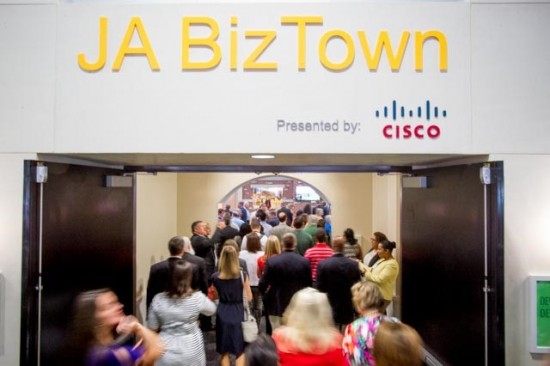
JA BizTown® presented by Cisco is one of two interactive venues within the Junior Achievement (JA) Discovery Center at Gwinnett.

The students’ experience begins with 18 in-class lessons of JA provided curriculum, then culminates with a day at JA BizTown presented by Cisco — a venue where students are able to interact within a simulated macro-economy, and take on the role of employee, tax payer, and consumer. During the visit to JA BizTown, students receive unique job assignments and work in teams at their assigned business. By the end of the simulation each student completes a day’s work, develops a personal budget, deposits a paycheck at the bank and makes purchasing decisions.

Continue reading “Cisco Supports Junior Achievement of Georgia to Help Middle School Students Thrive”

Authors

Alexis Raymond

Senior Manager

Chief Sustainability Office

Avatar

At last year’s Mobile World Congress, I had the honorchallengeup of co-announcing a new start up accelerator program along with my industry peers at Intel and Deutsche Telekom. Challenge Up! is a program created jointly by our three companies to help inventive startups from the Europe, Middle East, Africa and Russia (EMEAR) region go-to-market faster through joint projects, mentoring, high-value networking and corporate assets.

We received over 300 applications from 40 countries! After a grueling week of mentoring sessions, workshops and pitching at ‘Acceleration Week’ last month in Krakow, I’m happy to share 12 startups were selected to participate in the four month Challenge Up! acceleration program.

All participants are early stage companies with disruptive technologies in the Internet of Everything, Data & Analytics as well as Connected and Smart solutions. To see the action for yourself, check out the video below of highlights from the week. This program, geared towards bringing these startup’s ideas to reality, will take place at multiple events in Berlin, Dublin and London over the next three months. Continue reading “Fostering Innovation in the Startup Community”

Authors

Mike Flannagan

No Longer with Cisco

Avatar

Modern demands  in virtualization, cloud, and the Internet of Things are shifting the network landscape and require advanced solutions to manage critical network services across physical, virtual, and cloud environments.

Recently, I had the opportunity to speak with InfoBlox’s Chief Technology Officer, Alan Conley, about automating core network services – DNS, DHCP, and IP Address Management (DDI) – with Cisco Application Centric Infrastructure (ACI).  In this video interview, Alan spoke about the common challenges InfoBlox and Cisco customers face in security and automation in their data centers.

Alan eloquently explains how ACI micro segmentation to enhance security for East-West traffic in the data center complements InfoBlox’s secure DNS server that detects and mitigates malware and botnets trying to attack customer networks.

Alan Conley, InfoBlox CTO

He also shared how a number of InfoBlox customers are looking for the integration of InfoBlox DDI and Cisco ACI to deliver highly secured solutions but also ones that are operationally agile.

I really encourage you to listen to Alan Conley’s enlightening interview.

For more information:

www.cisco.com/go/aci

www.cisco.com/go/aciecosystem

InfoBlox Enterprise-grade DNS, DHCP, and IP Address Management (DDI) datasheet

InfoBlox Demonstrates a New Approach to DNS Security blog


Authors

Harry Petty

Director

Data Center and Cloud Marketing

Avatar

Man working in home office

I remember when 1 Mbps was big bandwidth. And 45 Mbps was unbelievably, outlandishly huge bandwidth. One spring day in 1995, at the headquarters of a large technology company outside of Dallas, there was excited chatter at the proverbial water cooler about the T3 access line that was being installed. A T3 line! Nearly 45 Mbps! Every thing really is bigger in Texas! We wondered what we would do with all that bandwidth, even though there were thousands of us at the location being served. Now, in 2015, the average broadband home has a 25 Mbps connection, and 20% of broadband homes worldwide have T3 speeds or higher, serving just the members of that household. And we now talk about yesterday’s data speeds Continue reading “The History and Future of Internet Traffic”

Authors

Arielle Sumits

Senior Analyst

Service Provider Marketing