Today’s conversations around innovation – particularly within the IT industry – tend to paint it as something disruptive, technology-based and radically changing markets.
This is a partial picture of it. It’s not always necessary to be radical, and it is not just about introducing new products or services into a market. There are several types of innovation that are equally effective and can bring enduring sources of competitive advantage.
Having a clear framework around the different dimensions of innovation can help organizations develop the right strategy and succeed in their innovation journey.
One of the innovation frameworks I use at Cisco categorizes innovation across four dimensions:
Products & technologies – This entails introducing totally new products and/or services often based on the latest technology developments. The category is indeed also about innovating existing products by making them better in terms of performance, features, forms and functionalities. For instance, a new BMW has better features, safety, and fuel efficiency than an earlier model, despite the fact that both models are, in essence, just cars.
As the world’s largest appliance maker, Whirlpool Corporation knows a thing or two about innovations. But the company recently looked at its factories’ mixed networking devices and realized that their backend infrastructure needed some innovating too. An unstable wireless network set-up was costing the company money, was difficult to troubleshoot and simply could not keep up with new technologies.
Whirlpool turned to Cisco and the appliance company’s service provider, Black Box Network Services, to come up with a plan to update their network architecture.
Beginning with five pilot sites—including one of Whirlpool’s largest plants—Cisco employed designs to modernize the network. The products included in the plans were:
Cisco Catalyst 3750X switch
Cisco Catalyst 2960X Series switches
Cisco FlexStack and StackWise cabling
Cisco Aironet 3600 Series Access Point with Cisco CleanAir technology
OpenStack Summit Tokyo is just eight weeks away now, and we’re happy to say that event organizers have chosen about a dozen of Cisco’s OpenStack pros to speak at different breakout sessions during the event.
And believe it or not, these sessions are not all about networking.
Oh sure, I can see how you’d think that. It is our thing after all.
But the truth is there’s more to us than that. Way more. We’re that bespectacled physics professor you once had, who rolls in to work on a Harley. The bodybuilder who rescues kittens. The goth-looking skateboarder that secretly speaks four languages and gets straight A’s in school. Sure, we’re a giant networking company, but we’re also totally committed to OpenStack. All of OpenStack. Not just the networking elements. So although we will, in fact, speak about Neutron while we’re at the Summit, we’re also going to talk about cloud QoS, OpenStack consumption models, encryption, and containers–among other things. We’re involved in these issues. We care about their success. And we look forward to sharing our ideas about them with you in Tokyo.
The full list is below. Check it out! Hope to see you there.
As a member of the Sales Engineer Organization, I spend lots of my time staying close to midsized customers observing how teams that do great work are leveraging applications to collaborate. The number of choices available can make choosing the right tools an interesting journey.
Is there one solution to meet all needs? Midmarket organizations face these questions. As I talked to several midsized companies this past year, I heard how improving team productivity is top of mind. Keeping employees connected across their various workplace resources and devices is increasingly important. Making customers happy with proactive service and quick response times is paramount to an organization’s success.
In the world of collaboration, consider the parallels between how online meetings and physical meetings take place. Don’t you find it to be more effective to have the right setting for the meetings you attend in person? A large group in a small space never works right.
For example, with physical meetings:
Large groups require large spaces, structured seating, the ability to share media, and the ability for participants to interact with presenters.
Fast moving small teams need rooms that are available on-demand and the ability to do real-time content tracking.
One-to-one interactions require privacy and rich-media sharing with the ability to call in additional participants as needed.
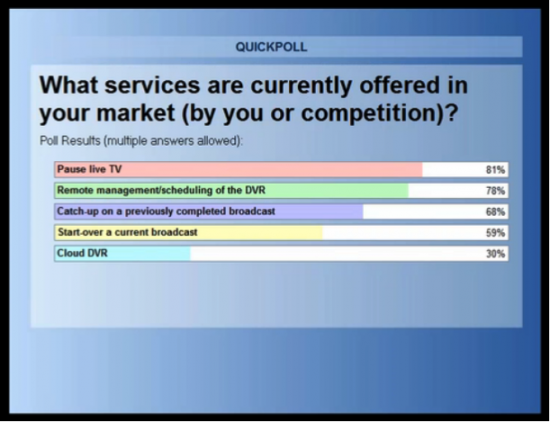
A few years ago, the idea of cloud-based digital video recording (DVR) was an aspiration. Today, while the technology is still relatively new, it’s already seeing broad adoption in the market. In a recent webcast conducted with Parks Associates, attendees revealed the breadth of cloud-based services they were already using to catch up on TV content. From basic “pause live TV” features to full cloud DVR, check out the range of cloud services already available:
Whoever said, “Youth is wasted on the young,” didn’t meet the next generation of innovators. This year’s winners of the IoT World Forum Young Women’s Innovation Grand Challenge demonstrated amazing technical and industry know-how – plus a whole lot of heartfelt social awareness – far beyond their years. They’re not wasting any time at all!
The Grand Challenge connected with a highly diverse group of 1,500 girls aged 13-18 who submitted 400 entries from 171 countries. I was overwhelmed by the maturity of their proposals, which were focused on leveraging IoT technology to improve how we live, work, play and learn in a wide range of industries.
Guest blog from Paul Jesemann, Cisco Solution Consultant, Mobile Architecture, APJ
In June, a mobile operator in India was accused of spying on its customers by inserting a javascript in browsing sessions on its 3G network. The service provider admitted it was using a solution to help customers keep track of data usage, yet in press and blogs, concerns were expressed about it being a privacy breach, and a means to track subscriber browsing data for monetisation purposes.
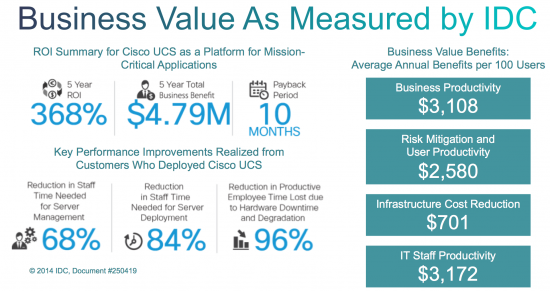
Cisco continues to develop their partnership with Microsoft becoming a critical component of the Microsoft Data Centers across the globe. 80% of the data centers around the globe already include Cisco networking switches and routers. More and more of these same Data Centers are also making the switch to Cisco UCS server platforms. There are many advantages to using Cisco UCS as your server platform. IDC recently competed a study interviewing many Cisco UCS installed customers and determined that by installing your application on a Cisco UCS server platform, those customers will gain the following business benefits.
You can get first hand knowledge of these benefits by visiting Cisco at several Microsoft events over the next couple of months.
Keeping up with all of the changes in today’s data center technology is can be daunting. Data center technologies are evolving quickly on a number of different fronts. This presentation will cover some of the latest trends in data center technology. You’ll see how they can impact your business and how you can best begin to incorporate them into your own infrastructure. The technologies discussed will include the cloud, the hybrid cloud, containers, consolidated management, software defined networking, flash storage, as well as converged and hyper- converged infrastructure.
This community initiative is the brain-child of several of Microsoft Canada’s Top MVP’s. It is our absolute pleasure to be able to share our knowledge locally allowing our communities to learn more and advance their technical knowledge base. You can follow Canadian MVP’s on Twitter #CDNMVP
Free 1 day training events for SQL Server professionals that focus on local speakers, providing a variety of high quality technical sessions. It’s a group of SQL Server database administrators, database and application developers, business intelligence experts, and users from around the globe. This community is represented by more than 285 local PASS Chapters worldwide, 28 virtual chapters, 120,000 members.
Join us at these different events and discover why the server platform on which you install these Microsoft solutions makes a difference. Hope to see you there.
Malware is constantly evolving and changing. One way to identify malware is by analyzing the communication that the malware performs on the network. Using machine learning, these traffic patterns can be utilized to identify malicious software. Machine learning faces two obstacles: obtaining a sufficient training set of malicious and normal traffic and retraining the system as malware evolves. This post will analyze an approach that overcomes these obstacles by developing a detector that utilizes domains (easily obtained from domain black lists, security reports, and sandboxing analysis) to train the system which can then be used to analyze more detailed proxy logs using statistical and machine learning techniques.
The network traffic analysis relies on extracting communication patterns from HTTP proxy logs (flows) that are distinctive for malware. Behavioral techniques compute features from the proxy log fields and build a detector that generalizes to the particular malware family exhibiting the targeted behavior.
The statistical features calculated from flows of malware samples are used to train a classifier of malicious traffic. This way, the classifier generalizes the information present in the flows and features and learns to recognize a malware behavior. We use features describing URL structures (such as URL length, decomposition, or character distribution), number of bytes transferred from server to client and vice versa, user agent, HTTP status, MIME type, port, etc. In our experimental evaluation, we used 305 features in total for each flow.














 Guest blog from Paul Jesemann, Cisco Solution Consultant, Mobile Architecture, APJ