Verizon Becomes the First Service Provider to Offer Cisco IWAN
Today, Verizon announced a new software-defined WAN service, becoming the first global carrier to incorporate Software Defined-WAN as a key component of their managed network service offers. We are excited that Verizon has chosen Cisco Intelligent WAN (IWAN) as the foundation for this new service, which will give Enterprise customers even more flexibility when choosing how to purchase their SD-WAN solution.
Cisco recently published an “SD-WAN Bill of Rights”, a guide designed to help you evaluate SD-WAN solutions as you prepare your WAN for digital transformation. Together, Cisco and Verizon are strengthening your ability to achieve two of these “rights”: The Right to Choose Your WAN Connectivity and The Right to Flexible Deployment Models.
The network and phone system for the largest charitable funder of child health research in Canada—SickKids Foundation—was ailing.
From dropped calls to poor voice quality to unexpected downtime, SickKids Foundation’s phone system was causing a lot of frustration among donors. SickKids Foundation depends on backers to fund their charity and employees realize that donor frustration can turn into donor apathy real quick.
SickKids Foundation called on Cisco to find a solution to their networking ills by refreshing its communication tools. Cisco came up with a plan and used the following products to rebuild the SickKids Foundation’s aging communication network:
Cisco Aironet 3500 Series Access Points with 802.11ac
Cisco 2500 Series Wireless Controllers
Cisco Catalyst 4500, 4500-X and 2960-S Series Switches
We are increasingly hearing about the value of improving the shopping experience by adding virtual expertise to the store. As head of Cisco’s Retail & Hospitality practice, I frequently talk to customers who are exploring this concept – though what I mainly hear are questions! While many are interested in the idea, they are still trying figure out whether or not a virtual customer expert is going to add more revenue to their bottom line.
Putting a collaborative expert into the store – virtual or physical – can actually be critical to meeting the needs of the consumer, especially during the purchase of a high-priced product or for a purchase where it is very important to make the right decision. However, very often this level of expertise is not available in the aisle when the consumer is dwelling there. And yet, the presence of such an expert can be extremely important. For example:
A mother is shopping for an over-the-counter decongestant late in the evening for her child, who is also taking medication for ADD. A pharmacist is not available, but getting the wrong medication could be life-threatening.
A couple is buying a printer for their college-age daughter, who shares an apartment with three other students. They need a printer that can be networked so all four girls can print their assignments and research papers.
A party host would like to purchase several cases of wine that complement the menu, but are not overwhelmingly expensive.
A couple is browsing the latest assortment of home security devices, trying to make sense of what will work with their current network configuration.
Savvy retailers debate how to solve the problem of providing highly paid experts to be immediately available to consumers, without footing the bill for an employee who may be idle part of the time. Additionally, it may be necessary to provide a level of privacy while engaging the expert. The retailer’s quandary is how to attractively offer this service in a way to increase basket and justify this use of valuable selling space.
Forward-looking retailers recognize that this capability is part of providing a truly integrated omnichannel experience. Shoppers are no longer either in the store or online… they are both, and sometimes at the same time. Thanks to our mobile devices, consumers can research, compare prices, and shop with our mobile devices in the aisle. According to Macy’s CEO Terry Lundgren, retailers need to adopt a “digical” strategy – a term coined by Bain & Company’s Darrell Rigby and Suzanne Tager – meaning the seamless integration of digital with physical retail. (For more, check out the article, “The Future of Retail Will Be Won or Lost in ‘Digical.’”)
In any channel in this digical world, retailers will lose revenue if they are unable to differentiate themselves by providing excellent value, combined with the appropriate amount of customer service. And here is where the virtualized experience can drive a new level of engagement for the brick-and-mortar store. Via video collaboration on a consumer’s mobile device, a kiosk display, online, or an associate’s tablet, shoppers looking for advice can easily connect with your centralized or outsourced pool of experts for immediate assistance. Let’s go back to the scenarios above:
A QR code is posted on a sign that reads: “Photograph this sign with your mobile device and you can speak to one of our pharmacists on call 24×7.” The pharmacy service immediately calls the mother’s mobile phone number to discuss which medication will be safe for her ADD son.
An associate in the printer aisle approaches the couple and boots up an expert session on his tablet to discuss feeds, speeds, and price points. This helps the family determine which printer will best fit their daughter’s needs.
The party host approaches a kiosk to engage a wine expert. He enters the date and time of the party so that weather can be taken into account, the centerpiece menu items, and his desired price range. He then engages with a virtual expert who provides options as well as a special discount based on the number of cases. Additionally, he is offered a 50% discount on disposable wine goblets.
As the couple browses an array of home security options, the retailer pushes a promotion to their mobile device: “If you would like a complementary home security assessment, follow this link to schedule an appointment with one of our specialists.” This in-home expert then cross-sells and upsells products from a tablet in the home, and schedules an in-store meeting when products arrive to discuss installation.
When used in conjunction with brick and mortar, virtual in-store and online expertise complement the natural selling journey with consumers to fill an important gap in the omnichannel experience. Click here to learn more about Cisco’s thinking in this area, or contact me at annmccle@cisco.com.
Talos, in conjunction with Microsoft’s security advisory issued on September 8th, is disclosing the discovery of a memory corruption vulnerability within the Microsoft Windows CDD Font Parsing Kernel Driver. This vulnerability was initially discovered by the Talos and reported in accordance with responsible disclosure policies to Microsoft. Please see Talos’s Microsoft Tuesday Blog for coverage information for this vulnerability. Read the full Talos Vulnerability Report via the talosintel.com portal here: TALOS-2015-0007
Details
A specially crafted font file can cause the Microsoft Windows CDD Font Parsing Kernel driver to corrupt internal memory structures. The DrvTextOut routine acquires and locks the associated device and behaves differently based on the surface type. If the type is a bitmap and the Windows DWM is on, the driver will read and write directly to the video frame buffer and calls EngTextOut, then exits. However, the driver behaves in an unexpected manner where a new background rect is generated mixing the “OpaqueRect” rectangle located in the sixth parameter and the rectangle located in the “pStringTextObj” object.
If the ClipObject describes a NON-Trivial clip, even the “rclBounds” of the clip object is merged to the background rectangle. The Font Object is parsed, and finally the routine decides if it should clip the background rect or not.
The final decision is based on the following check:
Today, Microsoft has released their monthly set of security bulletins designed to address security vulnerabilities within their products. This month’s release sees a total of 12 bulletins released which address 55 CVEs. Five bulletins are rated “Critical” this month and address vulnerabilities in Edge, Graphics Component, Internet Explorer, Journal, and Office. The other seven bulletins are rated “Important” and address vulnerabilities in the .NET Framework, Active Directory, Exchange, Hyper-V, Media Center, Skype for Business, and Task Management.
Cisco Interns aren’t your average interns! Whether they found us by way of LinkedIn or a university info session – no matter if we won them over with some sweet, sweet swag or two pretty little words: Silicon Valley – we’re glad they’re here, and we’re more excited than ever to have these energetic, creative minds helping us to tackle the future. As summer winds down and rolls into fall, we wanted to share the experiences of our summer 2015 HR Interns who offer insights, advice, and their two cents on what’s giving Cisco a bit of the “cool” factor.
When thinking of Cisco a few months ago, most of these interns could only identify the company by the logo being on telephones in offices or the knowledge that routers were involved. But now that they’ve had time to grow from within Cisco, they realize there is so much more to the company who fuels the Internet of Everything.
“Cisco provided a welcoming environment that was enjoyable, comfortable, and changing” Clark Anderson, an intern with Global Benefits: Family Services/Wellness said. These interns, after all, have been here through the CEO transition from John Chambers to Chuck Robbins and have gotten a unique, first-hand experience in how Cisco celebrates its future while honoring its past.
“Cisco says ‘Change the World’ but that never resonated with me because I didn’t even understand what Cisco even did. To hear how John and Chuck have sat down with these leaders to better their country’s circumstances – that left me wanting to know more. After researching, I thought this was something I could really get behind, and I hadn’t thought of that until that moment.”
“If people knew how frequently Cisco was involved in their daily lives and how many things Cisco is doing – we’d realize how cool this company really is!” says Kelly Andrews, an HR Services Intern.
Kayla Viola, an intern with the Talent Brand team, agreed.
“Yes, when you use FaceTime you’re using Apple, but you’re also using Cisco technology!” she realized. “The impact of this technology affects me more than just Cisco’s cool factor. It’s something that matters.”
Plus, Kayla learned first-hand that Cisco interns aren’t fetching coffee and running errands. They’re exposed to the company leaders and their ideas matter.
“How many interns get access to the CEO of a company?” said Kayla, “It’s rare to meet the CEO, yet at Cisco Chuck Robbins was interested in the #IChoseCisco campaign I was working on for Instagram, and even tweeted out a photo of me and him!”
Daniel Wright, a Global Benefits Intern Daniel even said “Our inexperience in the industry seemed to be attractive for those here at Cisco as many went to the interns for new ideas, which is encouraging.”
Megan Astarita, a Talent Management intern, summed it up nicely.
“The connections through our internship, with co-workers and even the interns in other locations, we all clicked even through distance. This reflects the type of people Cisco is bringing on – they’re all just really great people.”
Want to spark your future as a Cisco Intern? Apply Now!
The march toward a wireless world took another big step this week.
Cisco is partnering with Verizon in its aggressive roadmap for fifth-generation, or 5G, wireless technology.
By working closely with Cisco and other technology leaders, Verizon aims to launch 5G field technology trials next year. Last month, the companies kicked-off the first-ever Verizon 5G Technology Forum, co-hosted by Cisco, and have established working teams to ensure an aggressive pace of innovation.
By nearly all accounts, 5G technology should be introduced in the U.S. sometime after 2020, but Verizon is accelerating the expected rate of innovation, and Cisco is very pleased to help drive this new wave of development.
Robust wireless networks will be critical in facilitating this growth, which is being driven by the ongoing adoption of more powerful mobile devices and machine-to-machine (M2M) connections. We believe 5G will be instrumental in helping the industry develop a new economic model for offering new services for the next wave of digitization that is just around the corner.
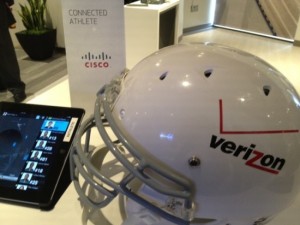
New 5G network environments, or “sandboxes,” are being created in Verizon’s Waltham, Mass., and San Francisco Innovation Centers. Just like in the early days of the development of 4G LTE technology, collaborating in a shared environment will foster compelling applications faster. (Pictured right is the Connected Athlete demonstration, which was featured in Verizon Innovation Center West when it re-opened in San Francisco in late 2013.)
“5G is no longer a dream of the distant future,” said Roger Gurnani, executive vice president and chief information and technology architect for Verizon. “We feel a tremendous sense of urgency to push forward on 5G and mobilize the ecosystem by collaborating with industry leaders and developers to usher in a new generation of innovation.”
Making the Right Connections Opens New Doors to Digital Business Success
The digital transformation of business isn’t just about the connection of things, though those connections are certainly important. Industrial or IT automation can take many forms, whether it’s connections between people, the connections between people and things or, perhaps most importantly, the processes that that enable connections of all kinds to happen quickly and intelligently. Without order, digital business transformation runs the risk of becoming digital chaos. What’s most essential in every case is creating the desired business outcome.
Hyper-Distribution: Billions of Connections Shouldn’t Mean Billions of Headaches
But connecting all these things isn’t easy. 50 billion things are projected to be connected to the Internet by 2020. Along with this hyper-distribution of things also comes the hyper-distribution of data. No longer is data only found in large centralized warehouses – it is being dynamically captured and acted upon at the edge of the network to respond to events in real time.
Organizations are struggling with the management of business processes in this expanding, hyperconnected world. Value chains are increasingly global, yet the decisions that need to be made are becoming increasingly local — and they need to be made in real-time. Hyper-distribution is fragmenting traditional business processes. Dealing with this growing complexity was identified as the number one IoT management challenge in a 2014 business study.
Not surprisingly, companies are being forced to re-imagine their processes and many are turning to software to turn what is being imagined into business reality. And they are calling upon new forms of automation and analytics to do it. Real business transformation will only occur when things connect with both people and process to turn information into actionable intelligence. Automation facilitates the new connections. Analysis gives the connections new meaning. Da Vinci instructs us, “Simplicity is the ultimate sophistication.” Finding ways to make the increasingly complex world of hyperconnectivity both simple to understand and simple to implement is the ultimate challenge for the networking industry.
In my position at Cisco I manage a team who helps our customers set an architecture vision and processes for using Cisco solutions to achieve business outcomes. Despite the fact that we have been creating solutions for Healthcare for many years now, some of our customers are still not fully aware that Cisco offers a suite of architectures and products besides the routing and switching portfolio that we are traditionally known for. Members of our Business Transformation team took this on as a challenge and created this video showing how Cisco solutions can be impactful across many points in the care continuum. https://youtu.be/X0AWC_rCK2c . Solutions from location services, physical safety and security, virtual patient observation, digital signage, care coordination, TeleHealth to any location using any number of endpoint devices, and patient infotainment can all drive measurable impact and outcomes which can increase productivity, improve patient satisfaction, improve provider satisfaction, and help organizations manage the care and wellness of their patients.


 Today, Verizon announced a new software-defined WAN service, becoming the first global carrier to incorporate Software Defined-WAN as a key component of their managed network service offers. We are excited that Verizon has chosen Cisco Intelligent WAN (IWAN) as the foundation for this new service, which will give Enterprise customers even more flexibility when choosing how to purchase their SD-WAN solution.


 The network and phone system for the largest charitable funder of child health research in Canada—SickKids Foundation—was ailing.




 “If people knew how frequently Cisco was involved in their daily lives and how many things Cisco is doing – we’d realize how cool this company really is!” says Kelly Andrews, an HR Services Intern.
 By nearly all accounts, 5G technology should be introduced in the U.S. sometime after 2020, but Verizon is accelerating the expected rate of innovation, and Cisco is very pleased to help drive this new wave of development.
 New 5G network environments, or “sandboxes,” are being created in Verizon’s Waltham, Mass., and San Francisco Innovation Centers. Just like in the early days of the development of 4G LTE technology, collaborating in a shared environment will foster compelling applications faster. (Pictured right is the Connected Athlete demonstration, which was featured in Verizon Innovation Center West when it re-opened in San Francisco in late 2013.)