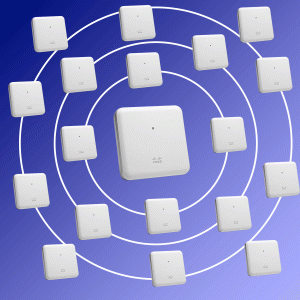
In the time it takes to get up from your desk, walk down the hallway and make a cup of coffee, a Cisco Mobility Express enterprise-level wireless network can be configured and deployed. You don’t even have to be chained to your desk to configure the dashboard; it can all be done via a mobile app while you’re at the coffee machine.
Introduced on September 15th, Cisco Mobility Express is geared toward small to medium-sized organizations (about 150 employees) and delivers the same type of Cisco advanced features that larger companies get for a fraction of the cost. These preconfigured features are all based on Cisco best practices. Cisco Mobility Express has a virtualized control function on a master access point, which means that no physical WLAN controller appliance is required, with up to 24 APs serving as subordinates.
Following the recently introduced Cisco Aironet 1850 802.11ac Wave 2 Access Point, we are introducing the Cisco Aironet 1830 Access Point. Both support the latest Wi-Fi standard: 802.11ac Wave 2. Due to an increase in bandwidth-intensive applications, Bring Your Own Device policies and the Internet of Things, studies show that within three years, wireless traffic is expected to triple. There is going to be a push for networks that support 802.11ac Wave 2 because they have the speed—three times faster than networks that support 802.11n—and bandwidth needed to support these extra devices. Both the Aironet 1850 and 1830 access points can run in Mobility Express mode and other Cisco deployment modes. Continue reading “With Cisco Mobility Express and CMX 10.2, their Beauty Lies in their Simplicity”
CMX just keeps getting better. When Connected Mobile Experiences was introduced nearly three years ago, it ushered in a new era of location based-services. The promise and business potential of the solution has always been exciting. The most recent release of Connected Mobile Experiences (CMX) 10.2, brings us ever closer to the full potential of that promise. In fact, we’re closer than any other solution by a substantial margin. And 10.2 widens that gap as we continue the evolution.
First, the release of CMX 10 represented new code for CMX and delivered substantially higher scalability and performance. With 10.2, we continue to build upon that foundation with new and upgrade features. These features can be subdivided into three categories: Analytics, Location, and Connect.
Analytics
CMX 10.2 introduces two new classes of analytics—social and presence.
As digital textbooks, laptops and tablets becomes the new normal of classroom tools – but education budgets for resources and personnel decline – Cisco’s Mobility Express Solution provides educators with consistent, secure and easy-to-manage network access that promotes connective and collaborative learning.
Lessons going digital? Mobility Express Solution can help meet emerging online learning mandates seamlessly.
As today’s mobile world evolves with the explosion of mobile and connected devices, small to medium-sized businesses are increasingly faced with the same wireless challenges and opportunities as large enterprises. To help our customers address their mobility needs, today we’re introducing the Cisco Mobility Express solution that is specifically designed to deliver enterprise class Wi-Fi for small to medium-sized businesses.
As the technology landscape continues its rapid transformation, those who work in the industry are faced with the constant challenge of keeping their skills up-to-date. To address the needs of professionals looking to build, assess and continually reinforce wireless technology or network design expertise throughout the spectrum of their career, we are announcing updates to three of our training and certification offerings: CCDA, CCDP and CCNA Wireless.
Designing Tomorrow’s Networks
Enterprise environments require networks designed for performance, availability and scalability with the flexibility to meet rapidly evolving demands. Skilled IT professionals are needed to plan, design and optimize today’s enterprise networks. Cisco’s Design certifications drive successful business outcomes by building and validating end-to-end network design skills.
The new training courses we are introducing teach Cisco network design principles that apply to enterprises of all sizes. This update to the curriculum extends the design perspective across all segments of Cisco’s Enterprise Network architectures while adding focus on new and evolving technologies such as services virtualization and programmable controller based architectures. The updated training and certification offerings are:
Updates to the design certification and training offerings include:
Teachings on current technologies and solutions that are leveraged in designing and optimizing reliable, scalable and resilient enterprise networks.
Goals that align to the promotion of a modular network design that Cisco formalized and that remains applicable to new and evolving enterprise networks.
Expansion of network design topics to include Network Programmability, controller based architectures and virtualized services that require a holistic design perspective in order to transform the digital enterprise.
Elevating the focus to consider design dependencies and considerations that span across the campus, data center, WAN and branch segments of advanced enterprise networks.
Additional aspects of the modular, hierarchical campus design, advanced addressing and routing to enable transitions to IPv6, optimizing WAN services, interconnecting data centers and improving overall network security.
Historically, threat actors have targeted network devices to create disruption through a denial of service (DoS) situation. While this remains the most common type of attack on network devices, we continue to see advances that focus on further compromising the victim’s infrastructure.
Today, Mandiant/FireEye published an article describing an example of this type of attack. This involved a router “implant” that they dubbed SYNful Knock, reported to have been found in 14 routers across four different countries.
The Cisco PSIRT worked with Mandiant and confirmed that the attack did not leverage any product vulnerabilities and that it was shown to require valid administrative credentials or physical access to the victim’s device.
SYNful Knock is a type of persistent malware that allows an attacker to gain control of an affected device and compromise its integrity with a modified Cisco IOS software image. It was described by Mandiant as having different modules enabled via the HTTP protocol and triggered by crafted TCP packets sent to the device.
Note: Cisco Talos has published the Snort Rule SID:36054 to help detect attacks leveraging the SYNful Knock malware.
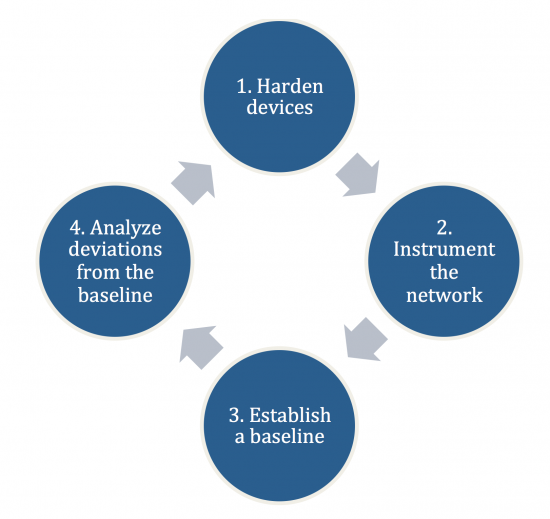
Given their role in a customer’s infrastructure, networking devices are a valuable target for threat actors and should be protected as such. We recommend that customers of all networking vendors include methods for preventing and detecting compromise in their operational procedures. The following figure outlines the process of protecting and monitoring Cisco networking devices.
We thank Mandiant/FireEye for their focus on protecting our shared customers, and for adding their voice to calls for greater focus on network security.
We’ve been hearing a lot about the Internet of Things or IoT. How it’s going to accelerate efficiencies. Grow profits. Disrupt industries. So it’s time to consider if IoT is real & if you should do something about it right now.
As is often the case, revisiting history can help us better understand what the future holds for us. Imagine it’s 1995, and you’re just starting to hear about this thing called the World Wide Web. How’s it’s going to use the Internet to disrupt commerce/communications and how it’s going to create a digital divide of haves and have-nots? At that time, companies like Compaq, Kodak and Sears were in the Fortune 100 and mobile phones were predominately used for phone calls.
Since then, startups like Google and Amazon have disrupted computing, shopping and entertainment, as well as mobile-web applications that dominate how we live our lives. The companies that survive are the ones that have deployed e-commerce platforms to engage with customers and suppliers, and have strategies to integrate the Web into their business.
Now fast-forward to 2015 and the projected $3.9 Trillion Value at stake for IoT in Manufacturing. Which begs the question: How do we make IoT work for us? And how can it drive change in the various manufacturing verticals?
IoT@ Work in Food Manufacturing
SugarCreek offers an excellent case study for how IoT can be utilized to optimize production, improving factory capabilities and enhancing analytics specifically for consumer packaged goods (CPG) or food & beverage (F&B) manufacturing. By way of background, SugarCreek is the largest independent processor of bacon, meatballs, sausage patties and chicken for both food service and retail. They are about to finish up the refurbishing of a brownfield plant, to create a 418,000 square foot Factory of the Future. Take a look at this video to see an overview of Sugar Creek’s business:
https://www.youtube.com/watch?v=LSz-SXUbG7Y
Actually, SugarCreek is ahead of the trend that Food Manufacturing magazine describes:
“IoT is a logical extension of the push to create more intelligent manufacturing processes. By embedding interactive technology in key machines, food manufacturers gain the ability to automate the optimization of equipment in real time, dramatically reducing or eliminating the risk of equipment failures capable of shutting down the entire process”.
Ed Rodden, the CIO of SugarCreek & I will be co-presenting the SugarCreek case study at the upcoming Smart Industry Conference happening from October 5-7 in Chicago. Ed will describe the decision process for the Industrial Internet of Things (IIoT) platforms in their new manufacturing plant, including insight into primary use cases, converged factory technologies and new architectures.
I will describe the IIoT process that SugarCreek went through. How we considered each key area of factory operations from product enhancements to how to better enable their workforce. We held workshops with key plant & IT stakeholders to discuss business outcome for each area that included:
Reducing expenses by optimizing plant operations
Increasing revenues by improving plant capabilities
Contributing to a safer & cleaner environment
In order to drill into the technology required in each area, we considered specific pain points & use cases such as how they could strengthen Quality Control through the utilization of technology to identify & eliminate packing material that may be mixed in with meats or how they can increase plant capabilities by including more sensors into their production process. Solving each pain point required a combination of devices, networks & applications to provide a complete technology platform. We will go thru how we conducted a high level return on Investment (RoI) analyses to help the company to quantify the costs & benefits of each platform & prioritize the platforms that would provide the greatest bang for the buck. Find out more details by attending our session.
We hope you can join us for this conference and in particular, this session on Industrial IoT. See you in Chicago!
The Internet of Things (IoT) is connecting sensors, cameras, machines, and other devices at an amazing rate. But what drives the value of these digitized devices is not just the connections—it’s the applications that the connections enable. Think, for example, of a connected transportation system. It is not enough that buses have GPS and can connect to the Internet—what could really make a difference is an application that dynamically plans bus routes based on where people are, how long they have been waiting, and where they are going. That’s where the true value is.
You might even say that applications are the reason we connect things and collect data from those things. So those of us who are building the IoT infrastructure must understand what application developers need, and then enable them to take advantage of the IoT infrastructure and the data it carries. This means we need more than open APIs—we must make it easy for an application to get the data it requires from the infrastructure and to provide input into the infrastructure.
Additionally, we need to respond to the changing ways people want to interact with the devices at the edge. Traditionally, a process engineer might control or program a production line using a fixed human-machine interface (HMI) screen physically attached to the production machinery. Today, there is a growing need for remote and mobile interface capabilities—especially for the growing ranks of Millennials who want to be able to use iPads and other mobile devices to interact with IoT deployments. Cisco’s IOx platform is a flexible application development environment with a goal of enabling developers to connect applications with any protocol, interface, or device. In the future, this could even enable a control engineer in the factory to look at a robot’s operation through smart goggles, instantly viewing maintenance statistics and malfunction alerts.
Millennials in the workforce demand flexibility and mobility in interacting with IoT deployments
A reminder of the fact that we’ll be doing a webinar tomorrow on this topic, and
A general observation regarding SDN making the world a better place (don’t roll your eyes yet. There’s beer involved. Well, kind of. Read on…)
The webinar is called “How To Simplify and Automate Your Data Center With Cisco’s SDN Strategy” and its tomorrow, September 15, 2015 at 10am PST. You can register here. We’ll spend a few minutes talking about ACI, then much of the time on Programmable Fabric and Programmable Networks. As the webinar name would imply, we’ll cover some cool tools that help make your life easier, if you have something to do with deploying and operating networks in a data center. We’ll have at least one demo and relate the technology back to some use cases, showing how SDN can be applied in practical ways.
As you consider the evolution of SDN over the past few years, its more or less gone from this thing with a limited definition (separation of control plane from data plane, etc.) that was kind of a solution looking for a problem, to a more loosely defined set of capabilities that are having real impact. There are still folks who define as SDN as “Still Does Nothing”, but I think that – even if you wipe away the hype from the media, analysts, vendors, etc. – SDN is making business more effective and helping make peoples lives better. I’m not talking like feeding the hungry, creating global peace type “make peoples lives better”.
I’m talking about the fact that most jobs have a certain amount of stuff that is cool/interesting/challenging/fun and another part that, well, just has to get done. The part that can be boring/laborious/mind numbing. A long time ago, I used to run a network. I would copy and paste configs from one box, make a few changes to IP addresses, or interface numbers, or ACLs, or maybe route redistribution metrics, or whatever – and paste them to another box. Rinse, repeat. Many times. This was tedious stuff. And for the most part, not very interesting. Any activity with a lot of copy and pasting is probably better done by a machine than a human. But a lot of people are still running their networks in pretty much the same way.
There is a better way. SDN can help you minimize the ‘just have to get it done’ part of your job, so you can spend more time on stuff that is impactful and engaging. We will dig into this more tomorrow. So, maybe you won’t be displacing Mother Theresa, but you can make your world a better, more cool/interesting/challenging/fun place. And have more time to drink beer. Or do whatever it is you like to do. In any case, I hope you can be there.



 the hallway and make a cup of coffee, a Cisco Mobility Express enterprise-level wireless network can be configured and deployed. You don’t even have to be chained to your desk to configure the dashboard; it can all be done via a mobile app while you’re at the coffee machine.








 The new training courses we are introducing teach Cisco network design principles that apply to enterprises of all sizes. This update to the curriculum extends the design perspective across all segments of Cisco’s Enterprise Network architectures while adding focus on new and evolving technologies such as services virtualization and programmable controller based architectures. The updated training and certification offerings are:

 platforms in their new manufacturing plant, including insight into primary use cases, converged factory technologies and new architectures.