
Avatar

LinkedIN logoIt’s no secret. I’m nuts about social media. (I lead the Cisco Careers “Life at Cisco” social media strategy.) Word gets around, so people who aren’t as nuts about social media ask me for advice. I love helping them, because when you’re passionate about something, you want others to be passionate about it.
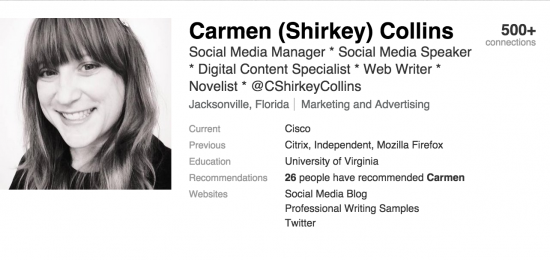
One of the biggest questions I get asked is about how to make a great LinkedIn profile. There are lots of tips out there – have a great profile picture, fill out all the sections of your profile, etc. However, there’s one word that I tell people will change the way they think about their LinkedIn profile.

Here it is. You ready for it? The word is “keywords.”

Carmen's LinkedIn profile
My LinkedIn profile, full of keywords!

LinkedIn is the Google Search of the professional world. If a hiring manager is looking to fill a role, they’re going to search for keywords. If a job seeker is looking for a new role, they’re going to search for keywords. If someone wants to network with their peers, reach out for new opportunities or build their contacts in a certain area, they’re going to search for keywords.

That’s why your LinkedIn profile better be filled with keywords.

Ask yourself this: “What are the words or phrases that best describe what it is I do.” (Or, if you’re early in your career, what you WANT to do.) Not sure what keywords are right for you? Do a LinkedIn search using the keywords you THINK you want to use, and look at the profiles that come up on the first two pages. Do those people represent what you’re looking for? Or, look at the profiles of people who you feel represent your chosen field. What keywords do they use?

Once you’ve got your keywords, you need to start building them into your profile.

1. Start with the Skills section of LinkedIn. (Go to Profile -> Edit Profile -> Scroll to Skills -> Click “Add Skils” box.) Enter your skills (which should be your top keywords). Now, LinkedIn will start asking your connections to endorse you for those skills/keywords. The more endorsements for those skills/keywords, the higher you’ll come up in search results for those skills. For example, my top two keywords are “social media marketing” and “social media.” I have the most endorsements on those two skillsets.

2. Now, look at your LinkedIn Headline (the short section under your name on your profile.) Are your top skills listed? If not, put them there. (Go to Profile -> Edit Profile -> Scroll over headline -> Click Pencil button to edit.) This area doesn’t have to be your title (we all know that sometimes a title says nothing about our skills.) The edit box even gives you the opportunity to see examples or what other people in your industry are doing. (Let’s hope they’re using keywords!)

3. Now, tackle your summary. Your summary is your chance to show your personality, while incorporating your keywords. Make sure when you use your keywords, you’re doing them in a way that makes sense so people don’t get annoyed. (For example, I didn’t write “social media” 50 times in one paragraph.)

4. Is your experience section filled out? Make sure that your experience section uses action verbs, is results-oriented, and features your keywords.

That covers the basics, but I’m going to go past LinkedIn 201 to LinkedIn 301 with my last tip, for those of you who are now so excited that you want to rank on the top search page for your keywords if it’s the last thing you do.

As you grow in your career, your keywords should be what people recognize you for – your areas of expertise. Pay it forward, and share your expertise with others. LinkedIn allows you to create what is essentially a blog post that is tied to your LinkedIn profile. (Go to your Home page, select “Write a Post.”) What should you write about? Your keywords. Share knowledge. Share projects. Share learnings. Share mistakes. When you write these posts, use your keywords.

Authors

Carmen Shirkey Collins

Social Media Manager

Talent Brand and Enablement Team, HR

Avatar

MPI-3.1 hardcover bookSimilar to previous versions of the standard, the MPI-3.1 standard is now available in hardcover.

Even though I have a copy of the MPI-3.1 PDF for quick/easy reference on my laptop, I find something intangibly inherently useful (and comforting?) in having a paper copy of the standard to thumb through.

The books have been (literally) spanning the color spectrum:

  • MPI 2.1: hardcover was yellow
  • MPI 2.2: hardcover was orange
  • MPI 3.0: hardcover was green
  • MPI 3.1: hardcover is blue

Continue reading “MPI-3.1 books now available in hardcover”

Authors

Jeff Squyres

The MPI Guy

UCS Platform Software

Avatar

The Cisco IPS network based intrusion prevention system (NIPS) uses signatures to detect network-based attacks. Signatures can be created in a variety of engines based on the type of network traffic being inspected. Cisco signatures have very flexible configurations. In this blog post, I will discuss the trade-offs between two basic approaches for signature configuration: anomaly detection and vulnerability detection.

With Cisco IPS, anomaly detection is a broad approach of detecting malicious network activity. Signatures written to detect broad categories of anomalous activity will catch many different attack vectors, but at a cost. The parameters of a signature designed to detect an anomaly will often put a strain on the system running Cisco IPS in the form of memory or CPU usage, limiting the number of signatures that may be enabled. They also carry a high false positive risk due to their broad approach.

Vulnerability based signatures are targeted and require less overhead. These signatures normally target one or more attack vectors associated with a specific CVE. Their engine parameters typically use less memory and impact the CPU performance less on the IPS device, permitting more signatures to be active. They also allow the user to finely tune the configuration based on the types of vulnerable systems in a user’s network. False positive risk is low if the active signature set is tuned for a user’s network environment. Continue reading “Anomaly vs Vulnerability Detection Using Cisco IPS”

Authors

Nick Smith

Team Lead

Security Research and Operations

Avatar

David WachtfogelBy David Wachtfogel, Director, Service Provider Video Security, Cisco


This week at IBC we are happy to announce that we’ve reached 300 million active VideoGuard Everywhere client devices. Think about that for a moment!

How did we get this far? Not long ago, service provider video distribution was simple: Service providers distributed the content they purchased from video programmers, over the networks they managed, to set-top boxes they also managed. (Ah, life was so much simpler then!)

And while this simplicity limited our viewing experience to a big screen at home, it was reasonably sufficient — because at the time, the big screen was pretty much the only screen we watched. Such end-to-end, managed environments simplified operations, and made it easier to protect the video service from piracy.


Family watching TV

Then came the emergence of broadband connectivity, and the Continue reading “The Importance of Video Security That Scales”

Authors

David Yates

as Director of Service Provider Video Marketing at Cisco

SP360

Avatar

JT TaylorBy JT Taylor, Senior Manager, Service Provider Video Solutions Marketing, Cisco

There comes a point in every industry where the evolution of how things get done changes. First there was manual cotton picking, then there was the cotton gin. First there were custom builds, then there were assembly lines. No matter the deliverable, we ultimately get things done better, and more efficiently.

Today’s industrialization chapter, especially as it relates to getting things done better, faster, and more efficiently in video delivery, is equal parts automation, and DevOps — the blending of the people who do development, and the people who keep the machines running, in operations.

For lots of us, DevOps is a relatively new ideology, even though Continue reading “IBC 2015: The State of the State of DevOps and the Video Business”

Authors

David Yates

as Director of Service Provider Video Marketing at Cisco

SP360

Avatar

technology image

It’s hard enough being a department of two. Now imagine managing an out-of-date network infrastructure in an old, three-story building. And add two other older buildings running the same decrepit network and you have the scenario that was facing the two-man IT department of the City of Biel, Switzerland.

The city’s network engineers turned to Cisco to help solve the difficult task of trying to fix their current situation while attempting to address the network’s future needs.

Cisco suggested utilizing a central point of management that can rapidly configure and deploy switches with a central switch. The following products were used:

  • Cisco Catalyst 6800 Series Switches
  • Cisco Catalyst Virtual Switching System
  • Cisco Catalyst Instant Access
  • Cisco Nexus 5000 Series Switches
  • Cisco Nexus 2000 Series Fabric Extenders
  • Cisco 5508 Wireless Controllers

Continue reading “Swiss City’s New Network a Success – Thanks to Cisco!”

Authors

Byron Magrane

Product Manager, Marketing

Avatar

The press lit up when we announced a landmark partnership with Apple last week. This was definitely an important announcement for us. As you can imagine, everyone is very excited with what this partnership can make possible for enterprises building new mobile strategies for their organizations.

Every week I meet customers who are taking steps toward digitizing their companies to be more efficient, collaborate better internally and externally and ultimately grow their business. But many businesses are just at the beginning of the journey – There’s so much more potential to change the way we work.

Together, Cisco and Apple have embarked on this partnership that will help businesses adopt new ways of mobile work where the real-time business insights, information sharing, collaboration and communication experience is awesome every time and anywhere. It’s time to move past email and BYOD to mobile transactions and enhanced business execution.

There are three areas we are working on together – extending our unified collaboration products to the iPhone; transforming team collaboration with iOS experiences on Cisco Spark, Cisco TelePresence, and Cisco WebEx; and of course ensuring unparalleled experiences for iOS devices on the network.

Continue reading “Cisco and Apple – It’s All About the Network”

Authors

Rob Soderbery

Former Senior Vice President

No Longer with Cisco

Avatar

During my college years, I worked for a major US airline. It was a great job but could get a little rough when faced with cancellations, overbookings, missed connections, etc. However, when faced with challenging situations I was always very calm. I recognized the passengers emotions associated with the situation were mostly because they had somewhere to be: vacation, home, a graduation, a wedding, perhaps even a funeral.

I had to do my best to get them where they needed to be and a number of times I operated outside the box and broke a rule or two. I did not always know what to do and sometimes made mistakes. But my goal was to support the customer and my mantra was “it’s easier to ask forgiveness then to get permission.”

The Rise of Shadow IT – Blame the Navy

“It’s easier to ask forgiveness than it is to get permission”, is a quote attributed to Grace Hopper, Rear Admiral U.S Navy. Hopper developed the first programming language compiler as well as a number of other significant achievements during her Naval career. In a way I think her quote is very representative of my airline career and Shadow IT.

IT “Called” the Shots

There was a time when IT was the keeper of all things (compute, network, storage). Getting a resource was a process of paper, purchase, procure, process, plan, prepare, and on, and on, and on. Your project needed time built into it for those processes and procedures. These processes and procedures are important to corporate accounting, security and resource management. However with Cloud services you can get the resource you need whenever you want it – and not have to worry about any of the corporate guidelines. Pay with a credit card, submit an expense report, and you’re ready to go.

This ability has given rise to the dichotomy of “just get it done”, but “within the guidelines of corporate processes.” The former is the driver of Shadow IT and the latter can be solved with Cisco Cloud Consumption & Cisco Intercloud Fabric and turn dichotomy into harmony. Here’s how.  Continue reading “Shadow IT and Breaking a Rule or Two”

Authors

John McDonough

Developer Advocate

DevNet

Avatar

Screen Shot 2015-09-09 at 11.38.40 AMBy Adam Davies, product marketing manager for Infinite Video, Service Provider Video Software and Solutions, Cisco

By now it’s very clear that TV and entertainment viewing habits are changing. More people are accessing more content on more devices than ever before. Revenue from subscription OTT services is expected to almost double — to $50 billion by 2020 (!) — a shift that represents a huge opportunity for service providers.

To meet this opportunity, service providers – and their partners, like us – need to think differently about how services are delivered. We need to give customers what they want – fast and easy access to the shows they love, when they want them on all the screens they want to use. Plus we need to move fast Continue reading “Cloud is Transforming TV: Cisco Is Transforming Cloud TV Delivery”

Authors

David Yates

as Director of Service Provider Video Marketing at Cisco

SP360