I have always been a passionate believer in The Power of Partnerships to improve diversity in the talent pipeline, the workplace and leadership positions at enterprises everywhere. My experience shows that partnerships must be formed both within the enterprise and outside of it in order to make a real impact on diversity.
This has been made more obvious to me in the last month than at any other time in my 20-year business career. The Power of Partnerships – both internally and externally – can make a difference, and I’ve seen that difference accelerated when these partnerships interconnect to advance Hispanic representation in the high-tech industry.
For example, on Oct. 21, Conexión, the Latino Employee Resource Organization (ERO) at Cisco, recognized its corporate history of progress, innovation and impact with a Cisco TV broadcast featuring presentations by Cisco leaders such as Guillermo Diaz Jr., Cisco’s CIO; Shari Slate, our Chief Inclusion & Collaboration Officer; and, Maria Dincel, a Marketing director who oversees Cisco’s sponsorship of the 2016 Summer Olympics in Rio de Janeiro. We also invited Gina Rudan, a Leadership Coach at Google, who inspired everyone with her insights on how each of us can unleash our “inner genius” by combining our specific skills and experience with our unique passion in life. Continue reading “The Power of Interconnected Partnerships – Internally and Externally”
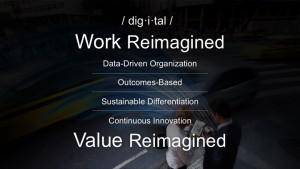
I’m an entrepreneur at heart, and I love coming up with wildly innovative ways to solve problems and create business value. This entrepreneurial mindset is a requirement in today’s digital age—as technology changes business landscapes and rules.
If you read the media, you associate entrepreneurs with start ups and small companies. But as technology rapidly disrupts every industry, the challenge for every enterprise—small and large—is to rethink their business models and enable their entrepreneurs to drive their digital strategy. I can tell you first hand that there is amazing entrepreneurial talent hidden in large enterprises like Cisco. This hidden talent can help identify new revenue streams, increase productivity, or even transform an entire industry.
That is why I am so excited about my mission as Cisco’s Chief Digital Officer. I have license to rewrite the competitive and operational playbooks for Cisco—to unleash the capability and innovation across the company. And I have the opportunity to do it for every one of our customers, in every industry, who wants to rewrite their playbooks with digitization at the core.
We’re well on our way to making Cisco the best example of a digital company. It’s a journey for every aspect of our business—from our systems and tools, to our engineering, to our people, and I am thrilled by the partnership, energy and commitment across the company.
As I talk with customers about what we’re doing and what they want to do, the conversation always goes to “Where do we start?” I thought I would share a few critical observations and conclusions I’ve drawn:
Driving a digital transformation is not automating existing workflows or layering new tools and technologies on top of traditional processes. It isn’t an IT strategy trying to catch up with a business strategy. It isn’t cloud, collaboration, systems or applications. And it isn’t just a technology issue.
What do you say when your customers want a diverse range of cloud services—SaaS, IaaS, PaaS, private, public, hybrid—with the ability to deploy on demand? What if they want the flexibility to order and manage them all from the cloud, while keeping their data onsite? And what if they say they can’t wait weeks for you to build a solution, they’d like it immediately please?
If you’re United Data Technologies (UDT), you say, “Sure, no problem.”
It’s no secret that public schools have needs that often go unfunded. So when a school district gets the opportunity to earmark funds for technology enhancements, they need to make sure they get the best.
After years of school budgets cuts, the Manteca Unified School District (MUSD) received a one-time gift from the state legislature to reinvest funds back in their schools. The district made the decision to create a “Going Digital” initiative. This initiative was created to completely overhaul the district’s entire network infrastructure. This infrastructure overhaul wasn’t child’s play as MUSD serves more than 32,500 students spread out over 32 campuses in California’s Central Valley. The district was given a time limit to complete the project—it had to be finished in nine months.
Using Cisco products such as Cisco Aironet 3700 Series Access Points, Cisco Catalyst 6500 and 2960-X Series switches, the school district completely updated their network. Thanks to devices supporting 802.11ac next-generation wireless standards, students are able to take advantage of their new wireless network. This means students can compete against classmates in digital quiz games or learn how to use a 3D printer. But this technology doesn’t just make the lives of students easier. By using management solution data, the district can locate lost devices, view usage statistics and learn about individual user’s connections from a central location. It can also quickly fix problem areas by giving the MUSD IT staff the ability to spot issues and fix them quickly. The network is scalable so that new technologies—such as a physical security system—can be added in the future.
To learn more about this case study, point your browser here.
Because of the nature of SDN, and specifically the automation available with Cisco’s Application Centric Infrastructure, ACI works really well with cloud orchestration tools such as OpenStack. I was able to be at the OpenStack Summit in Tokyo last week and gave a vBrownBag TechTalk about why Cisco ACI makes OpenStack even better.
So, how does ACI work with OpenStack and perhaps even make it better? First, ACI offers distributed and scalable networking. It supports Floating IP addresses in OpenStack. If you’re not familiar with Floating IPs, they are essentially a pool of publicly routable IP addresses that you purchase from an ISP and assign to instances. This would be especially useful for instances, or VMs, like web servers. It also saves CPU cycles by putting the actual networking in the Nexus 9000 switches that make up the ACI fabric. Since these switches are built to forward packets, and that’s what they’re good at, why not save the CPU cycles for other things like running instances?
OpenStack doesn’t natively work with Layer 4-7 devices like firewalls and load balancers. With ACI we can stitch in these necessary network services in an automated and repeatable way. We do this in a way that doesn’t sacrifice visibility as well. While it’s important that we’re able to automate things, especially in a private or public cloud that is constantly changing and updating, if we lose visibility, we lose the ability to troubleshoot easily. In the demo, shown in the video above, you will see just how easy it is to troubleshoot problems in ACI. We also get the ability to preemptively strike before a problem causes issues on the network by offering easily interpreted health scores for the entire fabric, including hardware and end point groups.
ACI is also a very secure model. Not only does it use a white-list model where traffic is denied by default and only allowed when explicitly configured that way, it will also give more security when it comes to multi-tenancy. In a strict overlay solution, if a hypervisor is attacked or owned the multi-tenancy model could be deemed insecure. In the ACI fabric the security is done at the port level. So even if a hypervisor is attacked the tenants will be safe.
In recent versions of ACI we are able to use OpFlex as a southbound protocol to communicate between OpenStack and ACI. By using OpFlex we get a deeper integration and more visibility into the virtual environment of OpenStack. Instead of attaching hypervisor servers to a physical domain in ACI we can attach them into a VMM (Virtual Machine Manager) domain. This allows us to learn which instances or VMs are on which physical server. It will also automatically learn IP addresses, MAC addresses, states and other information. We can also see which networks or portgroups contain which hypervisors and instances within our OpenStack environments.
For more information on how Cisco ACI works with OpenStack you can go to http://cisco.com/go/aci
The release of the fifth annual Cisco Global Cloud Index highlights the potential impact that Internet of Everything (IoE) applications could have on data centers and cloud computing infrastructures. The growing digitization trend is creating massive volumes of new digital data that represent both challenges and opportunities. As a proof point, by 2019, data generated by IoE apps is expected to reach 507 ZB annually — 49 times higher than total annual data center traffic of 10.4 ZB for the same year. Here are a few brief visual insights into the possible impact of IoE and Big Data on our future digital lifestyles.
Data is everywhere and growing!
By 2019, there will be 24.4B IP connected global devices and connections, an average of 3.2 devices and connections per capita. Per the GCI Forecast, the total amount of data generated by people, machines and “things” will be a “staggering” 43 Zettabytes per month.
Some of this data is finding a home on data centers. The (GCI) forecast estimates that the total volume of stored data on devices and in data centers will reach 3.5 zettabytes by 2019. Global data center computation and storage capacity is also on the increase— 2.5 fold workload growth between 2014 and 2019.
At its heart, Irish culture has a very strong love of sport. While the Irish are very passionate about it, sometimes our success is disproportionate to the size of our love and our population. But that doesn’t stop us!
Because the sporting community has a strong sense of volunteerism, it’s the foundation of many of the sporting clubs. This enthusiasm for giving back is not only part of the Irish culture, and the sporting culture, but Cisco’s culture. So when we can mix sport, culture and charity, the Irish get excited!
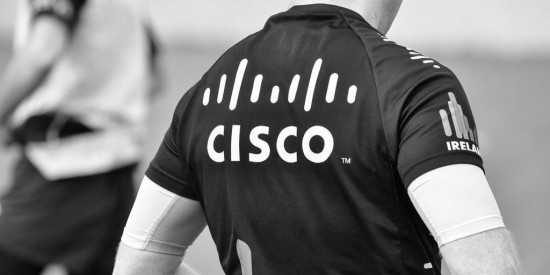
Enter GOAL Jersey Day. The idea behind GOAL Jersey Day is to run a nationwide fundraiser where participants across Ireland don the jersey of their favourite sports team and make a donation towards the GOAL charity.
We in Cisco Galway took this idea a step further (as we like to do) and took some time during lunch to play some of the Ireland’s favourite games! Over the last few years this has included the ancient and traditional game of hurling (the fastest game on grass and not for the faint-hearted!) but this year the team decided to play Rugby to celebrate Ireland’s successful participation in the Rugby World Cup. (Another game not for the faint-hearted!)
Because we can be a little competitive here at Cisco Galway (and we don’t want anyone injured), the team decided to tone down the physical aspect and play TAG.
We had a great day, and donated some time and money. Our team really got into it!
Cisco Galway employees have fun and raise money for GOAL.
“Getting groups of Cisco Galway employees together into team and letting them play sport while making money for charity just made sense!” said Anthony McLaughlin, a software engineer at Cisco Galway. “It was a fantastic afternoon of ‘craic‘ (it’s an Irish word and not to be mistaken for other interpretations 🙂 ) was enjoyed by everyone involved. And it was good to know that it was all in aid of charity”
“It’s an easy decision to make to be part of Cisco’s annual GOAL Jersey day,” said Brian O’Donoghue, a system engineer for sales at Cisco. “It allows employees to display their pride in their team, get out and be active on the sporting field, while at the same time donating money to a very worthy Irish charity. Cisco Galway employees played with a competitive but fun attitude that typifies the culture of Cisco globally!”
“’Jersey day’ is a great event in Cisco Galway – there’s great colour on site with Jerseys being worn that represent sports from different levels – International, Provincial, County and Club, and reflecting the wide variety of sports interests on site: Rugby, Hurling, Football, Camogie, Soccer and lots more,” said Colie McGarry, a software engineer at Cisco. “As for the matches themselves – they have been very well run and the Cisco competitive edge was quite evident to anyone involved.”
“It was an opportunity to have some super fun, healthy competition with coworkers out in the fresh air and all in aid of a fantastic cause,” said Katie NicGabhann a software engineering manager for Cisco.
“It was a good opportunity to meet with other colleagues in Cisco as well as to show my tag skills, J“ said Tuna Erdumaz, a Cisco software engineer. I had so much fun to get involved in this. I even did the winning try to make my team tournament winner.”
“The TAG match was great fun, and an excellent opportunity to get more familiar with the Cisco family here in Oranmore since I’m just a new graduate of 2months,” said Eamonn Clancy, a graduate software engineer at Cisco. “The Cisco spirit is best shown through it’s charity, even in the short time I’ve been here I’ve already signed up to a number of charity events. It’s definitely been all inclusive since I’ve joined”
“The Tag game for GOAL was a great opportunity to participate in the fundraising endeavor,” said Mary Newell, a software engineer for Cisco. “Unlike other sports, TAG is something that can easily cater for all skill levels (from the unskilled like myself to the wannabe Paul O’Connell’s). A few players were expecting their Rugby World Cup 2015 call-up after their performances! All in all a very enjoyable experience”
Trends like bring-your-own-device, mobility, and cloud computing are creating a surge in the number and types of devices connecting to the network and driving demand for WAN bandwidth. Remote and branch office employees expect fast, secure connectivity but most enterprises don’t have spare operational budget to increase their WAN bandwidth to backhaul all traffic to headquarters in order to keep it secure.
Enter Intelligent WAN, or IWAN. With IWAN, the Internet becomes a reliable, cost-effective way to supplement the WAN. Cisco’s IWAN also enables secure direct Internet access (DIA). Instead of backhauling branch office Internet traffic across the WAN, traffic is redirected to the Cisco Cloud Web Security (CWS) proxy, located in one of our data centers around the world, for inspection.
Now Cisco CWS is available on even more Integrated Services Routers (ISRs) for improved IWAN capabilities and additional deployment flexibility. Enterprises can use Cisco’s newest branch routing platform, the ISR 4000 Series, to redirect traffic to a CWS proxy using Generic Routing Encapsulation (GRE) over IPsec.
As organizations move toward digital transformation, they are embracing the benefits of delivering timely, personalized information to customers, citizens, and patients. Connecting people with information and services when, where, and how they want, is a pivotal point in the way organizations process, apply data and deliver that information.
Given my busy schedule, I appreciate a shopping experience that is hassle-free and fast. I also want the information I need about a product or service to be easy to find. And for that matter, I expect that a retailer knows what I am looking for and provides relevant promotions and discounts. These rising expectations have been born out of leading digital retailers and now that the bar has been set – anything that falls short feels like a disappointment.
Customer Experience
Today’s shoppers are looking for efficiency, ease in problem-solving, and faster time to purchase. They want to take advantage of savings through discounts and promotional offers and they want to be engaged when learning about new items, entertainment, and product options. To address these growing expectations, Cisco and Panasonic are partnering to transform the shopping experience through their Powershelf solution. The solution enables brick and mortar retailers to automate inventory tracking and pricing data, helping them optimize their supply chain and better manage demand. In addition, real-time product information can be delivered to a customer’s mobile device.
Citizen Experience
The future involves much more than improving customer engagement. Cities are challenged with delivering enhanced citizen services and information on a limited budget. In the face of inclement weather and emergencies, it is critical that cities link dispatch, first responders and the community with timely, accurate information. For example, the City of Mississauga is leveraging sensors and wireless connectivity to make these connections, analyze trends and share information between citizen services, public communications, and operations.
https://www.youtube.com/watch?v=klZCkxEQfIs
As more and more citizens prefer to receive information and updates via their mobile devices, this integrated public service system will allow cities to put a request into action quickly and efficiently and provide real-time updates. Now, the City of Mississauga can deploy operations teams and emergency services faster, enable new services without recognizing an increase in IT budget and improve public safety with immediate, actionable information.



 I have always been a passionate believer in The Power of Partnerships to improve diversity in the talent pipeline, the workplace and leadership positions at enterprises everywhere. My experience shows that partnerships must be formed both within the enterprise and outside of it in order to make a real impact on diversity.