Recently, there’s been a lot of discussion around digital disruption in various industries and in particular, how manufacturers need to jumpstart their digital transformation and adopt digital business models. We think the future of manufacturing in a connected world requires a roadmap as you go thru the journey of becoming a digital manufacturer. Attending educational conferences such as the upcoming Automation Fair, Rockwell Automation’s largest user conference which is coming up from November 17-18 in Chicago, can help tremendously.
As my colleague Chet Namboodri outlines in his blog, “Countdown to Automation Fair: Spotlight on Digital Manufacturing”, Cisco will have a presence in Booth 1045 at #AutoFair15 and will demonstrate solutions and products that can help enable digital transformation. I will be presenting on ‘The Future of Manufacturing in a Connected World: How to Get There Today’ (T85) where I will describe why the integration of control and information on the manufacturing floor will be essential for manufacturers Continue reading “The Future of Manufacturing in a Connected World: Learn More at Automation Fair”
During the OpenStack Summit last week, we released Mantl 0.4. In this blog I would like to go into more details about the release. But first I’d like to start by explaining what Mantl is – and what it is not.
System Integration as Open Source
Mantl is a layered stack that takes care of system integration. It does this by using tools at different layers – Terraform to provision Virtual Machines and Apache Mesos & Kubernetes for cluster management. Higher level services are taken care of by tools, such as Consul for service discovery, or by custom Apache Mesos frameworks, which are currently used for processing data.
You could say that Mantl create the “glue” to enable hybrid cloud. This is too dry an explanation for us. The truth is that Mantl has three design goals: Build; Deploy; Run
Firstly, it aims to shorten the development cycle. Most programmers recollect feelings of joy when they first coded. However, as web-development rose in conjunction with the monolith, coding was as much, if not more, about configuration management as it was application development. The extension of the feedback cycle, as well as not been much fun, seriously stunted productivity.
Currently it’s the same for cloud applications. Developers spend excessive amounts of time provision machines, opening ports and managing clusters when they could be developing their applications. One of the tenants of Mantl is it creates a ‘place to innovate’. It does this by making the cloud invisible and thus allowing developers to do what they do best: build innovative applications and get them into user hands as quickly as possible.
Secondly, Mantl aims to gently coach developers, helping them to write cloud native applications. Many developers, understandably so, design their first cloud applications as they would have their old, three tier systems. With a gentle opinion, Mantl nudges developers towards containerized services and multi-language systems while at the same time creating a bridge between the traditional and the cloud native.
Thirdly, Mantl aims to make interaction with the cloud as simple as possible. Famously, Joel Spolsky said that all abstractions leak. What this means is that you can never hide the underlying abstraction: virtual machines are bound by the hardware they run on; compilers are bound by underlying machine architectures. It’s the same for cloud: you cannot totally abstract the platform away. However, if you must interact with it, you should do at the right level of abstraction. Mantl provides a number of tools that make this easier. It relies on Docker containers and Terraform, for example, but also provides custom tooling, such as MiniMesos.
In summary, Mantl coaches, shortens the development life cycle and provides abstractions at the appropriate levels. In addition to this, it provides data-tooling.
Let’s now look at some of the innovations from release 0.4.
MantlUI
Mantl 0.4 includes a new WebUI that connects to the various applications (Mesos / Marathon / Chronos / Consul). For example, users can now access Mesos agent logs through an authenticated UI.
Backed by Consul service discovery, the new UI automatically connects to the correct Mesos masters and agents.
Mantl-api
We’re very excited to announce support for the first release of Mantl-API.
Mantl API provides a new way for you to manage Mantl clusters. With the first release, you can easily install pre-built applications and Mesos frameworks. With a single API call, you can now spin up Cassandra on your Mantl cluster.
We think Mantl-API will be useful for anyone who is currently running Mesos.
Glusterfs
Support for deploying GlusterFS as a shared filesystem has been added.
DNS provider support
Support for DNS providers. We’ve added example code to configure DNS registration of Mantl nodes in DNSimple. Thanks to contributors, we will be adding support for other DNS providers like Route 53 and Google Cloud. We’ll make these more configurable when terraform supports conditional logic.
Calico IP per container networking (tech preview).
Calico is a new virtual network solution that enables the IP per container functionality. Calico connects Docker containers through IP no matter which worker node they are on.
Data Tooling Built In
The ELK stack is built into Mantl as Apache Mesos frameworks. This means that developers can use Mantl’s Terraform modules to provision a cluster, setup the system, and immediately start building data-driven applications.
On its own, this functionality is powerful. However, because Mantl uses Apache Mesos frameworks for its data tooling, it can (and does) take advantage of Mesos’ scheduling and hardware utilization features. In addition to this, the frameworks provide extra functionality.
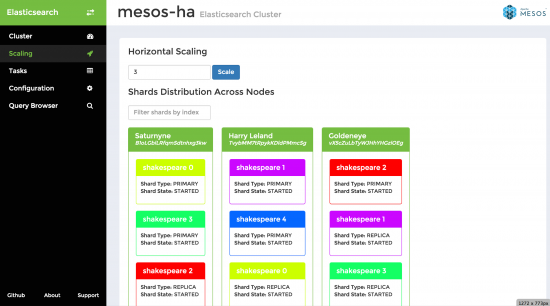
Let’s look at three features of the ElasticSearch framework. Firstly, the framework allows the scaling of the cluster via a GUI – it thus provide the right level of abstraction for developers to interact with the cluster. Secondly, it provides a visualization of the cluster, including where the PRIMARY and REPLICA shards are located. Thirdly, through the GUI, developers can search the cluster, which is handy for testing and debugging.
Please note, although these features are in progress, they are currently on the experimental branch.
Image 1 – ElasticSearch Framework GUI with the works of Shakespeare on a three machine cluster.
The Mantl Developer Tools – MiniMesos
One of the problems with Apache Mesos is that it’s hard to set up. In his O’Reilly article, “Swarm v. Fleet v. Kubernetes v. Mesos”, Adrian Mouat says that, ‘Mesos is a low-level, battle-hardened scheduler that supports several frameworks for container orchestration including Marathon, Kubernetes, and Swarm’. However, he goes onto say that for small clusters it may be an overly ‘overly complex solution’.
Mantl uses Mesos because its battle hardened. But since one of Mantl’s goals is to make interaction with complex tools as simple as possible, the teams building Mantl created MiniMesos.
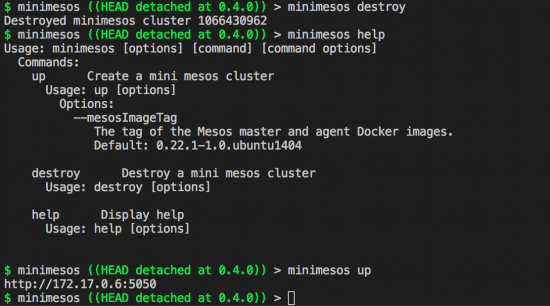
MiniMesos provides an abstraction layer over Apache Mesos. Minimesos allows developers to run, test and even share their clusters. Since Minimesos can bring a cluster up in milliseconds and lets developers test their code before checking in, it radically shortens the developer lifecycle. Importantly, Minimesos can be used from the command line or via its API, thus making automated system testing easy.
Minimesos now has its own Twitter account and website. It is one (of many) innovations to come out of the Mantl program and has captured the imagination of the community. Pini Reznik, CTO of Container Solutions, who are part of the team working in Mantl, says that ‘Minimesos is to Apache Mesos what Docker is to LXC’.
Image 2 – MiniMesos Command Line Interface as it is implemented in Mantl 0.4. More commands to come, including ‘install’ for quickly adding frameworks.
Use Cases
There are many uses cases for Mantl. One of the most interesting patterns that is emerging is around IoT. At DockerCon, in November, we hope to reveal the Wheel of Fortune application. The Wheel of Fortune connects a physical wheel to a REST endpoint. The endpoint is part of an application that scales automatically and displays the data via a web-application.
At first glance the Wheel of Fortune may seem like a bit of fun. However, collecting data, big or otherwise, from the IoT for storage and analysis is a key aim of Mantl. Because Mantl abstracts the underlying infrastructure away or makes it invisible, developers can get busy building and deploying their big data applications without worrying about system integration.
Another interesting use case is hybrid devops. Hybrid devops is the ability for enterprises to develop their applications leveraging Cisco Shipped (ciscoshipped.io) the way they always have. Then leverage Mantl to deploy their application on any external cloud environment supported by Mantl (AWE, GCE, Digital Ocean, Rackspace, Cisco Cloud) in a CI/CD framework that enables internal and external services to be leveraged by the application.
Whats next
We are making Mantl more modular, so that you can select the scheduling, logging and networking components you want to deploy.
The team is also committed to automated testing, and we’ll be testing Mantl against multiple cloud providers daily.
Features on the roadmap include:
Better haproxy support
Improved docker storage leveraging Cisco Contiv.
Full integration of Hashicorp Vault
Kubernetes/OpenShift support
Modular networking leveraging Cisco Contiv
Simplified API management
Application Policy Intent leveraging Cisco Contiv
New deployment and management tools
Conclusion
Modern enterprises face three often competing tensions. Firstly, they have to learn how to build cloud native applications. This involves much more than recreating monoliths in the cloud. It involves changes in process but also in structure. As enterprises encompass small and medium sized companies in their supply chains, they have to have a structure that supports language agnostic microservices.
Secondly, the challenge of big data is calling all companies. Enterprises not only need to tap into the power of data scientists and developers but they have to actively work around organizational scar tissue. It is impossible to work with large amounts of data and to test new algorithms against production data whilst carrying decades worth of old processes and procedures around. The new enterprise can be agile and take advantage of big data. What it can’t be is bureaucratic and take advantage of big data – these two concepts simply cannot coexist.
Finally, all enterprises must deal with governance. This includes security, operations and a shift towards DevOps or NoOps.
Mantl helps enterprises resolve the tension between these three challenges. Mantl enables repeatable and simple deployment procedures through its use of programmable infrastructure tools, like Docker and Terraform. Mantl promotes the microservice architecture and by default supports systems built in multiple languages by multiple teams. This means that enterprises can take advantage of an extended, horizontally aligned, supply chain. Finally, Mantl is both IoT and Big Data ready and friendly. Through its use of abstraction, programmers and data scientists can focus on what they do best whilst leaving system integration the Mantl.
References
● Mantl’s website, http://mantl.io/.
● MiniMesos’ website, http://minimesos.org/.
● Cisco Shipped website, http://ciscoshipped.io
● Cisco Contiv website, http://contiv.io
● ‘The Law of Leaky Abstractions’, Joel Spolsky, http://www.joelonsoftware.com/articles/LeakyAbstractions.html.
● ‘Swarm v. Fleet v. Kubernetes v. Mesos’, Adrian Mouat, http://radar.oreilly.com/2015/10/swarm-v-fleet-v-kubernetes-v-mesos.html.
● ‘Mini-Mesos: What’s a Nice XPer Doing in a Company Like This?’, Jamie Dobson, http://thenewstack.io/mini-mesos/.
Today Cisco completed its acquisition of ParStream, a company that has created a specialized database built for the Internet of Things (IoT).
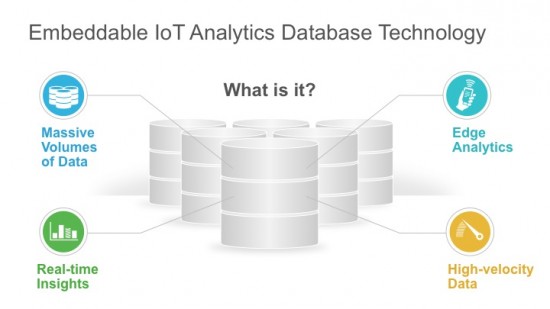
In hyper distributed data environments, massive amounts of data are being created and in a very distributed way. Many examples of this can be found in the IoT, from terabytes of data created by sensors places in offshore oil wells to extremely time sensitive data created by robots in manufacturing facilities. In these hyper distributed data environments, challenges arise with collecting, storing and analyzing data that can’t be solved with traditional solutions that rely on data to be in a central location before it can be used to derive meaningful insight. In some cases, there is simply too much data to move across the network, while in other cases the problem is that the data is extremely time sensitive and moving it to a data center or the cloud for action is just too slow. These cases require the capability to store and analyze data very close to where the data is created…near the edge of the network.
This is exactly what Cisco and ParStream will do together.
More employees need access to more enterprise resources from more devices than ever, and attacker ingenuity and persistence have reached new heights. As a result, organizations are losing sight of who and what is accessing the network – and the threats that may take hold. And the problem is only going to grow as 500 billion new devices are expected to be connected to the network by 2030.
How can you protect what you can’t see?
In the face of an ever-increasing number of attack vectors and advanced threats, Cisco is committed to helping organizations extend security everywhere – in effect, to wherever employees are and wherever data is – without sacrificing operational efficiency. Cisco ISE 2.0 extends security further into the network with new capabilities that help you see and control what’s on your network like never before and accelerate threat mitigation.
Introducing Cisco ISE 2.0
The newly redesigned Cisco ISE security management platform provides greater visibility, usability, and control.
Deeper Visibility Provides Superior Network Insight and Control
Expanding ISE’s Reach and Scope within Diverse Network Environments. Customers can now deploy ISE services such as Profiling, Posture, Guest, and BYOD with 802.1x NADs manufactured by non-Cisco vendors. This extends the reach and scope of advanced authorization capabilities in ISE to ensure endpoint compliance across a more varied range of networks.
Access Policy become geo-location driven! Create and enforce access policy controls based on specific geo-location information thanks to the integration with the Cisco Mobility Services Engine (MSE). For example, a healthcare organization can control a doctor’s access to patient records only while in the hospital, a corporation can grant executives’ access to confidential information for a board meeting while only in the board room, a school can control a student’s ability to stream content only when physically inside the classroom.
If you’ve ever gone hiking through the woods, you know the importance of a trail marker. You can have a great map and plenty of wilderness experience, but sometimes the wild gets the better of you. All of the trees start to look the same. It’s disorienting. You can be on the right path all along, but you’ll start to lose confidence and move more slowly if you aren’t sure you’ve taken the right fork in the trail. Only when you see that familiar symbol carved into a tree, or splash of paint on a rock, do you know with certainty that you are on the right track.
Today, I want to celebrate a key point along Cisco’s journey to lead companies down the path of digital transformation. Our Cisco marketing teams have won fourITSMA Marketing Excellence Awards – the most ever awarded to one company in a single year! The teams and the awards they won are as follows:
ITSMA Diamond Award for Marketing Excellence
Category: Driving Business with Thought Leadership
Winner: Cisco Thought Leadership Team
Our Thought Leadership Team has worked closely with Cisco Consulting Services over the past several years to codify a unified thought leadership agenda for the entire company. Their innovative research identified digital transformation in the Internet of Everything (IoE) as a major market transition and quantified the $19 trillion value at stake. Behind the strength of this analysis, Cisco made digital transformation in the IoE our top priority and company storyline. In recent months, this team has begun to translate their analysis into industry-specific roadmaps detailing how to capture the value from digital transformation.
As we have extended our thought leadership into specific industries, we have also worked to collect real customer stories of digital transformation in action as proof that the digital shift is a tangible reality. This integration of thought leadership across our consulting, sales, and marketing teams has helped to differentiate Cisco as a driver of business outcomes, given Cisco brand permission to enter new markets, and helped our customers take action to begin their digital transformations.
The way people collaborate is in the midst of an enormous shift. Whether you’re ready or not, it will impact how and where teams and employees conduct business.
In 2014 alone, global mobile data traffic grew 69% and nearly half a billion mobile devices were activated and connected. And by 2019? That traffic is expected to increase nearly tenfold. Tenfold!
Collaboration is a major driver for increased mobile usage. We’ve used chat and messaging tools to maintain personal connections for years with popular apps like FaceTime, WhatsApp, Voxer, and many others. With their success in fostering simple and straightforward communication, it was only a matter of time before these apps found their way into the business world. This “consumerization of IT” is paving the way for new breeds of business-class technology to redefine the boundaries of the workplace.
But it is more than technology fueling this shift. The way teams form and work together has changed as well. Entire functional teams may not even sit at a desk anymore, getting more done by working closely with customers, suppliers and far-flung colleagues, especially while on the go. Supporting the needs of this increasingly mobile workforce is critical. However, executing against those needs may leave you wondering where and how to start.
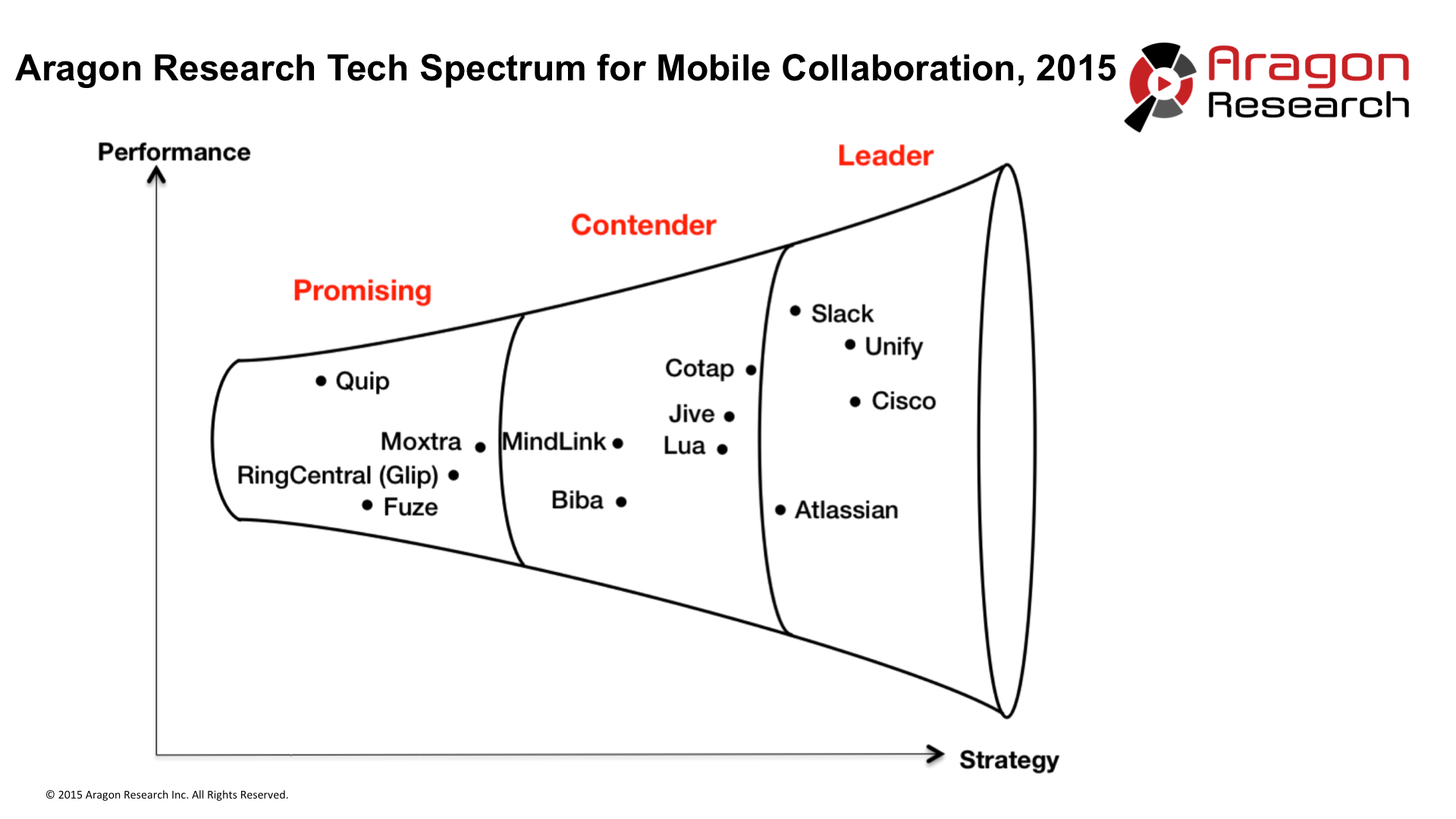
Aragon Measures the Market Aragon Research took an early look at applications aimed at solving these challenges in its recent Tech Spectrum for Mobile Collaboration report. Aragon looks at the products designed to enhance teamwork and team building across the workplace ecosystem. These tools, according to Aragon, “Are making it easier for people to interact with internal and external colleagues and partners on any device, without barriers.” And by 2020, Aragon estimates that 60% of users will rely on mobile collaboration as frequently as email.
As the 2016 Rio Olympics draw nearer, the eyes of the world are turning to Brazil and South America. Latin American economies have historically been increasingly exposed to global uncertainty and economic volatility. However, the region has made significant progress in adopting technology innovations leading to economic development and initiatives to accelerate and stabilize growth. And as host to some of the world’s largest events, Latin America continues to attract industry leaders, economists, financial executives, technologists, and government innovators that are rallying behind the quest for change. Significant drivers of that change will be innovative technology adoption and digital transformation.
Along with the rest of the world, Latin America is witnessing that digital technologies are not only an essential building block of a society, but currently also the driving force behind social, economic, and political development. We are the fortunate ones to live through – and hold the responsibility to shape – an era in which ubiquitously connected information and communications have become the catalyst of human progress. We really have only scratched the surface of what is possible. And as we observe businesses, communities, and countries as they progress in their respective digital revolutions, we will only continue to deepen our understanding on how technology innovations transform our world.
https://www.youtube.com/watch?v=-m1qDHNExC0
The Latin America Backpacking Experience
This week, our digital citizen is feeling adventurous as ever. In deciding to take a break from the average workweek, our citizen planned a backpacking excursion throughout Latin America. Follow along as we learn and see first-hand how technology is transforming lives in the region, with new job skills, entrepreneurial opportunities, innovative services and stronger, digitally inclusive societies. Continue reading “#WednesdayWalkabout Series: A Backpacker’s Guide to Digitization”
Lightreading commissioned the European Advanced Networking Test Center team evaluation of Cisco’s NFVI solution in September 2015. The first part of the resulting report, which provides an overview of Cisco’s NFVI and an in-depth, multi-page performance evaluation of Cisco’s virtual switch technology, has been published — see Validating Cisco’s NFV Infrastructure Pt. 1 and Cisco’s vSwitch Makes the Grade.
The convergence of market transitions, ranging from collaboration and video to virtualization and cloud-based services, is fundamentally changing the way businesses acquire and use technology.
The most successful organizations use training to evolve their practices and seize upon market opportunities, increase growth and build customer retention. In the competitive marketplace, the way to thrive is to arm your employees with the best and most comprehensive skills training.
A recent survey of Cisco Authorized Learning Partners found that 63 percent of their customers think that unauthorized training is lower priced. When it comes to training, however, the old adage rings true – you get what you pay for.