Avatar

As an Information Technology professional I believe that IT is changing and will keep changing the way we live and of course our future. IoT (Internet of Things) has been a major topic of discussion, especially in 2014.

Everyone predicts that in the near future almost everything will be connected to the Internet, and will have its own IP address.  Connectivity not only includes PCs, laptops, tablets and smartphone, but coffee machines, refrigerators, TVs, washing machines, microwaves ovens, cookers, closets, etc…

I am afraid that one day the refrigerator will refuse to open because it reads my mind about wanting chocolates, and finds that I am overweight. The next day my car will not drive me home, but to the local gym after checking my schedule and finding some free time. Then it will kick me out saying, “Go do some exercises, your extra weight consumes more fuel, and my chassis will not endure until next summer!” Thank goodness it’s just a dream right now. I don’t even own a car, and will never think about buying a smart internet connected refrigerator, simply because it’s very expensive. 🙂

In this article I will share my thoughts and raise questions about four main factors related to IoT’s future: Continue reading “Internet of Things (IoT) and our future”

Authors

Mohamed Abousena

Instructor

Cisco Networking Academy

Avatar

Traffic jams aren’t just stressful—they’re expensive. A recent study by the Centre for Economics and Business Research revealed that in 2013 traffic jams cost the U.S. $124 billion. By 2030, they estimate the annual price of traffic in the U.S. and Europe will soar to $293 billion.

Can we turn this around? I think so. The Last Traffic Jam can happen through the Internet of Everything (IoE) and the increased value that comes from connections between people, process, data, and things. It’s in this highly connected world where we’ll see amazing things happen—including the Last Traffic Jam. Continue reading “Making the Last Traffic Jam a Reality”

Authors

Joseph M. Bradley

Global Vice President

Digital & IoT Advanced Services

Avatar

For 30 years, we’ve been helping change the way people work, live, play, and learn. During this time, our world has advanced faster than ever.

It seems like yesterday when we saw the introduction of the Macintosh, the first-ever consumer machine with a mouse and graphical interface. Then, just two years later in 1986, Cisco introduced the Advanced Gateway Server, or AGS.

This breakthrough multiprotocol router became the foundation for moving traffic across networks. In 1990, researcher Tim Berners-Lee developed HTML—the official language of the World Wide Web and the spark to make the Internet mainstream.

Today, it’s hard to remember life before the Internet. The industry has come a long way, and so have we.

We owe our founding to Len Bosack and Sandy Lerner, two former Stanford University computer technologists, who set Cisco on an incredible journey as a networking and Internet pioneer.

In 1995, less than 1 percent of the world’s population connected on the Internet. Today, more than 40 percent connect online.

We’ve seen businesses transformed and economies modernized. The way we buy and sell products has changed—so has their design, production, and distribution. It’s as if no industry has been untouched.

In the next 30 years and beyond, we’ll see everything become connected—people, process, data, and things. This will expand our understanding of the world and the experiences we have, and we’ll generate new ideas and discover new solutions.

Continue reading “Let’s Talk Firsts and Lasts”

Authors

John Chambers

No Longer with Cisco

Avatar

IT-Harvest, founded by renowned security expert and industry analyst Richard Stiennon, provides reports, analysis, and advisory services on trends in emerging threats and the technology to counter them. Richard Stiennon is one of the most followed and well-respected IT security analysts and authors in the world. His recent white paper discusses why network segmentation is becoming increasingly critical to protecting networks. Further, it argues that Cisco TrustSec provides the right technology for leveraging the network to provide better security. Continue reading “New IT Harvest White Paper: How Policy-Based Software Defined Segmentation and Cisco TrustSec Improve Security”

Authors

Sanjay Raja

Director, Product and Solution Marketing

Secure Access and Mobility, Cisco Security Business Group

Avatar

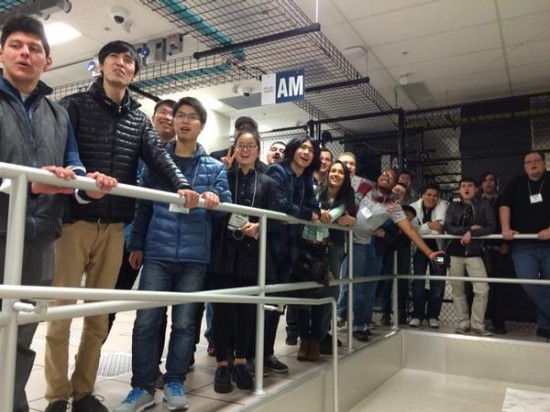
Earlier today, students from 13 different countries met for the first time on Cisco’s San Jose campus. For some, like Odwa Yekela, the visit is a first adventure away from home in South Africa. For others, like Richard Brunner, it’s a simple two-hour drive from Sacramento, California. No matter where the 18 students came from, though, the visit is more than just a trip — it’s a life-changing experience and celebration of their achievement as global winners of the Cisco Networking Academy NetRiders Competition.

The NetRiders winners took a tour of one of Cisco's data centers on their first day in San Jose
The NetRiders winners were excited to visit the Cisco campus and learn more about potential careers in the IT field

Continue reading “Cisco Welcomes Networking Academy NetRiders Winners to San Jose”

Authors

Austin Belisle

No Longer with Cisco

Avatar

With the near year come new resolutions.  For many people, among those at the top of the list is getting a new job.

For human resources leaders, the resolutions may be to get more creative to find new talent, and to retain and grow the existing talent. This challenge is even greater when you are attracting a new generation of workforce.

By 2015, millennials will make up 36% of the American workforce. They are more mobile than previous generations; they want greater choice on how and where they work.  They feel comfortable with technology and they’re used to being connected and collaborating all the time.

Video conferencing is one of the best technologies HR can use right away to attract, retain, and develop millennial employees.  Once seen as a nice-to-have, video conferencing for business use has come a long way.  It’s no longer just a big, expensive system in a large conference room where you need IT’s help to get it to work, nor is it relegating to consumer-grade video chat, bypassing IT.  For businesses that use the right video conferencing solution as part of their overall communication tools, they see an immediate business impact.

Here are six top benefits we see from our customers:

Continue reading “6 Ways HR Can Benefit from Video Conferencing”

Authors

Grace Kim

Senior Manager

Solutions Marketing

Avatar

In today’s era of increasing connectivity, data is getting generated in vast proportions.  Moreover, it is also important to be able to generate insights from it quickly and act accordingly.  Gone are the days when one would move data into a data warehouse and then extract insights from it to act at a later date.  Here are four scenarios why.

Scenario 1: Cloud and Social

If a discussion around a brand is trending positively or negatively, that organization needs to take action then and cannot wait for a future time to do so. They might want to capitalize on the positive sentiment and amplify it or perhaps take action and remedy a trending negative sentiment. Both Twitter and Facebook provide several real time analytics capabilities leveraging big data technologies that they pioneered themselves.  These analytics run within their cloud environment and provider users real time insights.

Continue reading “Could Big Data and Cloud go together?”

Authors

Vikram Gulati

Marketing Manager

Cloud Services Marketing

Avatar

Hi, everyone! Please be sure to check out Joe Bradley’s blog on how retailers face a rising tide of disruption driven by rapidly changing technologies. Joe presented yesterday at NRF to provide the results of Cisco’s annual shopper survey (see the white paper here) and has some great comments to how to adapt to today’s transforming retail landscape.

Authors

Dianne Lamendola

Senior Practice Advisor

Avatar

All too often we networkers spend our time defending the network not only from security threats but from blame as the root cause (actual or perceived) of performance problems. The network is guilty until proven innocent. So how do we counter these arguments, put the issue to rest, and uphold the integrity of the network? Logs, logs, logs.

Logs are evidence to support your hypothesis. There are a couple of different types of logs I’d like to talk through and the roles they provide in a tiered approach to troubleshooting.

SNMP – This is one of the first places I go to when an issue is reported. This provides a look at the current state of the network based on polling intervals and traps, and also a place to explore data patterns and trends. Most enterprises will have an NMS solution in place and in my experience this is also a great place to learn the topology of the network(s) when joining a new company. There are many commercial and open source products available and I suggest trying a few different options to find out which works best for you and your team as they all organize and present the data in slightly different manners. Continue reading “It’s Not The Network”

Authors

Chris Roessler

Network Engineer