Avatar

A recent blog from Sungard AS, Stretch Your IT Dollar with Cloud Computing Services, offers more than just ideas on how cloud can extend your IT budget.  It also covers ways organizations of all sizes can use cloud services strategically to meet their goals, as well as provides a link to materials useful for companies considering the move to cloud.

A key part of Cisco’s cloud strategy is to enable service providers like Sungard AS to offer a wide range of cloud-based services. These cloud services aren’t simply cloud-based copies of data center applications.  Because they are based in the cloud, they can provide even greater flexibility and value.  This gives businesses fast access to new technology without the delay or expense of capital expenditures.  Put another way, this gives businesses a powerful competitive edge.

For example, organizations can deploy disaster recovery in the cloud.  The use of shared, multi-tenant architectures enables businesses to minimize the cost and complexity of a disaster recovery solution.  This provides greater flexibility, giving businesses more options that can be tailored to meet their specific needs and budget.

Cisco’s portfolio of cloud services is extensive.  It includes:

Collaboration services like TelePresence as a Service (TPaaS) and Contact Center as a Service (CCaaS)

Infrastructure services like Desktop as a Service (DaaS), Infrastructure as a Service (IaaS), Disaster Recovery as a Service (DRaaS), and Bring Your Own Device as a Service (BYODaaS)

Software services like Application Experience as a Service (AXaaS)

Security services like Hosted Security as a Service (HSS)

And the list only continues to grow.

An important part of this portfolio is that providers can offer these services as Cisco Powered services.  Every service is built upon validated architectures.  As such, they provide enterprise-class performance and reliability as a minimum standard.

The top percentage of Cisco partners, however, take these services to the highest level.  By passing a third-party audit, cloud providers like Sungard AS have verified that they can deliver the service, security, and support they promise.  They also earn the right to use the Cisco Powered logo.

For you as a cloud user, the Cisco Powered logo means a service has passed Cisco’s stringent standards.  As a result, the service provides fast time to market with ensured performance.  You also benefit from ongoing innovation by your service provider and Cisco as they continue to innovate and improve services.

Using the cloud strategically is crucial for survival in today’s competitive world.  However, not all cloud services are created equal.  Commodity-based services built on best-effort networks can’t give you the confidence you need to move your mission-critical applications to the cloud.  To execute a great cloud strategy, you need cloud services you can trust.

Learn more about how Cisco Powered can transform your business.

Authors

Xander Uyleman

Senior Manager

Global Partner Marketing

Avatar

Welcome back from a restful holiday break, assuming you were able to take one. But, like many in manufacturing, you might not had too much time off.  According to Industry Week and MAPI, the High Tech industry in particular is booming and there is no slowdown to be seen.  For the IT teams supporting these types of manufacturing operations, that means a lot more time troubleshooting and making sure that the network is always up and running.  With the efficiencies that companies have put in place to see additional growth numbers (ERP, HRMS and other systems), the focus is moving more and more towards the work areas and away from the corporate side of the operations.

The recent blog from my colleague Chet Namboodri on “2015 Manufacturing Industry Predictions , highlights some key trends including the shift to the operational side of the house. In addition, new services offerings are coming from completely different markets to drive the space in new ways.  To do many of these offerings, the basics of the factory are going to start to be analyzed in ways that have not been possible before.  The base to build this analysis capability is the networking foundation where we will connect the information stores into a holistic view of the operations so you can understand what is going on from an end to end picture and drive new capabilities by tying in more and more information.

While this can be a daunting task to many, Cisco and our partners are currently doing this with our IoT and IoE initiatives. In my recent blog on The Internet of Things Accelerates Innovation and Value Creation for Manufacturers, I mentioned tying together systems that in the past were stand-alone operational systems with other operational systems as well as with the Enterprise systems that have been in place but were not part of the full picture.  This can include integrating maintenance systems with HR/Scheduling systems as well as sales and ordering systems.  An example I use (and am currently working with a customer on implementing) is to actually tie these systems together so that you know when machines are going to be down and when people are to be scheduled.  While this has been done in the past, we are now adding sales information to the mix to understand that if a system is down what orders may be delayed and if there is a key order for a key customer that should not be delayed. In the past, this extra step was rarely done and the result was a conflict between sales and operations and finger pointing all around.

This and other examples WILL result in improved operations and even more important increases in capacity management and employee productivity.  The costs are minimal, the time to get it right is the key. How are you focusing on operations and analytics in 2015?

Authors

Douglas Bellin

Global Lead, Industries

Manufacturing and Energy

Avatar

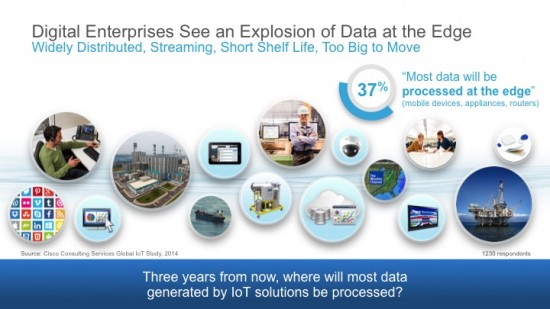
Last month, we proudly announced Connected Analytics for the Internet of Everything (IoE), easy-to-deploy software packages that bring analytics to data regardless of its location. It is a continued part of our commitment to delivering on our vision for fog computing, also called edge computing, a model that does not require the movement of data back to a centralized location for processing. If you’ve been reading my blog, you’ve seen me write about this as the concept of ‘Analytics 3.0’ or the ability to do analytics in a widely distributed manner, at the edge of the network and on streaming data. This capability is unique to Cisco and critical for deriving real-time insights in the IoE era.

To perform analytics using a traditional computing method, once data is generated it is aggregated, moved and stored into a central repository, such as a data lake or enterprise data warehouse, so it can be analyzed for insight. In the IoE, data is massive, messy, and everywhere – spanning many centralized data repositories in multiple clouds, and data warehouses. Increasingly, data is also being created in massive volume in a very distributed way…from sensors on offshore oil rigs, ships at sea, airplanes in flight, and machines on factory floors. In this new world, there are many problems that arise with the traditional method – not only is it expensive and time consuming to move all of this data to a central place, but critical data can also lose its real-time value in the process. In fact, many companies have stopped moving all of their data into a central repository and accepted the fact that data will live in multiple places.

Slide1

Analytics 3.0 creates a more appropriate model, where the path to derive insight is different by combining traditional centralized data storage and analysis with data management and analytics that happen at the edge of the network…much closer to where the huge volume of new data is being created. Analytics involves complicated statistical models and software, but the concept is simple…using software to look for patterns in data, so you can make better decisions.  It makes sense then to have this software close to where data is created, so you can find those patterns more quickly…and that’s the key concept behind Analytics 3.0. Once it’s analyzed, we can make more intelligent decisions about what data should be stored, moved or discarded. This model gives us the opportunity to get to the ‘interesting data’ quicker and also alleviates the costs of storing and moving the ‘non-interesting data.’

Analytics 3.0 is not about replacing big data analytics, cloud analytics and other centralized analytics.  Those elements are all part of Analytics 3.0, but they are not sufficient to handle the volume of massively distributed data created in the IoE, and so they must be augmented with the ability to process and analyze data closer to where it is created. By combining centralized data sources with streaming data at the edge, you will look for and find new patterns in your data. Those patterns will help you make better decisions about growing your business, optimizing your operations or better serving your customers…and that is the power of Analytics for the IoE.


Join the Conversation

Follow @MikeFlannagan and @CiscoAnalytics.

Learn More from My Colleagues

Check out the blogs of Mala AnandBob Eve and Nicola Villa to learn more.

Authors

Mike Flannagan

No Longer with Cisco

Avatar

One of the hottest topics at NRF this week has been delivery systems. Recent research by Cisco Consulting has found that delivery is one of the top concerns of not only retailers, but of shoppers as well. I now have personal experience of this: Just before the holidays, my husband and I ran an experiment: Living digitally for a few days, shopping online, using only available delivery systems.

Day 1 – Now, I order just about everything online except for groceries. However, my husband orders very little online, although he is a fan of eBay. The first question he asked was, “What about groceries?” I said we would order from Safeway (where I used to work before coming to Cisco). His next question was, “Well, that’s great for our basics, but what about the specialty items we get from Trader Joe’s, how are we going to get those?” He solved this problem himself by finding Envoy, a store-agnostic delivery service.

Amazon, Amazon Fresh, Google Express, Instacart, eBay Now!, Deliv… so many delivery options, though not all available in our area. The first order of business was to buy groceries. However, I needed to sign up for a delivery service – up until then I had purchased everything online except for perishables, and I must say that I was a little embarrassed that I had never ordered from my alma mater, Safeway.  So, I started there and was pleased to see that my Safeway id/password combination worked as well as giving me the option of free delivery, free water, and paper towels if I ordered within 24 hours. I love promotions and rarely pay full price for anything, but even more I love FREE.

Next, I signed up for Envoy to cover our Trader Joe’s and Whole Foods order, but found that I could only order from one at a time for $10/month each, with a service fee of $10 + 10% of my grocery bill. That seemed a little pricey.

That same evening, the washing machine broke, and my husband proceeded to determine how to best to repair it. Here we had a pleasant surprise, as we found that we could order a new part online for $35 (as opposed to or purchasing it locally for $90). So, that was a no-brainer… he placed the Amazon order with a scheduled arrival of mid-next week, labor not included.

Day 2 – I had scheduled our grocery order to be delivered between 11:00am and 3:00pm, and for my flexibility received a $6 discount. At 4:00pm, after a day of continuous meetings from home, I wondered where our order was and asked my husband to contact Safeway. At 5:00pm, I learned that our very first grocery order was stranded on a broken-down truck with no ETA. Finally, at 6:30pm a very apologetic driver contacted me, indicating that he was picking up all of the orders from the broken-down truck and would be arriving in about 30 minutes or so depending on traffic and the pelting rain. Then, I paused on our experiment to go get a pedicure (can’t order this online, yet).

That evening, all the groceries were delivered as ordered, with the exceptions of one item out of stock (one of the Just for You offers) and the condition of the avocados, which were definitely overripe.

Then we discovered we were out of firestarter logs. A quick check on Amazon found what we were looking for, with a promise of a Sunday delivery. Sunday, really?

Day 3 – My email box was becoming overwhelmed: I had received no less than 126 unique retail offers during the last 48-hour period. The most popular promotion was free shipping by online and multichannel retailers, with discounts on shipping from 20% to 50%. With all the noise, it was hard to tell which retailer or service was which.

Now I needed to deal with a few returns on the holiday presents I had been buying online. The easiest included free returns with a shipping label included in the package or printable online, or the ability to return directly to the store. The most difficult required a phone call, followed up by an email with an RMA (return merchandise authorization), and a requirement me to pay for the return. (I won’t be buying from that retailer again.)

Next, I was ready to mail my holiday cards. I thought since the mail is delivered every day to our house, I would be able to order stamps online. Guess how many days it takes to deliver stamps to your home: 7 to 10 days, plus 1 to 2 days extra due to the holiday season. There is certainly a disconnect between departments at the USPS. I hate to send out my holiday cards late!

Day 4 – Fortunately, I had remembered to order all of the items I needed to prepare my appetizer for a party that evening. And, Amazon delivered on its Sunday promise! Our firestarter logs appeared on the doorstep before noon.

Day 5 – Done! We lived for 5 days entirely digitally (except for the pedicure). How did it go? We found that:

  1. Living digitally requires planning ahead; even when new services are intended to provide same day service, they are not widely available
  2. Living digitally needs to be a family affair with extra coordination
  3. Service and delivery fees vary widely
  4. Returns can be challenging and time-consuming
  5. You’re dependent on the selections of the in-store shopper (i.e., the avocados)

Differentiation is still a major challenge. However, I would say that customers want the same thing they want in the store: a friendly, convenient shopping environment. Delivery services need to meet customer expectations on timing, and keep returns simple and convenient. Products ought to be in good condition, and fees need to be minimized. The challenge, obviously, is how to make this work financially.

Other delivery options are increasingly available, such as in-store pickup of online orders, locker-based pickup systems, etc. Keep an eye out for my upcoming paper on delivery systems – Cisco has some exciting ideas coming around this!

In the meantime, check out the new white paper on shopper trends.

Authors

Dianne Lamendola

Senior Practice Advisor

Avatar

As a service provider, whether you are a traditional “mobile network operator” or are a newly emerging operator, you are constantly re-inventing your offering to keep up with the changing demands of the mobile public.

Your Network, your Way!

Nowadays, the mobile public is looking for a network that fits them instead of adapting to fit the network.  To use an old fast food marketing term, mobile subscribers want to have their network “their way.”  Having it their way goes beyond providing information about data limits and providing the occasional targeted advertising.  Instead, they seek networks which provide exactly what they need, including Continue reading “Your Network, Your Way”

Authors

Maywun Wong

Manager, Market Management

Avatar

Cisco has been a prominent supporter of the Rockwell Automation Fair for a number of years. The relationship has grown over time to one where both Rockwell and Cisco collaborate on developing software, solutions and products for a wide range of both IT and OT (Operational Technologies) functions within industrial and other customers.

Recently Cisco showed off some of the technologies in the oil and gas space, and Ahmed Farrag, Business Development Director from Cisco, talks about Cisco’s presence at the show in the following video.

https://www.youtube.com/watch?v=CCCGvlwYwqs

Ahmed talks about Oil and Gas as one of Cisco’s key focus industries. He mentions the huge demand increases we’ve seen over the past few years.

That’s all changing right now.

The price of oil has plummeted to half what it was only a few months ago. With China slowing, parts of Europe close to another downturn, and oil now gushing following the huge investments that have been made in fracking and tar sands in the US, some say we have too much oil right now. Some companies are going to be worried about margins and future investments. So what’s the future?

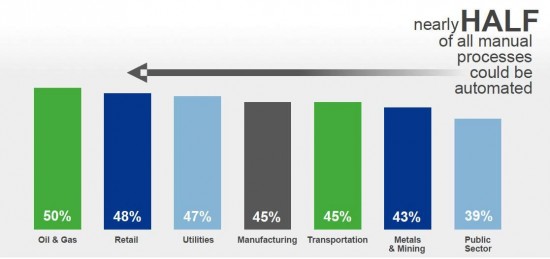
The show’s title gives us a clue. Just as automation has helped ‘onshore’ manufacturing back to the US in many cases, automation will reduce costs over the longer term. And many processes and practices in the oil and gas industries are ripe for Automation. Blair Christie, Senior Vice President and Chief Marketing Officer at Cisco, showed a chart at a recent press review (The Internet of Everything Changes Everything – The Future of Work) that highlights that the oil and gas industry is, perhaps, the most likely industry to benefit from the Internet of Everything and automation (slide 12):

Nearly half manual processes could be automated.
Nearly half manual processes could be automated in most industries, with Oil and Gas the most.

That chart holds the key to the future of the Oil and Gas industry.

With the advances that have already been made (and those yet to come) in the field of automation, along with rapid progress in collaboration and communications  technologies between workers and companies, one of the keys to profits will be enabling lower costs and higher efficiencies. Cisco and it’s partners are leading the charge.

You can read more about Cisco in oil and gas here: Cisco Industry Solutions: Oil and Gas. there you’ll find: Continue reading “Cisco Shows Oil and Gas Cost-Saving Technologies at Automation Fair”

Authors

Peter Granger

Senior Sales Transformation Manager

Avatar

This post was written by Yves Younan.

Microsoft’s first Update Tuesday of 2015 is pretty light, there’s a total of eight bulletins, all covering a single vulnerability. Seven of these bulletins are rated as important and just one is rated critical. No bulletin for IE is being released this month. Two of the vulnerabilities were publicly disclosed prior to today, while another one was being actively exploited by attackers.

Microsoft made a number of changes to Update Tuesday last month, such as dropping deployment priority in favor of their exploitability index (XI). This month more changes were made to the program: Microsoft is no longer providing their Advance Notification Service (ANS) to the general public, but is instead only providing it to premier customers.

Continue reading “Microsoft Update Tuesday January 2015: Another Light Month, No IE Bulletins, More Changes to Reporting”

Authors

Talos Group

Talos Security Intelligence & Research Group

Avatar

By 2030, an average American household is expected to incur traffic-related costs of $2,301 per year, a 33 percent increase compared to 2013. In fact, the annual price of traffic in the U.S. and Europe will soar to $293 billion by 2030, a rise of nearly 50 percent from 2013. Additionally, traffic conditions around the world only seem to be getting worse as well. Doesn’t sound too promising right?

Cisco and its partners are looking for ways to reduce these costs and eventually make everyday challenges like traffic jams, a thing of the past through the connection of people, process, data and things in an Internet of Everything era. And while the next wave of the Internet is sure to bring us some pretty amazing ‘firsts’, we are pretty excited about the “lasts” we could create. Imagine the last blackout, the last oil spill, or even the last hungry child. With that in mind, Cisco has launched a new campaign that focuses on “The Museum of Lasts.” Jenny Rooney in Forbes wrote a great article on our new campaign and “the lasts a connected world enables”…see here.

Think about everyday life situations you would love to live without. Traffic jams, long checkout lines, or my personal pet peeve: a missed delivery (especially when I am waiting for my children’s Christmas gifts!) The “Museum of Lasts” introduces a glimpse into how the world might change for the better if we all think bigger, work collaboratively and disrupt to make these “lasts” a reality. The Internet of Everything is enabling these “lasts” by connecting the unconnected, through the intersection of technologies such as data analytics, cloud solutions, security, collaboration, mobility, data center, and application centric infrastructure. All powered by an intelligent network.

Continue reading “The Last Traffic Jam and Other Lasts the Internet of Everything will Make Possible”

Authors

Blair Christie

Senior Vice President and Chief Marketing Officer

Avatar

Deploying a Voice over IP network can be daunting given all the technologies required to deliver consistently high voice quality. This becomes especially troublesome as the network grows and more network infrastructure and endpoints are added. Cisco has found a unique solution to this problem and has formally been granted a patent for these technologies by the US Patent Office. The patent (US Pat: 8867405) has been granted for technologies enabling a zero-touch, network-wide, voice deployment. And the best part? This is supported today on the Cisco SMB 500, 300, and 200 Series Switches.

The Cisco solution incorporates a combination of VSDP (Voice Services Discovery Protocol), CDP, LLDP-MED, Auto Smartports, and mDNS. This unique solution addresses the auto-configuration of the network of switches as well as the auto-configuration of the Voice endpoints, AP’s, UC, and desktops/servers. Endpoints are automatically discovered and instructed which QoS and Voice VLAN parameters to use, and the switch ports are dynamically configured. The entire network converges on (and automatically adjusts to) the parameters needed to deliver high quality voice.

What makes this solution especially unique is that one can literally take a new switch as it arrives from the factory, plug in the IP phones and other endpoints, and have a functioning network without any configuration.

“Cisco has raised the bar for this product category

– Kevin Tolly, Founder, The Tolly Group

For a more detailed description of the capabilities, a document has been posted on Cisco’s Support Forum.

A demo showing how this capability compares to competitive products in the market:

https://www.youtube.com/watch?v=OowfcLEEnW8&feature=youtu.be

Another demo showing the ease of deployment with the Auto capability in action:

https://www.youtube.com/watch?v=rXDuWSay1lU#t=185


Authors

Ivor Diedricks

Sr. Product Manager - Enterprise Switching

Enterprise Networking Group (ENG)