In the 3rd quarter of 2014, AT&T connected more new vehicles than new smartphones for the first time. Growing to reach a 40% share, automaker and aftermarket telematics will be the dominant sector for cellular M2M connections, according to ABI Research. The next frontier to create a differentiating connected vehicle experience is to connect our vehicles to our homes, our smart grids and most importantly a smart roadside infrastructure to deliver on the promise of safer, smoother and more enjoyable rides on our roads.
But smart connected roads appear to be utopia faced with a reality where current road funding is failing to even maintain our roads, and where bad roads are imposing a hidden tax on our economy, and as a result leaving underfunded governments to hold the lifeline for transportation innovation.
It is upon us again here in the Midwest. Our roads are facing the grueling cycle of freezing and melting that will strip away the band aids and rip open hardly healed scars from last winter and force us motorists to steer clear of minefields of treacherous potholes. In 2014, my “tax” for driving on substandard roads was two new suspensions, new steering seals and a set of new tires. Each vehicle owner in the U.S. pays this nearly $400 dollar “bad road tax” each year, totaling $80 billion according to a study by TRIP.
The “bad road tax” nearly doubles the roughly $100 Billion in fuel tax and tolls the U.S. collects and spends each year to maintain our road infrastructure. $100 Billion translates into a 0.4% return on our paved road assets of estimated $27 trillion in value and means that we are “sweating” our road transportation infrastructure for 250 years.
Cisco Identity Services Engine (ISE) is commonly associated with use as a network access policy, BYOD and AAA platform. But to do its job in network policy, ISE collects a great breadth of telemetry about network users and devices. Whether a device is trying to access the network or is already connected, ISE knows specifics about:
What the device type is (e.g., iPad Air 2 running iOS 8.1.2)
How it is connected to the network (e.g., enterprise Wi-Fi)
From where (e.g., access point in “California/SanDiego/Building 2/Floor 3/South”)
Security and compliance posture of the device (e.g., Antimalware operating and up to date? PIN lock configured?)
Who the user is on the device…or if it even has a user (e.g., printer)
What policy and AD/LDAP group the user belongs to (e.g., “IT Admin” authorization group)
Related session IP address and MAC address
While ISE primarily uses all this telemetry to establish network policies, it also shares it for use by other IT platforms. By doing so, ISE helps these platforms become more identity and device aware and thus more effective in a variety of ways. And this is where Splunk comes in.
#CiscoChampion Radio is a podcast series by Cisco Champions as technologists. Today we’ll be talking with Cisco Champions about content creation for the IT professional. Rachel Bakker (@rbakker) is this week’s moderator.
The Cisco 2015 Annual Security Report highlights many creative techniques that attackers are exploiting to conceal malicious activity, often taking advantage of gaps in security programs. They are continually refining and developing new techniques to gain a foothold in environments and, increasingly, they are relying on users and IT teams as enablers of attacks to persistently infect and hide in plain sight on machines.
Given this complex and dynamic threat landscape, organizations need a mature and adaptable incident response process.
We’ve all heard the expression, “you can never have too much of a good thing.” But we all know that’s not quite true. For example, a little dessert is good. But too much can be a problem for your waistline.
It seems data marts also fit this pattern. A few data marts can be very helpful, but too many create a huge total cost of ownership (TCO) burden.
Fortunately, with data virtualization, you can turn physical data marts into virtual ones. And when you do, you will never have to worry about having too much of a good thing.
What’s Great about Data Marts
Data marts were developed as a complement to enterprise data warehouses. Typically subject or domain specific, and derivative of the warehouse, they provide a number of benefits including:
Focused Content – Narrowing the scope to a specific domain such as finance or sales simplifies reporting and analysis.
Query Performance – Offloading workload from the enterprise data warehouse can improve query performance.
Data Structure – Certain reporting tools require certain structures, for example star schemas. Data marts can easily be modeled based on these structures as an alternative to the warehouse schema.
Local Control – Users find it easier to control and modify data marts than larger warehouses.
Costs Can Outweigh the Benefits
Given the benefits cited above, data marts have proliferated rapidly. Unfortunately, as with deserts, “A moment on the lips can be a lifetime on the hips.” Data mart TCO is huge. Costs include:
Development Costs – Each data mart requires a full design, development and deployment effort.
Operating Costs – Not only does the data need to be refreshed regularly, all the underlying databases, database servers, ETLs and more must be monitored and tuned.
Change Management Costs – Adding new data to respond to business change requires extensive rebuilding of complex data mart schemas and ETL scripts, adding costs and reducing agility.
Data Governance and Quality Costs – Because data is physically replicated in each data mart, each mart requires data governance to ensure consistent quality.
Data Virtualization to the Rescue
As an alternative to physical data marts, many organizations now use data virtualization middleware such as the Cisco Data Virtualization Suite, to create virtual data marts. Virtual data marts provide all the benefits listed above with far lower costs.
Development Costs – Virtual data marts have far fewer moving parts, which lessen design, development and deployment efforts.
Operating Costs – Fewer moving parts also means less infrastructure to maintain.
Change Management Costs – Adding new data to respond to business change can be done in minutes or hours via virtualized data sets, rather than days or weeks in the physical data mart world.
Data Governance and Quality Costs – With data virtualization, data mart content can be centrally governed to ensure consistent quality wherever that data is used.
Try the Data Mart Diet
If you agree that it makes sense to lighten up on data marts, the question is how? In other words, what is the “Data Mart Diet?”
This whitepaper include a step-by-step approach for migrating physical data marts to virtual data marts using Cisco Information Server. Steps include:
Recreating Physical Data Marts as Virtual Data Marts
Improving Query Performance on Virtual Data Marts
Identifying Common Specifications Among Virtual Data Marts
Redirecting Reports to Access Virtual Data Marts
Extracting Definitions from the Reporting Tools
Defining Security Rules
Adding External Data to Virtual Data Marts
This guidance, along with the cost-benefit summary included at the start of the paper, make this paper a must read for organizations who are seeking a data mart diet.
In my prior blog entry, I described the basics of Open MPI’s tree-based launching system over ssh (yes, there are still some valid / good reasons for using ssh over a native job scheduler / resource manager’s parallel launch mechanisms…).
That entry got a little long, so I split the rest of the discussion into a separate blog entry.
The prior entry ended after describing that Open MPI uses a binomial tree-based launcher.
As I was walking the aisles at the National Retail Federation “Big Show” in New York last week, I was impressed with the myriad of connected, smart solutions now available to retailers. Augmented reality, data analytics, video-enabled in-store robots and warehouse drones, you name it, it was there.
I’m just as dazzled as everyone else by these new technologies, but I believe it is important for retailers to view them within the wider context of making their organizations digital enterprises by taking action on the Internet of Everything (IoE). IoE is the networked connection of people, process, data, and things, and Cisco projects these connections to surge from 13 billion today to 50 billion by the end of the decade. With a total value of $19 trillion from 2013 to 2022, IoE is a profound market transition. Continue reading “The Hyper-Relevant Retailer: From Dark Assets to Dynamic Processes”
2014 ended with a flurry of technology conferences in Europe and the Middle East. In November, the European Commission’s (EC) annual Information and Communications Technology (ICT) Conference addressed how to make the EC a 21 Century organization. In December, the International Telecommunications Union Telecommunications Standardization Sector ( ITU-T) hosted a meeting in Doha, Qatar for CTOs. Among the issues discussed were updates on the Global Standardization Landscape, status of Internet of Things Standardization and next generation video technologies and standards. Also in Doha, at the same time The ITU hosted World Telecom whose theme was “Future in Focus: how disruptive developments in technology, business and society are transforming the ICT industry.” All the meetings gave us much to think about for 2015. Günther Oettinger , European Union Commissioner for Digital Economy and Society kicked-off the ICT DIGIT-IT conference by outlining his strategy for achieving a digital transformation within the European Union. He went on to detail specific areas he thought needed the most attention including:
Effective Workplace
Real time administration
Open Data
Collaborative working tools
Security and cyber-security (mentioned as number 1 priority)
Growing usage of Cloud for non-strategic data
Importance of Big Data and Internet of Everything
Openness and Collaboration between the different EU organizations
Attracting young generation within EU, build and retain talent
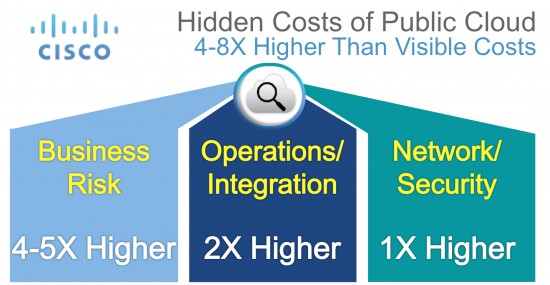
Reducing costs remains amongst the top reasons why organizations use public cloud services. However, when calculating the costs of public cloud services organizations need to look well beyond the license fees and billed costs.
With Cisco Cloud Consumption Services, we have worked with numerous customers to discover their public cloud usage and analyze cloud spend. At Cisco Live Milan, taking place January 26-30, we are sharing public cloud spending trends with our customers. We have found that the hidden or soft costs of public cloud services can be four to eight times higher than visible costs. These soft costs fall in three areas and include business risk, network and security costs, as well as cloud operations and integration.



 Continue reading “The Smart Connected Vehicle is Here – Now We Need Smart Connected Roads!”


 #CiscoChampion Radio is a podcast series by