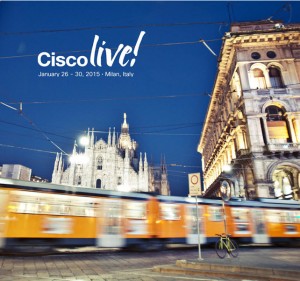
When I first visited Milan last year in January, the occasion was Cisco Live and I was pleasantly surprised to learn that the Alpine city is known as much for its Hi-tech as it is for fashion and tradition. I am one of the lucky few in Cisco to be visiting this great city for a second year in row as Cisco Live Europe is all set to commence here next week. What is special this year? From a Cisco Data center standpoint ACI, Inter-Cloud, IOT and UCS continue to grab the headlines. Particularly, ACI has established itself as the dominant SDN technology with more than 1,000 plus N9K customers, 200 plus ACI customers and a growing eco-system of 34 partners in just one year. In this blog, I am going to present excerpts of what attendees can broadly expect to see and experience at the buzzing event, and I will take you on a tour of how ACI is ready to engage and enrich you.
At the outset, I’d recommend that you attend all keynotes to understand Cisco’s strategy for the emerging technology trends and market transitions. Cisco Execs Carlos Dominguez and Jeremy Bevan kick-start the proceedings with an opening keynote on Jan 27 as they review the amazing things we have achieved in building the internet over the last decade and look at what we must do to build an Internet fit for purpose for the next decade. Don’t miss several technology trends keynotes occurring on Jan27 and 28. Soni Jiandani’s session scheduled for Jan 28 on SDN/ACI topic is going to be a sell-out. Come and listen to Soni to understand how ACI enables business outcomes and IT automation through the creation of an agile infrastructure.
Now I want to segue to ACI specifics. The last year has been phenomenal from an ACI eco-system momentum standpoint. F5 and Citrix, leading ADC vendors, have developed joint solutions with ACI and we have experienced several customer wins and success stories. F5 is a platinum sponsor and has a big presence at Cisco Live Milan this year to delight the 8,000 plus attendees. At the world of solutions F5 has dedicated demo stations to showcase multiple Cisco ACI-F5 joint solutions (featuring both BIG IP and BIG IQ), and F5’s engineers will be happy to explain via whiteboard how these solutions are relevant to your needs. Vincent Ng from F5, an expert presenter, has a technical breakout session on Jan 27 featuring ACI-F5 joint solution. Vincent’s expertise spans hands-on demos alongside lucid architectural illustrations, so do not miss this session.
Citrix has been a regular platinum sponsor at Cisco Live events. This year at Cisco Live Milan, Citrix has a large booth presence in the partner area. The key activities at the booth include joint solution demos featuring UCS-XD/XA, ACI-NetScaler, Mobility and Cloud among other major ones. Besides, David Potter and Christian Hietzschold from Citrix are doing a presentation on topic, “Delivering the best in SDN and ACI integration solutions.” If you happen to be in the DevNet zone, you may want to check out Citrix’s short theater presentations to get a well-rounded view of our joint alliance.
A10 Networks and Radware both have a presence in the WOS, showcasing joint solutions with ACI, thereby providing further evidence for the fast growing ACI L4-L7 eco-system.
At the World of Solutions (WOS) this year, ACI and Cloud take center stage in the Data center category. There are 10 demos showcasing ACI innovations and 6 on the Data Center Networking front. We also have an “Ask the Expert- Solutions Design Center” where Cisco architects will help address your data center, cloud, ACI strategy and design questions to accelerate ROI and reduce TCO. The ACI demos cover broad customer interest areas such as Analytics/Telemetry/Visibility, popular Cloud Management Platforms such as Microsoft Azure and Open Stack, Support for Multi-Hypervisors, Secure Application deployment etc. Our ACI subject matter experts will be on site to give you a real-life demo and explain how these are relevant to your needs.
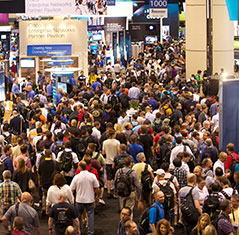
We also have Hands-on labs at the WOS that give you the opportunity to explore and evaluate a range of Cisco technologies, and our Meet the Engineer and Technical Solution Clinics give you access to the people who design Cisco’s solutions and give you the insight you need about your own environment and technical challenges. So stop by the WOS to explore new technologies and get answers to your unique questions.
In addition to the hands-on demos, we also have round the clock mini-presentations at the WOS Cisco Theater. This year we have three innovative ACI theater topics namely “Simplifying day-0, day-1, day-2 operations with ACI”, “Securing Applications with ACI” and “NX-OS Programmability and Automation”. The special draw at the WOS Theater is the topic of “Simplifying Operations with ACI”. This presentation will cover how application deployment can be accelerated and how easy it is to troubleshoot problems with ACI. To satisfy your broader interests we also have theater sessions on UCS, Cloud and Nexus switching portfolio. Check our WOS Theater roster in the agenda handout.
To your heart’s delight is how I’ll describe Cisco technical breakout sessions. Yes, we have more than 500 breakouts from industry recognized experts at the show. ACI breakouts feature prominently and ACI domain experts Carlos Pereira, Mike Cohen, Mike Herbert, Maurizio Portolani all co-present Jan 26 on topic ‘ACI-Policy Driven Data Center”. This session ranks at the top for me. If you are an Open Stack fan then you must look into the session “APIC Integration with Open Stack” presented by Sebastian Jeuk and Lijun Deng. Harry Petty is doing an ACI operations focused session PSODCT-2455. Data Center operators focused on tenant on-boarding, application monitoring and trouble-shooting will find this session very relevant, so mark this as a must-attend. There are many more breakouts and Lab sessions on ACI, and check out the session catalog for details. Another insightful breakout session PSODCT-1200 by Craig Huitema focuses on the Nexus switching portfolio and ACI and how together they enable a faster, responsive and flexible IT.
As a Cisco Live attendee you benefit from the opportunity to interact with your peers, Cisco staff and partner technical experts in both structured and informal settings. Our Welcome Reception and Customer Appreciation Event are the highlights of the week’s social calendar. Read more on the Social Events & Networking Onsite section. Our online communities on Facebook and Twitter provide year round access to like-minded individuals as well as valuable content, news and updates. We’d love it if you would join the conversation.
I can go on and on, but I’d never be able to cover all of the excitement in store. I’d leave some for you to explore on your own and our Meet and Greet ambassadors will be more than happy to assist you at the show. As for me, if time permits, I am planning on acquainting myself with some of the legendary artworks of MichelAngelo. Safe travels and a happy Cisco Live.
Related Links
www.blogs.cisco.com/datacenter
http://www.ciscolive.com/emea/







 The latest Wi-Fi physical layer standard 802.11ac, has been ratified and is enjoying widespread adpotion in the client device marketplace. The hype has been with us for a few years now proclaiming tremendous gains in throughput. The mechanisms 802.11ac uses to gain these speed improvements can also be used to improve client quality of experience and not necessarily just be used for higher data rates. The three key elements of a connect include distance, speed and reliability. These are in most cases mutually exclusive or at least have inverse relationships. You gain distance by trading throughput and reliabilty and gain