Simple is rarely a word used to describe Data center or Campus networks. Network operators and administrators are often bogged down by the complexity of network design and related configuration. Cisco has an innovative solution that simplifies setting up load balancer devices. Network services like load balancers now use Remote Integrated Service Engine(RISE) on Nexus switches. RISE enables simplified provisioning and configuration through automatic discovery and bootstrap of Citrix NetScaler Appliances.
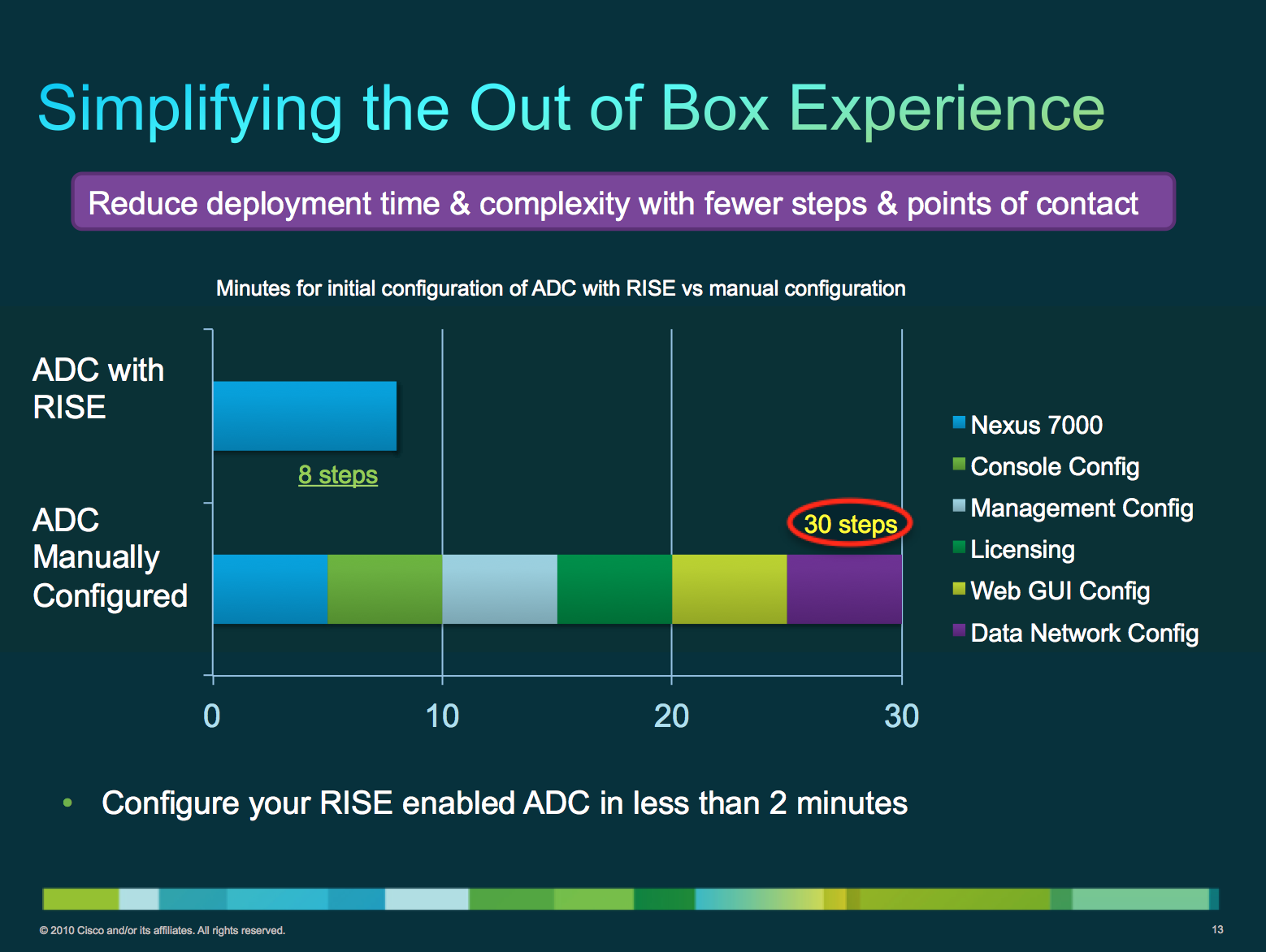
The innovative Cisco RISE technology tightly couples external service appliances, such as the Citrix NetScaler ADC, to Cisco Nexus 7000,6000,5000,7700 Series Switches, enabling more efficient and flexible delivery for network services. Automatic discovery and bootstrap reduce administrator involvement for Appliance implementations from 30 steps to 8 steps: creating the port channel, allowing the control and data VLANs, and enabling desired Cisco RISE features on the Cisco Nexus Series Switch. RISE eliminates the need to physically connect a serial cable to configure the device through a console cable.
RISE is available on Citrix Netscaler MPX,VPX and SDX and Cisco Prime Network Analysis Module.
Three Simple Steps to Configure RISE
Interconnect the Citrix NetScaler with the Nexus Switch
Create port-channel & set vlan(layer 2 ) configuration
Create a RISE service using CLI or DCNM
Cisco RISE integrates Citrix NetScaler as a service module within the Cisco Nexus 7000, 7700,5K,6K switch, even though it remains a physically separate device. Architecturally, this virtual service module arrangement is enabled by embedded intelligent services that securely integrate the control planes of the Citrix NetScaler ADC and Cisco Nexus Series Switches.
As more and more users and devices are connecting to the network via WiFi, Cisco has been focused on creating the best wired network to enable mission critical wireless:
In 2013, we introduced Catalyst 3850 & 3650 Stackable Converged Access Switches for wired & wireless networks. These switches simplified networks by combining separate wired and wireless networks into a single platform. This simplification makes IT agile. These switches also enabled a better user experience through deeper application visibility across wired and wireless with Cisco Flexible NetFlow. Click here to see an interactive demo showing the other benefits of our converged access switches.
In 2014, we expanded the converged access portfolio by introducing Converged Access on Catalyst 4500E, our lead modular access platform.
Today, we take the next big step in our wireless strategy by introducing Cisco Catalyst Multigigabit technology across several campus switches: Catalyst 4500E, 3850 and 3560-CX.
When I’m stuck in one of Silicon Valley’s many traffic jams, my frustration level rises as rapidly as my speedometer slows down. I think about how the digital synchronization of highways, vehicles and traffic lights could unclog congestion, lower pollution, eliminate delays and significantly reduce our collective frustration levels.
Just a little digital automation could go a long way to reduce not only traffic and accidents but also time, gas, smog and the costs of road and car repairs. Not to mention, helping us all attain a much more sustainable environment.
So when I’m stuck like this in traffic, whether at home or internationally, my thoughts turn to how we can get to the Last Traffic Jam.
https://www.youtube.com/watch?v=5oKsiv4jgMU
The answer is a more connected world—or the Internet of Everything. It’s how we’ll change the way we live, work, play, and learn. This has been Cisco’s goal for 30 years, and today we have an unprecedented opportunity, along with our partners, to transform our world for the better
And that includes eliminating traffic headaches.
Studies show that for every minute spent clearing an accident from a road, there is a four-minute delay to get traffic moving again. And it’s not just delays. Today, traffic congestion costs Americans alone more than $124 billion a year. By 2030, experts predict the average American household will spend 33 percent more in traffic-related costs than today and the annual price of traffic in the United States and Europe could rise nearly 50 percent from today’s costs.
Want to know more? Here are some insights on the Last Traffic Jam.
Today, we are already connecting roadways, cars, drivers, traffic lights, parking spaces, public transportation and commercial traffic. The early results show dramatic improvement in traffic flows, fewer roadside incidents, and lower transportation costs. And one day this all will lead to the Last Traffic Jam.
This is happening by connecting disparate intelligent transportation systems to provide a centralized view of highway systems, including road conditions, traffic, construction, and transit information. Connected roadways and connected cities, are improving decision-making while reducing operating and maintenance costs.
I believe the “beginning of the end” has started. Cities around the world are getting connected.
When people think of mentoring, the images of an apprentice learning from his master are often rendered. The senior blacksmith guiding his pupil through the craft he has spent his life perfecting. Over the years mentoring has changed, and today it is used throughout business to guide the greenhorns throughout their craft, or even life. But the idea that this advice must come from a wise old sage is a bit passé.In today’s world, the 1:1 ratio of mentor to apprentice isn’t common place. While you will still find these relationships around the world, the world has changed, and technology has helped us evolve. As a matter of fact, I believe the Cisco Champions program is fundamentally a group of mentors. We are all selected because we participate in social media, we blog, we have a sense of community. Because of all of these things, I believe many of us are already indirectly mentoring the community as a whole. But I wanted to mainly focus here on the local mentoring you do in your daily work life.
Listen – In any relationship the power of listening is massive, just ask a therapist what their number one tool is. When you take the time to listen, you are showing support and encouragement. Once you have taken the time to listen and understand, the advice you provide will be much more valuable.
Never stop learning – A career in IT means that you can never stop learning, lest your skills become antiquated. This just doesn’t mean you should keep up on the industry changes, or take a class on some new technology every year. I believe that it’s important for everyone to have their own mentor(s). It’s not always just about the technology, but sometimes the methodologies, and strategies that we can learn from our peers are much more important.
Be committed – Being a mentor is a commitment, it certainly takes time and effort, but it is an investment! You spend your time and energy into your pupils, but you end up getting much more out of the experience. Be sincere, and interested in their development. Remember that your fledgling is easily demotivated by your indifference towards their development.
Be open-minded – Some folks say that the best way to truly learn a subject is to teach it to others. Teaching is rewarding in that you get to not only review the subject matter for yourself, but you get to answer questions you may of never thought of. Also remember to listen, as some folks will never see your side of a discussion unless they’re convinced that you’ve understood theirs.
Blog – And participate in social media, because sharing information is important. It is easier today than ever to share knowledge and incite discussion amongst the community of your peers. And because of that, it is easier than ever to reach out for help and guidance. So remember, when someone does, be a mentor. Listen, Understand, and most of all, try to help!
There are 5 ways you can become a (better) mentor. But I imagine many of you are asking why… Mentoring isn’t just about taking care of a junior staff member, it’s great for you in many different ways. First of all, helping others provides a wonderful feeling. Especially when you’re able to help make a difference in their lives! In addition, teaching is a wonderful tool that not only helps educate the student, but also forces you to continue your own learning to stay ahead with your advice.
I hope this has convinced some of you to step up your mentoring game in 2015. I certainly hope to spend more time at a white board this year myself.
Last week marked the first steps forward for a broad-based coalition of businesses who are working together to fight wanton abuse of the patent litigation system by patent assertion entities (PAEs).
The coalition – United for Patent Reform – is comprised of grocery, hotel, retail, restaurant and technology associations and companies including Cisco. Our mission: to fight for patent reform legislation in Congress that will stop litigation factories that take advantages of anomalies in the patent system to extort financial settlements out of businesses large and small.
Simply put, patent assertion entities – companies who neither invent nor produce products, but simply buy patents for litigation value – file lawsuits or send intimidating demand letters, knowing that many defendants will pay to avoid litigation costs alone, or will pay to avoid the risk of losing a large sum in a lottery-like litigation system plagued by high costs and uncertain outcomes.
Opponents of reform claim that recent court decisions – particularly by the US Supreme Court, which in recent years has reversed a number of lower court decisions by unanimous or near unanimous votes –have solved the problem. They point especially to the decision last spring in Alice v CLS Bank, which in fact affects only a very narrow segment of the patent world.
The overall numbers, in fact, show just that the problem continues to persist.
The PAEs themselves, which exist solely for litigation, continue to invest and buy based on the reality of continued business as usual. In fact, according to Allied Security Trust, a leading analyst of the market, patent assertion entities bought just as many patents in the first 6 months of 2014 as they did in all of 2013.
The total number of defendants in cases brought by patent assertion entities remain within ten percent of recent years and still many multiples larger than a decade ago. The total number of defendants sued is comparable to 2012 and 2010. (2011 and 2013 were marked by significant action toward patent reform, which drove up the numbers.) The numbers of cases in 2014 were triple those of 2006.
This is not just a problem for a few large companies. Nearly half of the NPE defendants of 2014 were companies with less than $100 million of revenue.
As our coalition’s membership illustrates, this is a problem that includes businesses of all shapes and sizes. In both 2013 and 2014, half of the defendants were not tech companies.
Protections against suits against innocent end users rather than against the company that built the supposedly infringing product
Litigation procedures efficiency
Putting burden of litigation costs on those who bring suits that prove to be for extortion value only or where parties demand inefficient, costly litigation procedures
Encouragement of litigation alternatives
Over the next weeks and months, Cisco, in conjunction with United for Patent Reform and its member companies, will make the case for patent reform in the hope that Congress will approve meaningful reforms soon.
This is imperative if we’re to break the outlandish and exploitive business model that has encouraged patent assertion entities to thrive.
“Education then, beyond all other devices of human origin, is a great equalizer of the conditions of men – the balance wheel of the social machinery.” – Horace Mann, 1848
Mann, is he right. Education paves the way to opportunity and higher living standards. And today we recognize a technology with a similar power – the Internet. It’s been just twenty years since the spread of the commercial Internet, and evidence of its impact on employment, productivity and social development is all around us. But a major hurdle hinders the extension of the Internet’s benefits to more people: a worldwide shortage of skilled Internet technical (IP) professionals who ensure network connectivity for our homes, businesses, governments and economies.
Today Cisco participated in the launch of the 2014 Global Talent Competitiveness Index report, “Growing Talent Today and Tomorrow,” in Davos, Switzerland. And in Chapter 4 of the report, we specifically detail the shortage in IP networking professionals across 29 countries we most recently analyzed.
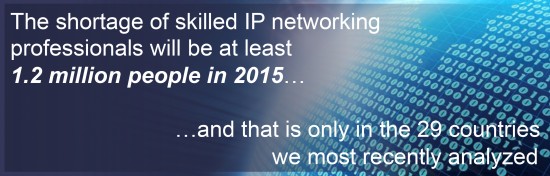
The headline: The shortage of skilled IP networking professionals will be at least 1.2 million people in 2015. In some countries, such as Costa Rica, the UAE and Saudi Arabia, there may be over a 45% gap. Even where countries have a relatively low shortage (e.g. Australia and Korea), the gap ranges between 10 to 20%. And in all countries, the networking skills gap is growing – due to increasing connectivity, the Internet of Everything, rising digitization of all business activity, globalization of trade and travel, and economic growth.
So what can be done to close the Networking skills gap and ensure the benefits, and opportunities, brought about by the Internet continue to spread to more people on the planet?
When it comes down to it, specific programs and targeted policies are needed to expand the total pool of qualified people. More effort is needed to expand the total pool of qualified networking talent by: 1) increasing the number of new Networking employees (graduates); 2) encouraging and enabling mid-career professionals to transition to ICT and Networking; and 3) increasing a country’s total talent by encouraging immigration. The policies and programs created to achieve these results should:
Integrate more technology training into educational curriculum. Expand efforts to increase the number of trained ICT professionals from universities, vocational programs and technical training centers, particularly by integrating elements of computer science (CS) and IP networking into general education curricula at the primary and secondary levels. And ensure that when CS and networking courses are offered, they also are eligible to fulfill graduation credit, as opposed to only being peripheral electives.
Increase mentorship opportunities. Mentoring students provides opportunities to experience and learn about careers in technology related fields. Programs like US2020 aim to match one million STEM mentors with students at youth-serving non-profits. Girls Who Code is another shining example. The program involves summer training for girls in high school centered on project-based computer science education with real-world tech industry exposure.
Reduce limits on the number of temporary and immigrant visas for skilled workers. Current immigration policies directly impact the immediate supply of skilled networking employees. Applications for H-1B visas in the U.S., for example, consistently reach their annual prescribed limit within a week of becoming available.
Implement successful technical training program, particularly through public private partnerships. Tailored training programs can accelerate the number of skilled networking employees that enter the global workforce. Cisco’s own Networking Academy Program prepares students for entry-level ICT jobs through the PPP model. To date, globally it has trained over five million students, 92% of whom obtained a new job and/or further educational opportunity following their graduation from the Academy.
While the presence of the IP networking gap highlights a missed opportunity for countries to reach potential economic growth, with dedicated public policy, specific training programs, and public involvement on the part of governments, citizens and private enterprise, we can solve the talent gap.
Recently I had the privilege to exchange thoughts at a roundtable discussion about the Future of Managed Services with our strategic partner Presidio. I would like to share some highlights from that dynamic dialogue.
We all agreed, the services industry overall is heading to a tipping point. Managed services are becoming more attractive to IT, and consequently the demand is growing exponentially. Our discussion focused on the key factors driving this demand and what managed service providers can do to stay ahead of customers’ needs.
Business leaders have ever growing expectations for increased IT speed and responsiveness. As the pace of change in business grows ever quicker, IT needs to become “Fast IT” – delivering new solutions at a more rapid pace In order to do that, IT needs to be able to integrate and automate all support interactions that it’s responsible for delivering.
Customer needs can change in a heartbeat. To meet these needs, organizations and service models have to be more fluid in order to adapt to the ebb and flow of the customer’s business. This embodies a new type of relationship between the customer and the managed services provider. Customers may want to use one service model for a few months or for a few years, changing models as the business changes – gone are the rigid, long-term outsource agreements that lock customers into one model for many years. Ryan Jordan, VP of Managed Services at Presidio put it well:
“Customers want more flexibility from their managed services providers. It’s true that just off-loading managed services allows IT to be faster on their feet. But offering a managed service that is also flexible and responsive adds tremendously to the goals of Fast IT.”
A one-size-fits-all approach doesn’t work in an era of ever changing business needs. For instance, rolling out a new application and updating the infrastructure to support the trading desks for a global financial services company requires a different service approach from supporting the operations for a hospital.
A standardized cookie-cutter approach gives you better economies of scale, which supports profitability, but can sacrifice the opportunity to customize offerings by industry or customer. This can affect your competitiveness. The future of managed services is in tailored solutions that meet the specific needs of customers and can adjust as the relationship develops over time.
Presidio and Cisco are working together to implement a new model – built on a foundation of real-time service integration. In this model customers, managed service providers and the technology vendors are all connected in real-time. It creates a new level of transparency and collaboration, speeding resolution times and ensuring all parties have a common view of what’s happening as its happening.
It is amazing how a vision can start, grow, morph and become a reality. Van White, President of The Council of Urban Boards of Education (CUBE) and Rochester City School District School Board President, had a vision, and he had a dream. His dream was to bring together students from across the county to have a face-to-face dialogue about Dr. Martin Luther King Jr’s speech, “I Have a Dream.”
On January 15, Martin Luther King Jr’s birthday, students in classrooms from across the country, in Rochester, NY; New York City, NY; Camden, NJ; Tampa, FL; Tulsa, OK; Pontiac, MI; Ferguson, MO, and Los Angeles, CA came together in a 90-minute conversation to explore their viewpoints and feelings on civil rights. Students shared videos they had created, presented a mock trial, and read poems to express their beliefs. Continue reading “#MLKDream – When Vision Becomes Reality”
A lot happened in IoT in 2014. About this time last year, John Chambers laid out $1.9T market projection for IoT at CES and that drew significant attention and generated momentum in many industries. Over the year, we saw some real world use cases and innovative companies and technologies at the IoT World Forum in Chicago. IoT really gained traction across many verticals over the year. While a lot of progress has been made, IoT is still evolving and globally companies and industries are still trying to figure out business models, technology selections and IoT standards. Cisco has led the way on many IoT fronts in 2014 and our own IoT Cisco Champion Pranay Prakash scopes the year and defines it as the Year of the Internet of Things and outlines what’s in store in future.