Avatar

Wainhouse Research polled a group of video conferencing users to gauge their feelings about video conferencing. What they found is great news for Cisco-CMR-Gifographicthose who want to integrate video into their collaboration strategies.
Comparing their experience to 2 years ago:

  • 95% agreed that video is more reliable
  • 97% agreed that they use video conferencing more
  • 92% agreed video conferencing is easier to use

Even so, the myth persists that successful video conferencing requires a complicated deployment strategy and a good bit of magic under the hood.

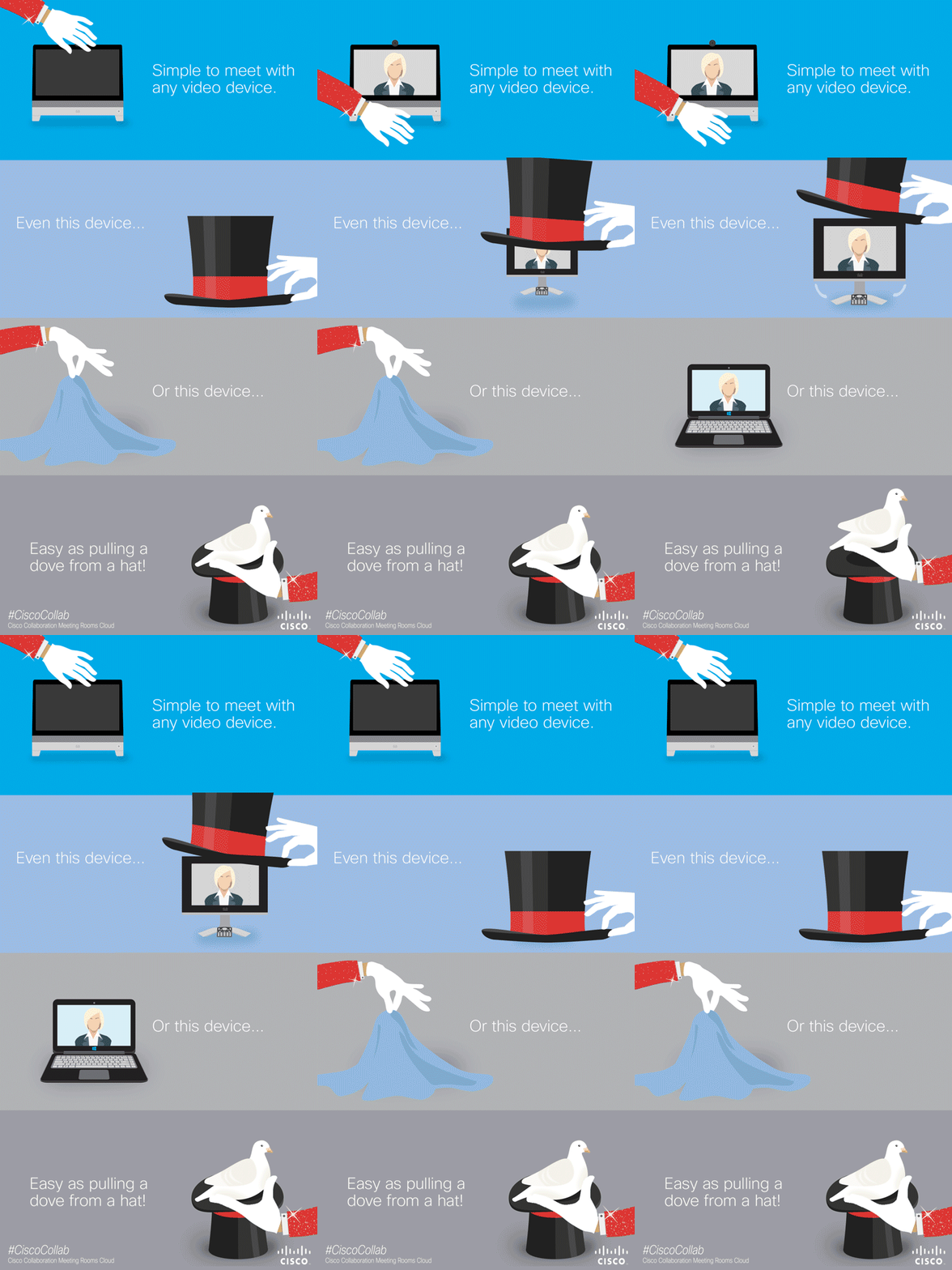
Now it’s time to put that rumor to rest.  Meeting from any video device can be simple.

Cisco® Collaboration Meeting Rooms (CMR) Cloud lets you meet over video with others, no matter what system they’re using. CMR Cloud simplifies meetings using a cloud-based video bridge. Meet with peers, customers, or partners. Get the same consistent WebEx experience across a desktop, browser, mobile device, or room system. If you ask me, it’s like magic!

To me, one of the greatest aspects about video conferencing – other than how simple it can be – is that almost anyone can use it to move initiatives, projects, and services forward.

For example, when it comes to finding top-tier talent for your staffing needs, prime candidates are not always local. Conducting interviews and screenings over the phone can give you a glimpse into a person. But nothing Continue reading “Make Video Meetings Simple”

Authors

Ellie Ruano

No Longer with Cisco

Avatar

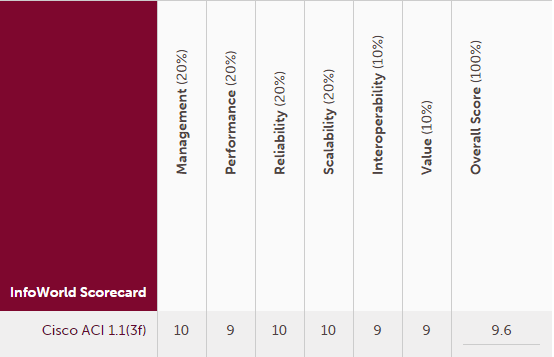
Recently, InfoWorld, a top IT publication, recognized Cisco’s powerful SDN solution, ACI, with the Editor’s Choice award based on an impressive overall review score of 9.6 out of 10. We’ve long-believed ACI is a breakthrough capability that offers greater automation and visibility, performance and scale, security, and openness, and this latest product review endorsement echoes our beliefs.

Here’s a breakdown of the InfoWorld Scorecard:

iWscorecard

Cisco ACI shakes up SDN!

Customer adoption of ACI and the APIC continue to accelerate, and the extensive InfoWorld article by Paul Venezia provides a full report on the Cisco ACI solution to further demonstrate and legitimize ACI’s leading capabilities.

Key points from the product review include:

  • “Cisco ACI is a powerful solution that’s designed for large-scale deployments. It represents a significant step away from traditional networking in both design and scale, and a significant step forward in managing Cisco networks through an open and modern API control structure.”
  • “At a high level, this is what ACI is — it is a method of building and maintaining a networking fabric that dispenses with the concepts of traditional networking, and offers significant software control, automation, and wire-speed switching on a very large scale.”
  • “ACI even provides a way to go back in time to see where faults or problems may have begun. This operates at a surprisingly low level, to the point where it’s possible to select several objects in the fabric and show packet-level details on traffic relating to that object several hours in the past. …Further, you can export statistics if you need data over a longer period. This tool can prove extremely helpful in troubleshooting efforts.”

Continue reading “Cisco ACI Awarded InfoWorld Editor’s Choice”

Authors

Rick Snyder

Senior Vice President

Americas Partner Organization

Avatar

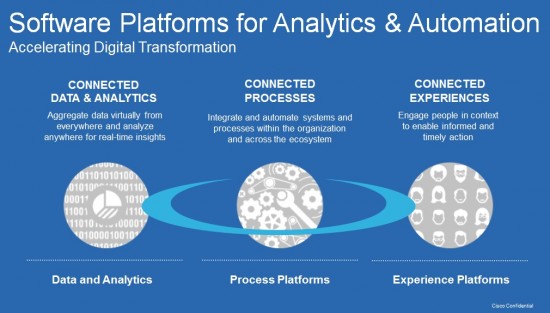
Imagine a future where data, processes and people are all digitally connected to provide real-time insights that change the user experience for the better. No need to wait. You can experience that future today. Forward looking businesses today are transforming themselves into digital enterprises. The choice is disrupt or be disrupted. Are you ready to get connected? Learn how with Cisco connected platforms.

AA_connected_digital_transformation_1010x574

Connected processes, connected analytics and connected experiences work in concert to complete an organization’s digital transformation. System and operational improvements provide the analytics and processes needed to drive new customer interactions. To define requirements for user experience, evaluation of input and actions of all participants and their modes of connection are necessary. The goal is to enable people to seamlessly and transparently access and interact with hyper-distributed centers of data, whether via smartphones, tablets, laptops, or specialized devices, so they can make and act on informed decisions. In other words, it’s about delivering the personal and/or professionally-relevant information that an individual needs, when and where they need it, and in the best way for them to understand or apply it.

To learn about developing requirements for connected experiences and see how a large international hotel chain is innovating for better guest interactions, read more in my article Insights to Interactions: Defining New Connected User Experiences.


Authors

Mala Anand

No Longer with Cisco

Avatar

Back in 2011, web pioneer Marc Andreessen wrote an op-ed in the Wall Street Journal, entitled “Why software is eating the world”. I couldn’t agree more!

First, let’s have a look at what’s going on in the industry at large. Every company in every vertical industry is facing unprecedented competitive pressure from new players making innovative usage of software and data analytics. It forces companies to embark on a digitization journey, which ends up having profound consequences on network infrastructure.

1

Great, so what does it mean to the network and to you?

The network infrastructure is Continue reading “Software Innovations for Cloud Scale Networking”

Authors

Sumeet Arora

SVP Engineering

Core Software Group - US

Avatar

This is part of a series on the evolution of the Cisco Collaboration Cloud platform, exploring the technical and design principles behind its unique architecture.

In the last post in this series, Rowan wrote about revolutionizing enterprise communications through the cloud to deliver amazing experiences. I am glad that Rowan mentioned experience, because that happens to be a passion of mine.

For me, experience manifests itself in several ways. It means:

  • Our technology is integrated and works easily across our platform;
  • Our technology is intuitive and easy to use by anyone at any level in the organization; and
  • Most importantly, it means users are delighted in every interaction.

But to deliver amazing experiences, we have to understand how people will use our technology and what they need to accomplish FIRST, before we build anything. When we understand the experience people want, we can tie that to the experience we deliver. Then, and only then, can we build a platform with products that are valuable and desirable.

We do this by leveraging three key design principles across Collaboration. Embedded in everything we do, they put users at the center of our platform and products. These principles are: simplify, connect, and delight.

Simplify: this is all about the experience. You’ve told us you need to connect with your teams quickly, no matter where they are Continue reading “The User Experience”

Authors

Jens Meggers

No Longer with Cisco

Avatar

In today’s hyper-connected economy, every company is a digital business. Technology professionals play an integral role in driving business outcomes, and that requires a new skills framework. There are new demands for IT expertise in a changing technology environment. For the individual, rapid change is driving the need for continuous skills refresh. For the enterprise, technology expertise must link to business outcomes. For the industry, a new skills framework is needed to develop cross-technology and cross-functional leaders.

The IT jobs of the future are being defined now, but many organizations and individuals are being left in the lurch. In fact, a report from the MIT Center for Digital Business Research found that nearly 80 percent of companies consider missing digital skills to be the key hurdle to digital business transformation.

To overcome this hurdle and stay ahead of disruption, a broader perspective is required – one that goes beyond the traditional infrastructure model. It’s a view not limited to just a network topology or architecture discussion, but rather, one that looks to the opportunities made available through evolving technologies. Additionally, organizations must be able to use these emerging technology trends to drive business outcomes.

Raising the Bar

That’s why Cisco is evolving its certification program to ensure that candidates are prepared for new and changing job roles that unfold with emerging technologies.

Core technology expertise is essential, of course, but practical IT expertise in a single, siloed technology area is no longer a differentiator. IT professionals also must have a clear understanding of the evolving and disruptive technologies that are fueling innovation.

With this evolution of the career certification program, Cisco is ensuring IT professionals are equipped with the skills and education needed for evolving technologies such as Cloud, Internet of Things (IoT), and network programmability. Continue reading “Creating a New Skills Framework for the Digital Economy”

Authors

Tejas R Vashi

Senior Director, Product Strategy & Marketing

Learning@Cisco, Cisco Services

Avatar

The OpenFog Consortium has made its debut as an ecosystem of industry and academic leaders to foster an open architecture for fog computing in the Internet of Things (IoT). This is an important milestone that will accelerate IoT deployments and maximize their value across a wide range of industries.

AP46072_small_croppedMy friend and colleague, Helter Antunes, has been a pivotal force in forming the OpenFog Consortium and has worked tirelessly with other founding members to iron out the myriad of details involved in creating this sort of multi-party organization. He has also been instrumental in developing Cisco’s own fog computing strategy. That is why I am particularly pleased to congratulate him on being named the OpenFog Consortium’s first chairman, who will guide the group through its formative stages. Continue reading “Cisco Provides Leadership in Newly Formed OpenFog Consortium”

Authors

Maciej Kranz

Vice President and General Manager

Corporate Strategic Innovation Group

Avatar

Shadow IT is nothing new as employees and lines of business bypass IT departments to get the cloud services they need to complete their jobs.   Rogue IT has resulted in a conversation around the unintended and potentially dangerous consequences of increased security risks, compliance concerns and hidden costs.

We all know that private and public clouds are here to stay, but in a recent study it was proven that the average enterprise organization is unaware of just how much shadow IT exists.

shadow-it-100467238-primary.idgeCisco recently completed a study with large enterprise customers across the United States, Europe, Canada and Australia.   This study was conducted from January 2014 through July of this year.  Actual usage data was collected from customer’s networks representing millions of users.


Ask your CIO today and they will probably respond that on average their organization is utilizing 51 cloud services.   Cisco’s survey indicates that in reality, over 730 cloud services are being used.

That is 15 times what was believed and the survey statistics provide a trend that by the end of the year that will increase to 20 times more than was authorized.   That’s more than 1,000 external cloud services per company.

To learn more about this study, read this thought leadership piece on CIO.com.

Continue reading “Shadow IT: You Can’t Manage What You Can’t See”

Authors

Joann Starke

No Longer with Cisco

Avatar

Chat Image

How often do you bank? ?

For me, it’s a few times a week, but more frequently when I have a few bills to pay. Today, digital technologies makes checking balances, transferring money and even depositing checks an “anytime, anywhere” process using apps and mobile devices. Banks and other financial institutions that plan to stay ahead of the digital disruption must find innovative ways to transform and differentiate themselves. Otherwise, they may end up a part of the estimated four out of today’s top 10 financial services giants that could be displaced by digital disruption in the next five years or as Chris Skinner predicts, ‘see all their margin on traditional products erode in the next decade’.

During our latest #CiscoChat, banking futurist Chris Skinner (@Chris_Skinner), chairman of Europe’s Financial Services Club, joined @CiscoFSI for a live and fun discussion on how banks can make money, when everything is ‘free’. When transactions are table stakes.

If you missed the chat, the full recap is here. Below, I summarized a few of the highlights and insights. Continue reading “#CiscoChat Recap: No More Bankers’ Hours”

Authors

Leni Selvaggio

Global Senior Manager

Financial Services Industry