Some of you may remember Marathon Man, starring Lawrence Olivier as the evil Nazi dentist Dr. Christian Szell, and Dustin Hoffman as a graduate student nicknamed Babe. Szell has come to New York from his South American jungle hideaway to retrieve a cache of diamonds, but he’s not sure he won’t be walking into a trap. He thinks Babe knows, and tortures him by repeatedly asking, “Is it safe?
Szell: “Is it safe? Is it safe?”
Babe: “You’re talking to me?”
Szell: “Is it safe?”
Babe: “Is what safe?”
Szell: “Is it safe?”
Babe: “I don’t know what you mean. I can’t tell you something’s safe or not unless I know specifically what you’re talking about.”
It’s a scary scene.
I’m reminded of it whenever people ask or say: “Is the cloud secure?” or “Public clouds aren’t secure” or “Multitenant applications aren’t secure.”
I hate it when I have to miss a podcast. And I don’t miss many. But this week I was in New York for customer meetings so I had to miss OpenStack Podcast #25, featuring Ryan Floyd of Storm Ventures!
Such a shame. It was a good interview too. For those of you who don’t know, Ryan was one of the early investors in OpenStack vendors Metacloud (acquired by Cisco in late 2014) and SwiftStack, as well as other well-known technology companies like Marketo, MobileIron, and Airespace.
He’s in the heart of the action in Silicon Valley, helping his funded startups succeed, and listening to pitches from entrepreneurs about the next round of exciting new technology-based businesses. So he’s got a unique perspective and he shared it with our audience today. Subjects he covered include:
How Amazon has leveled the playing field for startups
The future of public and private cloud
The importance of infrastructure companies supporting OpenStack
Where the opportunities are in the OpenStack space
The OpenStack business he’d start today (if he were in the business of starting companies)
What makes a promising startup
The importance of complexity when it comes to startup success
#CiscoChampion Radio is a podcast series by Cisco Champions as technologists. Today we’ll be talking about Cisco Home Labs with Cisco Education Specialist Charles Stizza.
The Internet of Things (IoT) has been among us for a while, but in recent years we have seen a change in scale, in part due to cheaper sensors that are emerging. Cities are deploying sensors to improve the quality of life for their citizens, while factories are connecting more and more machines and collecting more data about the production processes. Supply chains are being revolutionized by tracking in real-time not only position but also movement (shaking, dropping), humidity, etc… In almost every industry you can see the impact of IoT.
Due to this change in scale new challenges are starting to emerge that are demanding a rethink of the Cloud only paradigm, and the silo approach to IoT.
Challenges
IoT typically means deploying application intelligence and analytics at the edge (the area between Cloud/data centers and end points such as sensors, factory robots, etc…), or pushing data directly to the Cloud for processing. Both approaches have their advantages as well as potential drawbacks.
IoT painpoints
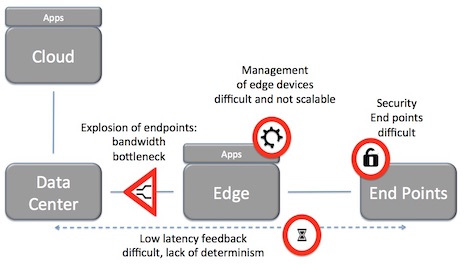
The network between the edge and the Cloud can be relatively expensive (especially if you send all data to the Cloud) or has limited capacity (capacity is of course correlated with price). Latency to the Cloud can also be relatively high, and often lacks determinism. For example changing the color of traffic lights via the Cloud might not be optimal.
More and more solutions are being deployed at the edge to address the challenges Cloud faces. But these solutions have their drawbacks too. Many different solutions (hardware and software) make it more challenging to manage these edge services in a consistent and coherent manner.
IoT deployment is typically not confined to the traditional enterprise IT domain (au contraire). This means that traditional security solutions do not always apply, resulting in potential high risk security breaches: it is not only about stealing data, but also about controlling machines For example manufacturing robots, location of vehicles, …
One of the trends that we are seeing is that providers of edge services want to focus on their service (application) as this is where their expertise is. Today however many providers also need to provide the hardware (not always a good source of revenue), a certain level of security (not always their primary level of expertise), and a way to manage their services and devices (which can pose a challenge if a customer deploys multiple silos of IoT services).
A Unified platform beyond Cloud only
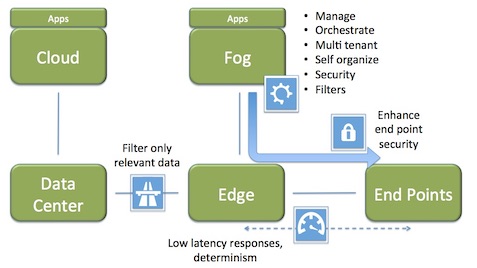
To address the challenges described above, a rethink is needed. On one hand the Cloud only paradigm is not sufficient, yet such a new platform needs to support a Cloud like methodology for the edge.
Fog, a driver for IoT
The emphasis here is on “like”, as the edge differs from a Cloud/data center in several important aspects such as: limited resources, limited network capacity, security challenges, and resource distribution. However, such a platform will also have things in common with Clouds. Just like in a Cloud environment it needs to manage the (edge) service life cycle and orchestrate deployment.
With such a platform in place, edge service providers can focus on their core business as this new platform provides them with hooks to develop, deploy, scale, monitor, and manage their services in a secure and safe environment while seamlessly connecting to the Cloud.
Moving to Cloud and beyond
The vision of such a unified platform has been described by Bonomi et.al. and labeled Fog Computing. We are now seeing this vision unfold in several distinct stages.
Unified (IP based) connectivity is typically the first stage. For example, cities offering free Wi-Fi in the city center, or factories that are consolidating their different networks.
Once unified connectivity is in place, it becomes easier to deploy services at the edge by connecting hardware to this IP network. This can lead to service silos, which are sometimes difficult to avoid due to legacy applications and hardware.
The next stage is the deployment of a unified platform (Fog platform) between Cloud and the endpoints to enhance service deployment beyond the Cloud but also to spur innovation by making it easier to share data between these services. This stage is where there is a true added value, as service management is unified and hardware platforms can become more consolidated.
This paradigm shift to think beyond Cloud towards a unified platform, will lead to new products, services and business models, but can also increases the risk of fragmentation due to lack of standards, architectural vision and abstraction. In order for this paradigm shift to truly succeed it is therefore important to have a continuous conversation between the IT and OT industry.
To ensure companies capture the value of IoT, it is important to start the thought process on a Fog and IoT vision early on: service deployments, connectivity capacity beyond Cloud, data filtering and analytics at the edge, device consolidation, real-time requirements, etc…
Such an IoT vision will enable companies to better prepare and understand the risks and opportunities in an increasingly connected world.
Cisco’s Connected Mobile Experience (CMX) solution employs data from the Wi-Fi network to generate information about devices visiting a venue, which in turn can be used by businesses to gain greater insight into the behavior of their customers and improve customer experience. At the center of the CMX product is the Mobility Service Engine (MSE), version 10 of which was announced at Cisco Live! Milan.
Mobile World Congress 2015 was another great opportunity to demonstrate the scale at which MSE 10 can now operate. The MSE 10 installation for MWC 2015 was entirely cloud-based and the week’s visitor data was captured using only a single box setup.
In the this blog, we’ll show how MSE 10 was used to generate custom reports during the event to give some interesting insights into how the conference unfolded.
Registration area
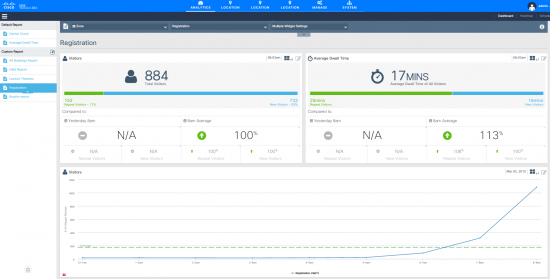
Day 1 of MWC begins at 9:00am, when the main doors open for the first time. People begin arriving well before then and waited patiently to be allowed into the halls. We were able to witness this using a custom report focused on the registration area showing a graph of the number of visitors increasing as opening time approached (Figure 1)
This was also reflected in the heat map report, where a bright red spot can be observed representing the increasing number of visitors waiting to gain entrance (Figure 2) Continue reading “MSE 10 at Mobile World Congress 2015”
IOT::Empowering the Enterprise turned out to be quite the dance party this year. Or at least the kind of Internet of Things (IOT) party you’d expect when you bring together over 300 IOT thought leaders, including startup founders, venture capitalists and corporate investors, and Fortune 500 executives.
And adding real-time biometric analytics doesn’t hurt either, tracking everything from temperature, movement, sound, and even crowd sentiment and energy levels.
Source: LightWave
With much of the IOT buzz focused on consumer tech, this event was specifically focused on IOT in the enterprise. It showcased the ecosystem of innovators that are fundamentally changing cities, manufacturing, energy, transportation, retail, and the many other industries embracing the Internet of Everything (IOE). Cisco Investments, co-hosted the event on our campus with other leaders in the space – SAP, Siemens, Sapphire Ventures, and Silicon Valley Bank, all helping to make IOT transformative. Continue reading “IOT Dance Party! And the winner of the IOT startup challenge is…”
One of the well-received demonstrations that Cisco showed at MWC 2015 was: Cisco Internet of Everything: Solutions for SP Business Opportunity, aka the “Connected Bus Stop”. This demo prompted a lot of good discussion about what role Service Providers can play in the Internet of Things (IoT) and the Internet of Everything (IoE). We summarized 4 areas for Service Providers to add value:
Deliver Intelligent Connectivity over lower-cost, dynamically scalable virtualized networks
Offer complete solutions and managed services in focused vertical segments
Monetize new sources of analytics from aggregated and contextualized IoT data
Provide provisioning, end-to-end device management, and added-value aligned to the business process productivity gains that customers seek from IoT.
Cisco’s approach to IoT encompasses an understanding of key business care-abouts and pain points, derived from our longstanding position as Continue reading “The Connected Bus Stop”
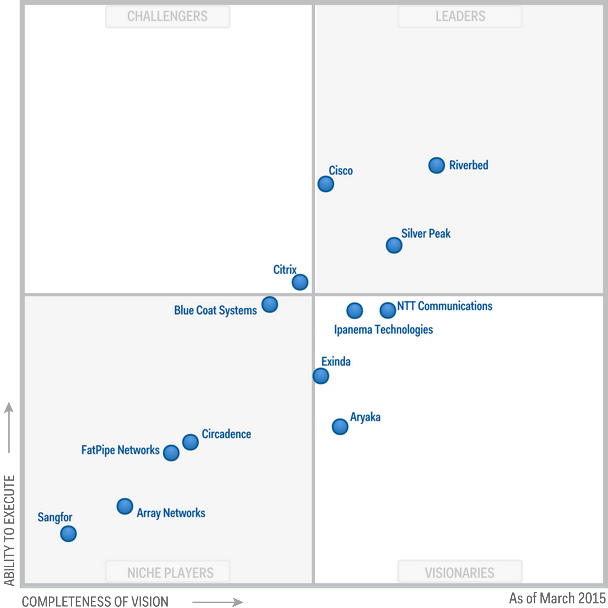
I’m very excited and proud to announce that Gartner has placed Cisco into the Leaders quadrant in the Magic Quadrant for WAN Optimization. We believe this accomplishment reflects the substantial progress Cisco has made in developing and executing on its vision for the Cisco Intelligent WAN (IWAN) with Cisco Wide Area Application Services (WAAS) over the past three years – a record that we feel clearly demonstrates Cisco’s ability to compete in this space.
Magic Quadrant for WAN Optimization
*Source: Gartner (March 2015)
The timing couldn’t be better
The analyst research and press coverage tells us loud and clear that the WAN is hotter than ever, and for good reason: mobility, cloud and the digitization of the enterprise are changing how we consume and deliver applications. Even the applications themselves are changing, as we’ve seen with the rise of a whole new class of bandwidth-intensive and latency-sensitive mobile apps and video. Continue reading “Gartner Recognizes Cisco WAAS as a Leader in the Magic Quadrant for WAN Optimization”
Be Fearless! That was the theme of an incredible Cisco Women of Impact Conference last week, and like most of the 4,850 people joining from about 80 sites around the world, I came away inspired and energized by all I heard and learned during the day. We came together as women (and men) that wanted to learn, connect and share ideas on how we could personally make a bigger impact. I know I took home many new ideas and many new friendships.
I’m very proud and extremely fortunate to be the EMEAR executive sponsor of Connected Women. The Women of Impact day is one of our key events – designed to provide ideas and insights, help women connect, and encourage them—no, all of us—to reach for more. It’s a powerful reminder of the power of diversity in our business.
So, what does it mean to be fearless?
First of all, it’s about going beyond fear. It’s about recognizing fear when it crops up (and believe me, it will), and then having the courage to set it aside and to move forward, whatever the obstacles. Effective leadership often means stepping into the unknown, disregarding fear and focusing on how you can make an impact.







 #CiscoChampion Radio is a podcast series by