If there’s one common element across the major television/video trade shows this year — the International Consumer Electronics Show (CES), the upcoming National Association of Broadcasters (NAB) Show, and likely those that follow, it’s the focus on “the rest of the ecosystem,” as it relates to 4K, Ultra High-Definition (UHD) TV. Meaning, the televisions are out there. Everything else is still catching up.
With NAB coming up, and video picture quality a hot topic, I wanted to highlight what’s been going on with Cisco’s 4K encoder work, as evidenced by customer wins — some of which we can discuss, some of which we can’t — in a series of recent “encoder bake-offs” around the world.
Building an IoT company is a great opportunity to work on things you have never done before. Here is a list of my conclusions with brief anecdotes about the difficulties of building az IoT company.
Choose the size of your funding need wisely
When we started, our pre-seed angel investor suggested to close an angel round by involving other investors. The more money you attract at the beginning, the longer runway you have to develop the product that you believe in without having to take away your focus from value creation. It turned out without having the credibility of using small investments wisely and build traction with it you won’t be given the opportunity to get funded with hundreds/millions of Dollars. Build up your credibility together with your venture. One step at a time. Continue reading “Building an IoT Company in Europe”
The convergence of Operational Technology (OT) and Information Technology (IT) is becoming more important now than ever – and that sentiment was heard loud and clear at last week’s complementary Cisco Live Melbourne and Rockwell Automation ConnectED events. Held for the first time under the same roof, the two events provided a unique opportunity for end users to learn how to accelerate industrial business performance in a joint experience.
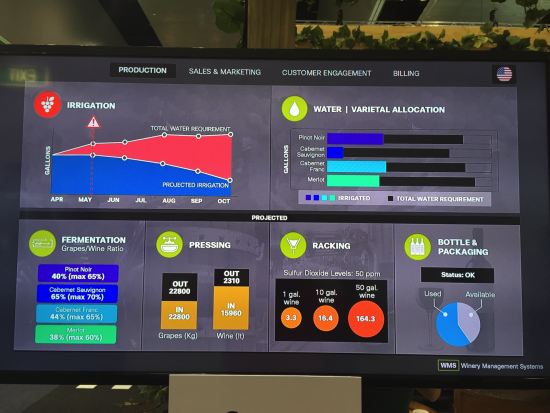
Attendees to both events alike enjoyed seeing examples of industrial technology in action such as the Connected Vineyard demo, which I had the pleasure of demonstrating to customers in the Cisco Live World of Solutions.
In the demo, we discussed how to add business value on top of sensor information. For example, the images below show sensor information in an easy-to-read dashboard that can help us troubleshoot potential issues before they affect the bottom line.
Ask any storage administrator trying to deploy Business Continuity and Disaster Recovery (BC/DR) solutions between two data centers if it is simple to get the networking set up for mission critical applications in a BC/DR scenario. I am willing to wager you’ll hear the same tales I’ve often heard, that the storage team and the network team have a difficult time setting up the necessary network configurations for the storage replication application’s service level requirements between sites. Equally important, there is also a complicated challenge with providing a duplicate infrastructure at the secondary site so that the application will be able to come up to restore the application to service quickly (often referred to as the Recovery Time Objective, RTO).
Cisco’s Application Centric Infrastructure enables a novel solution to this problem which one of our ACI partners, World Wide Technology, Inc. (WWT), recently deployed. It illustrates the power of the Application Policy Infrastructure Controller’s (APIC) and the ACI fabric’s open programmability. To appreciate this, let’s take a closer look at the problem.
Thank you to everyone who took the time to read through the OpenStack Summit speaker submissions and cast votes for their favorites. The Foundation notified the selected speakers this week, and I’m happy to say that the Cisco team fared quite well. We will be represented in 25 presentations (as of Monday, 3/23*), including the following:
Every year at the SXSW Interactive Conference, tens of thousands gather in Austin, Texas to get a first look at what’s new in innovative technology. And while the atmosphere this year was festive, it’s safe to assume that many attendees were trying to stay connected and get work done on-the-go with colleagues back in the office.
While email and conference calls have long been the staples of business communication, the reality is that people on-the-go, whose mobile devices are their business lifelines, need solutions that make it simple and easy to work together from anywhere. Since Cisco was on the ground with attendees at SXSW, it was the perfect opportunity to not only hear how they collaborate, but also discuss the future of collaboration and find out directly from users what they are looking for.
While we think collaboration is the best thing since sliced bread – or in Austin, taco trucks – we wanted to hear how users describe it: how do they use it, how does it help them, what do they wish it could do? Because Cisco Spark is so easy to put in the hands of users, we asked people to try it out. Continue reading ““Sparking” Collaboration at SXSW”
Powerful technology trends including, social, mobile, cloud, and Big Data are converging, creating unprecedented “digital disruption.” We are in a unique period of time where business and technology leaders have the opportunity to create new value and win market share by leveraging the advantages of a hyper-connected world.
Agile competitors with better business models seemingly emerge overnight. Ingrained ways of thinking and working make changing to an innovative culture painfully slow. Needed talent and resources lie outside the four walls of the organization in a wider ecosystem of capabilities. And while technology challenges abound as we confront the future, people and process changes are even more vexing for most organizations.
So how do executives keep their companies from being added to the growing heap of once venerable brands that didn’t transform fast enough?
It’s not easy.
According to Gartner research, by 2020, 75 percent of companies will be a digital business or will be preparing to become one, yet only 30 percent of these efforts will be successful. The number one reason companies fail to transform is because they don’t re-imagine and reinvent the business from top to bottom before they begin.
Wins, Accomplishments, Fast Action, welcome to the world of Cisco ACI. In this blog, I want to take you closer to the core of ACI excitement. Cisco Insieme Business Unit and Cisco’s premier Partner, World Wide Technology Inc (WWT) have come together in developing an ACI based Business Continuity/Disaster Recovery (BC/DR) solution for the next generation Data Centers. This blog specifically addresses the Disaster Recovery ACI use case implemented in WWT’s Advanced Technology Center (ATC). I will present highlights of how ACI has been implemented at ATC as two fabrics, across two Data Centers with federated controllers implementing an autonomous infrastructure and with replicated tenant configurations that will provide for disaster recovery.
This BC/DR use case couples the storage replication solution by Zert0 on NetApp storage and with a completely integrated and consistent ACI network solution on the primary and secondary sites to enable rapid application bring up on the remote site. Network and security policies are replicated, compute resources are virtualized and synchronized, and storage is continuously replicated. This integrated architectural approach addresses one of the major challenges enterprise customers have in deploying BC/DR solutions – aligning the configuration and deployment of network infrastructure in a simple process with the storage and application teams to achieve the Recover Point and Recover Time Objectives.
Network architecture: The ACI based network architecture is comprised of two independent fabrics with L3 connectivity between them. Each data center has a unique IP addressing namespace scheme and connects to the WAN. In the operational model per diagram-1, the “East” Data Center is termed primary and the “West” Data Center termed the backup (disaster recovery). Each Application Policy Infrastructure Controller (Cisco APIC) controller cluster is identified as the primary or secondary instance, and changes, additions or deletions to the application tenants, are replicated from the primary to the backup controller. Application tenant configurations are managed through a special Python module developed by WWT that programmatically synchronizes the two fabrics.
External WAN connectivity for each Data Center is provided through the common tenant in respective ACI fabrics. By using the common tenant for external connectivity, the network and security administrator can assign the appropriate network configuration policy, security contracts and as well as firewall and load balancing services for the fabrics in each data center. The application (DevOps) teams will reference the common configuration and configure application connectivity for intra- and inter-tanant communications through the Application Network profile (ANP). F5 Gobal Traffic Manager (GTM) allows holistic management of multi-data center application delivery via intelligent DNS.
This ACI based Disaster recovery solution has several other facets like storage replication, orchestration software (developed in-house by WWT) among other solution components. Please watch the YouTube Video for a demo illustration and the whitepaper for design details.
In closing, some key takeaways. Cisco ACI’s innovative architecture enables enterprise apps to treat the Data center as a dynamic, shared resource pool. This pool of resources is managed through a central controller (Cisco APIC) exposing all configuration and management components through a northbound REST API. WWT exploits this programmatic interface of ACI to develop business continuity/disaster recovery solutions for customers.