
Avatar

Cloud brings enterprise technology capabilities to mid-market businesses. As such, mid-sized businesses are rapidly turning to cloud technology to gain a competitive edge.

According to Deloitte’s latest technology survey of mid-market executives, 48 percent are using cloud services and 36 percent have pilot projects underway or are investigating cloud. I believe cloud use to be much higher for mid-market organizations as we have seen that organizations are using 10-15 times more cloud services than they are aware of.

The growing use of known and unknown cloud services presents a new host of challenges for mid-market IT teams, including:

Authors

Robert Dimicco

Senior Director

Advanced Services

Avatar

By Todd McCrum, Director of Product Management, Cable Access Business Unit, Cisco

If you’re making the rounds at this week’s INTX, you’ve likely gotten wind of our flagship product announcement — the Gig-maker that is the cBR-8, as part of Cisco’s Evolved CCAP solution. Our categorization of it as an “Evolved CCAP” solution may need further defining. The answer requires a bit of background, starting with CCAP itself. It stands for “Converged Cable Access Platform,” where the “converged” part refers to a one-size-fits-all QAM modulation system that works for video, voice and data. Prior to CCAP, modulation was handled individually for video and data/voice products — I still remember the cable system GM who lamented that “every time I turn around, somebody’s sending me a request to buy more QAMs.” CCAP alleviates that concern.

What’s evolved about an evolved CCAP, and in particular, the cBR-8, can be characterized in three ways. First, the original CCAP spec (started about five years ago) covered a total of 64 6-MHz channels. They’re typically divvied up half and half: 32 channels for DOCSIS 3.0/broadband traffic, and 32 for MPEG-delivered, narrowcast video, like VOD. (Note: Not live or linear.) Subsequently, the DOCSIS specification itself evolved to 3.1, which substantially increases available bandwidth for IP-based services. As a result, and in our view, CCAP needed to develop in lockstep.

Evolved CCAP enables 100% convergence of all video types — narrowcast/VOD, sure, but also linear/MPEG, and any managed IP video tiers that might be entering the service mix. Plus enough room for both DOCSIS 3.0 and 3.1-based traffic. The reason I feel confident in saying that the cBR-8 is ahead of the marketplace on this one is that our competitors tend to use an off-the-shelf chassis, which puts a hard architectural limit on how many total serving area groups they can reach. Trying to wring more bandwidth, or reach more serving areas, becomes expensive with forklifts in that scenario.

Which brings me to the second characteristic of an evolved CCAP: Continue reading “What’s “Evolved” About An “Evolved CCAP”?”

Authors

David Yates

as Director of Service Provider Video Marketing at Cisco

SP360

Avatar

Here’s an industrially trending topic: Broadband speeds. We had the January 2013 FCC mandate for at least one Gigabit community in all 50 states by this year. We have Google’s continued Gigabit push, expected to roll into 18 more cities this year. The National Cable & Telecommunications Association (NCTA) is leading broadband expansion into 93% of U.S. cable homes, while driving initiatives to triple broadband speeds, and further the industry’s leadership and innovation in broadband.

This isn’t the easiest mandate, for service providers. Recall that broadband consumption continues to grow at 50% year-over-year.. And coming up fast are the things of the Internet of Everything, which put another multiplier on broadband consumption.

In short, and whether or not you believe Gigabit services are more “billboard speeds” right now, the Internet needs to go faster..and faster. That’s why you’ll be hearing so much from us this week at INTX about our new cBR-8 — the industry’s first platform with the speed and capacity to deliver (not just test!) 10Gbps DOCSIS 3.1 and capable of supporting scaled deployments of bouquets of DOCSIS 3.0, DOCSIS 3.1, and converged data/video services.

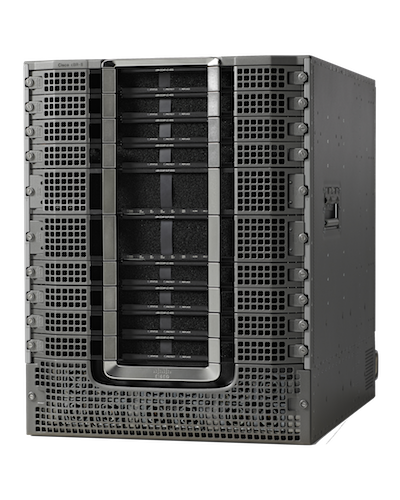
cBR-8 front-100pixel

That’s tech-talk for super fast, available, and effective broadband — without the unpopular “forklift upgrade.” We designed the cBR-8 that way on purpose, with three sustaining project goals: 1) massive bandwidth, 2) delivered cost-effectively, to 3) enable our customers a rapid market-entry with reliably competitive broadband products.

Here’s what the cBR-8 brings to the broadband table: Continue reading “Getting Broadband Where It Needs to Be: Introducing the CBR-8”

Authors

Brett Wingo

SVP, Software, Systems and Operations

Cisco Services

Avatar

One of the many great attributes of Connected Mobile Experiences (CMX ) is that it offers a rich location analytics solution. With advanced capabilities like Path Analysis and Correlation, zone-based reporting relies on a minimum of three or more access points which seamlessly detect and report the received signal strength (RSSI) of a client. In simplistic terms we can say that CMX triangulates the location of a client.

Unfortunately (and realistically) not all venues are equipped with 3 APs. Many of our customers, have a large number of satellite offices . Imagine a popular coffee chains or even well known financial institution, who have small branch offices or stores spread across the country. They too need insights into their customer’s behavior, even if they don’t have multiple AP’s

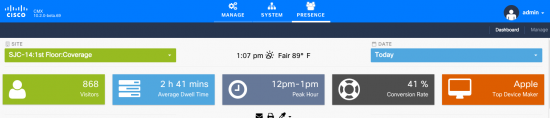
To address the needs of businesses with smaller sites and wireless deployments not designed for location accuracy, we’ve developed Presence Analytics, which provides priceless customer insights for businesses like those very coffee shops and financial institutions, earlier mentioned.


There are numerous facets of Presence Analytics, here are a few of my favorites:

  1. The Banner visually shares how effectively the business is performing and reaching targets. It provides, if you will, a sort of Key Performance Indicators.

quick look analytics 1


  1. Key Insights provides a clear look into business peak hours, days, weeks, and months.

Continue reading “Presence Analytics”

Authors

Pritam Shah

Director, Engineering

Avatar

Meaningful use stage 2 sets the bar of 5% portal access for patient engagement and stage 3 raises the bar to 25%. What does it take to drive the adoption curve?

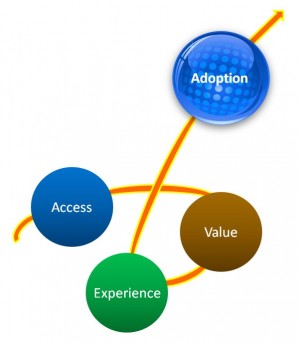
access-value-expThere are multiple factors that help the adoption curve to take off. The three key factors that are very important are:


   1. Access: The key question is what information and resources are made available for the patients?

   2. Value: The key question is based on the data that is made available, what is the value for the patients?

   3. Experience: The key question is how seamless experience does the patient have while accessing information and the experts?

While today, the primary focus is to increase access to information by providing a portal to your information system, it will be difficult for adoption to take off if value and experience are not focused on.

Enabling a portal to your information system is the starting point. Providing value added capabilities such as collaboration capabilities in your portal to communicate with your care teams increases the value for the patients. Once these capabilities are provided anytime, anywhere and on any device, with a seamless experience, patients will start using these systems. Enabling continuity of care from the hospital room to the patient’s home and enabling the data to be seamlessly available in the portal when the patient is discharged enables a higher experience. In the era of social media, a great experience leads to more influence with other patients and the adoption continues to grow.

Checkout the Cisco booth (#1301) to learn more about how Cisco is enabling access, value and experience leveraging its solutions at the American Telehealth Association (ATA) conference 2015 currently underway from May 3-5, 2015 in Los Angeles.

Authors

Rajesh Vargheese

CTO

Cisco Healthcare Solutions

Avatar

Jeff Zucker of NBC Universal coined the prescient expression “Trading analogue dollars for digital pennies” in 2008 to describe the huge gap that he was observing between the lucrative promises of online and digital advertising and the reality of the meager revenues that it was in fact producing.  Could the same be true of the Internet of Things (IoT) revolution?  Are we trading the hundreds of dollars that we are generating from mobile users for the pennies that providers get for connecting “things”?

Connecting the 50 billion projected devices, or things, to the Internet is the cornerstone of the Internet of Things.  Given the challenges of remoteness, mobility and the cost of wiring up these devices, many of these connections will be made over mobile networks.  In fact, Beecham Research estimates that the number of cellular machine-to-machine connections will grow to 1 billion by 2020, up from 172 million in 2013.  It is no wonder that the mobile operators are salivating at the prospect of all this new revenue to be earned from connecting inanimate objects.  This windfall is especially at a time when there traditional mobile business is under attack.  Changes in voice usage and bundled minutes are causing voice revenues to decline and data revenues are under attack from Wi-Fi connections and over-the-top providers (see The Mobile Paradox). Continue reading “Trading Mobile Dollars for IoT Pennies”

Authors

Stuart Taylor

Director

Service Provider Transformation Group

Avatar

This post was authored by Ben Baker and Alex Chiu.

Executive Summary

Threat actors and security researchers are constantly looking for ways to better detect and evade each other.  As researchers have become more adept and efficient at malware analysis, malware authors have made an effort to build more evasive samples.  Better static, dynamic, and automated analysis tools have made it more difficult for attackers to remain undetected. As a result, attackers have been forced to find methods to evade these tools and complicate both static and dynamic analysis.

Table of Contents
Executive Summary
The 10,000 Foot View at Rombertik
Analysis
A Nasty Trap Door
The Actual Malware
Coverage and Indicators of Compromise
Conclusion

It becomes critical for researchers to reverse engineer evasive samples to find out how attackers are attempting to evade analysis tools. It is also important for researchers to communicate how the threat landscape is evolving to ensure that these same tools remain effective. A recent example of these behaviors is a malware sample Talos has identified as Rombertik. In the process of reverse engineering Rombertik, Talos discovered multiple layers of obfuscation and anti-analysis functionality. This functionality was designed to evade both static and dynamic analysis tools, make debugging difficult. If the sample detected it was being analyzed or debugged it would ultimately destroy the master boot record (MBR).

Talos’ goal is to protect our customer’s networks.  Reverse engineering Romberik helps Talos achieve that goal by better understanding how attackers are evolving to evade detection and make analysis difficult.  Identifying these techniques gives Talos new insight and knowledge that can be communicated to Cisco’s product teams.  This knowledge can then be used to harden our security products to ensure these anti-analysis techniques are ineffective and allow detection technologies to accurately identify malware to protect customers. Continue reading “Threat Spotlight: Rombertik – Gazing Past the Smoke, Mirrors, and Trapdoors”

Authors

Talos Group

Talos Security Intelligence & Research Group

Avatar
Carl Moberg from Tail-f covers NSO on TechWiseTV

This is the first in a new series of Service Provider focused topics.  We had a lot of choices on where to start but this jumped out as my favorite.  Tail-f brought us some incredibly successful work that dovetails nicely into our SP strategy.   

Tedious CLI and home-spun scripts continue to characterize a boom of network growth that is now struggling under its own weight.  SP networks, and many enterprises in fact, just can’t keep up with the demand for services.  This now affects their ability to compete and thrive.   

It has been impossible to implement network management and/or automation from the outside in.  Even if our networks were all from one single vendor, the number of updates, traffic characteristics and unique configurations would still make it an uphill battle.  SP networks are multivendor and full of legacy equipment that continues to have value.  Cisco’s NSO is now offering a way to work this problem from the inside out.  Standards and protocols that have been grown and tested over the last decade are now ready to turn this into one of those great ‘why didn’t we do this before’ situations.

Watch the full 20 minute show now

  • Wayne Cullen walks us through Cisco’s Evolved Services Platform (ESP), the vision and the updated roadmap.
  • Carl Moberg explains NETCONF, YANG and the benefits of a model driven architecture.

Continue reading “Network Service Orchestration enabled by Tail-f”

Authors

Robb Boyd

Producer, Writer, Host

Avatar

By Roderick C. McGeary, Cisco Board Member and Chair, Compensation and Management Development Committee, and Francine Katsoudas, Senior Vice President and Chief Human Resources Officer

McGeary and Katsoudas


Cisco CEO John Chambers has consistently said that the next time we would talk about CEO succession would be when a successor is announced. Today is that day, and we are proud that Chuck Robbins has been appointed Cisco’s next CEO.

Over the past 16 months, Cisco’s Compensation and Management Development Committee and Board of Directors have been focused on the succession process for one of the most dynamic, respected, and longest-tenured CEOs in the tech industry.

For almost a decade, we have led robust succession planning and leadership planning for all of our critical roles. And, as a result, since John Chambers has been CEO, we’ve managed numerous successions seamlessly, including our CFO transition last fall.

The board initiated the formal CEO succession process in January, 2014, knowing that the transition would occur at some point in the following couple of years. Early in this process, we adopted five key principles to guide our approach and decisions:

  1. Execute a transition that is thorough, strategic, well managed and, in hindsight, highly successful.
  2. Establish clear criteria that will define a successful CEO for the next decade and beyond.
  3. Assess and develop the leaders who will play key roles during the CEO transition and beyond.
  4. Lead a highly confidential process that minimizes the distractions to the business and is fair and respectful to all candidates.
  5. Given the speed of disruption in our industry, select a candidate who can both execute in the short term as well as drive a dynamic vision and strategy for the next decade.

Continue reading “Identifying Cisco’s Next-Generation Leader”

Authors

Francine Katsoudas

Executive Vice President

Chief People, Policy & Purpose Officer