An interesting read for me one day last week was the Wall Street Journal reporting on the exploding yet ungoverned use of cloud services by employees in just about every organization. Referring to Rachael King writing for CIO Journal, author Steve Rosenbush outlines the potential for security problems and the surprising reaction of companies who start to understand how many cloud services employees are really using.
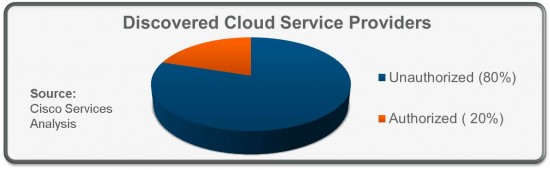
The facts of unregulated cloud usage are surprising, no debate. A few months back I was talking to an industry analyst and I asked him how many cloud providers enterprise organizations knew they had, and how many were actually being used by employees. He replied “probably 5 or 6” are known, and “maybe 10 or so are actually in use in total”. “So maybe double?” I replied to confirm my understanding. He nearly fell off his chair when I told him what we are finding in Cisco Services engagement, that it’s more like a factor of 10-15 than a factor of 1-2! (as the following diagram shows)
There are two aspects to this problem I’d like to discuss in this blog, identifying the cloud usage and then both consolidating and tidying it up, with the aim of increasing security and saving you money in the process. I’ll also related this to two key services we offer in this arena, Cisco Cloud Consumption Services and Cisco Cloud On-boarding Services.
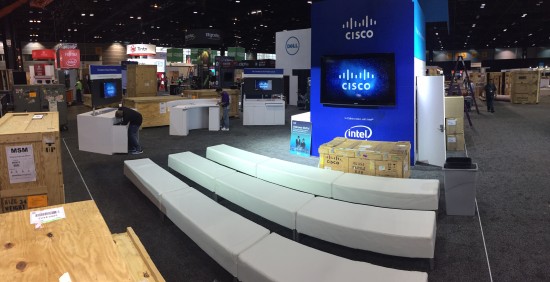
Like many of us I am in the wonderful city of Chicago on a warm sunny day preparing Cisco’s presence for Microsoft Ignite 2015. Starting Monday in booth #122 at McCormick Place we’ll be showcasing our leading solutions for the Microsoft stack. Stop by if you are here!
Our Ignite focus will be on our core technologies: our UCS family for compute, the Nexus portfolio for switching, and our industry leading integrated infrastructure solutions. In addition we will breakout some cool new Cisco technologies and solutions but you are going to have to wait until Tuesday morning to get that news!
It’s undeniable that the biggest convergence happening in the access layer is Wired/Wireless. Today, we’re no longer forced to treat wired and wireless any differently when it comes to network visibility and management. However, the unification of Wired/Wireless doesn’t come without its own challenges and complexity.
As we’ve seen with the latest switching announcement at Interop 2015, there is a lot of noise in the marketplace and customers and partners increasingly need to cut through this to achieve their IT goals and meet today’s increasing demands on the network and the demands of tomorrow.
Earlier this week, HP made false claims about our Catalyst 4500E switch. To help you out, here is what you need to know about Cisco switching and, specifically, our Catalyst 4500E switch:
As the world becomes increasingly more digital, there is an elevated need for a flexible and scalable network to address rapid shifts in technology use and its associated traffic. We’ve seen tremendous demand for our modular switches that supply the best flexibility for this change. In fact, Cisco has the industry’s most widely deployed modular access switches with a modular PoE port share that just reached an all time high of 81.5 percent.
To tackle the biggest convergence in the access layer, Catalyst 4500E supports built-in wireless controller capabilities and delivers common intelligent services across wired and wireless for security and policy, application visibility and control, network resiliency, smart operations, and more.
Cisco’s Catalyst Multigigabit (mGig) technology available across the access portfolio including the Catalyst 4500E can prepare customers’ access switches for the next wave in wireless, 802.11ac wave 2 by delivering speeds beyond 1 Gigabit on existing Category 5e cables. This technology also supports PoE, PoE+, and Cisco Universal PoE (UPOE) so you don’t need to install new electrical circuits to power your access points.
Cisco’s modular access switch portfolio offers backward compatibility with up to three generation of line-cards providing unmatched investment protection – 2x in terms of number of years over other vendors.
A key operational consideration for IT is to maximize uptime and provide seamless code upgrades. In Service software upgrades (ISSU) have been available on Cisco’s 4500E portfolio for almost a decade
The Catalyst 4500E has unmatched scale to meet the needs of a customer’s network and future proof for an influx of new devices – 25X route entries, 16X multicast entries & 42X Security/QoS entries when compared to other vendors.
As IoT trends upward, more “things” connect to the access network and it is key that the network is able to scale to meet these needs – Cisco offers 33 percent more scale in terms of POE+ ports and 50 percent more POE+ scale for redundant power deployments to connect more users, devices and things. Additionally, Cisco supports UPOE, which future-proofs our customers for upcoming applications requiring more than 30W/port.
Security is a top of mind for our customers and Cisco offers a complete end-to-end solution with support for MacSec, Cisco TrustSec, Identity Services Engine and Flexible Netflow, providing the best in class network encryption, segmentation and networking sensing solutions.
The Catalyst 4500E is designed for supporting rich media services with its superior multicast scale and design. Cisco Catalyst 4500 is designed to support hardware accelerated multicast with deep buffers. The Cisco Catalyst 4500E accommodates up to nine times larger data bursts, delivered to otherwise loaded output ports, without loss.
Cisco Catalyst 4500E supports a multitude of capabilities that support IT simplicity and smart operations. Examples: Simplified provisioning with Plug and Play, Simplified configuration of switches & interfaces with AutoConfiguration and Interface templates and faster troubleshooting with embedded wireshark, a world-class protocol analyzer.
How well do you understand this Wave 2 release of the 802.11ac specification?Our latest ‘Fundamentals of’ addresses the technical differentiators and the potential pitfalls you should be aware of.There is a lot of power in this wave.
Just 5 Minutes to increase your knowledge: WATCH NOW
I put the full script at the bottom of this blog if interested.
For those of us who have been in this industry awhile, the Property and Casualty (P&C) insurance market continues to be plagued by inefficiencies in claims handling and litigation management. Adjusters assigned to manage the claim are geographically dispersed, have varying degrees of expertise about the loss event, and handle multiple claims simultaneously. Disparate legacy systems still exist, and silos are prevalent between business, technology, and lines of business. This can result in wasted time and compromised claim performance.
Industry leading insurers should consider applying unified communications and collaboration technologies to lower claim expenses, while transforming the entire claims process into a seamless experience for all parties involved. Insurers continue to be challenged with diverse collaboration methods, especially for long-tail, complex claims in litigation, frequently with high monetary exposure potential and multiple collateral sources involved. A well-defined collaboration strategy can benefit customers, self-insureds, defense law firms handling insurer claims in litigation, agents, brokers, third-party administrators, government entities, court systems and reinsurers. Continue reading “Make Collaboration a Key Part of Your Litigation and Claims Handling Strategy”
Running a Las Vegas resort and casino is like running a small city. As Vice President of IT at the Palms Casino Resort in Las Vegas, Eric Saint-Marc is responsible for keeping traffic and maintenance of that city running as smoothly as possible. But his added responsibilities go further than any city council member of your typical city municipality.
The Palms property includes over 1,200 rooms and suites across three towers, a 95,000 square foot casino, a 2,500-seat concert theater, a recording studio, a Michelin-starred restaurant and more than 60,000 square feet of meeting space.
And at the core of the Palms operations is a Cisco network that essentially runs this “city” and the business.
When you consider all the elements of the Palms that Saint-Marc and his staff need to manage, it can seem like a tall order for a network to handle.
Not only does Saint-Marc use the network to employ a private cloud to manage critical systems, such as the Palms’ gaming systems and email, but also to manage the Palms’ point of sale system for all purchases on the property, which includes over 1,200 gaming machines throughout the resort and casino, totaling 5,000 devices in all.
“IT is a business enabler, allowing our business to grow while preparing for new technologies and guest services,” said Saint-Marc. “On a regular day, we can have 4,500 customers conducting 30,000 transactions in a constantly changing environment, so the network has to be flexible to accommodate these changes.”
Over the years, the role of the network at the Palms has gone through several phases, beginning with the ability to provide basic WiFi connectivity for guests in their rooms. However, the rise of smartphones and mobile apps has required the network to move beyond basic access to provide personalized, targeted content and promotions for guests during their stay.
So when the Palms recently underwent a multi-million dollar transformation of the entire property, they did so with the resort and casino guests in mind, looking for ways to engage with guests on the property that would enhance the overall experience.
Saint-Marc’s vision is to build “services of the future” that leverages mobile technology to personalize the guest experience that knows a consumer’s tendencies so they can provide benefits such as special comps, coupons and other deals as they move around the resort and casino.
And when they began plans for this network transformation to support these new demands, Eric and the Palms looked to Cisco. Presently, the Palms network is exclusively Cisco switching, with Nexus and UCS servers in the data center and Integrated Services Routers (ISRs) and access points throughout the property, in addition to voicemail and collaboration technologies.
At a press and analyst reception at the Palms during the Interop Las Vegas show, Saint-Marc unveiled his vision, which included the latest phase by including new Cisco IP phones for the entire property.
“The network is a platform for innovation,” said Saint-Marc. “Cisco has taken us forward by providing this innovation platform that provides presumptive outcomes when engaging with our guests. We want to provide a personalized experience for guests when they arrive on the property through notifications based on their preferences, and the network makes this happen.”
Tonight I’m heading out for a huge slice of nostalgia. I’m going to see 1980s pop group Simple Minds. No doubt there’ll be much reminiscing and swaying of hands to classics like “Don’t You (Forget About Me).”
This year Cisco has been celebrating its 30th birthday. Another recent addition to the 30-something list is the movie “The Breakfast Club.” This John Hughes classic became an icon of the time and helped make Simple Minds and “Don’t You (Forget About Me)” world famous.
As a remote worker, I understand it could be easy to feel “forgotten” and become disillusioned with a lack of information and sporadic contact with your managers, peers, and co-workers. How do you, for example: Continue reading “Don’t You (Forget about Employee Engagement)”
Over the past three years, Cisco has invested in the creation of an application security awareness program. The program helps the good citizens of this company understand, apply, and act upon a strategy to build more trustworthy products. We launched the existence of the program to the world at the RSA Conference 2015. I am sharing this with you because we’ve created something unique to the industry, and we want to encourage other companies to pursue the creation of an application security awareness program.
When you think about security awareness, do you envision phishing e-mails, Nigerian princes, and tailgating cyber criminals? Security vulnerabilities are a fact of life, but we can help our organizations develop a greater level of understanding and a desire to put security first in their development efforts. At Cisco, we believe that security awareness training should feature traditional training about crazy links you should not click under any circumstances and how to stop strangers from entering your buildings, as well as application security awareness. Application security awareness, when done well, can drive security culture change to make a company and its products and solutions safer. Moving an organization to focus on security is possible, because we have done it.
Enough talking about it, please take a sneak peek at how we do it here in this video.