In this digital age, retailers’ digital strategy and business strategy are becoming one as consumers increasingly expect a more customized shopping experience — one that provides value and convenience. Their expectations are higher than ever before, with more choices in products and more ways in which to interact with retailers. This is a huge challenge in an industry already dealing with complex operations and intense competition.
It’s a familiar scene – people sitting in a coffee shop or waiting room, fiddling with their mobile phones – punctuated by a single question. “Do you have Wi-Fi?” As Wi-Fi has become ubiquitous in everyday life, customers have come to expect some level of access when visiting businesses – from coffee shops to hospitals, from waiting areas to public parks.
Guest access has becomes an essential – almost required – service for practically every business, and, as technology has advanced, their guests expect easy access and a fast connection. Often times, such services present a pricey proposition to many smaller organizations and cost-conscious institutions. In response to this, the Cisco ISE team is pleased to announce the release of Cisco ISE Express, a comprehensive licensing bundle that offers Enterprise-level guest services – including hotspot, sponsored and self-registration portals – and RADIUS/AAA for access at an aggressive, entry-level price.
ISE Express is a complete package for guest access, and it’s fast and easy to get it up and running in your network. The bundle includes Cisco Identity Services Engine (ISE). Base licensing for 150 endpoints, an ISE virtual machine, unlimited access to the ISE Portal Builder, a web-based portal customization tool, and a quick installation guide. Cisco ISE includes native design capabilities that allow you to quickly design a portal by adding images (e.g., logos and banners) and selecting a color theme to match a corporate brand. Included with ISE Express is unlimited use of the ISE Portal Builder, a web-based tool that allows users to create highly customized portals in 17 different languages with a suite of 10 designer templates that are easily customizable and easily exportable to Cisco ISE. Continue reading “Cisco ISE Express Now Offers Enterprise Guest for Less”
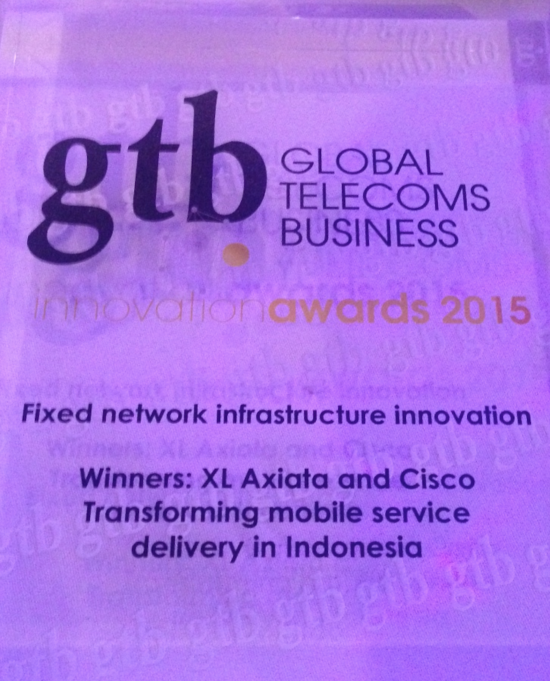
What a great time to be in London this week, the weather was great with blue skies and warm weather. But the main reason this week to be in London was to attend the annual Global Telecoms Business Summit and Innovations Awards, and what a great industry event it was. During the event there were lots of customer interactions, industry discussions & best practices, and of course the Innovation Awards.
Guest Blog by Marcel Cappetti, Managing Director, Oil and Gas, Global Enterprise Theater
I’ve just returned from CERAWeek in Houston—an international event that could be described as “Davos for the energy industry.” It’s a gathering of the power elite, including industry, finance, technology, and government leaders from around the globe. For me, it was the perfect sensing post for all the angst and opportunity that pervades the industry today.
It was my privilege to participate in a panel on “Leveraging Operational Excellence to Drive Margin Expansion”—a key concern of oil and gas (O&G) executives following the crash in oil prices. Too often in previous downturns, companies have relied heavily on deep cost cuts—including massive layoffs and cancelled projects—to keep margins afloat. But this time seems different. There is general agreement in the industry that we will not be returning to $100-a-barrel oil prices any time soon. So it’s time for more than a course correction. It’s time for digital transformation. Digital transformation will drive operational excellence and, yes, margin expansion.
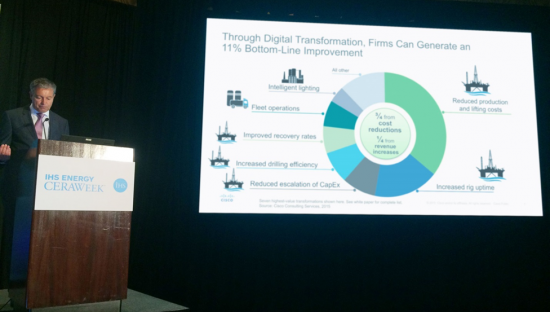
During my talk last week, I shared highlights from a new Cisco study discussing the new reality in O&G and the opportunity for digital transformation through the Internet of Everything (IoE)—the networked connection of people, process, data, and things. Key findings include:
“Operational efficiency of existing projects” and “maintenance of assets and infrastructure” will be the top two areas of increased investment over the next 24 months.
O&G leaders clearly understand data’s potential—they named “data analytics for faster, better decision-making” as the No. 1 driver for IoE investment.
Business transformation—including breaking down organizational silos and converging IT and OT people, processes, and technologies—is essential for digital transformation. According to Cisco’s study, 59 percent of respondents do not believe their IT and OT organizations are aligned.
Companies that transform will have a significant bottom-line impact. Analysis by Cisco Consulting Services shows that by implementing a range of IoE-empowered solutions, oil and gas companies can capture their share of $600 billion of Value at Stake between 2016 and 2025. For a $50 billion firm, this translates into an 11 percent bottom-line (EBIT) improvement.
Cisco can help O&G companies in their journey to digital transformation through the investments we have made in key technologies—such as analytics, data, sensors, wireless, and mesh—and through solutions developed with key partners. For example:
Remote Operations—Developed with GE, our Connected Oilfield solutions increase personnel safety and improve asset integrity with predictive maintenance; real-time analytics at the edge and virtual expert support enable faster and better decisions.
Pipeline Automation—In partnership with Schneider Electric, Cisco’s Connected Pipeline solution uses analytics at the edge to improve security and environmental protection with predictive detection of pipeline intrusion, leakage, and deformation.
Wireless Operations—Developed in partnership with Honeywell and Emerson, this Connected Processing Plant solution improves personnel safety and process efficiency with wireless real-time tracking, video analytics, and automated incident response.
Secure Operations—Industrial cybersecurity solutions improve security and risk management to combat new and evolving cyber security threats, specifically in the process control domain. A good example is a project for Royal Dutch Shell that provides remote proactive monitoring and SLA-driven management of security, applications, and infrastructure. We are working with industrial control system delivery partners such as Yokogawa Electric and Rockwell Automation to support this solution, which Shell plans to deploy at all upstream, downstream, and lubricant sites.
For most manufacturing companies today, product and services innovation, the introduction of new models, and the need for flexibility and workforce engagement are some of the business drivers requiring a new way to look at factory automation. Often, the ideal opportunity to tackle these challenges arises when a company is expanding capacity or building a new production facility ‘greenfield’. The Internet of Everything plays into this opportunity perfectly as easier and more seamless ways to connect people, process and data have emerged. Mahindra and Mahindra, one of India’s leading automakers, seized just that opportunity to deploy a Connected Factory of the future, building the Chakan facility north of Pune in Maharashtra, to expand capacity on existing models and introduce brand new Mahindra model categories. Continue reading “How IoE Enabled the Automotive Connected Factory of the Future”
There’s a lot of hype around securing the Internet of Things (IoT). At the end of the day, I suggest that a more reasoned approach is in order. Securing the IoT will not be achieved by frantic worry about the volume of endpoints. Myopic focus on the volume of devices in an IoT ecosystem can lead to an important misstep: forgetting that it’s the Internet of Things. That means that all this data is passing through the network. Therefore, tackling security can only occur with diligent attention to the core of the IoT, namely, the network stack. In that way security can become as pervasive as the IoT itself.
I recently had the privilege of participating in a panel discussion at LiveWorx’s CXO Forum on Securing the IoT. Here are two predictions with respect to the IoT and security that I shared with the audience and my co-panelists at the event:
Access and identity management will be critical in an IoT ecosystem. However, the username and password won’t be part of tomorrow’s approach: the password will die – and soon. It’s not radical to point out that passwords are insufficient on their own for authenticating access to sensitive data. I don’t think that means we’re going to go immediately to 21 levels of authentication, for example. We do need a human factor, and it can be biometric, or it can be at an endpoint. We’re familiar with straightforward biometrics such as the iPhone’s fingerprint scan, but there are also newer methodologies that track the exact way a human swipes a smartphone screen. We can leverage technologies such as this to enhance security in the IoT and its member devices.
Our industry must work together in public-private partnerships to put a stop to the proliferation of regulations – country by country or region by region – that are creating a tangled web of laws, regulations, and guidelines around security. Conflicting guidance, standards, and regulations cause confusion rather than clarity. International standards bodies and government regulators should consider removing territorial blinders and revisiting the real mission: ensuring, to the greatest extent possible, that information and communications technology (ICT) are genuine and free from compromise and will not permit control over the operations for which they are used.
While strong international standards for IoT security and new authentication methods are just two pieces of the larger puzzle that will make IoT more secure, they are essential pieces. We at Cisco are working to make inroads in both these areas. Stay tuned.
I know I often say nice things about the guests on this podcast–because they routinely blow me away with their technical acumen and genuine enthusiasm–but really, there aren’t enough nice words in the dictionary to adequately express my fondness for Anne Gentle. She’s been an exceptional contributor to OpenStack as the project team lead for documentation, plus she serves as the OpenStack Documentation Technical Lead at Rackspace. And she’s a mom. And she spends her spare moments helping both women and school-age children find a passion for technology and a pathway to a career in the industry.
Bam.
Can you see why I like her?
In last week’s podcast we talked to Anne about a wide variety of OpenStack- and open source-related subjects, including:
How quilting got her into technology
How she gets elementary school kids (and their teachers) excited about network topology design
Why she loves doing OpenStack documentation
How a “book sprint” works
Which audiences she’d like the foundation to write guides for next
Why her team is transitioning from Docbooks to RST
What the Night Scout Foundation is doing to help kids manage diabetes
https://www.youtube.com/watch?v=Nsh9k6GQiZY
You can follow Anne on Twitter at @annegentle and find her OpenStack sessions here.
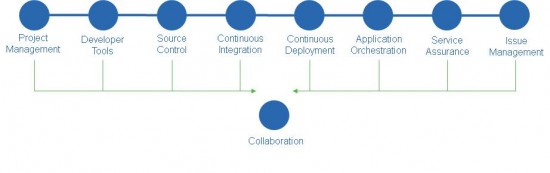
Businesses have been and will continue to be disrupted by software agility and innovation. If you have any questions, just ask, if they are still in business, Movie Rental Companies (Netflix), Taxi Companies (Uber), and Retail Companies (Amazon) to just name a few areas (companies that disrupted an industry with Software). Software defined disruption has changed the landscape and continues to drive tremendous business value like never before. What’s most exciting is that we have not seen anything yet compared to what the Internet of Everything (IoE) will disrupt! To understand software disruption better and determine the innovation opportunities it helps to take a look at the typical devops model today, challenges, and opportunities.
The typical devops model is represented the figure below:
I recently attended the Strata + Hadoop World Conference in San Jose, and came away impressed with the accelerating pace of innovation in the world of Big Data. Companies and startups are innovating in every area of the Big Data value chain – from automating how data is collected, cleaned, and organized; to data governance and management; to data storage using a plethora of NoSQL database technologies; and to the numerous emerging tools for data science. Continue reading “Opportunities and Value Through Data Science (Part 1)”